EV Home Charging Stations and EMF Australia 2026
Drafted with AI assistance and checked against published specifications and certifications. First-hand measurements appear only where stated. How we make content
How this assessment was made. I have not personally tested this unit. This assessment is based on manufacturer specifications, independent certification records (NSF/ANSI, WaterMark AS3497) and Australian supply and pricing data current at the time of writing. Where I have personally measured a product in my own home, the article says so explicitly and gives the readings. Clean and Native earns affiliate commission on some links. That does not affect which products are assessed or what the specifications say.
Home EV wallbox chargers produce AC magnetic fields during active charging, primarily from current flowing through the charging cable and internal wiring — the same category of non-ionising electromagnetic field generated by induction cooktops, solar inverters, and household wiring under load. According to a 2022 peer-reviewed assessment published in Sensors, static magnetic field exposure near DC fast chargers measured up to 0.2 mT — classified as “negligible” relative to international safety limits — and Level 2 AC home chargers produce substantially lower fields than that.
A home EV wallbox charger is a low-risk household EMF source when installed correctly — meaning away from bedroom walls and sleeping areas. The AC magnetic fields produced during charging drop off sharply with distance. At 1-2 metres from the unit, field strength is typically well below ARPANSA’s reference level of 1,000 µT at 50 Hz and well below the precautionary Building Biology SBM-2015 sleeping guideline of 0.2 µT. The real exposure concern is not the wallbox itself — it is overnight charging with the unit mounted on a wall that shares a bedroom, where 6-8 hours of continuous current flow occurs within 1-2 metres of a sleeping person’s head. Place the charger on an exterior garage wall away from bedrooms, and this source effectively disappears from your exposure profile.
| Source | What It Does | Verdict |
|---|---|---|
| EV wallbox (Level 2 AC) | AC magnetic field from 7-22 kW current during charging | Low concern at >2m from sleeping areas |
| Charging cable (coiled on ground) | AC magnetic field proportional to current and loop area | Keep cable run short, avoid coiling near living spaces |
| Wi-Fi-enabled wallbox | RF transmission at 2.4 GHz for app control | Intermittent, low power — same category as any IoT device |
Key catches
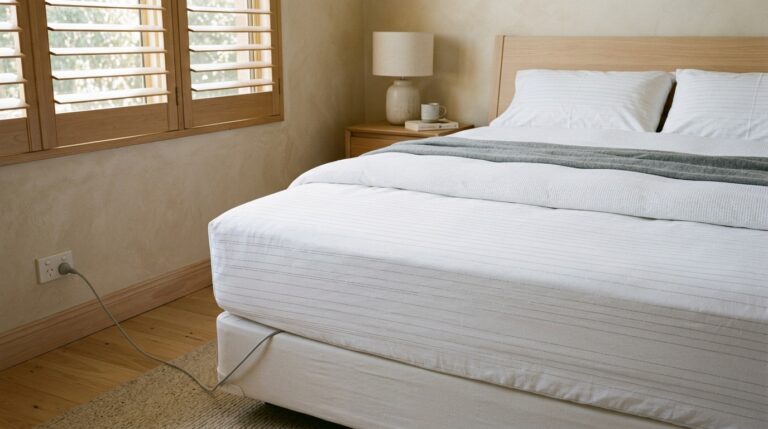
- Overnight charging with a wallbox on a shared bedroom wall is the highest-exposure scenario — 6-8 hours of continuous magnetic field within 1-2 metres of your head
- ARPANSA’s 1,000 µT reference level is a thermal safety limit, not a precautionary guideline — Building Biology recommends below 0.2 µT for sleeping areas
- You cannot assess your specific exposure without a meter — every installation is different
What a Home EV Charger Actually Emits
If you have just installed — or are about to install — a wallbox charger in your garage, you are adding a fixed source of AC magnetic fields to your home. Not RF radiation. Not ionising radiation. AC magnetic fields at 50 Hz, the same frequency as every other mains-powered device in your house. The difference is the current draw. A typical Australian household circuit carries 10-20 amps. A Level 2 EV wallbox pulls 32 amps on a single phase, or up to 32 amps per phase on a three-phase installation. Higher current means a stronger magnetic field around the cable and the unit itself.
The physics is simple. A current-carrying conductor produces a magnetic field proportional to the current and inversely proportional to the distance from the conductor. Double the current, double the field. Double the distance, halve the field. This is the same inverse-distance relationship that governs every other household wiring source — your switchboard, your induction cooktop, your solar inverter. The WHO International EMF Project, established in 1996, classifies these fields as non-ionising radiation, meaning the photon energy is far too low to directly damage DNA, unlike X-rays or gamma radiation.
There are three distinct EMF sources associated with a home EV charger:
1. The wallbox unit itself. Contains a contactor (relay), power electronics, and internal wiring. When the contactor closes and current flows, the unit generates an AC magnetic field. The field is strongest at the surface of the unit and drops rapidly with distance.
2. The charging cable. The cable between the wallbox and the vehicle carries the full charging current. A cable coiled on the ground creates a larger loop area, which produces a stronger and more spatially distributed magnetic field than a cable routed straight. This matters if you charge in a garage directly under a bedroom.
3. Wi-Fi or Bluetooth module (if equipped). Many modern wallboxes — Zappi, Tesla Wall Connector, Wallbox Pulsar — include a 2.4 GHz Wi-Fi radio for app-based monitoring and scheduling. This is a low-power RF source, equivalent to any smart home device. It transmits intermittently, not continuously, and at power levels far below ARPANSA’s general public exposure reference level of 1,000 µW/cm² at 2.4 GHz.
Measured Field Strength: What the Data Shows
You want numbers. Here is what the published data says — and what it does not say.
A 2022 peer-reviewed assessment published in the Sensors (PMC8914635) examined electromagnetic field exposure from electric vehicle charging infrastructure. The study found static magnetic field (SMF) exposure near DC fast chargers measured up to 0.2 mT (200 µT), classified by the authors as “negligible” relative to the International Commission on Non-Ionizing Radiation Protection (ICNIRP) reference levels. Level 2 AC home chargers — the type installed in Australian garages — produce substantially lower fields than DC fast chargers because they operate at lower power levels (7-22 kW vs 50-350 kW).
Reviewed
Study
Sensors (Basel) • 2022;22(5):1719
Complex Electromagnetic Issues Associated with the Use of Electric Vehicles in Urban Transportation
Gryz, Karpowicz & Zradziński • DOI: 10.3390/s22051719
Read the study on PubMed Central →For context, here is how that compares to Australian regulatory and precautionary standards:
| Standard | Magnetic Field Limit (50 Hz) | Basis |
|---|---|---|
| ARPANSA (Australia) | 1,000 µT | Thermal safety — acute stimulation threshold |
| ICNIRP (international) | 200 µT (general public) | Thermal safety — same basis as ARPANSA |
| Building Biology SBM-2015 (sleeping area) | <0.2 µT (no anomaly) | Precautionary practitioner guideline |
| DC fast charger (measured, PMC8914635) | Up to 200 µT at surface | Peer-reviewed field measurement |
| Level 2 AC home charger (estimated) | Substantially lower than DC fast charger | Lower power draw (7-22 kW vs 50-350 kW) |
Notice the gap. ARPANSA’s 1,000 µT limit exists to prevent acute nerve and muscle stimulation — it is not a precautionary guideline for long-term chronic exposure. The Building Biology SBM-2015 sleeping area standard of 0.2 µT is 5,000 times more conservative. Even a Level 2 charger operating at full power is unlikely to exceed 0.2 µT at distances beyond 2-3 metres — but it may well exceed it at 0.5-1 metre, which is the relevant distance if your wallbox is mounted on a wall that backs onto a bedroom.
The honest limitation: there is no published dataset of AC magnetic field measurements specifically from Australian Level 2 wallbox installations at various distances. The DC fast charger data gives an upper bound. The physics of inverse-distance decay gives the trajectory. But the specific number at your sleeping position depends on your installation — the charger model, cable routing, wall construction, and charging current. Without a meter reading at your wall, you are estimating.
Installation Placement: Where You Mount It Matters More Than What You Buy
This is where you actually control your exposure. The wallbox brand — Zappi, Tesla, OCPP-compliant generic — matters far less than where your electrician bolts it to the wall. Every metre of distance between the charger and your sleeping area reduces the magnetic field by roughly half. That is not a marginal improvement. That is the difference between a source that registers on a meter at your pillow and a source that is indistinguishable from background.
Here are the placement principles, ranked by impact:
1. Never mount on a shared bedroom wall. If your garage shares a wall with a bedroom, mount the charger on a different wall — ideally an exterior wall or the wall furthest from any sleeping area. A single layer of plasterboard and timber framing provides zero magnetic field shielding. Brick veneer provides zero. Double brick provides zero. AC magnetic fields at 50 Hz pass through residential wall construction as if it is not there. The only effective intervention is distance.
2. Detached garage or carport is ideal. If your garage is detached from the house — common in older Queensland, Victorian, and South Australian properties — the charger is already several metres from any sleeping area. This is the lowest-exposure configuration by default. Even a carport post-mounted installation gives you more distance than an attached garage wall.
3. Consider cable routing. The charging cable carries the same current as the wallbox internals. A cable coiled in a pile on the garage floor creates a concentrated magnetic field source that sits on the floor — potentially directly below a bedroom. Route the cable straight from the wallbox to the vehicle. If the cable is longer than needed, hang the excess on a wall hook, not in a coil on the floor. Every loop in the cable creates an additional field source.
4. If attached garage is your only option, maximise horizontal distance. Mount the charger on the wall furthest from bedroom walls. In a typical Australian double garage (5.4m wide), mounting on the far wall puts 4-5 metres between the charger and a bedroom on the other side. At 32 amps, this distance reduces the magnetic field to a fraction of what it would be at the 0.5m distance of a shared wall.
5. Switchboard proximity. Your EV charger circuit connects back to your switchboard. If the switchboard is on a bedroom wall and the EV circuit cable runs through that wall, the cable itself becomes a magnetic field source during charging. Discuss cable routing with your electrician during installation — not after.
Overnight Charging and Bedroom Proximity: The 6-8 Hour Exposure Window
This is the scenario that separates an EV charger from a kettle or a hair dryer. When you charge overnight on a cheap tariff (most Australian EV owners use off-peak rates between 10pm and 6am), the wallbox delivers continuous current for 6-8 hours. That is 6-8 hours of uninterrupted AC magnetic field generation. If the source is 1 metre from your pillow through a shared wall, that is a chronic overnight exposure that no other household appliance replicates at comparable current levels — except perhaps an electric hot water system on a shared bedroom wall, which is the same category of concern.
Compare this to intermittent sources. An induction cooktop draws similar or higher current (up to 32 amps on a single zone) but operates for 20-40 minutes during cooking, and you stand 0.5m away, not sleep 0.5m away for 8 hours. A solar inverter operates during daylight hours when most people are not sleeping. The EV charger is unique because it combines high current draw with overnight duration and potential bedroom proximity.
Practical solutions for overnight charging in an attached garage:
- Move the bed. If the charger is on a shared wall, move the bed to the opposite side of the room. Two extra metres of distance halves the field strength at your sleeping position. Free.
- Schedule charging to complete before bedtime. If your EV only needs 3-4 hours of charge, start at 6pm and finish by 10pm. You lose the off-peak tariff advantage but eliminate the overnight exposure entirely. Most smart wallboxes (Zappi, Tesla Wall Connector, Wallbox Pulsar) support scheduled charging via app.
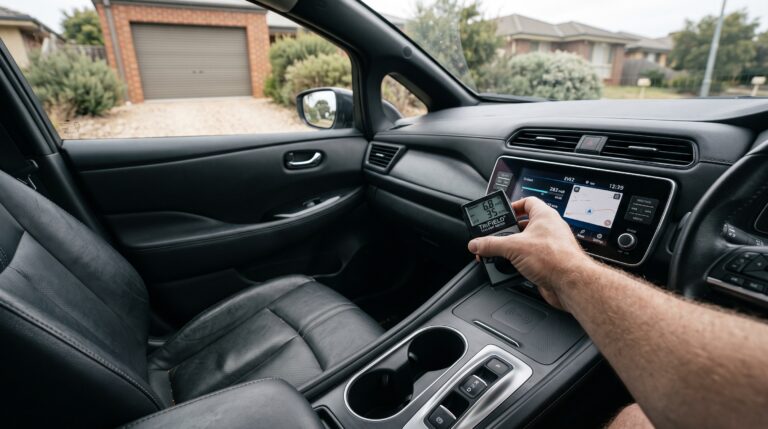
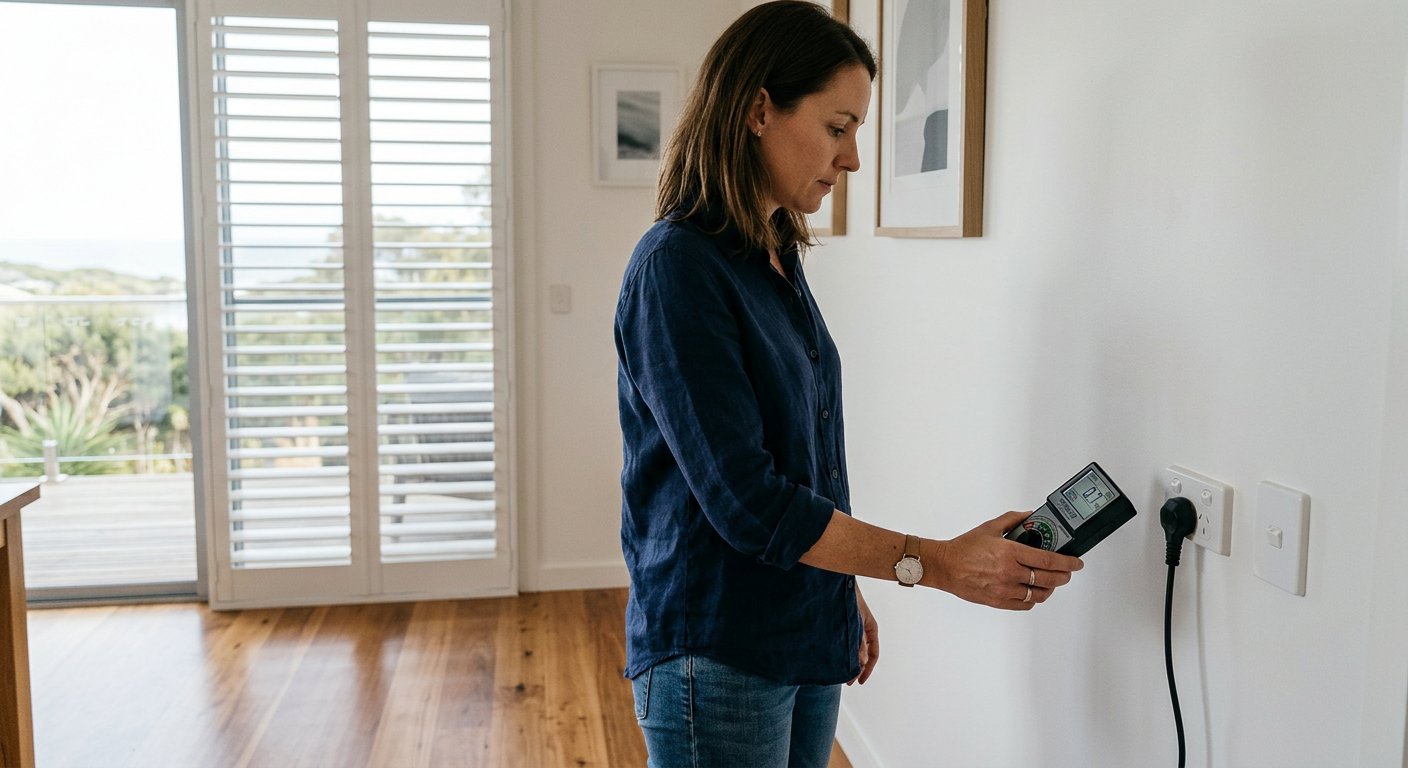
- Measure first. Before rearranging furniture or changing your charging schedule, take an actual reading. The TriField TF2 meter reads AC magnetic fields at 50 Hz directly. Place it on your pillow. Start a full-power charge. Read the number. If it is below 0.2 µT, you have no problem to solve. If it is above, you know exactly how far the bed needs to move.
This is the same measure-first principle that applies to every household EMF source. Without a reading, you are guessing. With a reading, you have a number and a threshold, and the decision is mechanical.
EV Charger EMF vs Other Household Sources: Perspective
If you are concerned about your wallbox, you should also know where it sits relative to every other magnetic field source in your home. Context prevents both panic and complacency.
| Source | Typical Current | Duration | Typical Distance from Person |
|---|---|---|---|
| EV wallbox (Level 2, 7 kW single-phase) | 32 A | 6-8 hrs overnight | 1-5 m (wall-dependent) |
| Induction cooktop (single zone) | Up to 32 A | 20-40 min | 0.3-0.5 m |
| Solar inverter | 10-25 A | Daylight hours (8-10 hrs) | 1-3 m (wall-mounted) |
| Switchboard | Variable (total household) | 24 hrs | 1-3 m |
| Electric hot water system | 15-20 A | 2-4 hrs (heating cycle) | 1-3 m |
| Bedside lamp | <1 A | 1-2 hrs | 0.3 m |
The EV wallbox is not the most powerful magnetic field source in a typical Australian home. Your switchboard, your solar inverter (covered in detail in the solar inverter EMF guide), and your induction cooktop all produce comparable or stronger fields at close range. What makes the EV charger worth addressing is the combination of relatively high current, long duration, and the fact that Australian garages are frequently attached to — and share walls with — bedrooms. That is a placement problem, not a technology problem.
For a detailed assessment of EMF exposure while driving the vehicle itself — a separate topic covering in-cabin magnetic fields from the battery pack, motor, and onboard electronics — see the electric car EMF levels guide.
How to Measure EV Charger EMF at Your Sleeping Position
Every installation is different. The charger model, mounting height, wall thickness, cable routing, and charging current all affect the field at your sleeping position. The only way to know your actual exposure is to measure it.
The correct sequence — and this applies to every household EMF source, not just EV chargers:
Step 1: Get an AC magnetic field meter. The TriField TF2 reads AC magnetic fields (labelled “Magnetic” mode on the meter) at 50 Hz, which is the frequency of your EV charger’s magnetic field in Australia. Set it to weighted magnetic mode. This is the same meter you would use for your switchboard, solar inverter, or any other wiring-related source.
Step 2: Take a baseline reading. With the EV charger idle (vehicle disconnected or fully charged), place the meter on your pillow. Record the ambient magnetic field. In most suburban Australian bedrooms, this is 0.02-0.1 µT — well within the Building Biology “no anomaly” range.
Step 3: Start a full-power charge and re-measure. Plug in the vehicle. Wait 2-3 minutes for the charger to ramp to full current. Walk the meter along the shared wall (if applicable) to find the peak. Then place it back on your pillow and record the field during active charging.
Step 4: Compare to thresholds.
- Below 0.2 µT at sleeping position: Building Biology SBM-2015 “no anomaly” — no action needed
- 0.2-1.0 µT: “slight anomaly” — consider moving the bed or relocating the charger
- 1.0-5.0 µT: “severe anomaly” — move the bed or charger, or reschedule charging to daytime
- Above 5.0 µT: “extreme anomaly” — immediate relocation recommended
If you are adding an EV charger to a home that also has a solar inverter on a bedroom wall, measure both. The fields add. A solar inverter producing 0.15 µT during the day and an EV charger producing 0.15 µT overnight might each be below threshold individually — but if they are on the same wall and you are within range of both, the combined field matters.
The Wi-Fi Module: A Secondary Source Worth Mentioning
Most modern wallboxes include a 2.4 GHz Wi-Fi radio for app-based scheduling, energy monitoring, and firmware updates. Some also include Bluetooth. This generates radiofrequency (RF) EMF — a different type from the AC magnetic fields discussed above.
The RF output from a wallbox Wi-Fi module is low-power and intermittent. It transmits data in short bursts — status updates to your phone app, energy consumption data to the cloud. It is not continuously broadcasting like a Wi-Fi router. ARPANSA’s general public exposure reference level for RF at 2.4 GHz is 1,000 µW/cm² (10 W/m²). A wallbox Wi-Fi module operates at a tiny fraction of this limit.
This article contains affiliate links. We may earn a commission at no extra cost to you.
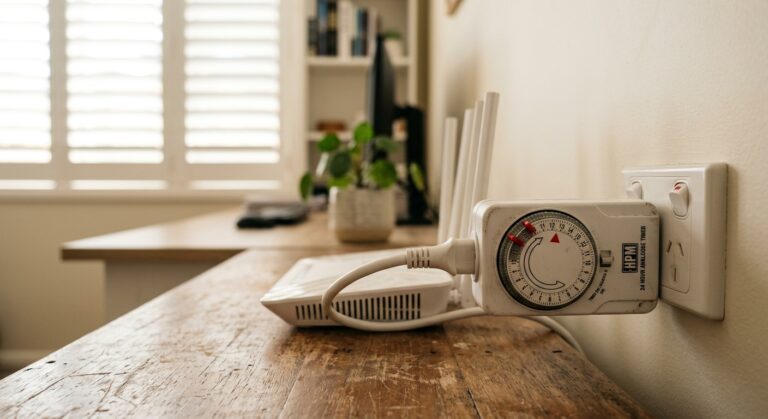
If you are already managing Wi-Fi RF in your home — using a mechanical outlet timer on your router at night, or switching to ethernet — the wallbox Wi-Fi module is one more device to consider. Most wallbox manufacturers allow you to disable Wi-Fi after initial setup, controlling the charger via a physical button or scheduled timer instead. Check your model’s documentation.
For a full assessment of the correct sequence for managing household RF — including Wi-Fi routers, smart meters, DECT phones, and IoT devices — see the complete EMF guide for Australian homes.
Decision Framework: EV Charger EMF Checklist for Australian Homes
Before your electrician drills the first hole, run through these three questions. They take 60 seconds and eliminate 90% of the exposure concern.
Question 1: Is the proposed mounting wall shared with a bedroom?
- No → Low concern. Proceed with installation.
- Yes → Move to a different wall. If no alternative wall exists, maximise distance from the bed on the other side.
Question 2: Will you charge overnight (off-peak)?
- No → Short daytime charges (1-2 hours) produce brief, intermittent exposure. Low concern.
- Yes → The 6-8 hour exposure window makes placement critical. Revisit Question 1.
Question 3: Do you have a meter to verify the field at your sleeping position?
- Yes → Measure during a full-power charge. Below 0.2 µT at pillow = no issue. Above = increase distance.
- No → Get one. The TriField TF2 reads AC magnetic fields at 50 Hz directly, and you will use it for every other household EMF source as well — switchboard, solar inverter, wiring, appliances. It is a one-time purchase that applies to every future EMF question you have.
Related Guides: In-Vehicle EMF and Solar Inverter EMF
This guide covers the home wallbox as a fixed household EMF source. Two related topics are covered in their own dedicated guides:
EMF inside the electric vehicle itself — the magnetic fields from the battery pack, electric motor, and onboard electronics while driving — is a separate exposure scenario. The distances, durations, and field characteristics are different. See the full assessment: Electric Car EMF Levels: What Australian Owners Should Know.
Solar inverter EMF — another wall-mounted high-current device that operates for extended periods — follows the same physics and placement principles as an EV charger. If you have both a solar inverter and an EV charger on shared bedroom walls, the fields add and both need to be addressed. See: Solar Inverter EMF Australia: Placement, Measurement, and Mitigation.
If you are managing EMF across your entire home — not just one source — the complete EMF guide for Australian homes covers the correct sequence: measure, identify sources, address sources, shield only confirmed external residual. Start there if you want the full picture.
Last reviewed: August 2026 – Clean and Native
Start with measurement. The TriField TF2 is the only meter you need.
Measures AC magnetic, AC electric, and RF in one device. Without real readings, every EMF decision is a guess.
Frequently Asked Questions
Does an EV home charger emit radiation?
Yes — an EV home charger emits non-ionising electromagnetic fields. The primary emission is AC magnetic fields at 50 Hz from the current flowing through the unit and cable during active charging. If the wallbox includes Wi-Fi, it also emits low-power RF at 2.4 GHz intermittently. Neither is ionising radiation, meaning neither has enough photon energy to directly damage DNA, according to the WHO International EMF Project.
How far should an EV charger be from a bedroom in Australia?
At minimum 2-3 metres from any sleeping position. AC magnetic fields from a Level 2 charger at 32 amps drop below Building Biology’s 0.2 µT sleeping threshold at this distance in most installations. Verify with a meter reading at your pillow during active charging — every installation is different.
Does a wall block EMF from an EV charger?
No. AC magnetic fields at 50 Hz pass through standard Australian residential wall construction — plasterboard, timber framing, brick veneer, and double brick — with effectively zero attenuation. Only distance reduces the field strength. Shielding 50 Hz magnetic fields requires specialised mu-metal or similar high-permeability materials, which are not practical for residential walls.
Is it safe to charge an EV in the garage overnight?
From an EMF perspective, charging overnight in a detached garage is low-concern because the distance from sleeping areas is typically 5+ metres. In an attached garage, it depends on which wall the charger is mounted on and how close the nearest bedroom is. Measure at the sleeping position during a full-power charge to verify.
What is the ARPANSA limit for magnetic fields in Australia?
ARPANSA’s reference level for general public exposure to 50 Hz magnetic fields is 1,000 µT. This is a thermal safety limit designed to prevent acute nerve and muscle stimulation. It is not a precautionary guideline for long-term chronic exposure. The Building Biology SBM-2015 sleeping area guideline of below 0.2 µT is 5,000 times more conservative.
Can I measure EV charger EMF myself at home?
Yes. A TriField TF2 meter in weighted magnetic mode reads AC magnetic fields at 50 Hz directly. Place it at your sleeping position, start a full-power charge, and read the measurement. Below 0.2 µT means no action needed per Building Biology guidelines. The meter costs approximately $200-250 AUD and is used for every other household EMF source as well.
Does coiling the EV charging cable increase EMF?
Yes. A coiled cable creates a larger loop area, which produces a stronger and more spatially distributed magnetic field compared to a straight cable run. Route the cable directly from the wallbox to the vehicle. If the cable is longer than needed, hang the excess on a wall hook rather than coiling it on the garage floor — especially if a bedroom is above.
Is EV charger EMF higher than a solar inverter?
A Level 2 EV charger at 32 amps and a 5 kW solar inverter produce comparable AC magnetic fields at the same distance. The key difference is timing: the solar inverter operates during daylight hours (typically when you are not sleeping), while the EV charger often operates overnight during sleep. If both are on shared bedroom walls, their fields add and both need to be assessed.
Can I disable Wi-Fi on my EV wallbox?
Most smart wallboxes allow Wi-Fi to be disabled after initial setup and scheduling configuration. Check your specific model’s documentation. The Tesla Wall Connector, Zappi, and Wallbox Pulsar all support physical button control or pre-set schedules that do not require ongoing Wi-Fi connectivity.
Should I worry about EV charger EMF if I am healthy?
The peer-reviewed evidence classifies Level 2 charger exposure as negligible relative to ICNIRP safety limits. The WHO International EMF Project continues to assess low-level EMF health effects but has not established a causal link between ELF magnetic fields at household levels and adverse health outcomes. The precautionary approach is simple: mount the charger away from bedrooms and measure. If the reading at your sleeping position is below 0.2 µT, there is no indication of concern from current evidence.
Get the Australian Home Environment Checklist
30 checks across water, air and EMF. Most of them free. Ranked by impact.
No spam. Unsubscribe any time.

Former Royal Australian Navy Clearance Diver and TAG-E counter-terrorism operator. Founded Clean and Native to apply the same rigorous thinking to the home environment.
Full biography →