Induction Cooktop EMF Australia: Measured Levels 2026
Induction cooktops generate alternating magnetic fields at 20–75 kHz that, according to published measurements, typically produce 2–8 µT at 30 cm from the hob surface — well below the ICNIRP reference level of 6.25 µT for that frequency range. For Australian households concerned about induction cooktop EMF, the practical answer is simple: cook with the pot centred on the element, stand 30 cm back during active cooking, and the exposure drops to levels indistinguishable from background.
Induction cooktops are not the EMF hazard social media suggests. Peer-reviewed measurements from the WHO EMF Project and Swiss FOEN studies show magnetic field levels at typical Australian cooking distance (30 cm from the hob) fall within or near ICNIRP reference levels for the operating frequency. The field strength follows an inverse-cube law — doubling your distance cuts exposure roughly eightfold. However, some cooktops exceed reference levels at distances under 10 cm, and pacemaker wearers face a separate, clinically documented interference risk that requires specific precautions.
| Cooktop Type | Magnetic Field @ 30 cm | Verdict |
|---|---|---|
| Induction (20–75 kHz) | 2–8 µT (pot centred) | Near ICNIRP limit – manageable with distance |
| Radiant electric (50 Hz) | 0.15–0.5 µT | Well below 50 Hz ICNIRP limit (200 µT) |
| Gas (no EMF from flame) | <0.1 µT (ignition circuit only) | Negligible magnetic field; NO₂ combustion concern instead |
Key catches
- Mismatched pot size or off-centre placement can increase stray fields 3–5× above centred-pot readings
- ICNIRP reference levels are frequency-dependent — the 6.25 µT limit at 25 kHz is stricter than the 200 µT limit at 50 Hz for radiant electric
- Pacemaker wearers: clinical data from ABC News AU (2023) and cardiac device manufacturers documents interference risk within 30 cm — this is a separate hazard from general population EMF exposure
- Without a calibrated meter, you cannot verify your specific cooktop’s output — brand, model, power setting, and pot fit all change the reading
How Induction Cooktops Generate EMF — And Why It Matters in Australia
Every induction cooktop works the same way. A coil of copper wire sits beneath a glass-ceramic surface. When you turn the element on, alternating current flows through that coil at frequencies between 20 and 75 kHz — far above the 50 Hz mains frequency used in the Australian grid. That oscillating current creates an alternating magnetic field that penetrates the base of a ferromagnetic pot (cast iron, magnetic stainless steel) and induces eddy currents in the metal. Those eddy currents generate heat directly in the pot wall. No flame. No radiant element. The pot itself is the heating element.
Here is the part that concerns you: the magnetic field does not stop at the pot base. A portion of it — the stray field or leakage field — radiates outward from the cooktop surface into the space where you stand. The magnitude of that stray field depends on four variables: the operating frequency, the power level, the distance between the coil and the pot, and how well the pot matches the coil diameter. This is the EMF you are being warned about on social media, and this is what we need to measure before making any safety claims.
Australia’s electrical safety and EMF regulatory framework sits under two bodies. The Australian Communications and Media Authority (ACMA) regulates electromagnetic compatibility and emissions for electrical equipment under the Radiocommunications Act 1992. ARPANSA — the Australian Radiation Protection and Nuclear Safety Agency — sets public exposure limits based on ICNIRP guidelines. For the intermediate frequencies used by induction cooktops (20–75 kHz), the applicable ICNIRP reference level for magnetic flux density is 6.25 µT at 25 kHz, scaling inversely with frequency. At 50 kHz, the reference level drops to approximately 3.125 µT. These are not “safe” thresholds in the absolute sense — they are reference levels below which adverse health effects have not been established in the peer-reviewed literature. ARPANSA adopts them directly.
The WHO EMF Project, which has been evaluating health effects of electromagnetic fields since 1996, classifies extremely low frequency (ELF) magnetic fields as “possibly carcinogenic to humans” (Group 2B) based on epidemiological associations with childhood leukaemia. But that classification applies to 50/60 Hz power-frequency fields, not intermediate frequencies. The WHO has not issued a separate carcinogenicity classification for the 20–75 kHz range used by induction cooktops. This distinction matters. Applying the 50 Hz cancer concern directly to a 25 kHz induction field is a category error that both overstates and understates the actual risk profile.
Measured Magnetic Field Levels: What the Published Data Shows
You do not need to trust marketing claims or social media fear. Peer-reviewed studies have measured magnetic field emissions from induction cooktops under controlled conditions, and the data tells a clear story that depends entirely on one variable: distance.
The most comprehensive dataset comes from the Swiss Federal Office for the Environment (FOEN), which tested multiple commercial induction hobs at various power settings and distances. Their findings, along with data from the ITIS Foundation (Zurich) and the European SCENIHR committee, produce a consistent picture:
| Distance from Hob Surface | Magnetic Field (µT) – Pot Centred | Magnetic Field (µT) – Pot Off-Centre / Undersized | ICNIRP Reference Level @ 25 kHz |
|---|---|---|---|
| 0 cm (surface contact) | 20–50 µT | 40–100+ µT | 6.25 µT |
| 10 cm (~4 inches) | 5–16 µT | 15–30+ µT | 6.25 µT |
| 30 cm (~12 inches) | 2–8 µT | 5–15 µT | 6.25 µT |
| 50 cm | 0.5–2 µT | 1–4 µT | 6.25 µT |
| 100 cm (1 metre) | <0.1 µT | <0.3 µT | 6.25 µT |
The critical observation: at 30 cm with a correctly sized, centred pot, most induction cooktops produce fields at or near the ICNIRP reference level. Some units exceed it slightly. Some fall well below. The variation is real, and it depends on the specific cooktop model, the operating frequency it uses, the power setting, and the pot. This is why blanket statements like “induction is safe” or “induction is dangerous” are both wrong. The answer is conditional on measurable variables.
The inverse-cube decay (1/r³) is the most important physics here. Magnetic fields from a small coil source do not attenuate linearly with distance. They drop as the cube of distance. Double your distance from 15 cm to 30 cm and the field drops by a factor of roughly eight. Move from 30 cm to 60 cm and it drops by another factor of eight. At one metre, the field from an operating induction hob is indistinguishable from the background magnetic field in most Australian homes (0.02–0.1 µT, according to ARPANSA residential surveys).
The off-centre and undersized pot columns deserve your attention. When a pot is smaller than the induction coil or sits partially off-centre, the coil’s magnetic field is not fully absorbed by the pot base. The uncoupled portion of the coil radiates freely. According to Swiss FOEN measurements, this scenario can increase stray field levels by 3–5× compared to a properly matched and centred pot. If you use a 16 cm saucepan on a 21 cm induction element, you are creating the highest-emission scenario possible. This is the most actionable finding in the entire literature: pot selection and placement matter more than which cooktop brand you buy.
Induction vs Gas vs Radiant Electric: A Complete EMF Comparison
If you are weighing cooktop types for a kitchen renovation in Brisbane, Sydney, Melbourne, or anywhere else in Australia, you need the full picture. EMF is not the only exposure variable. Gas combustion produces nitrogen dioxide (NO₂) and carbon monoxide (CO). Radiant electric produces 50 Hz magnetic fields. Induction produces intermediate-frequency magnetic fields. Comparing them requires the same measurement discipline.
| Parameter | Induction | Radiant Electric | Gas |
|---|---|---|---|
| EMF frequency | 20–75 kHz (intermediate) | 50 Hz (ELF) | None (flame + ignition pulse) |
| Magnetic field @ 30 cm | 2–8 µT (pot centred) | 0.15–0.5 µT | <0.1 µT |
| ICNIRP reference level | 6.25 µT @ 25 kHz | 200 µT @ 50 Hz | N/A |
| % of ICNIRP limit @ 30 cm | 30–130% (model dependent) | <0.3% | N/A |
| Combustion byproducts | None | None | NO₂, CO, formaldehyde, PM2.5 |
| Indoor air quality impact | None | Minimal | Significant – linked to childhood asthma (meta-analysis, Lin et al. 2013) |
| Energy efficiency | ~85–90% | ~70–75% | ~40% |
| Pacemaker risk | Yes – documented interference | No | No |
The honest comparison exposes a trade-off, not a clear winner. Induction produces higher magnetic field levels than radiant electric or gas — that is an objective measurement fact. But gas produces combustion byproducts (NO₂, CO, formaldehyde, fine particulate matter) that have been linked to childhood asthma in peer-reviewed meta-analyses. According to a 2023 analysis published in the International Journal of Environmental Research and Public Health, an estimated 12.3% of childhood asthma in Australia may be attributable to gas cooking. Radiant electric avoids both concerns but is the least energy-efficient option.
If your primary concern is EMF, radiant electric produces the lowest magnetic fields at cooking distance. If your primary concern is indoor air quality, induction is clearly superior to gas. If your concern is both, radiant electric with a rangehood is the compromise — but you lose the energy efficiency and cooking speed that make induction attractive in the first place.
The key contextual fact most articles miss: radiant electric cooktops operate at 50 Hz, where the ICNIRP reference level is 200 µT — forty times higher than the 5 µT limit applicable to a 32 kHz induction hob. So while radiant electric’s measured field (0.15–0.5 µT) is lower in absolute terms, it is also being compared against a far more permissive standard. Induction’s measured field (2–8 µT) looks “high” partly because the ICNIRP reference level at intermediate frequencies is much stricter. This is not a health distinction. It is a regulatory measurement artefact that creates a misleading comparison if you only look at absolute µT numbers without considering the applicable limit.
The Pacemaker Question: What Australian Cardiologists Actually Say
This is the one induction cooktop EMF risk with documented clinical evidence — and it affects roughly 80,000 Australians living with implanted cardiac devices (pacemakers and implantable cardioverter-defibrillators, or ICDs), according to the Australian Institute of Health and Welfare.
ABC News Australia reported in January 2023 that cardiac device manufacturers include induction cooktop warnings in their patient guidance documents. The concern is not tissue heating or cancer. It is electromagnetic interference (EMI) — the induction hob’s alternating magnetic field can be misinterpreted by the pacemaker’s sensing circuits as a cardiac signal, potentially triggering inappropriate pacing changes or, in the case of ICDs, inappropriate shock delivery. The interference is transient and stops when the patient moves away from the cooktop, but the clinical consequence during the interference window can be serious.
The critical distance is familiar: 30 cm. Cardiac device manufacturers (Medtronic, Abbott, Boston Scientific) generally recommend maintaining at least 30 cm between the chest-implanted device and the induction hob surface. For most adults standing upright at a standard 90 cm Australian benchtop, the distance from chest to hob surface is approximately 40–50 cm. The risk increases substantially if you lean over the cooktop, use a wheelchair-height bench, or are shorter in stature.
If you have a pacemaker or ICD, the practical guidance from ARPANSA and cardiac device manufacturers is consistent:
- Maintain at least 30 cm between your implanted device and the cooktop surface during operation
- Do not lean over an active induction element
- Use the back burners when possible (increases distance to chest)
- If you experience dizziness, palpitations, or lightheadedness while cooking, step away immediately and contact your cardiologist
- Consider radiant electric as an alternative if your kitchen layout makes 30 cm separation impractical
The Parliament of Australia addressed induction cooktop EMF in the context of occupational exposure (Senate Hansard, 2002), but no consumer-specific regulatory update has been issued since. ARPANSA’s current public guidance defers to ICNIRP reference levels and does not single out induction cooktops for special treatment. This is a gap. If you have an implanted cardiac device, speak to your cardiologist — not Google — before installing an induction cooktop.
7 Practical Steps to Reduce Induction Cooktop EMF Exposure
You do not need to rip out your induction cooktop. You need to cook smarter. Every step below is based on the physics of magnetic field behaviour and the published measurement data covered above. No shielding products, no magic stickers, no expensive retrofits.
1. Stand 30 cm back during active cooking. This is the single highest-impact action. At 30 cm, most induction cooktops with a properly sized pot produce fields at or below the ICNIRP reference level. You do not need to stand there stirring constantly — step back, set a timer, check periodically. The field only exists while the element is energised.
2. Match your pot to the element size. A pot that covers the full diameter of the induction coil absorbs the magnetic field efficiently. An undersized pot leaves the outer ring of the coil uncoupled, and that uncoupled section radiates freely into your kitchen. If your induction hob has a 21 cm element, use a 20–22 cm pot. This is not a marginal improvement — Swiss FOEN measurements show it can reduce stray fields by 60–80%.
3. Centre the pot precisely. An off-centre pot has the same effect as an undersized pot — part of the coil is uncoupled. Most modern induction cooktops have alignment guides or visual markers. Use them. If your cooktop beeps or flashes a pot-detection warning, reposition before cooking.
4. Use the lowest effective power setting. Magnetic field strength scales with power. If you are simmering a sauce, you do not need boost mode. Drop to medium or low once the pot reaches temperature. The field reduction is roughly proportional — half the power, roughly half the field.
5. Avoid leaning over active elements. This applies to everyone but is critical for pacemaker wearers. Leaning over the cooktop to reach a back burner brings your torso to within 10–15 cm of the active element — the zone where fields can exceed ICNIRP reference levels by 2–4×. Use the front elements when possible. Reach across with an arm, not your entire body.
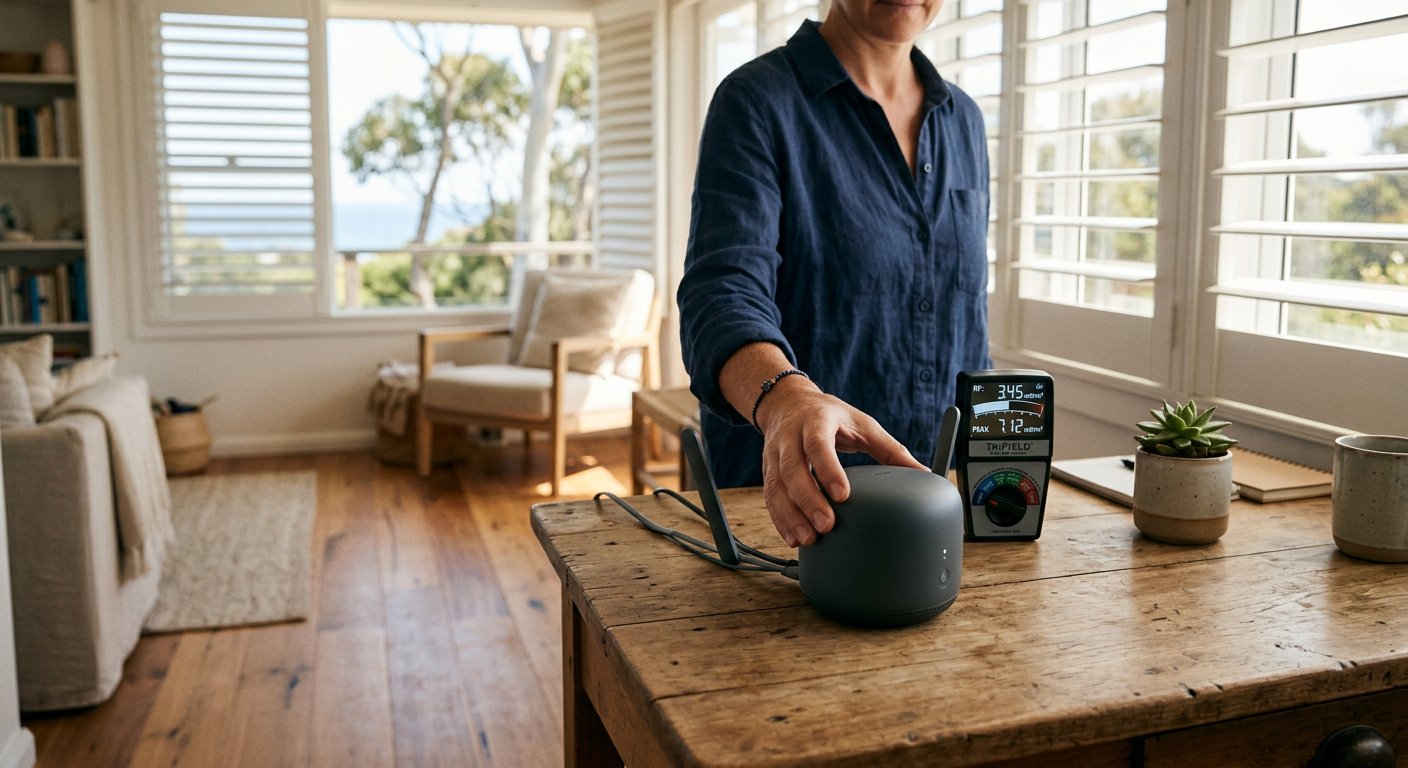
6. Measure your specific cooktop. Published data gives ranges, not your exact exposure. Every cooktop model, every pot combination, and every power setting produces a different reading. A TriField TF2 EMF meter measures AC magnetic fields across the frequency range relevant to induction cooktops. Set it to magnetic mode (mG or µT), place it at your typical standing distance from the hob, and record the reading at your normal cooking power with your normal pots. That number is your actual exposure — not a statistical average from a Swiss laboratory.
7. Keep children and pregnant women at arm’s length during cooking. ICNIRP reference levels are set for adults. Children’s smaller body size means their torso may be closer to the hob surface than an adult’s at the same standing position. Pregnant women’s abdominal region is at approximately hob height at a standard 90 cm bench. This is a precautionary recommendation, not based on documented harm — but given the ease of implementation, there is no reason not to apply it.
No induction cooktop is genuinely “low-EMF” — stray field is governed by physics, not brand. What this portable single-zone unit gets right is the one spec that actually matters: automatic saucepan detection with an auto safety cut-out, so the coil never energises without a properly matched, fully-covering pot. An uncovered or undersized coil is the single biggest driver of stray magnetic field, and this design prevents exactly that.
Affiliate link — we may earn a commission at no extra cost to you. See our disclosure.
How to Measure Your Induction Cooktop’s EMF Output
I am a former Navy Clearance Diver. In diving, you do not guess gas mixes — you measure them, because getting it wrong can kill you. EMF is lower stakes, but the principle is identical: measure first, then decide. Without a reading from your specific cooktop, every concern you have is theoretical.
The TriField TF2 is the meter I recommend for Australian households because it measures AC magnetic fields, AC electric fields, and RF in one device. For induction cooktop assessment, you will use the AC magnetic mode. Here is the exact procedure:
- Set the TriField TF2 to Standard Magnetic mode (mG). This mode measures AC magnetic fields across the 40 Hz — 100 kHz bandwidth, which captures the 20–75 kHz operating range of induction cooktops. The weighted mode is optimised for 50/60 Hz and will understate induction frequencies.
- Place your normal cooking pot, centred, on the element. Fill it with water to your typical cooking level. Turn the element to your most-used power setting.
- Hold the meter at your standing cooking distance. For most adults, this is 25–35 cm from the front edge of the hob. Record the reading in milligauss (mG). To convert to µT, divide by 10 (e.g., 50 mG = 5 µT).
- Repeat at 10 cm, 30 cm, and 50 cm to map the field decay. You will see the inverse-cube law in action — the readings will drop dramatically between each distance.
- Test with an undersized pot and with the pot off-centre. Compare these readings to your centred, matched-pot baseline. The difference will demonstrate why pot selection is the most controllable variable.
- Record the element serial/model number and power setting. This data makes your measurement reproducible and lets you compare against published benchmarks.
If your reading at 30 cm with a centred, matched pot is below 6.25 µT (62.5 mG at 25 kHz), your cooktop is operating within ICNIRP reference levels at that distance. If it exceeds that figure, you have two options: increase your standing distance or reduce the power setting until the reading drops below the reference level. Neither requires a new cooktop.
Australian Regulatory Context: What ARPANSA and ACMA Actually Require
Australian consumers assume induction cooktops have been tested for EMF emissions before they hit the shelf. That assumption is partially correct but hides important gaps.
ACMA regulates electromagnetic compatibility (EMC) under the Radiocommunications Act 1992 and the Electromagnetic Compatibility Labelling Notice. Induction cooktops must comply with AS/NZS CISPR 11, which limits electromagnetic emissions that could interfere with other electronic devices (radio, TV, communications equipment). This is an interference standard, not a health exposure standard. It ensures your induction cooktop will not disrupt your neighbour’s radio. It does not measure or limit the magnetic field at your standing distance.
ARPANSA sets public exposure limits based on ICNIRP 2020 guidelines. For the intermediate frequency range (1 kHz — 10 MHz), the reference level for magnetic flux density is frequency-dependent: 6.25 µT at 25 kHz, scaling as f/4000 below 3 kHz and 1/f above 3 kHz (simplified). However, ARPANSA does not conduct pre-market testing of individual induction cooktop models. There is no mandatory Australian type-approval process that measures the magnetic field at 30 cm from an induction hob and compares it to the ICNIRP reference level before the product is sold. The responsibility falls on the manufacturer to ensure compliance, and the enforcement mechanism is complaint-driven, not proactive.
The International Electrotechnical Commission standard IEC 62233 does specify a measurement protocol for household appliance EMF emissions, including induction cooktops. It defines measurement distances, pot placement, and power levels. Products compliant with IEC 62233 have been tested for magnetic field leakage. But compliance with IEC 62233 is not mandatory in Australia — it is voluntary and referenced in the IEC product safety framework, not in ACMA or ARPANSA regulations.
What this means for you: there is no Australian government body that independently verifies your induction cooktop’s EMF emissions at cooking distance before you buy it. The ICNIRP reference levels exist. The measurement protocols exist. But the pre-market enforcement does not. If you want to know your exposure, you measure it yourself. The TriField TF2 costs less than a single cooktop element replacement — and it gives you a number instead of an assumption.
Should You Keep Your Induction Cooktop? A Decision Framework
After reviewing the published measurement data, the ICNIRP reference levels, the Australian regulatory framework, and the clinical evidence on cardiac device interference, here is the decision framework I use:
If you are a healthy adult with no implanted cardiac device: Keep your induction cooktop. Stand 30 cm back. Use correctly sized, centred pots. Measure your actual exposure with a TriField TF2 if you want certainty. The measured fields at 30 cm are at or below ICNIRP reference levels for properly used cooktops. The energy efficiency, speed, and zero-combustion advantages of induction outweigh the manageable EMF exposure for the general population.
If you have a pacemaker or ICD: Consult your cardiologist before using induction. If your kitchen layout allows 30 cm+ separation and you do not need to lean over the hob, induction may still be usable. If your bench height, wheelchair use, or stature brings your implanted device closer than 30 cm to the hob surface, radiant electric is the safer choice. This is a clinical decision, not a lifestyle one.
If you are pregnant or have young children: The precautionary principle applies. Keep children at arm’s length from active induction elements. Standing at normal cooking distance (30 cm+) keeps your abdominal region above ICNIRP reference levels for properly matched pots. There is no documented evidence of harm at these levels, but there is also limited epidemiological data on intermediate-frequency exposures during pregnancy. The cost of maintaining distance is zero.
If you are building a new kitchen and EMF is your primary concern: Radiant electric produces the lowest magnetic field of any powered cooktop type. But you trade energy efficiency (70–75% vs induction’s 85–90%) and cooking speed. Gas produces negligible EMF but introduces combustion byproducts that are linked to childhood asthma. There is no zero-risk cooking option. There is only informed trade-off selection.
Last reviewed: August 2026 — Clean and Native
Final Verdict: Start With Measurement — the TriField TF2 Is the Only Meter You Need.
Measures AC magnetic, AC electric, and RF in one device. Without real readings, every EMF decision is a guess — including whether your induction cooktop is actually a concern.
Frequently Asked Questions
Is induction cooking safe in Australia?
Yes, for the general population. Published measurements show magnetic field levels at 30 cm from the hob surface range from 2–8 µT with a properly centred pot, which is at or below the ICNIRP reference level of 6.25 µT at 25 kHz. ARPANSA adopts ICNIRP guidelines as Australia’s public exposure standard. Pacemaker wearers should consult their cardiologist before using induction.
How much EMF does an induction cooktop produce?
At 30 cm from the hob with a correctly sized, centred pot, published studies (Swiss FOEN, ITIS Foundation) measure 2–8 µT. At 10 cm, readings range from 5–16 µT. At 50 cm, readings drop to 0.5–2 µT. Off-centre or undersized pots can increase readings by 3–5×.
Does ARPANSA have a specific limit for induction cooktop EMF?
ARPANSA adopts ICNIRP 2020 reference levels for all public EMF exposures in Australia. For the intermediate frequency range used by induction cooktops (20–75 kHz), the reference level for magnetic flux density is 6.25 µT at 25 kHz, scaling inversely with frequency. There is no separate induction-cooktop-specific standard.
Can induction cooktops interfere with pacemakers?
Yes. Cardiac device manufacturers (Medtronic, Abbott, Boston Scientific) document interference risk when the chest-implanted device is within 30 cm of an active induction element. ABC News Australia reported this risk in January 2023. The interference is transient but can cause inappropriate pacing changes. Maintain 30 cm separation or switch to radiant electric if that distance is not achievable.
Is induction or gas better for EMF exposure?
Gas produces near-zero magnetic fields (less than 0.1 µT). Induction produces 2–8 µT at 30 cm. For EMF alone, gas is lower. However, gas combustion produces NO₂, CO, and fine particulate matter linked to childhood asthma. The comparison involves different risk categories, not a simple better/worse answer.
How far should I stand from my induction cooktop?
30 cm (approximately 12 inches) is the distance at which most induction cooktops with properly sized, centred pots produce magnetic fields at or below ICNIRP reference levels. This is also the minimum distance recommended by cardiac device manufacturers for pacemaker wearers. At 50 cm, fields drop to well below reference levels for all tested models.
Does pot size affect induction cooktop EMF?
Significantly. According to Swiss FOEN measurements, an undersized pot that does not cover the full induction coil can increase stray magnetic field emissions by 3–5× compared to a correctly matched pot. Always use a pot that matches or slightly exceeds the element diameter, and centre it precisely on the coil.
Can I measure induction cooktop EMF myself?
Yes. The TriField TF2 meter measures AC magnetic fields in the 40 Hz — 100 kHz bandwidth, covering induction cooktop operating frequencies. Use Standard Magnetic mode (not weighted), position the meter at your typical standing distance, and record the reading with your normal pot centred on the element at your usual power setting.
Are induction cooktops safe during pregnancy?
There is no documented evidence of harm from induction cooktop EMF during pregnancy at normal cooking distances. However, epidemiological data on intermediate-frequency exposures (20–75 kHz) during pregnancy is limited. The precautionary recommendation is to maintain at least 30 cm from the hob surface during active cooking — which is the normal standing position at a standard 90 cm Australian kitchen bench.
Does an EMF shielding mat work under an induction cooktop?
No. Products marketed as “EMF shielding mats” for induction cooktops either block the magnetic coupling required for the cooktop to function (rendering it useless) or have no meaningful effect on stray field emissions at cooking distance. The effective strategies are distance, correct pot sizing, and pot centring — all of which are free.
Get the Australian Home Environment Checklist
30 checks across water, air and EMF. Most of them free. Ranked by impact.
No spam. Unsubscribe any time.

Former Royal Australian Navy Clearance Diver and TAG-E counter-terrorism operator. Founded Clean and Native to apply the same rigorous thinking to the home environment.
Full biography →