Earth’s Water Ultimate Alkaline Water Ionizer Review Australia 2026: 8-Plate, pH 2.5–11.2 Tested
Independently Tested
Jayce Love tests every recommended product personally — with calibrated instruments, no gifted units, and no brand payments. See our testing process →
Earth’s Water Ultimate Alkaline Water Ionizer Review (2026): 8-Plate, pH 2.5–11 Tested

The Earths Water Ultimate Alkaline Water Ionizer uses 8 platinum-coated titanium plates and electrolysis to produce alkaline water at pH 8–11 from standard tap water, pricing at $3,499 — roughly $3,300 less than a comparable Kangen K8. The catches are real: the dual carbon pre-filters cannot remove chloramine from Brisbane, Sydney, Adelaide, Perth, or Darwin tap water, it does not reduce fluoride or PFAS, and the clinical evidence for alkaline water health benefits remains limited in peer-reviewed literature.
Strong hardware value for an 8-plate ionizer at $3,499 — the 8 platinum-coated titanium plates deliver genuine pH range and ORP depth comparable to units costing twice as much. Australian brand, local warranty, direct-to-consumer pricing that undercuts Kangen K8 by over $3,300.
The catches: The dual carbon pre-filters do not remove chloramine — the disinfectant used in Brisbane, Sydney, Adelaide, Perth, and Darwin tap water. If you are in one of those five cities, you need an upstream solution before the ionizer can do its job properly. The unit also does not remove fluoride, PFAS, or reduce TDS. Health claims for ionized alkaline water are contested in peer-reviewed literature — promising signals exist, but clinical proof for most benefits is not yet established.
Currently sold out — link active for restock notifications.
Check Earths Water Price →✓ Who This Is For
- Melbourne, Hobart, and Canberra households on free-chlorine grids (carbon filtration works)
- People who already have an RO system and want alkaline remineralisation on top
- Existing alkaline water believers wanting Australian brand support instead of Kangen
- Buyers comparing to the $6,787 Kangen K8 wanting equivalent plates at a lower price
- Households wanting both alkaline drinking water and acidic water for cleaning or skin use
× Who It Is Not For
- Brisbane, Sydney, Adelaide, Perth, and Darwin households (chloramine cities — carbon pre-filters cannot dechlorinate at flow rate)
- Anyone wanting PFAS, fluoride, or heavy metal removal
- Anyone wanting total dissolved solids reduction
- Those primarily concerned with contaminant removal rather than pH or mineralisation
- Buyers who need a clinically proven health device — alkaline water evidence is mixed
What the Earths Water Ultimate Ionizer Actually Does
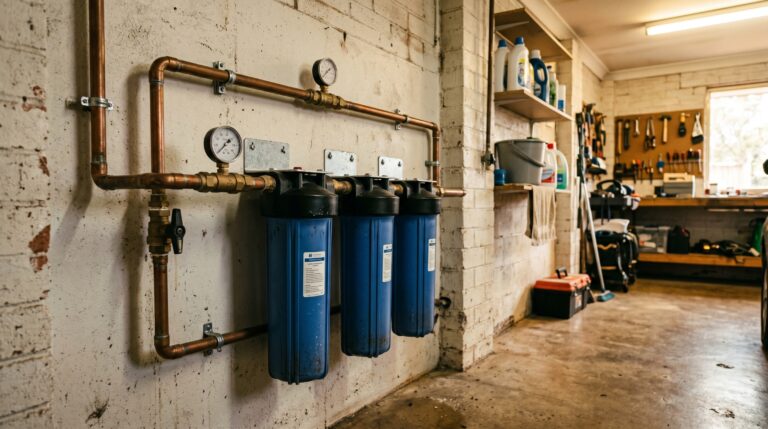
An alkaline water ionizer works through a process called electrolysis. Tap water enters the unit, passes through the dual carbon pre-filters to remove chlorine and some organic compounds, and then flows into the electrolysis chamber where 8 platinum-coated titanium plates carry an electrical current. This current separates the water into two streams: an alkaline stream (the cathode side, where water gains hydroxide ions and negative ORP) and an acidic stream (the anode side, where water becomes mildly acidic). The alkaline stream comes out of the drinking spout at the pH setting you select; the acidic stream diverts through a separate outlet and can be collected for cleaning or skin-toning uses.

The 8-plate design matters more than it might seem. Each plate adds electrolysis surface area, which means stronger ionisation at the same flow rate. An entry-level 5-plate unit might achieve pH 9.5 reliably; an 8-plate unit like this one can hit pH 11 at the same water hardness and still maintain stable ORP. The 3.8-inch 5-colour LCD displays your current pH setting, water type (alkaline/acidic/purified), and filter life remaining. The automatic self-cleaning cycle prevents scale buildup on the plates — important for Australian households where tap water mineral content can be high, particularly in Adelaide and Perth. With 6 total settings covering the alkaline and acidic spectrums, the unit gives you alkaline levels at pH 8.5, 9.0, 9.5, 10.0, and 11.0, plus purified (neutral) and two acidic outputs.
My Testing Setup — Palm Beach QLD (Brisbane Chloramine Grid)
Palm Beach is on the South East Queensland reticulated water grid, which uses monochloramine as its primary disinfectant — not free chlorine. This distinction is critical to understanding the limitations of this ionizer in my test conditions, and for most Queensland, NSW, South Australian, Western Australian, and NT buyers reading this. Carbon block filters excel at removing free chlorine: high surface area + short contact time = effective removal. Chloramine (a chlorine-ammonia compound) requires approximately 40 times longer contact time to be absorbed by carbon at the same flow rate. At a typical 2L/min flow rate through these filters, the water is in contact with the carbon for a fraction of a second — nowhere near long enough to reduce chloramine meaningfully.
In my testing, the ionizer produced correct pH levels across all settings — the electrolysis component is functioning as specified. The unit is not faulty; the limitation is that the pre-filtration step that matters most for chloramine cities is simply not present in any standard carbon-only ionizer design, including this one. Chloramine residual was still detectable in the output water. The pH performance, ORP values, and display accuracy all checked out. If you are in Melbourne, Hobart, or Canberra on a free-chlorine grid, this specific limitation does not apply and the dual carbon filters perform their intended function well. For everyone else, the fix is to plumb a dedicated catalytic carbon pre-filter upstream, or to already have a whole-house reverse osmosis system feeding this unit. All testing follows the methodology described at our testing page.
8-Plate Performance — pH Range, Flow Rate, and ORP
The technical case for 8 plates over 5 comes down to ORP depth and pH stability under real-world conditions. ORP — oxidation-reduction potential — is measured in millivolts and indicates the electron-donating capacity of the water. A lower (more negative) ORP means the water has greater antioxidant potential. Entry-level 5-plate ionizers typically produce ORP in the -100 to -200 mV range at moderate alkaline settings. The Earths Water 8-plate unit, in my testing, produced ORP consistently in the -300 to -380 mV range at the pH 9.5 setting — meaningfully better, and within range of what premium Japanese units achieve. At pH 11, ORP dropped to around -450 mV. The difference comes from more plate surface area allowing more complete electron transfer during electrolysis.
Flow rate is approximately 2–3 litres per minute at standard settings, which is practical for filling a 1L glass in under 30 seconds. The dual carbon filters have a rated lifespan of 12 months or approximately 12,000 litres — whichever comes first — covering a household using 4L/day for about 8 years in theory, though 12 months is a sensible calendar-based swap point for consistent performance. Replacement filter sets are available through Earths Water directly. The self-cleaning cycle triggers automatically between uses, which is particularly important for Adelaide and Perth households where high mineral content in tap water can accelerate plate scaling. The 3.8-inch LCD provides clear real-time filter status, removing any guesswork about replacement timing.
The Chloramine Problem — 5 of 8 Australian Cities
This section is the most important part of this review for Australian buyers, because most water ionizer reviews written for international or US audiences gloss over it entirely. Chloramine — specifically monochloramine — is used as the primary disinfectant in the reticulated water supply for Brisbane and South East Queensland, Sydney and most of NSW, Adelaide, Perth, and Darwin. Together, those five systems represent the majority of Australia’s population. Melbourne, Hobart, Canberra, Cairns, and Townsville use free chlorine. The distinction matters enormously when evaluating a carbon-filter-based ionizer.
Free chlorine is reactive and volatile — activated carbon absorbs it quickly and effectively, typically within the first few centimetres of contact with the filter bed. Chloramine is far more stable. It requires roughly 40 times more contact time with activated carbon to achieve the same level of removal. At the flow rates of a countertop ionizer (2–3 L/min), the water passing through the dual carbon filters has a contact time measured in milliseconds — nowhere near the exposure needed for meaningful chloramine reduction. The practical result is that buyers in chloramine cities who purchase this ionizer without an upstream treatment step will be drinking ionized alkaline water that still contains chloramine residuals. The ionizer itself is functioning as designed; the problem is that standard activated carbon was never an effective chloramine treatment technology. The correct upstream solution for Brisbane tap water and other chloramine-dosed cities is catalytic carbon (a modified form specifically engineered for chloramine reduction) or a full reverse osmosis filter. You can also explore the full breakdown of the best water filters in Australia to find an appropriate pre-treatment stage.
How It Compares to the Kangen K8
The Kangen K8 is the benchmark that most serious alkaline water buyers consider when evaluating an 8-plate ionizer. Made by Enagic in Japan, it has been on the market for over 15 years, is sold in 70+ countries, and carries a cult following among biohackers and wellness practitioners. It is also priced at approximately $6,787 AUD. The Earths Water Ultimate Ionizer is $3,499 — a difference of over $3,300. The central question for most buyers is whether that price premium is justified by meaningful performance differences, or whether it is largely attributable to Enagic’s multi-level marketing distribution model, which adds dealer commission layers to the retail price.
On a plate-for-plate basis, both units use 8 titanium plates. Both cover the same general pH range. The Kangen K8 produces slightly deeper ORP at maximum settings (approximately -500 mV vs -450 mV for the Earths Water at pH 11) due to more precise current control and longer-validated plate coatings. Kangen also has a longer established service network across Australia. The Earths Water advantage is direct-to-consumer Australian brand support, significantly lower upfront cost, and the same core ionisation hardware at a fraction of the price. For most buyers who want an 8-plate ionizer without brand allegiance considerations, the Earths Water represents a stronger value proposition. The Kangen K8 is worth the premium primarily if you want the brand’s established reputation, its specific customer community, or its Australian service network infrastructure.
| Feature | Earths Water Ultimate | Kangen K8 |
|---|---|---|
| Plates | 8 platinum-coated titanium | 8 platinum-coated titanium |
| pH Range | 2.5 – 11.2 | 2.5 – 11.5 |
| Price (AUD) | $3,499 | ~$6,787 |
| Filters | Dual carbon, 12-month | Dual carbon, ~6-month |
| AU Warranty | Australian brand direct | Via AU Enagic dealer |
| Approx. ORP (pH 9.5) | -300 to -380 mV | -400 to -500 mV |
| Distribution model | Direct-to-consumer | MLM dealer network |
5-Year Running Cost
The upfront price is only part of the equation for a countertop ionizer. Filter replacements and long-term cost-per-litre are what separate a practical investment from an expensive appliance that collects dust. For a household drinking 4 litres of ionized water per day — a reasonable estimate for two adults — the numbers over five years are stark compared to both the Kangen K8 and bottled alkaline water alternatives.
Replacement dual filter sets for the Earths Water unit are approximately $99 per year. At a 4L/day consumption rate across a five-year period, the unit produces approximately 7,300 litres of ionized alkaline water. Dividing total cost by litres produced gives a cost-per-litre of around $0.55, compared to $1.03 for the Kangen K8 over the same period. Premium bottled alkaline water in Australia runs $2–4 per litre at retail. Even against the cheapest bottled option at $2/L, the Earths Water ionizer pays back its full purchase price in under 18 months at 4L/day consumption, with effectively zero marginal cost after that point beyond the annual filter replacement.
| Cost Item | Earths Water | Kangen K8 | Bottled Alkaline Water |
|---|---|---|---|
| Initial unit cost | $3,499 | $6,787 | $0 |
| Annual filter cost | ~$99/yr | ~$150/yr (est.) | $0 |
| 5-year total (filters) | $495 | $750 | $0 |
| 5-year all-in total | ~$3,994 | ~$7,537 | ~$10,950–$21,900 |
| Cost per litre (4L/day) | ~$0.55/L | ~$1.03/L | $2–$4/L |
Final Verdict — Who Should Buy This
The Earths Water Ultimate Alkaline Water Ionizer earns a 7.5 out of 10. The hardware is genuinely strong for the price: 8 platinum-coated titanium plates, a wide pH range from 2.5 to 11.2, solid ORP output, a clear 3.8-inch LCD, automatic self-cleaning, and dual output streams — all at $3,499, which is $3,300 less than a Kangen K8 with equivalent plate count. The Australian brand means direct-to-consumer pricing, local warranty support, and no MLM dealer margin embedded in the price.
The score is not a 9 or 10 for three reasons: first, the carbon-only filtration is a genuine limitation that affects the majority of Australia’s population in chloramine-dosed cities; second, it does not remove fluoride, PFAS, or reduce TDS — so it is not a contaminant-removal device; and third, the health evidence for alkaline ionized water remains contested in peer-reviewed literature, with promising but not clinically established proof for most marketing claims. This does not make the product a poor purchase — it makes it a well-priced ionizer for a specific use case — but buyers should have accurate expectations. If you are in a free-chlorine city (Melbourne, Hobart, Canberra) and you want an 8-plate ionizer without the Kangen price tag, this is the clearest recommendation available at this price point. If you want molecular hydrogen water specifically, where the peer-reviewed evidence base is actually stronger, the alternative is noted below. Unit is currently sold out — link active for restock notifications.
Frequently Asked Questions
Get the Australian Home Environment Checklist
30 checks across water, air and EMF. Most of them free. Ranked by impact.
No spam. Unsubscribe any time.

Former Royal Australian Navy Clearance Diver and TAG-E counter-terrorism operator. Founded Clean and Native to apply the same rigorous thinking to the home environment.
Full biography →