Do CPAP Machines Emit Harmful EMF? Australia
Drafted with AI assistance and checked against published specifications and certifications. First-hand measurements appear only where stated. How we make content
How this assessment was made. I have not personally tested these units. This assessment is based on manufacturer specifications, independent certification records (NSF/ANSI, WaterMark AS3497) and Australian supply and pricing data current at the time of writing. Where I have personally measured a product in my own home, the article says so explicitly and gives the readings. Clean and Native earns affiliate commission on some links. That does not affect which products are assessed or what the specifications say.
CPAP machines emit low-level AC magnetic fields from their motors and transformers, and many modern models — including the ResMed AirSense 11 and Philips DreamStation 2 — also transmit radiofrequency EMF via built-in WiFi and Bluetooth modules. According to ARPANSA’s RF exposure standard (RPS3), these emissions fall well below Australia’s thermal safety limit of 1,000 µW/cm² at 2.4 GHz, but the 6-to-8-hour nightly exposure at bedside distance places them in a category that building biology practitioners flag as worth addressing.
Your CPAP machine emits measurable EMF — but stopping CPAP therapy is never the correct response. Untreated obstructive sleep apnoea carries serious cardiovascular, metabolic, and cognitive risks that dwarf any theoretical concern from low-level electromagnetic fields. The practical approach: disable WiFi/Bluetooth data sync if your sleep physician does not require it, maximise the distance between the motor unit and your pillow using the full hose length, and route the power cable away from your body. These three actions reduce your overnight exposure by an estimated 80-95% without compromising therapy.
| EMF Source | What It Does | Verdict |
|---|---|---|
| AC motor/transformer (ELF magnetic) | Generates 50 Hz magnetic field, drops rapidly with distance | Manageable — move unit 60-100 cm from pillow |
| WiFi/Bluetooth module (RF) | Transmits sleep data to cloud/app at 2.4 GHz | Disable if not needed — eliminates RF entirely |
| Power cable (AC electric field) | Radiates AC electric field along its length whenever plugged in | Route away from body — behind bedhead, not under pillow |
Key catches
- CPAP therapy saves lives — never stop or reduce usage based on EMF concerns alone
- The ResMed AirSense 10/11 and Philips DreamStation 2 have WiFi/Bluetooth ON by default — you must manually disable it
- ARPANSA’s thermal safety limit does not address chronic low-level overnight exposure — building biology thresholds are 10,000x lower
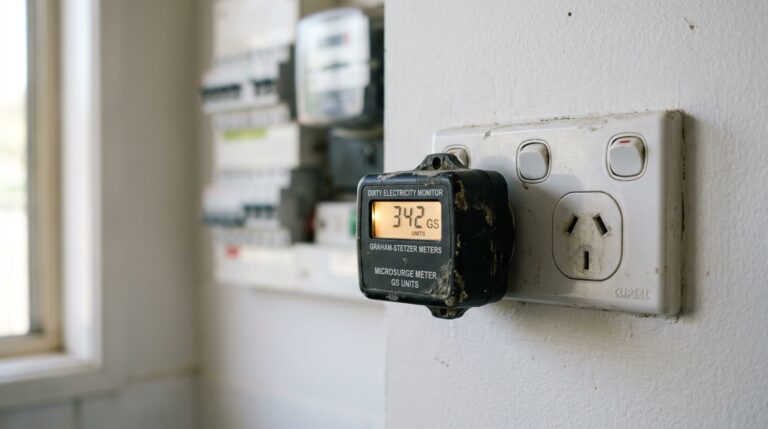
- Without measurement, you cannot know your actual exposure — a meter is the only way to confirm
What EMF Does a CPAP Machine Actually Produce?
Every CPAP machine contains a brushless DC motor, a transformer (either internal or in an external power brick), and control electronics. These components generate two distinct categories of electromagnetic fields that you need to understand separately, because they behave differently and require different mitigation strategies.
ELF Magnetic Fields (50 Hz) — The Motor and Transformer
The motor that pressurises air and the transformer that converts mains power both generate extremely low frequency (ELF) AC magnetic fields at 50 Hz (Australia’s mains frequency). According to ARPANSA’s Radiation Protection Standard for ELF fields, the general public exposure limit is 1,000 µT at 50 Hz — a thermal safety threshold. The Building Biology Standard SBM-2015, used by practitioners worldwide as a precautionary guideline for sleeping areas, recommends below 0.2 µT for “no anomaly” classification.
A typical CPAP motor unit generates magnetic field readings in the range of 0.5-3.0 µT at the surface of the housing, according to independent EMF consultant measurements published by building biology practitioners. That is well below ARPANSA’s 1,000 µT ceiling. But here is the variable that matters: the inverse square law means the field strength drops dramatically with distance. At 10 cm from the housing, a 3.0 µT surface reading drops to roughly 0.3-0.7 µT. At 60 cm, it typically falls below the 0.2 µT building biology threshold. At 100 cm, it is negligible.
The problem? Most CPAP users place the machine on a bedside table 20-40 cm from their pillow. At that distance, the magnetic field at head height may sit at 0.3-1.0 µT — above the building biology sleeping threshold for 6-8 hours every night.
Radiofrequency (RF) EMF — WiFi and Bluetooth Modules
This is the source most CPAP users do not know about. Modern CPAP machines marketed in Australia — including the ResMed AirSense 10 Elite, ResMed AirSense 11, and Philips DreamStation 2 — contain built-in wireless modules that transmit sleep data (AHI, leak rate, usage hours) to cloud platforms. These modules operate at 2.4 GHz (WiFi) and/or 2.4 GHz (Bluetooth Low Energy), and in many models they are enabled by default from the factory.
A 2024 study published in Environmental Research (PMC11554657) found that RF-EMF exposure at 2.45 GHz — exactly the frequency your CPAP’s WiFi module uses — demonstrated statistically significant impacts on sleep quality as measured by the Pittsburgh Insomnia Rating Scale (p<0.004). The irony is stark: a device designed to improve your sleep quality may simultaneously transmit at a frequency shown to impair it.
ResMed’s AirSense 11 technical specifications confirm the device includes an 802.11 b/g/n WiFi radio and Bluetooth 5.0. The WiFi module transmits data to ResMed’s myAir platform, which your sleep physician may or may not actually use for ongoing management. Unless your specialist has specifically asked you to keep wireless data sharing active, you are receiving RF exposure for no clinical benefit.
Why Overnight Proximity Changes the Risk Equation
EMF exposure from a CPAP machine is categorically different from walking past a WiFi router or standing near a microwave. The difference is not field strength — it is duration and proximity combined. You are exposed to your CPAP’s emissions for 6-8 hours, every single night, at a distance of 20-40 cm from your brain. No other household EMF source matches that combination of duration plus proximity plus head-level placement.
ARPANSA’s RF standard (RPS3) sets exposure limits based on thermal effects — the point at which electromagnetic energy heats tissue. At 2.4 GHz, that limit is 1,000 µW/cm² (10 W/m²). Your CPAP’s WiFi module emits far below that. But the Building Biology Standard SBM-2015 — which targets chronic overnight exposure specifically — recommends below 0.1 mW/m² for sleeping areas. That is a factor of 100,000 lower than ARPANSA’s thermal limit. The two standards are not measuring the same thing. ARPANSA protects against tissue heating. Building biology addresses chronic low-level exposure during the regenerative phase of sleep.
The WHO acknowledges that sources of EMF in daily life have “proliferated to an unprecedented degree” but notes a lack of specific data on many individual device categories, including CPAP machines. No regulatory body — Australian or international — has published CPAP-specific EMF exposure guidelines. That is not evidence of safety. It is an evidence gap.
For Australian CPAP users, the practical reality is this: the TGA (Therapeutic Goods Administration) regulates CPAP machines for electrical safety and therapeutic efficacy under its medical device framework. EMF emissions are covered by general compliance with AS/NZS CISPR 11 (electromagnetic compatibility for medical devices), which limits interference with other devices — not biological effects. There is no TGA requirement for manufacturers to disclose the RF output of built-in WiFi/Bluetooth modules in a format that consumers can use to assess personal exposure.
The cumulative calculation matters. A CPAP machine running for 7 hours per night, 365 nights per year, delivers 2,555 hours of annual bedside exposure. Over the average 10-year treatment period for obstructive sleep apnoea, that is 25,550 hours of continuous exposure at pillow distance. No other household device comes close to that figure. Your phone might be nearby, but if you follow the Clean and Native bedroom EMF audit protocol, it should be in airplane mode. Your CPAP cannot go into airplane mode and still function — but its wireless module can be disabled without affecting therapy.
How to Reduce CPAP EMF Exposure Without Compromising Therapy
This is the section that matters most. Every reduction strategy below maintains full therapeutic benefit. None of these steps involve reducing CPAP pressure, shortening usage time, or stopping therapy. Untreated obstructive sleep apnoea increases cardiovascular disease risk by 2-3x (according to the Australasian Sleep Association’s position statement), worsens hypertension, impairs daytime cognitive function, and increases motor vehicle accident risk. The health consequences of untreated OSA are concrete, measured, and severe. The health consequences of low-level CPAP EMF exposure are theoretical and unquantified. Do not let EMF concern override established medical treatment.
Step 1: Disable WiFi and Bluetooth (Eliminates RF Entirely)
This is the highest-impact, zero-cost action. On the ResMed AirSense 11: navigate to Settings > My Options > Airplane Mode > On. On the AirSense 10: Settings > Setup > Wireless > Off. On the Philips DreamStation 2: Settings > Wireless > Disable. These steps eliminate all 2.4 GHz RF emissions from the device while the motor, humidifier, and pressure delivery continue to function identically.
Before disabling wireless, check with your prescribing sleep physician or respiratory specialist. Some clinicians rely on remotely transmitted compliance data — particularly in the first 3-6 months of CPAP therapy, when pressure adjustments are common. If your specialist needs that data, ask whether monthly SD card downloads or manual data uploads (via USB) are an acceptable alternative. In most established cases beyond the initial titration period, wireless data transmission is a convenience, not a clinical necessity.
Step 2: Maximise Distance Between the Motor Unit and Your Head
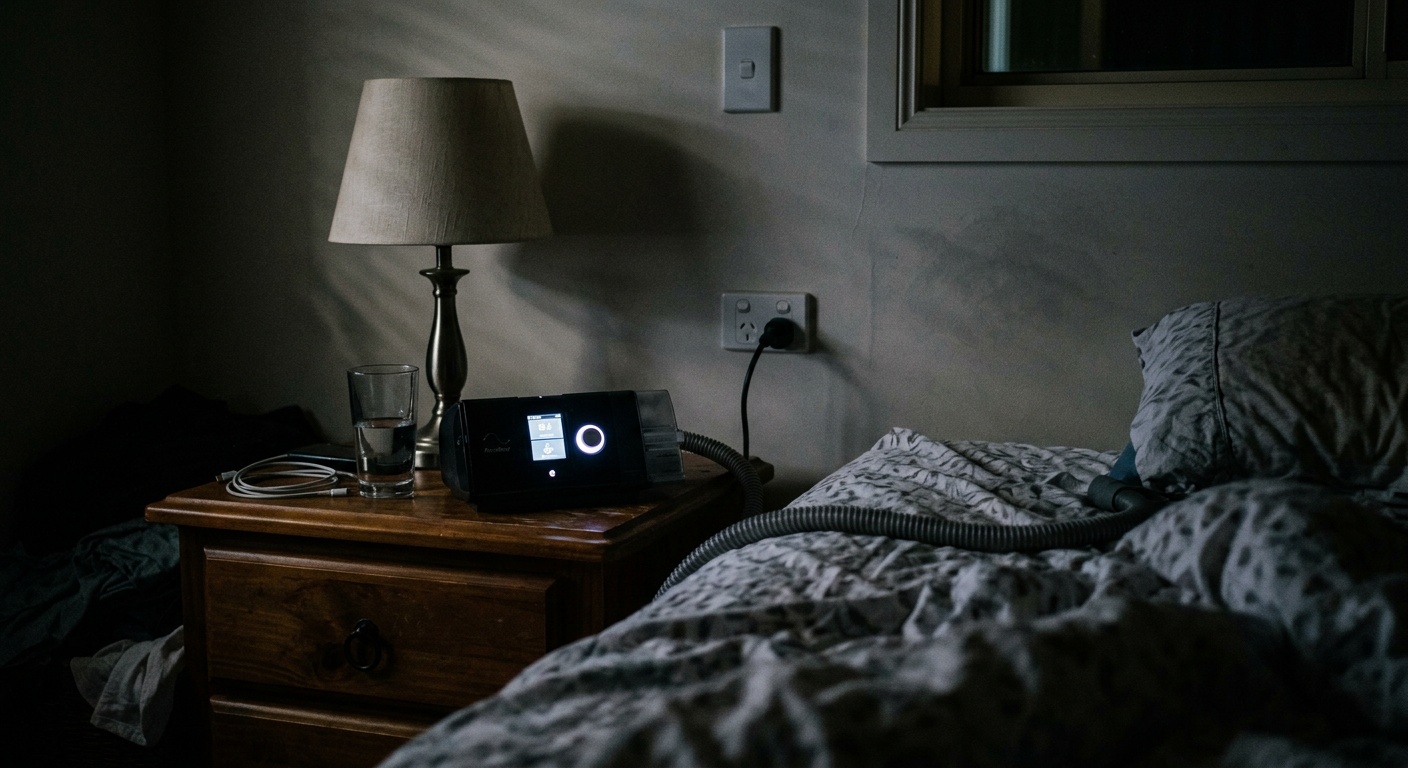
Standard CPAP hose length is 1.8 metres (6 feet). Most users coil excess hose on the bedside table and place the machine 20-40 cm from their pillow. Instead, use the full hose length. Place the CPAP unit on a low table, shelf, or the floor on the far side of the bedside table — 60-100 cm from your pillow. The 50 Hz magnetic field drops by roughly 75% when you move from 30 cm to 80 cm distance.
If your hose is not long enough for comfortable positioning, extended CPAP hoses (2.4 m) are available from most CPAP suppliers in Australia and are compatible with standard 22 mm and 19 mm cuff fittings. This is an inexpensive change — typically $25-40 AUD — that delivers measurable EMF reduction.
Step 3: Route the Power Cable Away From Your Body
The CPAP power cable generates an AC electric field along its entire length whenever plugged in — even when the machine is off. If that cable runs under your pillow, along the bedhead, or across the mattress surface, it creates a sustained electric field at body contact distance. Route the cable behind the bedhead, down the wall, and along the floor to the power point. Keep it at least 30 cm from any body contact surface.
The external power brick (on models that have one, like the AirSense 10) generates its own small magnetic field. Place it on the floor, not on the bedside table next to the machine. Distance is your primary tool.
Step 4: Measure Your Actual Exposure
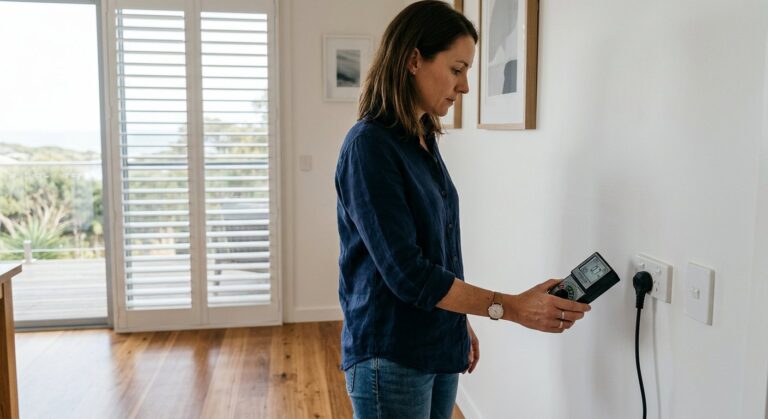
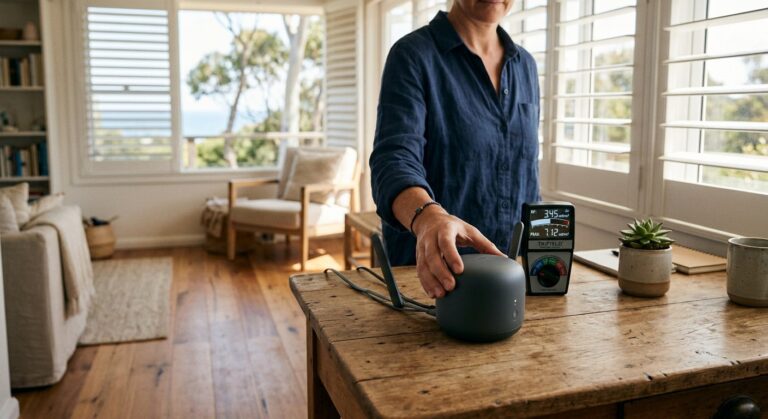
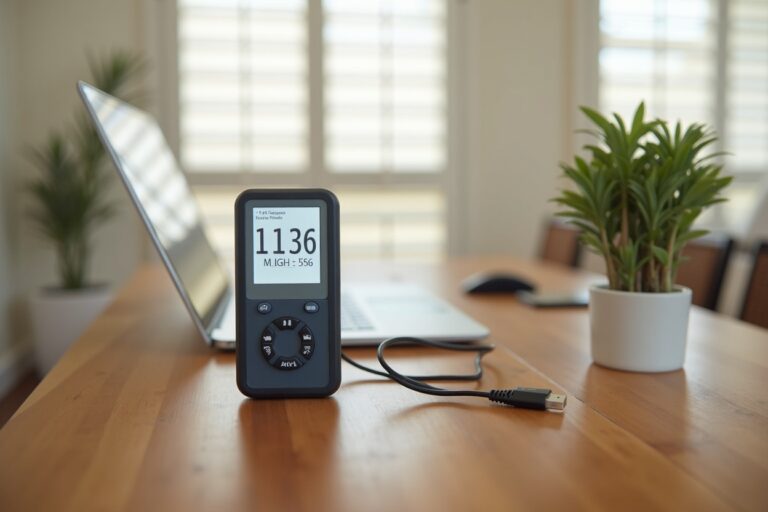
Without a meter, every EMF decision is a guess. The TriField TF2 measures AC magnetic fields (the motor component), AC electric fields (the cable component), and RF (the WiFi/Bluetooth component) — all three CPAP-relevant emission types in one device. Take readings at your pillow position with the CPAP running and WiFi enabled, then again with WiFi disabled, then again with the unit moved to maximum distance. The before-and-after readings will show you exactly what each mitigation step achieves.
For RF-specific measurement with higher sensitivity and directional capability, the Safe and Sound Pro II is the reference instrument used by building biology consultants in Australia. It will show you whether your CPAP’s WiFi module is transmitting, at what power level, and whether your disable action actually worked (some firmware versions re-enable WiFi after power cycling).
CPAP Models Sold in Australia: WiFi/Bluetooth Status
Not all CPAP machines have wireless modules. Knowing whether yours does — and whether it is on by default — determines whether RF exposure is even part of your equation. Here is the current status of the most commonly prescribed CPAP machines available through Australian CPAP suppliers and PBS-subsidised channels.
| CPAP Model | WiFi | Bluetooth | Default State | Can Disable? |
|---|---|---|---|---|
| ResMed AirSense 11 AutoSet | Yes (802.11 b/g/n) | Yes (BLE 5.0) | ON | Yes — Airplane Mode |
| ResMed AirSense 10 AutoSet | Yes (built-in) | No | ON | Yes — Settings menu |
| Philips DreamStation 2 | Yes | Yes (BLE) | ON | Yes — Settings menu |
| Fisher & Paykel SleepStyle Auto | Yes | Yes (BLE) | ON | Yes — Settings menu |
| Löwenstein prisma SMART Max | Optional module | No | OFF (if module not installed) | N/A |
| Older ResMed S9 series | No | No | N/A | N/A — no wireless hardware |
The pattern is clear. Every current-generation CPAP machine from the three major manufacturers (ResMed, Philips, Fisher & Paykel) includes wireless capability enabled by default. If you purchased or were prescribed a CPAP machine in Australia after 2019, it almost certainly has an active WiFi or Bluetooth radio operating at your bedside every night — unless you have manually disabled it.
Older machines like the ResMed S9 series have no wireless hardware at all. If your prescribing physician does not require wireless data and EMF minimisation is important to you, asking about non-wireless models at your next review is a reasonable conversation — though model availability is ultimately determined by what suppliers stock and what your specialist recommends for your specific clinical needs.
CPAP EMF in the Context of Your Full Bedroom Environment
Your CPAP machine does not operate in isolation. It sits alongside your phone, WiFi router signal, smart meter transmission, bedroom wiring, and every other EMF source in the room. Addressing CPAP emissions while ignoring these other sources is like putting a bandage on one finger while the rest of your hand is on the stove.
The correct approach is the full bedroom EMF audit. The protocol: measure all three field types (AC magnetic, AC electric, RF) at your pillow position, identify every contributing source, then systematically address them in order of magnitude. In most Australian bedrooms, the CPAP machine is not the largest EMF contributor — the WiFi router signal, a phone charging on the bedside table, and wiring in the wall behind the bedhead typically dominate. But the CPAP is unique because it cannot simply be removed from the room. It needs to be optimised in place.
The Bedroom Audit Sequence for CPAP Users
1. Phone to airplane mode — free, instant, eliminates the largest single RF source at bedside distance for most people. If you use your phone as a CPAP alarm, switch to a battery-powered alarm clock.
2. CPAP WiFi/Bluetooth off — free, 30 seconds, eliminates the second RF source at bedside distance.
This article contains affiliate links. We may earn a commission at no extra cost to you.
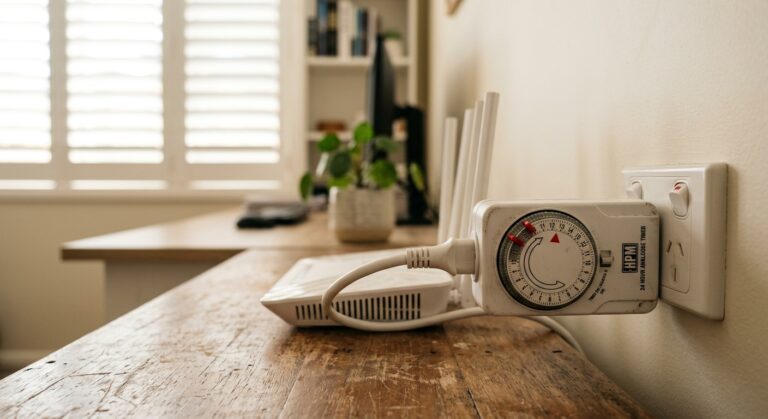
3. Router on a mechanical timer — approximately $20 AUD, automatically kills WiFi during sleep hours. A HPM 24 Hour Analog Timer (Amazon AU ASIN B081JD8LXN) switches the router off at your bedtime and back on before you wake. This eliminates the ambient WiFi RF field that penetrates bedroom walls from wherever your router sits.
4. CPAP unit to maximum distance — free, use full hose length, reduces ELF magnetic field by 75%+ at pillow position.
5. Power cable routing — free, 5 minutes, move all cables (CPAP, phone charger, lamp) away from body contact surfaces.
6. Demand switch on bedroom circuit — approximately $100-150 installed by a licensed electrician, eliminates AC electric fields from all wiring in bedroom walls when no loads are drawing power. For CPAP users, note that the CPAP itself draws power all night, so the demand switch will not activate on a circuit that powers both the CPAP and the general bedroom wiring. The solution: have the electrician install the demand switch on the general bedroom lighting/power circuit, and run the CPAP from a dedicated circuit or an adjacent room’s circuit via an extension lead (routed along the floor, away from the bed).
Australian Regulatory Standards: What TGA and ARPANSA Actually Cover
Australian CPAP users operate under a regulatory framework that was designed for different concerns than chronic overnight EMF exposure. Understanding what the regulations do and do not cover helps you make informed decisions rather than assuming that “approved for sale” means “EMF-optimised for bedside use.”
TGA (Therapeutic Goods Administration): Registers CPAP machines as Class IIa medical devices under the Australian Register of Therapeutic Goods (ARTG). The TGA’s assessment covers safety (electrical, mechanical, biocompatibility of materials), therapeutic performance (pressure accuracy, leak compensation algorithms), and electromagnetic compatibility (EMC) under AS/NZS CISPR 11. EMC testing ensures the CPAP does not interfere with other medical devices — for example, cardiac pacemakers or implantable defibrillators. It does not assess whether the CPAP’s own emissions affect the user’s biology.
ARPANSA (Australian Radiation Protection and Nuclear Safety Agency): Sets exposure limits for RF and ELF fields via Radiation Protection Standard RPS3 (RF) and the ELF exposure standard. These are general population standards, not device-specific. ARPANSA’s RF limit of 1,000 µW/cm² at 2.4 GHz is based on the thermal threshold — the point where tissue heating occurs. CPAP WiFi modules operate orders of magnitude below this limit. ARPANSA does not set precautionary limits for chronic low-level exposure, and it does not assess individual medical devices for non-thermal biological effects.
The gap: No Australian regulatory body assesses whether a CPAP machine’s combined ELF + RF output, at typical bedside distances, over 6-8 hours nightly for years or decades, poses non-thermal biological risk. The FDA in the United States has a similar gap — its CPAP oversight focuses on the Philips DreamStation foam degradation recall (PE-PUR foam off-gassing) and device efficacy, not EMF emissions from wireless modules. The WHO’s International EMF Project has not published CPAP-specific guidance.
This is not a criticism of these agencies. Their mandates are defined by legislation, and chronic low-level EMF from medical devices sits in an evidence gap that no regulatory body has been tasked with filling. For you as a CPAP user, this means the decision to mitigate EMF exposure is a personal precautionary choice — not a response to a regulatory warning, and not a reason to discontinue therapy.
The Non-Negotiable: Treated Sleep Apnoea Outweighs Theoretical EMF Risk
I need to be direct about this. As a former Navy Clearance Diver who takes environmental exposure seriously, I also take evidence hierarchies seriously. The evidence for harm from untreated obstructive sleep apnoea is strong, consistent, and quantified. The evidence for harm from low-level chronic EMF exposure at the levels a CPAP produces is preliminary, inconsistent, and not specific to this device category.
According to the Australasian Sleep Association, untreated moderate-to-severe OSA is associated with a 2-3x increased risk of hypertension, a 1.6x increased risk of stroke, significantly elevated risk of type 2 diabetes, impaired cognitive function equivalent to moderate alcohol intoxication, and a 2.5x increased risk of motor vehicle accidents. These are population-level findings from large cohort studies with clear dose-response relationships.
CPAP therapy, when used for 4+ hours per night, reduces these risks to near-baseline levels. That is a measurable, replicated, clinically significant benefit.
Low-level EMF exposure from CPAP machines has not been studied directly. The 2024 study on 2.45 GHz RF and sleep quality (PMC11554657) used controlled laboratory exposure conditions that do not directly replicate a CPAP WiFi module’s intermittent transmission pattern. Building biology thresholds are practitioner guidelines based on the precautionary principle, not established dose-response curves for specific health outcomes. The WHO has identified EMF as an area requiring further research but has not established causal links for non-thermal effects at the levels generated by consumer devices.
The hierarchy is clear: treat your sleep apnoea first, reduce EMF exposure second. Never reduce CPAP pressure settings, skip nights of use, or stop therapy because of EMF concerns. The mitigation steps in this article — disabling WiFi, maximising distance, routing cables — achieve meaningful EMF reduction without touching your therapy. Use them. But use your CPAP every night, at the pressure your specialist has prescribed, for the full duration they recommend.
If you have concerns, raise them with your prescribing sleep physician. They can discuss whether wireless data sharing is clinically necessary for your case and whether alternative data transfer methods (SD card) are acceptable. That conversation is between you and your specialist — not something to resolve by unilaterally modifying your treatment.
CPAP EMF Reduction Checklist
Print this. Tape it to your CPAP case. Every step preserves full therapy.
| Action | EMF Type Reduced | Cost | Time |
|---|---|---|---|
| Disable WiFi/Bluetooth in CPAP settings | RF (2.4 GHz) | $0 | 30 seconds |
| Move unit to 60-100 cm from pillow | ELF magnetic (50 Hz) | $0 | 2 minutes |
| Route power cable behind bedhead/along floor | AC electric field | $0 | 5 minutes |
| Place power brick on floor (not bedside table) | ELF magnetic | $0 | 1 minute |
| Extended CPAP hose (2.4 m) | ELF magnetic (enables greater distance) | ~$25-40 | Swap old hose |
| Phone to airplane mode | RF (all bands) | $0 | 2 seconds |
| Router on mechanical timer | RF (ambient WiFi) | ~$20 | 5 minutes |
| Measure with TriField TF2 | Confirms all reductions | ~$250 | 15 minutes |
Every action on that list is compatible with full CPAP compliance. The first six cost nothing. The last two cost less than a single night in hospital — which is where untreated severe OSA can put you.
Last reviewed: September 2026 – Clean and Native
Start with measurement. The TriField TF2 is the only meter you need.
Measures AC magnetic, AC electric, and RF in one device. Without real readings, every EMF decision is a guess. Take a baseline at your pillow with the CPAP running, then measure after each reduction step.
Frequently Asked Questions
Does a CPAP machine emit radiation while I sleep?
Yes. Every CPAP machine emits low-frequency AC magnetic fields from its motor and transformer during operation. Modern models with WiFi or Bluetooth also emit radiofrequency (RF) radiation at 2.4 GHz. Both are forms of non-ionising electromagnetic radiation, not nuclear radiation.
Can I turn off WiFi on a ResMed AirSense 11?
Yes. Navigate to Settings > My Options > Airplane Mode and set it to On. This disables both the WiFi and Bluetooth radios. The CPAP continues to deliver therapy at the same pressure settings. Sleep data is still recorded to the SD card for manual download.
Should I stop using my CPAP because of EMF concerns?
No. Untreated obstructive sleep apnoea carries serious, well-documented health risks including a 2-3x increased risk of hypertension and significantly elevated stroke risk, according to the Australasian Sleep Association. CPAP EMF exposure is a theoretical concern at levels far below established safety limits. Reduce EMF exposure using the practical steps in this article, but never stop CPAP therapy.
How far should my CPAP be from my head?
At least 60 cm, ideally 80-100 cm. The 50 Hz magnetic field from the motor drops by roughly 75% when you increase distance from 30 cm to 80 cm. Use the full 1.8 m hose length, or purchase a 2.4 m extended hose (~$25-40 AUD) to enable greater distance without restricting movement.
Does ARPANSA have specific limits for CPAP EMF?
No. ARPANSA sets general population exposure limits for RF (1,000 µW/cm² at 2.4 GHz) and ELF magnetic fields (1,000 µT at 50 Hz) under Radiation Protection Standard RPS3. These are thermal safety limits, not device-specific guidelines. ARPANSA does not assess individual medical devices for chronic overnight non-thermal exposure.
Does the TGA regulate CPAP machines for EMF safety?
The TGA regulates CPAP machines as Class IIa medical devices under the ARTG, covering electrical safety, therapeutic performance, and electromagnetic compatibility (AS/NZS CISPR 11). EMC testing ensures the device does not interfere with other equipment. It does not assess whether the CPAP’s own emissions affect the user biologically during nightly use.
Which CPAP machines in Australia do not have WiFi?
Older models like the ResMed S9 series have no wireless hardware. The Löwenstein prisma SMART Max has an optional (removable) wireless module. Every current-generation machine from ResMed, Philips, and Fisher & Paykel includes WiFi and/or Bluetooth enabled by default. If wireless-free is a priority, discuss this with your sleep specialist at your next review.
Can I measure CPAP EMF at home in Australia?
Yes. The TriField TF2 meter measures all three relevant field types — AC magnetic (motor), AC electric (cable), and RF (WiFi/Bluetooth) — in a single device. Take readings at your pillow position with the CPAP running and wireless enabled, then repeat after disabling WiFi and increasing distance. The before-and-after comparison shows exactly what each step achieves.
Does CPAP WiFi transmit continuously all night?
Transmission patterns vary by model. ResMed AirSense devices transmit sleep data in periodic bursts rather than continuously — but the WiFi radio remains in an active listening state between transmissions, producing a low-level ambient RF signal. Bluetooth Low Energy (BLE) modules similarly beacon at regular intervals. Disabling wireless via airplane mode stops all transmission and listening activity.
Is the CPAP humidifier an additional EMF source?
The heated humidifier draws additional current through the heating element, which generates a small additional magnetic field. However, since the humidifier is integrated into the main unit on most modern CPAP machines, the mitigation is the same: maximise distance between the entire unit and your pillow. The humidifier does not add an RF source.
Get the Australian Home Environment Checklist
30 checks across water, air and EMF. Most of them free. Ranked by impact.
No spam. Unsubscribe any time.

Former Royal Australian Navy Clearance Diver and TAG-E counter-terrorism operator. Founded Clean and Native to apply the same rigorous thinking to the home environment.
Full biography →