AirPods and Bluetooth Earbuds EMF Exposure 2026
Drafted with AI assistance and checked against published specifications and certifications. First-hand measurements appear only where stated. How we make content
How this assessment was made. I have not personally tested this unit. This assessment is based on manufacturer specifications, independent certification records (NSF/ANSI, WaterMark AS3497) and Australian supply and pricing data current at the time of writing. Where I have personally measured a product in my own home, the article says so explicitly and gives the readings. Clean and Native earns affiliate commission on some links. That does not affect which products are assessed or what the specifications say.
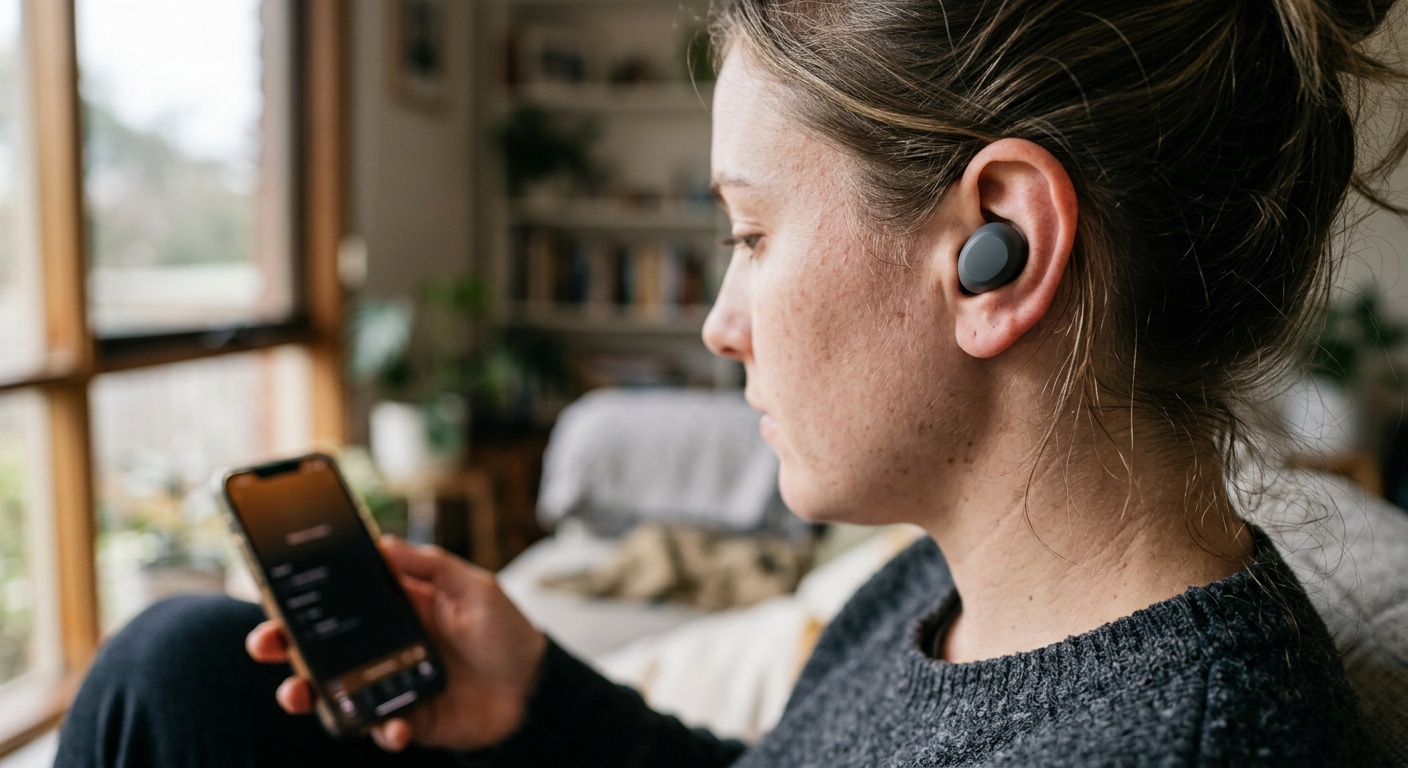
Bluetooth earbuds like AirPods transmit RF energy at power levels roughly 100 to 1,000 times lower than a phone’s cellular radio, and current peer-reviewed evidence does not establish a health effect at these exposure levels according to both ARPANSA and the WHO. That said, earbuds sit inside the ear canal — closer to brain tissue than any other consumer wireless device — so the proximity question is legitimate, and understanding the actual numbers matters more than either panic or dismissal.
| Technology | RF exposure level | Verdict |
|---|---|---|
| AirPods / Bluetooth earbuds | SAR 0.07–1.19 W/kg (model-dependent) at <10 mW transmit power | Well below AU safety limit. Proximity is the concern, not power. |
| Phone cellular radio (4G/5G) | SAR up to 1.6 W/kg at up to 200 mW (4G) or 200+ mW (5G) | 20–100x higher transmit power than earbuds |
| Air-tube headphones | Zero RF to the head (wired + hollow tube for final segment) | Recommended for readers wanting zero head-level RF |
AirPods and Bluetooth earbuds emit RF energy well below ARPANSA’s Australian safety limits — but they sit in the ear canal, closer to tissue than any other wireless device you own. The honest position: current evidence does not demonstrate harm at Bluetooth Class 1 power levels (≤10 mW typical). The honest caveat: no long-term (20+ year) studies exist for in-ear-canal exposure in this frequency range. If you want to eliminate the variable entirely, air-tube headphones are the only consumer product that delivers sound to the ear with zero RF at the head.
Key catches
- Bluetooth earbuds transmit at ~1–10 mW — roughly 100–1,000x less power than a phone’s cellular radio
- SAR values vary wildly by model and earbud position — AirPods 4th Gen right earbud: 0.11 W/kg vs case-adjacent: 1.19 W/kg (WaveBlock data)
- ARPANSA’s position: typical RF exposures from wireless devices are “usually well below Australian Standard limits” in normal use
- Air-tube headphones are the only way to achieve zero RF at the ear — wired headphones still conduct small RF currents along the cable
Why In-Ear-Canal Earbuds Are Different From Headphones
The concern about AirPods and true wireless earbuds is not fundamentally about power output. It is about proximity. A Bluetooth earbud sits inside the ear canal — typically 2–3 cm from the tympanic membrane and roughly 3–5 cm from brain tissue. Over-ear headphones sit on or around the pinna, placing the Bluetooth antenna 2–4 cm further from the skull. That distance matters because RF energy intensity drops with the inverse square of distance: doubling the distance from the antenna reduces exposure by approximately 75%.
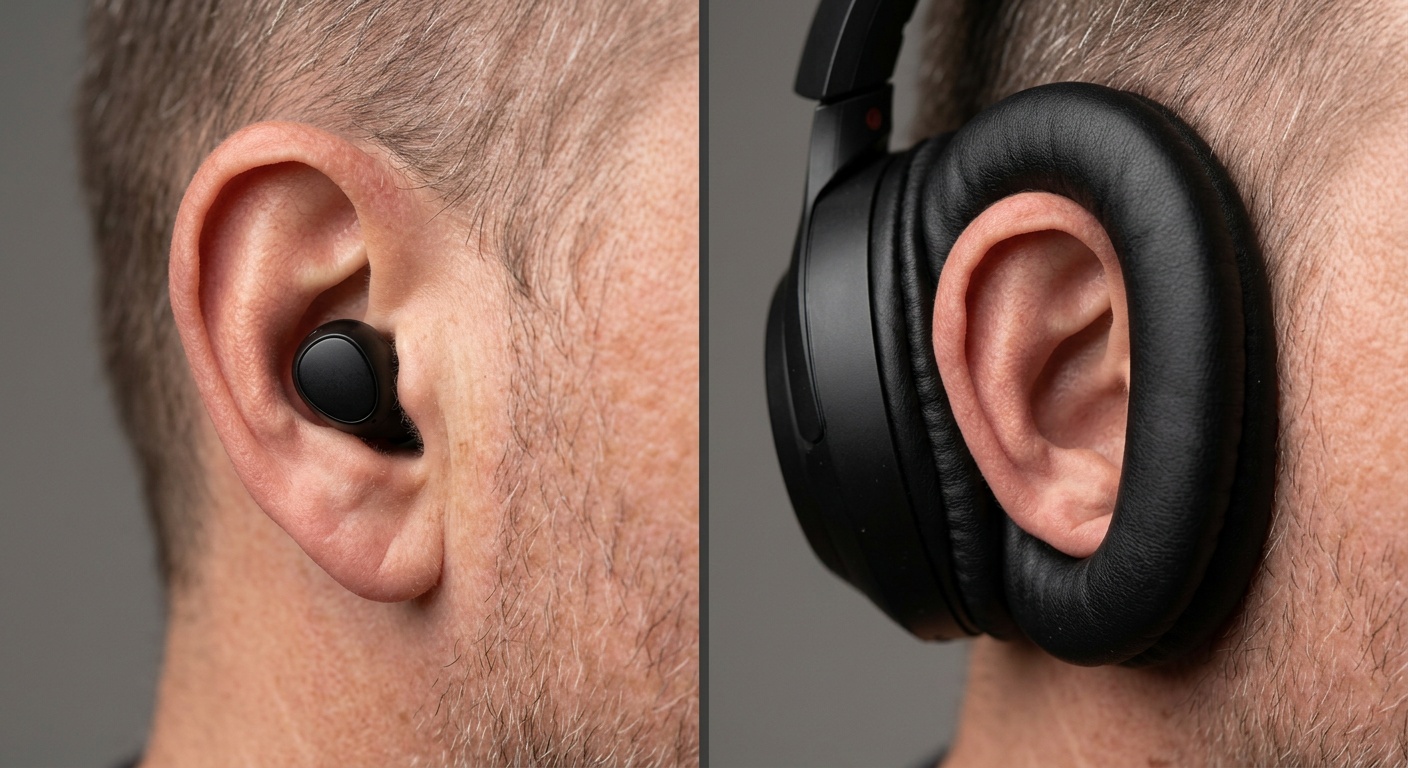
This is not a theoretical concern invented by wellness marketers. The inverse-square law is a fundamental principle of electromagnetic radiation, documented in every undergraduate physics textbook and cited by ARPANSA in their guidance on reducing exposure to mobile phones. When ARPANSA advises Australians to “increase the distance between your body and the device”, they are referencing this exact relationship.
True wireless earbuds also transmit RF between left and right buds — not just to the phone. Earlier AirPods models (1st and 2nd generation) relayed Bluetooth through the head from the primary bud to the secondary bud. Apple’s H2 and later chips improved this with dual-device connectivity, but both buds still maintain active RF links. This means your head sits between two active transmitters, each operating at 2.4 GHz, for the entire listening session.
None of this proves harm. But it does mean that earbuds represent a qualitatively different exposure scenario from over-ear Bluetooth headphones, and lumping them together is technically sloppy. The question is whether the power levels involved are enough to matter at all.
Bluetooth Power Output vs Phone Cellular Radios: The Actual Numbers
If you are worried about AirPods EMF exposure, the single most important fact to understand is this: Bluetooth Class 1 devices (which includes all AirPods and most consumer earbuds) transmit at a maximum of 100 mW — and typically operate at 1–10 mW during normal audio streaming. A phone’s 4G LTE radio, by contrast, can transmit at up to 200 mW, and 5G NR (sub-6 GHz) radios can push 200+ mW depending on band and network conditions. That is a 20x to 200x difference in transmit power.
Here is the comparison in a format you can actually use:
| Source | Frequency | Max TX power | Typical TX power | Distance from brain |
|---|---|---|---|---|
| AirPods / BT earbuds | 2.4 GHz | 100 mW (Class 1) | 1–10 mW | 3–5 cm (in ear canal) |
| Phone 4G LTE | 700–2,600 MHz | 200 mW | 50–200 mW | 0–2 cm (held to ear) |
| Phone 5G NR (sub-6) | 3.5 GHz | 200+ mW | 100–200+ mW | 0–2 cm (held to ear) |
| Wi-Fi router (2.4 GHz) | 2.4 GHz | 200 mW (ACMA limit) | 50–200 mW | 1–10 m (room distance) |
| Air-tube headphones | N/A | 0 mW | 0 mW | N/A (no RF) |
The SAR (Specific Absorption Rate) figures tell the same story. SAR measures the rate at which RF energy is absorbed by body tissue, expressed in watts per kilogram (W/kg). Australia’s ARPANSA standard, aligned with ICNIRP guidelines, sets the SAR limit at 2.0 W/kg averaged over 10 grams of tissue. AirPods 4th Generation have been independently measured (WaveBlock data) at 1.19 W/kg for the case-adjacent position and 0.11 W/kg for the right earbud alone. Both figures are below the Australian limit — the earbud-only reading is roughly 18x below it.
This is worth sitting with. The SAR measurement that looks alarming (1.19 W/kg) is the case-adjacent figure — that is, the earbud measured near the charging case, not in your ear. The actual in-ear reading is 0.11 W/kg. Context changes everything.
When ARPANSA states that typical RF exposures from wireless devices are “usually well below Australian Standard limits” in normal use, Bluetooth earbuds are firmly within that assessment. The power levels involved are a fraction of what your phone produces during a voice call — and you hold your phone against the same side of your head for that call.
What the Peer-Reviewed Evidence Actually Shows
This is where honest content separates from fear-based marketing. You will find articles online claiming Bluetooth earbuds cause brain tumours, tinnitus, DNA damage, and neurological dysfunction. You will also find articles dismissing all concern as anti-science paranoia. Both positions are inaccurate.
Here is what the evidence actually says, as of 2026:
The IARC classification. The International Agency for Research on Cancer (IARC), part of the WHO, classified radiofrequency electromagnetic fields as “Group 2B — possibly carcinogenic to humans” in 2011. This classification applies to all RF-EMF, not specifically to Bluetooth. Group 2B means there is limited evidence of carcinogenicity in humans and less than sufficient evidence in experimental animals. For reference, Group 2B also includes pickled vegetables, aloe vera whole leaf extract, and coconut oil diethanolamine condensate. The classification indicates uncertainty, not confirmed danger.
The Interphone study (2010). The largest case-control study on mobile phone use and brain tumours (Interphone, published in the International Journal of Epidemiology) found no overall increase in glioma or meningioma risk for mobile phone users. It noted a suggestion of increased risk at the highest decile of cumulative call time, but the authors stated this could be due to recall bias. Critically, this study examined phone calls — exposures orders of magnitude higher than Bluetooth earbuds.
The NTP study (2018). The US National Toxicology Program exposed rats to whole-body RF-EMF at 1.5, 3, and 6 W/kg — 15 to 60 times higher than the maximum SAR measured in AirPods, and 135 to 545 times higher than the in-ear earbud measurement. They found some evidence of tumours in male rats at the highest exposures. The NTP explicitly cautioned against extrapolating these results to typical human wireless device exposure. The exposure levels simply do not correspond to Bluetooth power output.
The WHO position (current). The WHO states there is “no precise delineation between safety and hazard” and that RF exposure risk is graduated, not binary. They do not identify Bluetooth as a specific concern. Their current position, as published in their Q&A on electromagnetic fields, is that exposures below ICNIRP guideline levels (which ARPANSA adopts) have not been shown to produce health effects.
What is missing. No peer-reviewed study has specifically examined long-term (20+ year) in-ear-canal Bluetooth exposure. This is a genuine evidence gap — not because the evidence suggests harm, but because the technology has not existed long enough for multi-decade epidemiological studies. True wireless earbuds became mainstream around 2016–2017 with AirPods 1st Generation. That gives us roughly 9–10 years of widespread use. This is insufficient for long-latency outcomes.
The honest summary: current evidence does not demonstrate harm at Bluetooth earbud power levels, but long-term in-ear-canal studies do not yet exist. Anyone who tells you earbuds are definitively dangerous is overstating the evidence. Anyone who tells you the question is definitively settled is overstating certainty.
ARPANSA’s Position: What Australia’s Regulator Actually Says
ARPANSA — the Australian Radiation Protection and Nuclear Safety Agency — is Australia’s statutory authority on radiation safety. Their position on wireless device RF exposure is clear and publicly documented. If you are an Australian consumer trying to figure out whether your AirPods are safe, this is the regulatory authority whose guidance applies to you — not the FCC (United States), not Health Canada, not random wellness websites.
ARPANSA’s key statements on wireless device exposure:
- “Typical RF exposures from wireless devices are usually well below Australian Standard limits in normal use” — ARPANSA guidance on reducing exposure to mobile phones and wireless devices.
- Australia’s RF safety standard is based on ICNIRP 2020 guidelines, which set exposure limits to protect against all established health effects of RF exposure (thermal effects).
- The Australian standard SAR limit is 2.0 W/kg averaged over 10 grams of tissue — more conservative than the US FCC limit of 1.6 W/kg over 1 gram (different averaging mass, not directly comparable without adjustment).
- ARPANSA acknowledges public concern but states that devices compliant with the standard are “not considered to pose a health risk”.
It is worth noting that ARPANSA’s limits are thermal safety limits — they protect against tissue heating. They are not precautionary limits designed to account for non-thermal biological effects, which some researchers have proposed but which have not been established by the weight of evidence reviewed by ICNIRP or ARPANSA. The Building Biology SBM-2015 standard, used by some EMF consultants in Australia, recommends sleeping-area RF exposure below 0.1 mW/m² — a precautionary guideline that is approximately 100,000 times lower than ARPANSA’s limit. That gap reflects a difference in philosophy (precautionary vs evidence-based threshold), not a measurement error.
All Bluetooth devices sold in Australia must comply with ACMA (Australian Communications and Media Authority) technical standards, which reference the ARPANSA limits. AirPods sold through Apple Australia are compliant. This is not a claim — it is a regulatory requirement enforced before the product reaches the shelf.
Continuous vs Standby: How Earbuds Actually Transmit
One of the biggest gaps in online AirPods EMF content is the failure to distinguish between active streaming, idle-connected, and standby modes. These are radically different exposure scenarios, and treating them as identical is misleading.
Active audio streaming. When you are listening to music or a podcast, the earbuds maintain a continuous Bluetooth link with your phone. This is the highest-exposure mode — the transmitter is active, sending and receiving data packets continuously. However, even in this mode, adaptive power control means the earbuds reduce transmit power to the minimum needed to maintain the link. If your phone is in your pocket (30–50 cm away), the earbuds do not need full Class 1 power.
Idle-connected (ANC active, no audio). If your earbuds are in your ears with active noise cancellation running but no audio playing, the Bluetooth link remains active but data throughput drops significantly. The earbuds send periodic keep-alive packets, not continuous data streams. RF exposure in this mode is substantially lower than during audio streaming.
In case / standby. When AirPods are in their charging case with the lid closed, Bluetooth is off. RF exposure is zero. The case itself has a Bluetooth radio for Find My functionality, but it transmits intermittent beacon pings — not continuous RF.
The practical implication: your daily AirPods RF exposure depends heavily on how many hours you spend actively streaming audio versus sitting with earbuds idle. Someone who wears AirPods for 8 hours a day streaming music has a meaningfully different exposure profile from someone who wears them for 2 hours of calls and stores them in the case the rest of the day. Neither scenario has been shown to produce health effects at Bluetooth power levels — but if you are trying to reduce exposure, usage duration is the lever you can pull immediately, for free.
The Air-Tube Alternative: Zero RF at the Ear
If you have read the evidence above and decided that — despite the low power levels and absence of demonstrated harm — you want to eliminate in-ear RF entirely, there is exactly one product category that achieves this: air-tube headphones.
Standard wired headphones conduct sound electrically through the cable to a speaker driver that sits at or near the ear. That cable also acts as an antenna, conducting small amounts of RF from the phone along its length. Air-tube headphones solve this by replacing the last 10–15 cm of cable with a hollow flexible tube. The speaker driver sits partway down the cable, converts the electrical signal to sound, and the sound travels through the air inside the tube to your ear. No wire reaches the ear. No RF reaches the ear. No magnetic field from a driver reaches the ear.
The tradeoff is audio quality. Air-tube headphones are not competing with AirPods Pro on bass response, spatial audio, or noise cancellation. They sound adequate for calls, podcasts, and background music. They do not sound like premium audio equipment. That is the honest assessment.
For a full breakdown of models, sound quality, and where to buy in Australia, see the dedicated guide: Best Air-Tube Headphones Australia 2026. For the broader comparison between wired, Bluetooth, and air-tube options, see: Wired vs Bluetooth Headphones EMF Australia.
The DefenderShield air-tube headsets are the most widely available option in Australia through SaferEMF AU, with both 3.5mm and USB-C models in stock.
Practical Middle-Ground: 5 Actions Ranked by Impact
Not everyone wants to swap AirPods for wired alternatives. If you have decided the convenience matters more to you than a theoretical risk that has not been demonstrated at these power levels, these five actions reduce cumulative exposure without changing your hardware. They are ranked from highest impact to lowest.
1. Reduce total daily streaming hours. This is the biggest lever. If you currently wear AirPods 8 hours a day, cutting to 4 hours halves your cumulative RF exposure. Free. Immediate. No gear required.
2. Use speaker mode or air-tube headphones for long calls. Voice calls require continuous bidirectional data transfer — higher RF throughput than music streaming. Switch to speaker mode for calls over 10 minutes, or use air-tube headphones plugged into your phone. This avoids in-ear RF during the highest-throughput use case.
3. Keep your phone close to reduce transmit power. Bluetooth uses adaptive power control. If your phone is in your pocket (30–50 cm from your earbuds), the earbuds transmit at minimum power. If your phone is across the room (5–10 m), the earbuds increase transmit power to maintain the link. Keep the phone close to keep the transmit power low.
4. Take breaks. Remove earbuds during periods when you are not actively listening. Sitting at your desk with AirPods in but no audio playing still maintains an active Bluetooth connection. Take them out. Put them in the case. The case has the lid-closed Bluetooth off mode.
5. Turn off unnecessary features. Features like “Hey Siri” always-on listening, Find My network participation, and automatic ear detection keep sensors and radios active even when you are not streaming audio. Disabling these in iOS Settings > Bluetooth > [your AirPods] > info reduces background RF activity.
These are practical, proportionate actions. They do not require you to believe Bluetooth earbuds are dangerous. They follow the same logic ARPANSA applies to mobile phones: if you want to reduce exposure, reduce usage time and increase distance. Simple physics, no ideology required.
The Bedroom Rule: Why Sleep Hours Matter Most
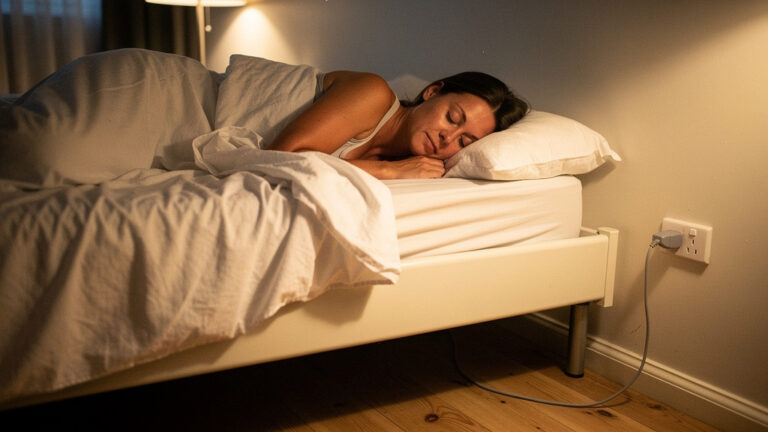
If you sleep with AirPods in — and many Australians do, particularly for sleep podcasts and white noise — you are adding 6–8 hours of continuous in-ear RF exposure during the period when your body is in its deepest recovery state. The Building Biology SBM-2015 standard recommends sleeping-area RF exposure below 0.1 mW/m² for exactly this reason: sleep is when the body performs cellular repair, and the precautionary approach says minimise all unnecessary exposures during this window.
You do not need to agree with Building Biology guidelines to see the logic here. Even from a pure physics standpoint, wearing Bluetooth transmitters in your ear canals for 8 hours of sleep adds more cumulative exposure than 2 hours of daytime music streaming. If you are going to reduce exposure anywhere, the bedroom is the highest-value target.
This article contains affiliate links. We may earn a commission at no extra cost to you.
The better alternatives for sleep audio: a phone playing through a speaker placed 1–2 metres from the bed (RF drops with distance squared), or a simple mechanical timer on the speaker so it switches off after you fall asleep. For the full bedroom EMF reduction protocol — including router timers, demand switches, and smart meter positioning — see the Complete Guide to EMF in the Australian Home.
How to Measure Your Own Exposure
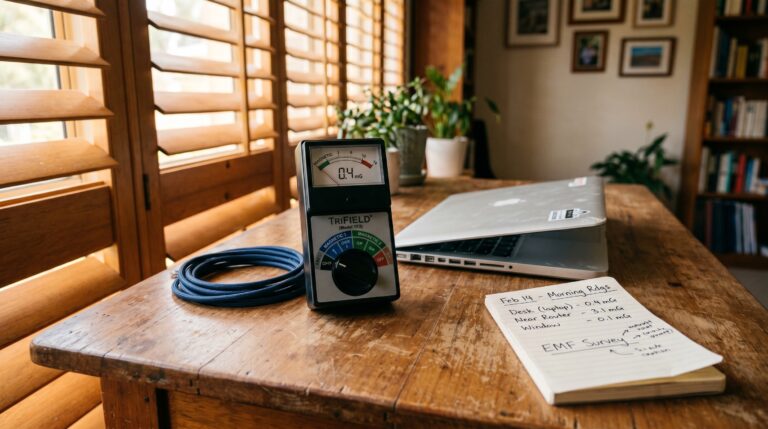
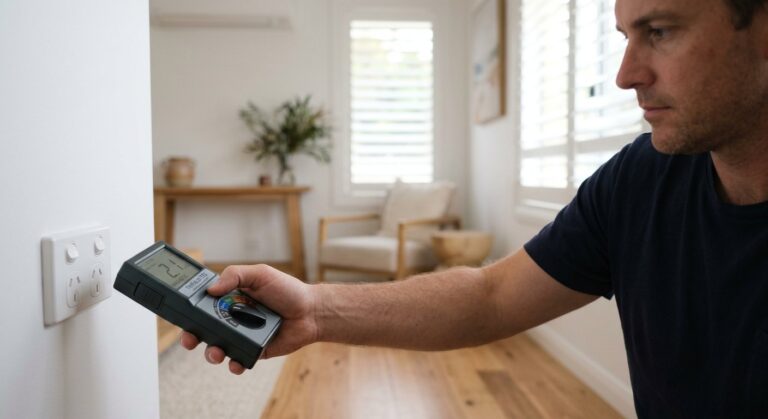
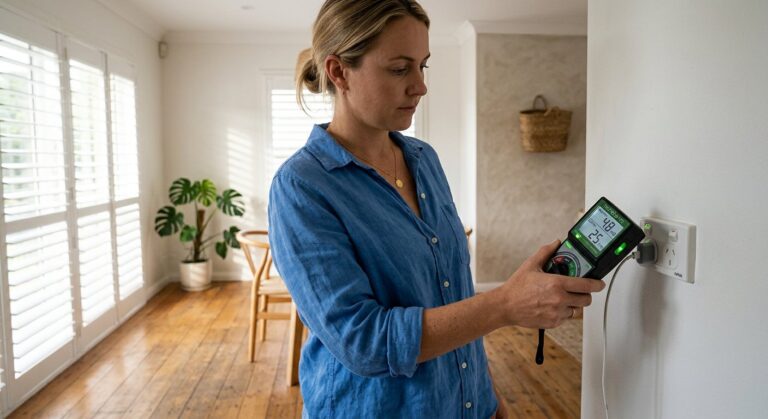
Everything above is based on manufacturer SAR data and regulatory limits. If you want to verify the RF output of your own earbuds — or any wireless device in your home — you need an RF meter. A consumer-grade RF meter will not give you SAR readings (those require laboratory equipment and tissue phantoms), but it will show you the RF power density at a given distance from the device, which is the practical measure of your exposure environment.
The TriField TF2 measures RF alongside AC magnetic and AC electric fields in a single device. For RF-only measurement with higher sensitivity, the Safe and Sound Pro II provides audio readout of RF power density and detects signals down to 0.02 µW/m². Both are available in Australia.
A practical measurement to try: turn on your AirPods, play audio, and hold the meter at ear distance (2–3 cm from the earbud). Compare the reading to the meter held at the same distance from your phone during a 4G call. The difference — typically two orders of magnitude — puts the earbud exposure in perspective faster than any article can.
Last reviewed: August 2026 – Clean and Native
Start with measurement. The TriField TF2 is the only meter you need.
Measures AC magnetic, AC electric, and RF in one device. Without real readings, every EMF decision is a guess.
Frequently Asked Questions
Do AirPods emit more EMF than a mobile phone?
No. AirPods transmit at approximately 1–10 mW via Bluetooth, while a phone’s 4G LTE cellular radio transmits at 50–200 mW. AirPods emit roughly 100–1,000x less RF power than a phone during a voice call, according to Bluetooth SIG Class 1 specifications and carrier-published device power data.
Are AirPods safe according to Australian standards?
Yes. All Bluetooth devices sold in Australia must comply with ACMA technical standards referencing ARPANSA’s SAR limit of 2.0 W/kg over 10 g of tissue. AirPods 4th Gen measure approximately 0.11 W/kg in-ear (WaveBlock data), which is roughly 18x below this limit. ARPANSA states typical wireless device exposures are “usually well below Australian Standard limits.”
What is the SAR value of AirPods?
AirPods 4th Generation have been independently measured at 0.11 W/kg for the right earbud alone and 1.19 W/kg for the case-adjacent measurement (WaveBlock data). The in-ear value is the relevant figure for daily use, and it is well below ARPANSA’s 2.0 W/kg limit.
Can Bluetooth earbuds cause brain cancer?
No peer-reviewed study has demonstrated a causal link between Bluetooth-level RF exposure and brain cancer. The IARC classified all RF-EMF as Group 2B (“possibly carcinogenic”) in 2011 based on limited evidence from higher-power mobile phone studies — not Bluetooth devices. The WHO states that exposures below ICNIRP limits have not been shown to produce health effects.
Do air-tube headphones actually reduce EMF exposure?
Yes. Air-tube headphones replace the last 10–15 cm of cable with a hollow tube, so no wire or speaker driver reaches the ear. This eliminates all RF energy and electromagnetic fields at the ear. The tradeoff is reduced audio quality compared to Bluetooth earbuds or conventional wired headphones.
Is it safe to sleep with AirPods in?
AirPods comply with ACMA standards during sleep use. However, sleeping with them adds 6–8 hours of continuous in-ear Bluetooth exposure during the body’s recovery period. Building Biology SBM-2015 guidelines recommend minimising RF exposure in sleeping areas. A phone speaker at 1–2 metres distance is a zero-RF alternative for sleep audio.
How can I measure Bluetooth EMF from my earbuds at home?
Use an RF meter such as the TriField TF2 or Safe and Sound Pro II. Hold the meter at ear distance (2–3 cm) from the active earbud while streaming audio. Compare the reading to the same distance from your phone during a 4G call. Consumer meters measure power density, not SAR — but the relative comparison is informative.
Does turning off AirPods features like “Hey Siri” reduce EMF?
Yes, marginally. Always-on features like “Hey Siri”, Find My network participation, and automatic ear detection keep sensors and Bluetooth radios active even when no audio is streaming. Disabling these in iOS Settings reduces background RF activity, though the reduction is small compared to simply removing the earbuds when not in use.
Are wired headphones safer than Bluetooth earbuds for EMF?
Standard wired headphones eliminate the Bluetooth transmitter but the cable can act as an antenna, conducting small amounts of RF from the phone to the ear. Air-tube headphones eliminate this pathway entirely by replacing the final cable segment with a hollow tube. For a full comparison, see Wired vs Bluetooth Headphones EMF Australia.
What does ARPANSA say about Bluetooth health risks?
ARPANSA’s published position states that typical RF exposures from wireless devices, including Bluetooth, are “usually well below Australian Standard limits” in normal use. ARPANSA’s standard is based on ICNIRP 2020 guidelines, which protect against all established (thermal) health effects of RF exposure. They do not identify Bluetooth as a specific health concern.
Get the Australian Home Environment Checklist
30 checks across water, air and EMF. Most of them free. Ranked by impact.
No spam. Unsubscribe any time.

Former Royal Australian Navy Clearance Diver and TAG-E counter-terrorism operator. Founded Clean and Native to apply the same rigorous thinking to the home environment.
Full biography →