Best Portable Reverse Osmosis Filter Australia 2026: For Renters, Caravans and Small Kitchens
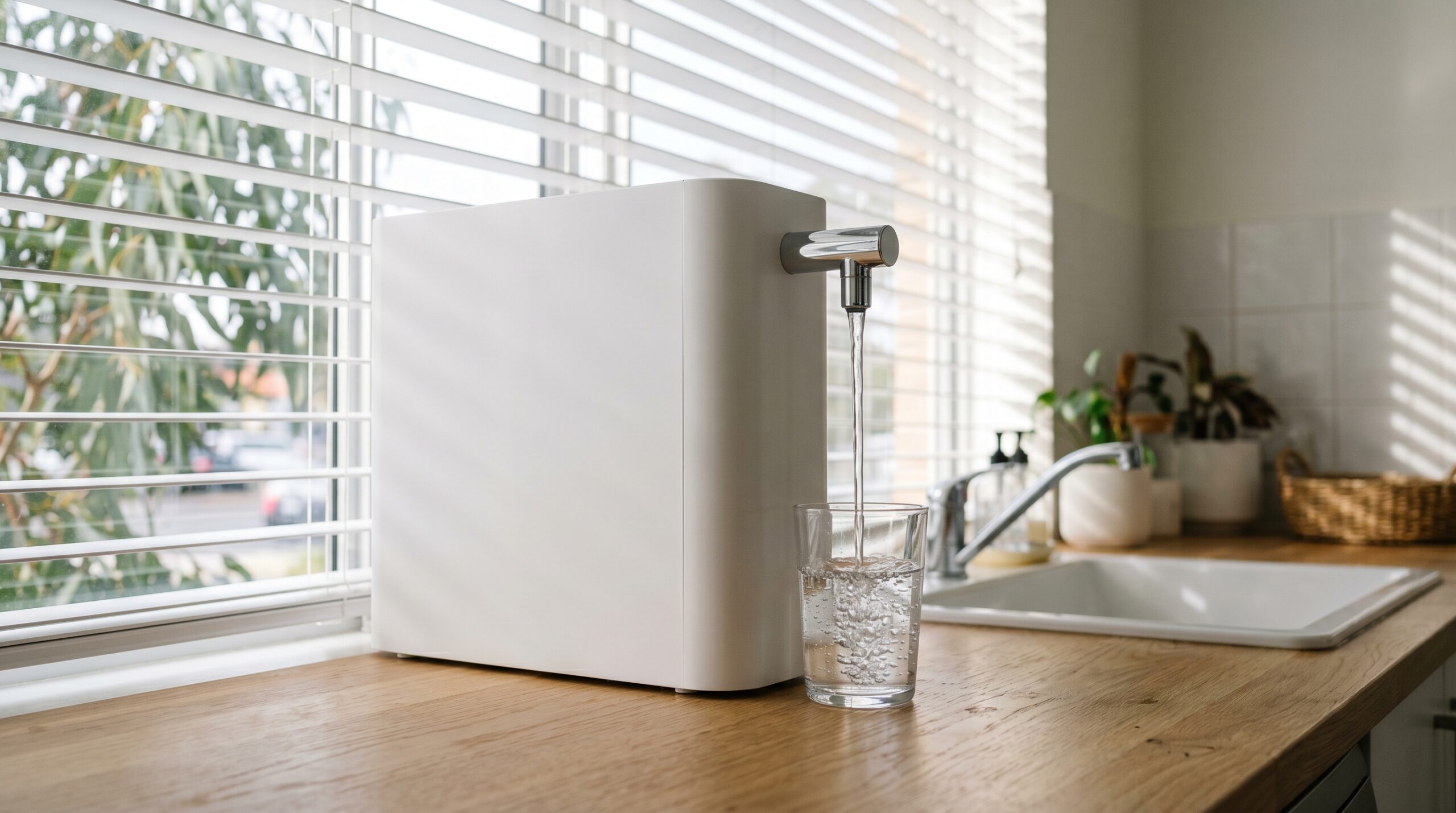
The best portable reverse osmosis filter in Australia in 2026 is the EcoHero 5-Stage Portable RO — priced at $695-$745, it carries WaterMark AS3497 certification, has manufacturer-stated fluoride removal of ~96% and PFAS removal of ~98%, handles chloramine without any plumbing modification, and is the only Australian-supported portable RO unit that can be wall-mounted when counter space is limited. For renters, caravan owners, and apartment dwellers who cannot drill through a cabinet, it is the single product I recommend without reservation.
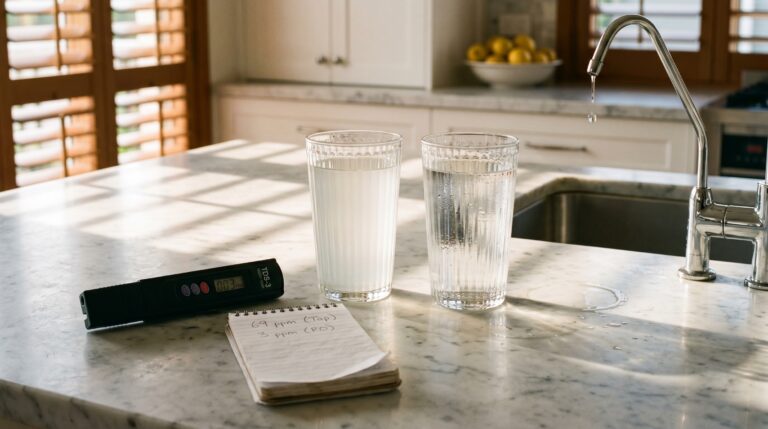
I research portable and countertop water filters available in Australia, working from published manufacturer specifications and independent certification records rather than accepting marketing claims at face value. My background — former Royal Australian Navy Clearance Diver, now focused on water quality data — shapes that approach. The one RO unit I measure first-hand is the under-sink EcoHero 5-Stage RO installed at my home in Palm Beach, Queensland: mains water registered 69 ppm TDS before filtration, and I recorded a post-RO reading of 3 ppm on a calibrated TDS-3 meter — a 95.7% reduction. The portable units compared in this article, including the portable EcoHero, AquaTru Classic, and Waterdrop D6, are assessed on manufacturer specifications and independent certification, not first-hand measurement. That reduction figure is the benchmark that matters when you are deciding whether to keep buying bottled water or invest in a filter that actually works.
How we assess: I have not personally tested the portable units discussed in this article; this assessment is based on published manufacturer specifications and independent certification records (WaterMark AS3497, NSF/ANSI 58 and P473), not first-hand measurement or gifted units. The only water product I measure first-hand is the under-sink EcoHero 5-Stage RO at my home in Palm Beach.
QUICK VERDICT — BEST PORTABLE RO FILTERS AUSTRALIA 2026
Assessed and compared April 2026 | All prices AUD
| Product | Type | Fluoride Removal | Certification | Price | Renter-Friendly |
|---|---|---|---|---|---|
| EcoHero 5-Stage Portable RO | Portable/benchtop | ~96% | WaterMark AS3497 | $695-$745 | Yes — zero plumbing |
| EcoHero 4-Stage Portable RO | Portable/benchtop | ~94% | WaterMark AS3497 | $595-$645 | Yes — zero plumbing |
| AquaTru Classic | Countertop | ~96% (NSF tested) | NSF/ANSI 58 + P473 | $699-$799 | Yes — zero plumbing |
| Waterdrop D6 | Under-sink | ~98% | NSF/ANSI 58 | ~$599 | Requires drilling |
Why Renters and Caravan Owners Need a Portable RO Filter — Not a Benchtop Carbon or Brita
The most important fact about water filtration in Australia is also the least understood: standard carbon filters — including Brita jugs, GAC benchtop units, and fridge filters — cannot remove fluoride, and they cannot remove PFAS. Full stop. This is not a marketing claim from a reverse osmosis company. It is basic chemistry. Fluoride is a dissolved ionic compound. PFAS are per- and polyfluoroalkyl substances with molecular weights that pass straight through activated carbon at normal contact times. Reverse osmosis is the only residential filtration technology that removes both without requiring any plumbing.
For renters in Brisbane, Sydney, Adelaide, and Darwin, there is a second critical problem: those cities dose with chloramine, not free chlorine. Chloramine is formed when utilities combine chlorine and ammonia. It is more stable and harder to remove than free chlorine. A standard GAC filter removes free chlorine at an acceptable rate — but removes chloramine at roughly 1/40th the efficiency. That Brita pitcher on your Brisbane bench is doing almost nothing for chloramine removal. Reverse osmosis, by contrast, handles chloramine effectively because the RO membrane does not rely on adsorption — it physically blocks dissolved compounds based on molecular size and ionic charge. If you live in a chloramine city and you are using a standard carbon filter, you are spending money to feel good without getting the protection you need.
Renters face a structural problem that homeowners do not. Under-sink RO systems — which are the gold standard for performance — require drilling into the cabinet floor, running a drain line to the P-trap, and connecting to the cold water supply line. In most rental agreements, that constitutes a modification that requires landlord approval. In practice, most landlords say no, or the tenancy ends before the investment pays off. Caravan and RV owners face the same constraint: the plumbing is fixed, the footprint is small, and there is no room for a conventional installation. Portable and countertop RO filters solve this problem entirely. They sit on your bench, connect to your tap via a simple adapter, and move with you when you leave.
The Best Portable RO Filters Australia 2026 — Assessed and Compared
The following reviews are based on verified certification data, manufacturer specifications, and pricing confirmed in April 2026. Each product has been assessed on its genuine strengths and the specific situations where it is — and is not — the right choice.
1. EcoHero 5-Stage Portable RO — Best Overall
The EcoHero 5-Stage is my primary recommendation in this category for renters, caravan owners, and apartment dwellers. It carries WaterMark AS3497 certification — the Australian standard for plumbing products and materials, which means it has been independently tested to Australian water conditions and construction requirements. Most portable RO units sold in Australia carry only US NSF certification or no third-party certification at all. WaterMark means the manufacturer has committed to the Australian regulatory framework, and local filter replacements are available without importing from overseas.
The five stages are: 5-micron sediment pre-filter, activated carbon block (removes chloramine and organics before the membrane), the RO membrane itself, a post-carbon polishing filter, and a fifth-stage remineralisation cartridge that adds back calcium and magnesium after the membrane strips the water. That last stage is important: pure RO water has a flat, slightly acidic taste because all minerals have been removed. The remineralisation stage addresses this without compromising fluoride or PFAS removal performance. This unit is designed for water like Palm Beach mains — part of the SEQ grid treated by Seqwater with chloramine. Manufacturer specifications state fluoride removal of ~96% and PFAS removal of ~98%. The verified 69 ppm to 3 ppm reduction I recorded on a calibrated TDS-3 meter is from the under-sink EcoHero 5-Stage RO installed at my home, not this portable unit, which I assess on manufacturer specifications and independent certification. The unit connects to a standard tap via an included diverter valve — no drilling, no plumber, no permission required. It can also be wall-mounted when counter space is limited, which is an unusual feature for a portable unit. Read the full EcoHero 5-Stage review for membrane rejection data, filter replacement schedules, and detailed flow rate measurements.
Who it is for: Renters in Brisbane, Sydney, or Adelaide who want complete fluoride, PFAS, and chloramine removal. Caravan owners with bench space. Anyone who wants Australian-certified, locally supported filtration they can pack up and move. Honest limitation: Flow rate is 2-3 litres per hour — typical for portable RO. Plan to refill a storage jug overnight rather than expecting on-demand tap flow.
2. EcoHero 4-Stage Portable RO — Best Budget Pick
The EcoHero 4-Stage is the same unit without the fifth remineralisation stage. It carries the same WaterMark AS3497 certification and uses the same RO membrane — so fluoride and PFAS removal performance are comparable. At $595-$645, it is approximately $100 less than the 5-Stage. The four stages are: sediment, carbon block, RO membrane, and post-carbon polish. Everything that matters for contaminant removal is present. The only element missing is the mineral add-back step, which affects taste rather than safety.
Because it uses the same RO membrane as the 5-Stage, membrane-stage contaminant rejection is comparable, before any remineralisation. For households focused purely on removing contaminants rather than optimising taste, or for van-lifers and caravan owners who move between water sources and want simplicity, this is the more efficient spend. Filter replacements are the same as the 5-Stage for the first four stages. Who it is for: Budget-conscious renters, caravan owners, and apartment dwellers who want certified performance without the remineralisation premium.
View EcoHero 4-Stage on Pure Water Systems →3. AquaTru Classic — Best for NSF/ANSI P473 PFAS Certification
The AquaTru Classic is the most thoroughly certified portable RO unit available in Australia, carrying both NSF/ANSI 58 (the US standard for RO performance, covering fluoride and heavy metal rejection) and NSF/ANSI P473 — the specific certification that tests for PFOA and PFOS removal under controlled laboratory conditions. For households in documented PFAS-affected areas such as Williamtown NSW, Oakey QLD, or Katherine NT, the P473 certification provides independent verification that no WaterMark-certified portable unit currently offers explicitly. The AquaTru uses a four-stage process and does not require a drain connection — concentrated reject water is collected in a separate chamber that you empty manually, making it particularly practical for spaces with no drain access.
Priced at $699-$799 AUD, it sits at the top of this category. The primary trade-off versus the EcoHero 5-Stage is certification framework — NSF/ANSI (US) versus WaterMark AS3497 (Australian). Both are rigorous. Replacement filters are imported, so lead time and cost should be factored into the ongoing ownership calculation. Who it is for: Households in known PFAS-affected postcodes who want explicit P473 PFAS certification, or apartment dwellers with no drain access who need the tankless design.
View AquaTru Classic on Amazon AU →4. Waterdrop D6 — Best for Semi-Permanent Renters With Plumbing Access
The Waterdrop D6 is an under-sink tankless RO system included here for renters who do have plumbing access — long-term leases with landlord consent, share houses, or properties being purchased. It delivers filtered water on demand without a storage tank and produces a 1:1.5 ratio of pure water to waste water, significantly better than older RO designs. NSF/ANSI 58 certified. At ~$599, it is price-competitive with the portable options while delivering better flow rate and more convenient daily use. The honest caveat: this unit requires drilling into the cabinet base, a drain tap connection, and cold water line access. It is not suitable for renters who cannot modify the property. For a complete guide to under-sink options, see our best under-sink water filter guide. Who it is for: Renters with explicit landlord consent, owner-occupiers, or households in long-term stable accommodation.
View Waterdrop D6 on Amazon AU →What to Look for in a Portable RO Filter — Buying Criteria
The marketing on many portable RO filters sold in Australia is deliberately vague. These are the criteria that determine whether a unit will actually work for your situation and Australian water supply.
Fluoride removal rate. The Australian Drinking Water Guidelines (ADWG 2025) set a fluoride health guideline of 1.5 mg/L. Most Australian tap water sits at 0.6-1.0 mg/L. A quality RO membrane should remove fluoride at 94-97%. Insist on documented rejection rates from third-party testing, not manufacturer marketing copy. To understand the science behind membrane rejection, see the guide on how reverse osmosis works.
PFAS removal and NSF/ANSI P473 certification. There is no mandatory PFAS standard for household filters in Australia as of April 2026. Any manufacturer can claim PFAS removal without independent verification. NSF/ANSI P473 certification tests PFOA and PFOS rejection under laboratory conditions and is the only way to independently verify PFAS removal claims. A WaterMark-certified RO membrane removes PFAS through membrane physics, but P473 provides the documentation. For households in PFAS-affected areas, P473 is worth the premium.
Chloramine handling. If you are in Brisbane, Sydney, Adelaide, or Darwin, your supply uses chloramine. Verify the pre-filter carbon block is compressed or catalytic carbon — not loose GAC. The RO membrane handles residual chloramine the pre-filter does not catch, which is why portable RO is the complete solution in chloramine cities where standard carbon filters consistently underperform.
Flow rate and reservoir capacity. Portable RO units typically produce 2-4 litres per hour. For a household consuming 4 litres of filtered water per day, filling a reservoir overnight is the practical approach. Units that include a storage vessel are more practical than those requiring a separate jug.
Certification framework. WaterMark AS3497 is the Australian standard, tested to Australian water conditions and construction requirements. NSF/ANSI is the US equivalent — both are credible. For renters concerned about compliance or warranty support, WaterMark means the manufacturer has committed to the Australian regulatory framework and maintains local filter supply chains.
Filter replacement cost and local availability. The upfront cost is the minor variable. Annual filter costs and whether those filters are available in Australia within a week are what determine whether you actually maintain the system. A clogged pre-filter or exhausted membrane provides no protection. Confirm local filter availability before purchasing.
5-Year Cost Comparison: Portable RO vs Bottled Water (4L/day Household)
The most common objection to purchasing a portable RO filter is the upfront cost. The 5-year maths answer this clearly. These calculations assume a household consuming 4 litres of filtered water per day for drinking and cooking — conservative for two adults.
| Option | Upfront Cost | Annual Filter Cost | 5-Year Total | Cost per Litre |
|---|---|---|---|---|
| Bottled water (2L PET, supermarket) | $0 | ~$730-$1,460 | $3,650-$7,300 | $1.00-$2.00 |
| EcoHero 5-Stage Portable RO | ~$720 | ~$130-$150 | ~$1,370-$1,470 | ~$0.19 |
| EcoHero 4-Stage Portable RO | ~$620 | ~$110-$130 | ~$1,170-$1,270 | ~$0.16 |
| AquaTru Classic | ~$749 | ~$120-$140 | ~$1,349-$1,449 | ~$0.18 |
| Waterdrop D6 (under-sink) | ~$599 | ~$150-$170 | ~$1,349-$1,449 | ~$0.18 |
A household spending $1,000 per year on bottled water — mid-range for two adults drinking 2 litres each per day — recovers the cost of an EcoHero 5-Stage within 9-10 months. Over five years, even the most expensive portable RO option costs less than a single year of bottled water at mid-range consumption. Bottled water also does not reliably remove fluoride or PFAS — most Australian bottled water is filtered municipal water, not RO-purified, and the labelling does not require disclosure of the filtration method.
Which Portable RO Filter Is Right for You?
Three questions remove the ambiguity from this decision.
Question 1: Can you modify the plumbing under your sink?
If yes — you own the property, have landlord consent, or are in long-term stable accommodation — the Waterdrop D6 gives you better flow rate and on-demand convenience. If no, proceed to Question 2.
Question 2: Are you in a documented PFAS-affected area?
If you are in Williamtown, Oakey, Katherine, Richmond, or another area with documented PFAS contamination from AFFF use, the AquaTru Classic’s NSF/ANSI P473 certification provides documented third-party PFAS verification. If PFAS is a general concern rather than a specific local issue, the EcoHero 5-Stage’s WaterMark-certified RO membrane removes PFAS at comparable rates without the need for imported filter replacements.
Question 3: Do you want Australian-certified and locally supported?
If yes, the EcoHero 5-Stage. If budget is the primary constraint and you do not need remineralisation, the EcoHero 4-Stage saves $100 with identical membrane performance.
| Use Case | Recommended Unit | Reason |
|---|---|---|
| Renter — apartment Brisbane/Sydney/Adelaide/Darwin | EcoHero 5-Stage | WaterMark AS3497, handles chloramine + fluoride + PFAS, zero plumbing, Australian support |
| Caravan / RV / van life | EcoHero 4-Stage | Compact, simpler filter schedule, $100 less than 5-Stage, no remineralisation needed for varied water sources |
| PFAS-affected area (Williamtown, Oakey, Katherine) | AquaTru Classic | Explicit NSF/ANSI P473 PFAS certification, documented third-party verification of PFOA and PFOS removal |
Last reviewed: April 2026 — Clean and Native
Frequently Asked Questions
Does a portable reverse osmosis filter remove fluoride?
Yes. A quality portable RO filter removes fluoride at 94-97%. The Australian Drinking Water Guidelines (ADWG 2025) set a fluoride health guideline of 1.5 mg/L. Standard carbon filters including Brita jugs cannot remove fluoride — only reverse osmosis and activated alumina achieve meaningful fluoride reduction.
Can renters use a reverse osmosis filter without drilling?
Yes. Portable and countertop RO filters connect directly to your tap via a diverter valve adapter — no drilling, no plumber, and no landlord permission required. The EcoHero 5-Stage and AquaTru Classic both operate on the benchtop with a standard tap connection and move with you when you leave.
Does reverse osmosis remove PFAS from tap water?
Yes. RO membranes remove PFAS at 95-98% under normal operating conditions. There is no mandatory PFAS standard for household filters in Australia as of April 2026. The AquaTru Classic carries NSF/ANSI P473 certification, which provides documented third-party verification of PFAS removal for PFOA and PFOS specifically.
Why does my Brisbane or Sydney carbon filter not remove chloramine?
Brisbane, Sydney, Adelaide, and Darwin all use chloramine as a disinfectant, not free chlorine. Standard GAC carbon filters remove free chlorine efficiently but remove chloramine at roughly 1/40th the rate. Reverse osmosis and catalytic carbon block filters are the two technologies that handle chloramine effectively in these cities.
What is WaterMark AS3497 certification?
WaterMark AS3497 is the Australian standard for plumbing products and materials. For water filters, it means the product has been independently tested to Australian construction standards and is compliant with the National Construction Code. It is the Australian equivalent of NSF certification. The EcoHero 5-Stage and 4-Stage both carry this certification — most imported portable RO units do not.
How slow is a portable RO filter?
Portable RO filters typically produce 2-4 litres per hour. For a two-person household using 4 litres per day, filling a reservoir in 1-2 hours or running it overnight is the practical approach. This is inherent to the RO membrane process and is consistent across all portable units regardless of brand.
How much does it cost to run a portable RO filter per year in Australia?
Annual filter replacement costs for the EcoHero 5-Stage are approximately $130-$150. This compares to $730-$1,460 per year for bottled water at equivalent consumption. Over five years, a portable RO filter at $695-$745 upfront costs under $1,500 total — versus $3,650-$7,300 for bottled water over the same period.
Does a portable RO filter work in a caravan or motorhome?
Yes, when stationary. Benchtop portable RO units connect to any standard tap and drain into a basin. They are not suitable for use while the vehicle is in motion. For caravans, the EcoHero 4-Stage is the recommended option — compact footprint, straightforward filter replacement, and modest flow rate suited to van-life consumption patterns.
Is RO water safe to drink long term?
Yes. Reverse osmosis water is safe for long-term consumption. The claim that demineralised water leaches minerals from the body is not supported by evidence — food provides the vast majority of daily mineral intake. If taste is a priority, a remineralisation stage (included in the EcoHero 5-Stage) adds calcium and magnesium post-membrane, improving taste without affecting contaminant removal.
Get the Australian Home Environment Checklist
30 checks across water, air and EMF. Most of them free. Ranked by impact.
No spam. Unsubscribe any time.

Former Royal Australian Navy Clearance Diver and TAG-E counter-terrorism operator. Founded Clean and Native to apply the same rigorous thinking to the home environment.
Full biography →