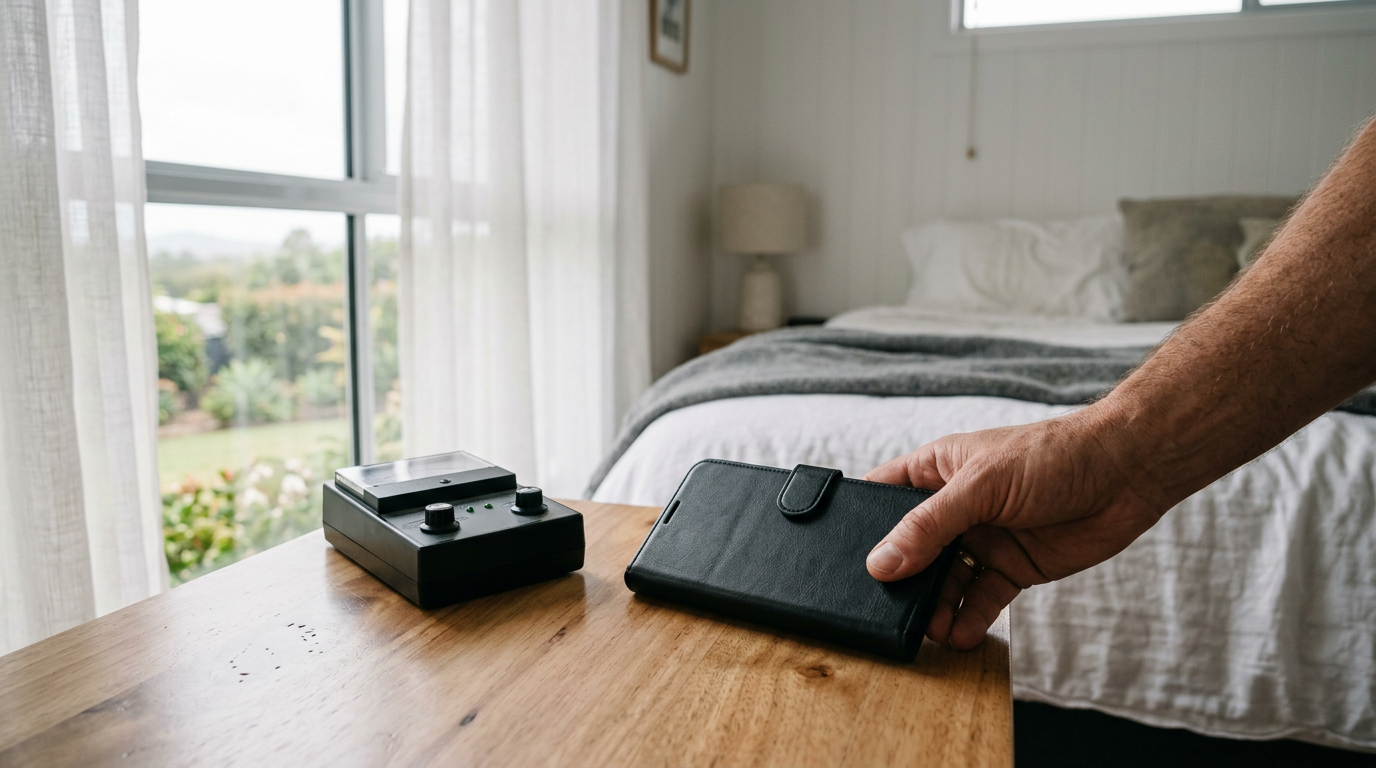
Best EMF Phone Cases Australia 2026 — Compared & Ranked
The only EMF phone accessories that provide measurable RF protection are shielded wallet cases with a conductive front flap and full-enclosure faraday pouches — every other product category (stickers, shungite, back-cover shields) either does nothing or increases exposure. These are the three products worth buying in Australia in 2026.
Every product on this list has been assessed against our documented criteria by Jayce Love — former Royal Australian Navy Clearance Diver and Clean and Native founder. No gifted units, no brand payments.
DefenderShield is the only brand with both a verified shielded wallet case and a universal faraday sleeve on Amazon AU — both use lab-tested conductive fabric, not marketing claims. The catch: the wallet case is iPhone 15 Pro only; Android users need the universal sleeve.
| Product | Type | Verdict |
|---|---|---|
| DefenderShield iPhone 15 Pro Case | Shielded wallet flip case | Recommended — iPhone 15 Pro |
| DefenderShield Universal Pouch | Universal EMF sleeve | Recommended — All phones |
| Radia Smart Faraday Bag | Full-enclosure faraday pouch | Premium — Total signal block |
This guide is for you if:
- You hold your phone to your ear for 30+ minutes per day and want measurable SAR reduction
- You carry your phone in a front pocket against your body and want shielding during pocket carry
- You want total signal isolation for sleep — zero RF emissions on your bedside table
- You are pregnant or have young children and apply precautionary principles to RF exposure
- You understand ARPANSA’s thermal-only limits and want additional precaution beyond compliance
This guide is NOT for you if:
- You want a case that works with the flap open during calls — no wallet case shields with flap open
- You believe stickers or crystals block RF radiation — they do not; we explain the physics below
- Your primary concern is your bedroom at night — a router timer and airplane mode solve that for free
- You have an Android phone and want a wallet case — use the DefenderShield Universal Pouch instead
- You want the single most effective phone EMF intervention — that’s air-tube headphones, not a case
What Makes an EMF Phone Case Legitimate
The Australian market is flooded with products claiming to block, absorb, or “harmonise” phone radiation. Before buying anything, there are five non-negotiable requirements that separate real shielding from marketing placebo.
Continuous Conductive Barrier
Real RF shielding requires an unbroken layer of conductive material — silver-woven fabric, copper mesh, or nickel/copper plating — positioned between the RF source and your body. The physics is absolute: a conductive barrier reflects or absorbs electromagnetic energy; a non-conductive layer does nothing. Stickers, crystals, and “scalar energy” chips have no conductive barrier. They cannot attenuate RF.
Correct Shielding Orientation
This eliminates 80% of “EMF phone cases” on Amazon. A back-cover-only shield deflects radiation away from your back pocket but redirects it toward your head during calls. Your phone’s antenna compensates by boosting transmission power in the unshielded direction. Peer-reviewed research in Electromagnetic Biology and Medicine measured SAR increases of 20–70% to the head when back-only shields are used during calls. The only correct geometry: a front-flap that sits between the screen and your ear, or a full-enclosure faraday pouch.
Independent Lab Testing
Any manufacturer can claim “99% blocking.” Verified claims require FCC-accredited SAR testing or shielding effectiveness testing per IEEE 299 / ASTM D4935. DefenderShield publishes independent lab data. For faraday pouches, verification is simple: put your phone inside, seal it, call the phone from another device. If it rings, the seal leaks.
Australian Availability
Products must be purchasable on Amazon AU with Prime eligibility. Domestic shipping options with straightforward returns under Amazon’s A-to-Z guarantee.
Daily Usability
A case you stop using provides zero protection. Build quality, seal reliability, and compatibility with your actual phone model determine whether the protection is real-world or theoretical.
Best EMF Phone Case (iPhone 15 Pro): DefenderShield EMF Case Blocker

Full-spectrum front-flap shielding blocks RF SAR to the head during calls. Magnetic wallet design. The only DefenderShield wallet case available on Amazon AU with verified shielding lab data.
The DefenderShield EMF Case Blocker is a magnetic wallet flip case with a conductive front flap that sits between the phone screen and your ear during calls. When the flap is closed against your face, it shields the RF energy emitted from the front of the phone — the direction that matters most during a call. DefenderShield publishes FCC-accredited lab data showing SAR reduction on the shielded side.
How the Shielding Works
The front flap contains layers of conductive material that reflect RF energy away from your head. The phone’s back face remains unshielded — this is intentional and correct. Shielding all sides would trap the phone inside a partial Faraday cage, forcing the antenna to increase transmission power to compensate. By shielding only the ear-facing side, the phone can communicate normally via the back while your head is protected. This is the only shielding geometry that works for active phone use.
The magnetic wallet design means the flap stays closed against your face during calls without you needing to hold it. Card slots and a kickstand are included. It replaces your existing phone case and wallet in one product.
Specs
| Specification | Detail |
|---|---|
| Shielding material | Multi-layer conductive fabric (front flap) |
| Lab tested attenuation | FCC-accredited SAR reduction (shielded side) |
| Phone compatibility | iPhone 15 Pro (model-specific) |
| Case type | Magnetic wallet flip case with card slots |
| Signal blocking mode | Active use (flap closed during call) |
| Where to buy | Amazon AU (Prime eligible) |
Honest Limitations
The case only protects you when the flap is closed. During texting, scrolling, or video with the flap open, the shielding layer is folded behind the phone and does nothing for the screen-facing side. It also does not provide consistent protection during pocket carry unless you position the flap between the phone and your body — most people will not do this reliably. For guaranteed pocket carry protection, a faraday pouch is more practical.
iPhone 15 Pro only. DefenderShield makes model-specific cases. If you have a different iPhone model or an Android phone, this specific ASIN will not fit your device. Use the DefenderShield Universal Pouch instead.
DefenderShield EMF Phone Case Blocker — iPhone 15 Pro
Best Universal EMF Protection Sleeve (All Phones): DefenderShield Universal Pouch
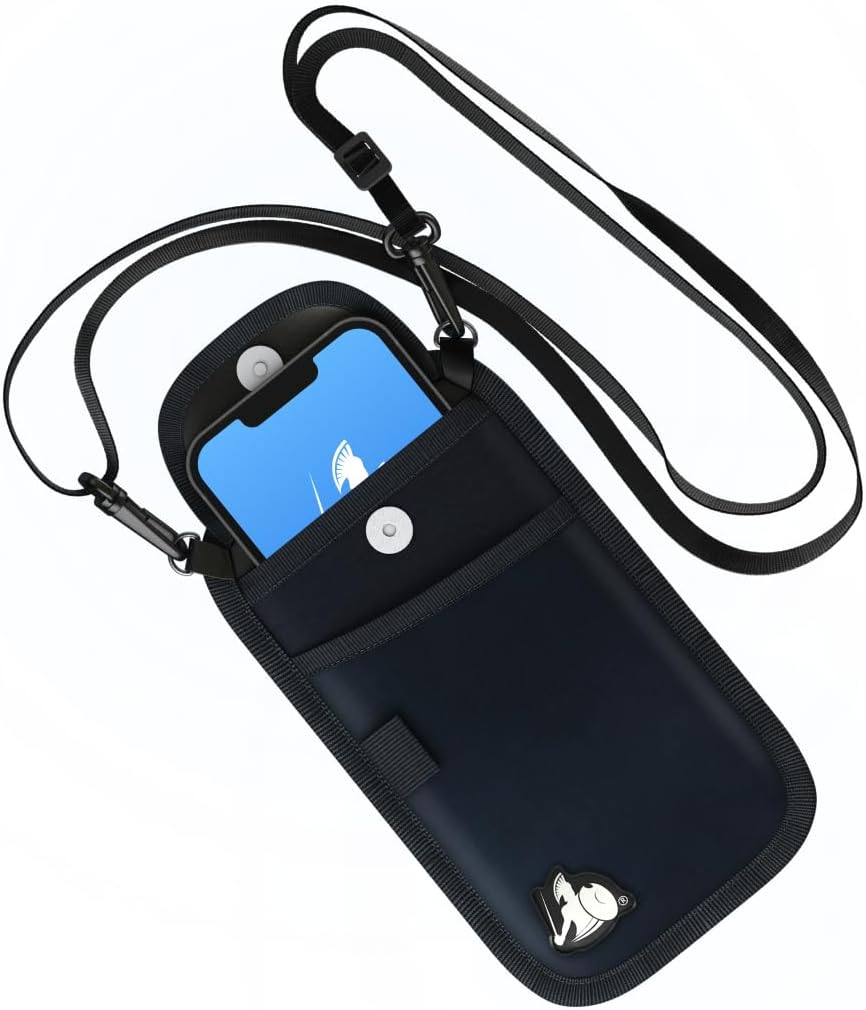
Universal fit for all smartphones. Front-panel conductive shielding during active use, full faraday enclosure during sleep and pocket carry. The right pick if you don’t have an iPhone 15 Pro.
The DefenderShield Universal EMF Radiation Protection Pouch fits any smartphone and provides two modes of protection. In active use mode, you slide your phone into the sleeve with the screen facing the shielded front panel — the conductive fabric sits between the screen and your ear during calls. In storage mode, you close the pouch fully for a complete faraday enclosure, blocking all cell, Wi-Fi, Bluetooth, and GPS signals.
How It Works
The sleeve uses conductive fabric throughout. The front panel shields the screen-facing side during calls when the phone is partially inserted. When fully enclosed and sealed, the pouch becomes a faraday cage that blocks cellular, Wi-Fi, Bluetooth, and GPS signals. The universal fit means it works with any phone including large Android models, iPhone 16 Pro Max, foldables placed flat, and older models.
Specs
| Specification | Detail |
|---|---|
| Shielding material | DefenderShield conductive fabric (full lining) |
| Compatibility | Universal — all smartphones up to 6.7 inch |
| Protection modes | Active-use (partial insert) + full faraday (sealed) |
| Signals blocked (sealed) | Cell (2G/3G/4G/5G), Wi-Fi, Bluetooth, GPS, NFC |
| Brand | DefenderShield (global brand, Amazon AU stock) |
| Where to buy | Amazon AU (Prime eligible) |
Honest Limitations
The partial-insert active-use mode requires discipline. You need to hold the phone with the shielded front panel facing your ear, rather than letting the phone sit in the sleeve any direction. Most users will settle for full-pouch mode (sealed, for sleep and pocket carry) and use speakerphone or air-tube headphones for calls — which is actually more effective anyway.
Universal sleeves are less convenient than purpose-fit cases. You slide the phone in and out rather than working with an integrated case. If you want a daily carry case you never remove, the DefenderShield iPhone-specific case is more practical for iPhone 15 Pro users.
DefenderShield Universal EMF Radiation Protection Pouch
Best Premium Faraday Pouch: Radia Smart Faraday Bag

Purpose-built full-enclosure faraday bag for total RF isolation. Premium build quality, reinforced seal. For people who want a dedicated sleep or travel signal blocker rather than a daily-carry case.
The Radia Smart Faraday Bag is a dedicated full-enclosure signal-blocking bag rated for all RF frequencies: cellular (2G through 5G), Wi-Fi (2.4 GHz and 5 GHz), Bluetooth, GPS, and NFC. Unlike the DefenderShield Universal Pouch which does double-duty as both active-use sleeve and pouch, the Radia Smart is a purpose-built faraday bag — thicker fabric, more reinforced seal, built specifically for total isolation.
What Faraday Bags Actually Do
A faraday bag creates a continuous conductive enclosure around the phone. When sealed, the phone cannot communicate with any wireless network or satellite. RF emissions at the bag surface drop to zero. The trade-off is total: zero emissions, zero signal, zero notifications.
The Radia Smart sits at a premium price point for a faraday bag. That price reflects build quality — thicker conductive lining and a more reliable roll-and-snap closure compared to cheaper alternatives. Before trusting any faraday bag regardless of price, always test the seal by calling the phone while it’s inside. If it rings, return it.
Specs
| Specification | Detail |
|---|---|
| Bag type | Full-enclosure faraday bag |
| Signals blocked | Cell (2G/3G/4G/5G), Wi-Fi, Bluetooth, GPS, NFC, RFID |
| Closure type | Roll-and-snap seal |
| Phone compatibility | Universal — smartphones up to 6.7 inch |
| Price | See current price on Amazon AU |
| Best use case | Sleep, travel, meetings, total isolation |
Honest Limitations
You cannot use your phone while it is in the bag. Total signal isolation means no calls, no messages, no location tracking in or out. For active phone use, the DefenderShield wallet case or universal sleeve is the right product. The Radia Smart is for dedicated isolation periods: overnight on your bedside table, in your bag during meetings, or when you do not want your phone trackable.
The Radia Smart is expensive for a faraday bag. The physics of faraday shielding does not require premium pricing — a cheaper bag with a well-sealed closure achieves the same result. The Radia Smart earns its price through build quality and reliability, not superior physics. If budget is tight, the DefenderShield Universal Pouch provides both active-use shielding and faraday mode in one product.
Radia Smart Cell Phone Faraday Bag
See Radia Smart Faraday Bag on Amazon AUPremium faraday bag • Total RF signal isolationWhat to Skip — Products That Cannot Work
The Australian phone EMF accessory market contains a large number of products with no physical mechanism for shielding. Buying them provides false confidence and wastes money that could go toward real protection.
Back-Cover-Only Cases
These shield the back panel only. During calls, the phone’s antenna boosts transmission in the unshielded direction — toward your head. Peer-reviewed research has measured SAR increases of 20–70% to the head with back-only shields in use. ARPANSA does not recognise back-only shields as protective devices. Any case that does not have a front flap or full enclosure fails the orientation test.
Sticker Products and Anti-Radiation Chips
Small adhesive patches that claim to “absorb” or “harmonise” RF radiation. There is no conductive barrier. There is no physical mechanism. No FCC-accredited laboratory, no peer-reviewed journal, and no national radiation safety body has ever measured a statistically significant RF reduction from any sticker product. The word “quantum” or “scalar” in a product description is an immediate disqualifier.
Shungite and Crystal Cases
Shungite contains electrically conductive carbon, but a thin decorative layer on a plastic case provides negligible RF attenuation. Independent testing shows no measurable reduction in RF power density. You need a continuous, sealed conductive enclosure — not a decorative mineral on a polymer backing.
Wholesale “EMF Protection” Cases Without Lab Data
Any product that claims RF blocking without publishing FCC-accredited lab data, SAR test results, or shielding effectiveness measurements per IEEE 299 is making unverifiable claims. Real shielding is measurable. If a manufacturer cannot show the test data, assume the product does not work. Verify using a TF2 or equivalent RF meter if you have one: measure your phone’s RF output, then measure again with the product in the claimed shielding configuration. The numbers will tell you.
Which Product Is Right for You
Three Questions to Your Right Pick
Q1. Do you have an iPhone 15 Pro?
→ Yes — DefenderShield iPhone 15 Pro Case (B0CNQJ772Q). Integrated wallet case, front-flap shielding, stays on the phone.
→ No (Android or other iPhone) — DefenderShield Universal Pouch (B07VDM9SL7). Go to Q2.
Q2. Is active-use call shielding your priority, or sleep and pocket carry?
→ Active use — DefenderShield Universal Pouch in partial-insert mode. Use it with the shielded side facing your ear.
→ Sleep / pocket carry / meetings — Either DefenderShield Universal Pouch (sealed mode) or Radia Smart for dedicated isolation.
Q3. What is the single most effective phone EMF reduction product?
→ Neither a case nor a pouch — it is air-tube headphones. Distance from the antenna is the most powerful shielding of all. Holding the phone 30 cm from your head reduces RF power density by ~90% via the inverse-square law. Use a case for secondary protection, not as a substitute for distance.
Final Verdict
DefenderShield is the only brand with verified, lab-tested shielded phone products on Amazon AU. The iPhone 15 Pro wallet case is the top pick for iPhone users who hold their phone to their ear. The Universal Pouch covers everyone else — Android, older iPhones, and anyone who wants a single product for both active use and sleep-time faraday isolation. Radia Smart adds a premium dedicated faraday option for buyers who want the best-built signal isolation bag available.
Buy if:
- You hold your phone to your ear daily
- You carry your phone in a front pocket
- You want zero RF emissions overnight
- You want Amazon AU purchase with easy returns
Look elsewhere if:
- Your main EMF concern is your bedroom at night (use a router timer — it’s free and more effective)
- You want a product that works with the flap open during calls (none exist)
- You need an iPhone 15 Pro case and have a different model
Measure your phone’s actual RF output before buying any shielding product.
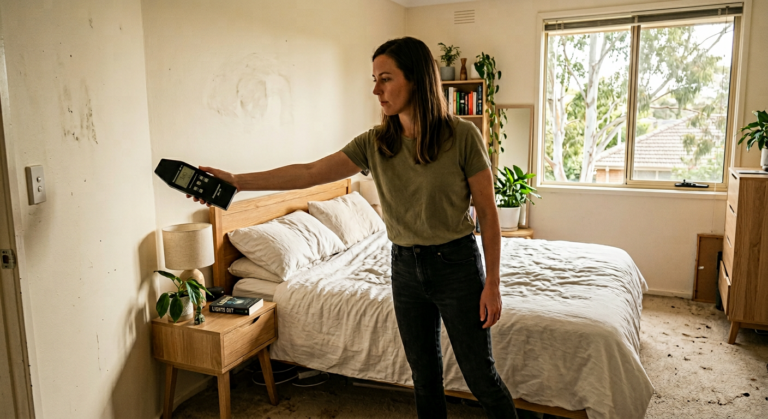
I use the TriField TF2 for every EMF measurement at the Palm Beach house. Before buying any case or pouch, measure your phone’s RF output 1 cm from the surface. If your phone regularly shows <0.1 mW/m², you are already in the building biology ‘no anomaly’ range and a shielding case provides marginal additional benefit. Measure first.
Last reviewed: June 2026 — Clean and Native
Frequently Asked Questions
Do EMF phone cases actually reduce radiation exposure?
Shielded wallet cases with conductive fabric in the front flap reduce RF SAR to the head by a measurable amount during calls, according to FCC-accredited lab testing. Faraday pouches block all signals completely when properly sealed. Back-cover-only cases and sticker products have no measurable protective effect.
What is the difference between a wallet case and a faraday pouch?
A wallet case shields one side (the screen-facing side) while the phone functions normally. A faraday pouch blocks all signals completely — you cannot make or receive calls while the phone is sealed inside. Use a wallet case for active call protection; use a faraday pouch when you want total signal isolation for sleep, travel, or meetings.
Does DefenderShield have an EMF phone case for Android?
DefenderShield’s wallet cases on Amazon AU are iPhone-specific. For Android users, the DefenderShield Universal EMF Radiation Protection Pouch (ASIN B07VDM9SL7) provides both active-use front-panel shielding and full faraday enclosure in a universal fit that accommodates all smartphones.
Can a back-cover-only EMF case increase radiation to my head?
Yes. Peer-reviewed research has measured SAR increases of 20–70% to the head when back-only shields are used during calls. The phone antenna compensates for the shielded direction by boosting output toward the unshielded front face. ARPANSA does not recognise back-only shields as protective. Always check for front-flap or full-enclosure designs.
Do I need a faraday pouch AND a wallet case?
Not necessarily. The DefenderShield Universal Pouch provides both modes in one product: partial-insert active-use mode for calls, and sealed faraday mode for sleep and pocket carry. iPhone 15 Pro users who primarily want call protection may find the wallet case more convenient for daily use, with the phone switched to airplane mode overnight as a free alternative to the pouch.
How do I test whether my faraday pouch actually works?
Put your phone inside the pouch, seal it completely, then call the phone from another device. If it rings, the seal has gaps and the pouch is leaking RF. If it goes straight to voicemail, the pouch is working. Do this test when the product arrives and periodically thereafter if the seal shows wear.
What is the most effective way to reduce phone EMF exposure?
Distance. Using speakerphone or air-tube headphones reduces RF power density by approximately 90% due to the inverse-square law. Airplane mode eliminates all RF emissions. Shielded cases and faraday pouches are secondary measures — useful additions to the fundamentals, not substitutes for them. A router timer costs under $20 and eliminates the highest bedroom RF source overnight.
Does ARPANSA recommend EMF phone cases?
ARPANSA does not endorse specific EMF phone case products. ARPANSA’s position is that mobile phones sold in Australia comply with the RF safety standard (1,000 µW/cm² at 2.4 GHz), which is a thermal-only limit. ARPANSA does advise using hands-free options and keeping the phone away from the body as simple precautionary measures — recommendations consistent with using air-tube headphones or a wallet case with the flap closed.
Get the Australian Home Environment Checklist
30 checks across water, air and EMF. Most of them free. Ranked by impact.
No spam. Unsubscribe any time.

Former Royal Australian Navy Clearance Diver and TAG-E counter-terrorism operator. Founded Clean and Native to apply the same rigorous thinking to the home environment.
Full biography →