Quietest Air Purifier Australia 2026: Real Noise Levels for Bedrooms
Drafted with AI assistance and checked against published specifications and certifications. First-hand measurements appear only where stated. How we make content
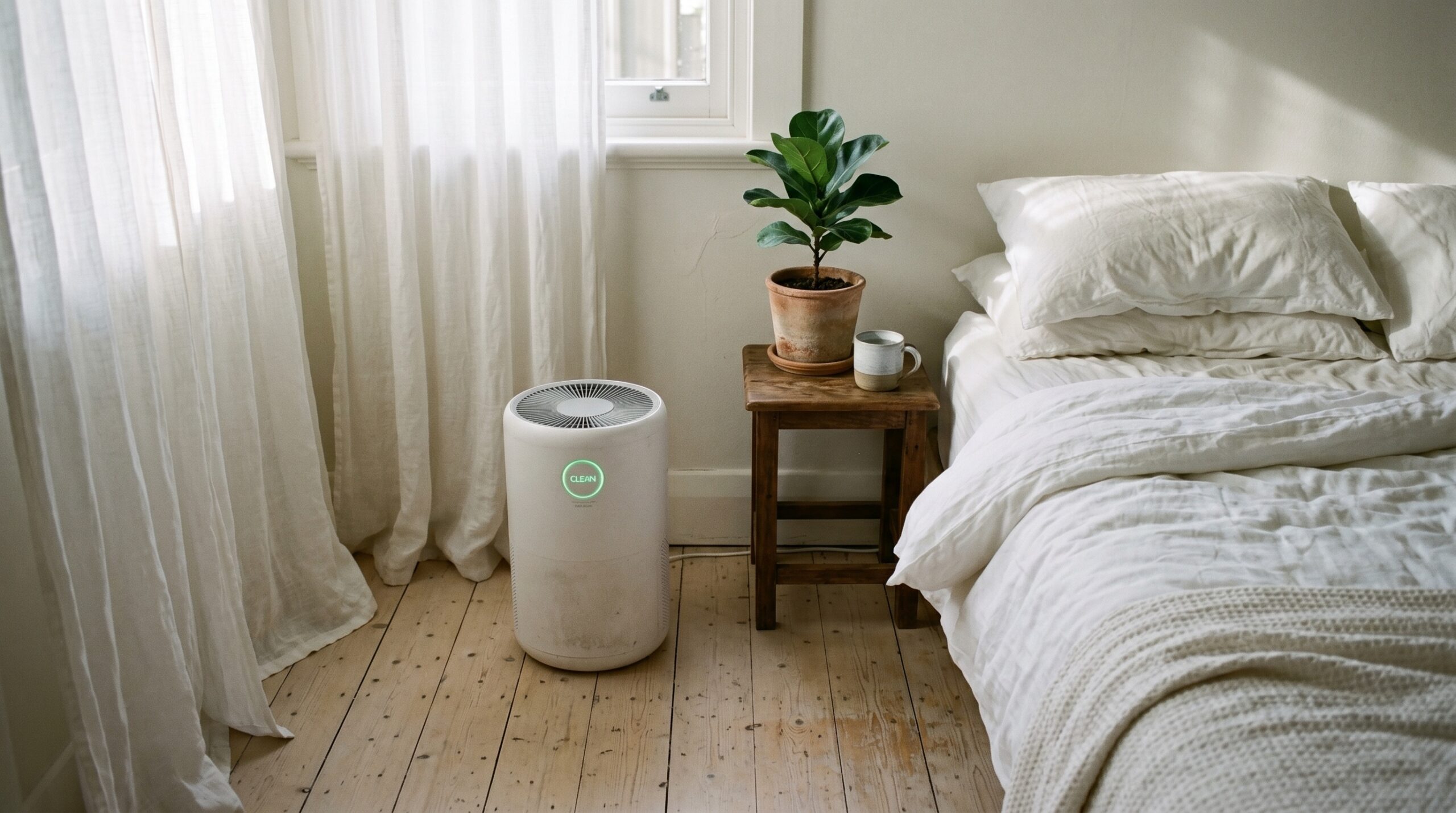
How this assessment was made. I run a Coway Airmega 150 in my own bedroom in Palm Beach, QLD, and measured it with the Decibel X phone app; that reading and the photos are mine. I haven’t measured the other purifiers. Their noise figures come from each manufacturer, with the test conditions where the maker gives them, plus one independent measurement (HouseFresh, for the Winix). Prices, sellers and ratings were checked on Amazon Australia on 28 Oct 2026. Clean and Native may earn a commission on some links.
The quietest air purifier on paper in Australia is the Philips PureProtect 3200, rated from 15 dB(A), measured to the IEC 60704 standard at 1.5 metres. For a bedroom, the one I run in my own bedroom is the Coway Airmega 150: on Silent I measured 32.1 dBA at one metre, close to the World Health Organization’s 30 dB guideline for bedrooms. For a nursery or small room, the Coway Airmega 100 starts at 20 dB(A).
But the lowest decibel number on a box is a trap. It is measured on the slowest fan speed, where the purifier is cleaning very little air, and brands measure at different distances, or don’t say. As a former Navy Clearance Diver, I learnt to compare readings only when they were taken the same way. This guide shows how to compare purifier noise properly, what I measured at home, and which purifier is quietest for the room you actually have.
Pick a purifier big enough that it can clean your room on a low setting. A bigger unit running slowly is usually quieter than a small one running flat out.
| Pick | Why | Price |
|---|---|---|
| Philips PureProtect 3200 | Quietest rated minimum: 15 dB(A) at 1.5 m | $498.00at Amazon AU · as of 22 Nov 2026, 5:43 am AEST Details |
| Coway Airmega 150 | Bedrooms to ~21 m²; 32.1 dBA on Silent (my reading) | $199.00at Amazon AU · as of 22 Nov 2026, 5:43 am AEST Details |
| Coway Airmega 100 | Nurseries and small rooms to ~15 m² | Currently unavailable on Amazon AUas of 22 Nov 2026, 5:43 am AEST Details |
| Levoit Core 300 | Budget, 24 dB in Sleep mode | $129.00at Amazon AU · as of 22 Nov 2026, 6:29 am AEST Details |
| Levoit Core 600S-P | Big bedrooms and open plan, run on low | $429.00at Amazon AU · as of 21 Nov 2026, 11:29 pm AEST Details |
✓ A quiet purifier matters if
- It will run in the room where you sleep
- You’re a light sleeper, or it’s for a baby’s room
- You want to run it all night during allergy or smoke season
- You work or study in the same room
× Noise matters less if
- It’s for a living area you only use in the daytime
- You need maximum smoke cleaning fast (run it on high and accept the noise)
- Someone in the house relies on white noise to sleep anyway
- You’d only ever run it while you’re out
Why the lowest dB number misleads
Every purifier’s quietest figure is measured on its slowest fan setting, often called Sleep or Silent. On that setting the fan is barely turning, so the purifier is also delivering only a small fraction of its rated clean air. The headline CADR is measured on the top setting, where the same purifier is at its loudest. Put the quietest number next to the highest CADR on one box and you are reading two different machines. For whether a purifier actually improves sleep, see can an air purifier improve your sleep.
The measurement itself varies too. Philips states its figures are sound pressure “IEC 60704, at 1.5m”. Coway publishes “19.98 ~ 48.3 dB(A)” for the Airmega 150 without saying how or where it was measured. In open space, sound pressure drops by roughly 6 dB each time the distance doubles, so a reading at 1.5 metres is not comparable with one at 1 metre, and a figure with no distance can’t be compared with anything.
What the brands quote, and how
| Purifier | Quoted noise | Measured how | Source |
|---|---|---|---|
| Philips PureProtect 3200 | 15 to 47.5 dB(A) | IEC 60704, sound pressure at 1.5 m | Philips |
| Coway Airmega 150 | 19.98 to 48.3 dB(A) | Not stated | Coway |
| Coway Airmega 100 | 20 to 48 dB(A) | Not stated | Coway spec sheet |
| Levoit Core 300 | 24 to 48 dB | Not stated | Levoit AU listing |
| Levoit Core 600S (600S-P sold here) | 26 to 55 dB | Not stated | Levoit AU manual for the 600S |
| Winix 5500-2 | 38.8 to 58.9 dBA | Measured by HouseFresh at 3 ft (about 0.9 m) | HouseFresh |
Only Philips names a standard and a distance. The Winix figures look loudest, but they are an independent measurement at under a metre, not a maker’s figure, so they aren’t a fair comparison either. The Australian distributor’s spec sheet for the Winix Zero, a different model, quotes 47 dBA at maximum.
What I measured at home
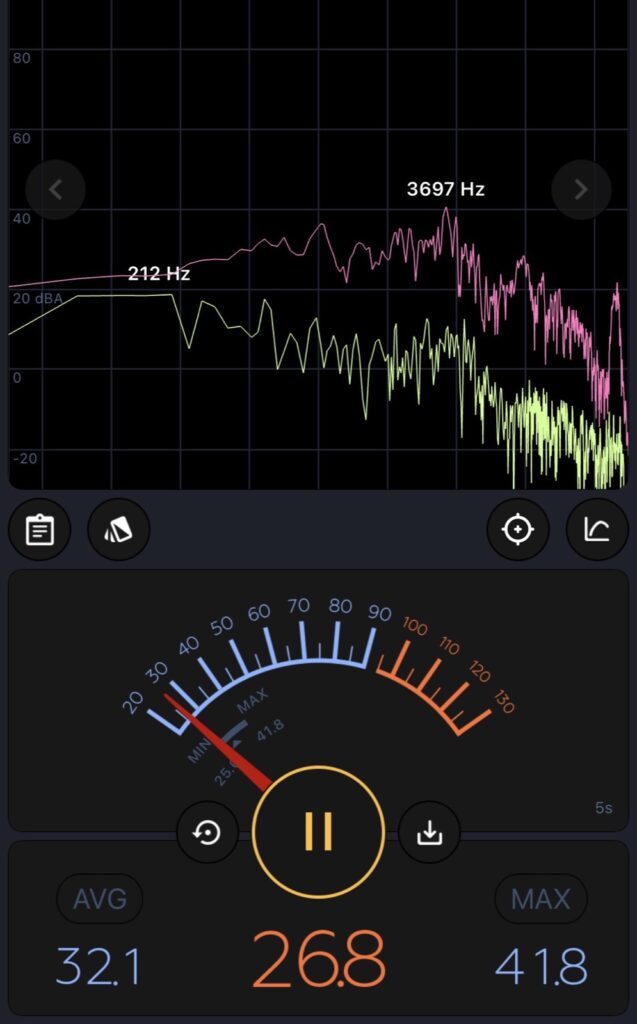
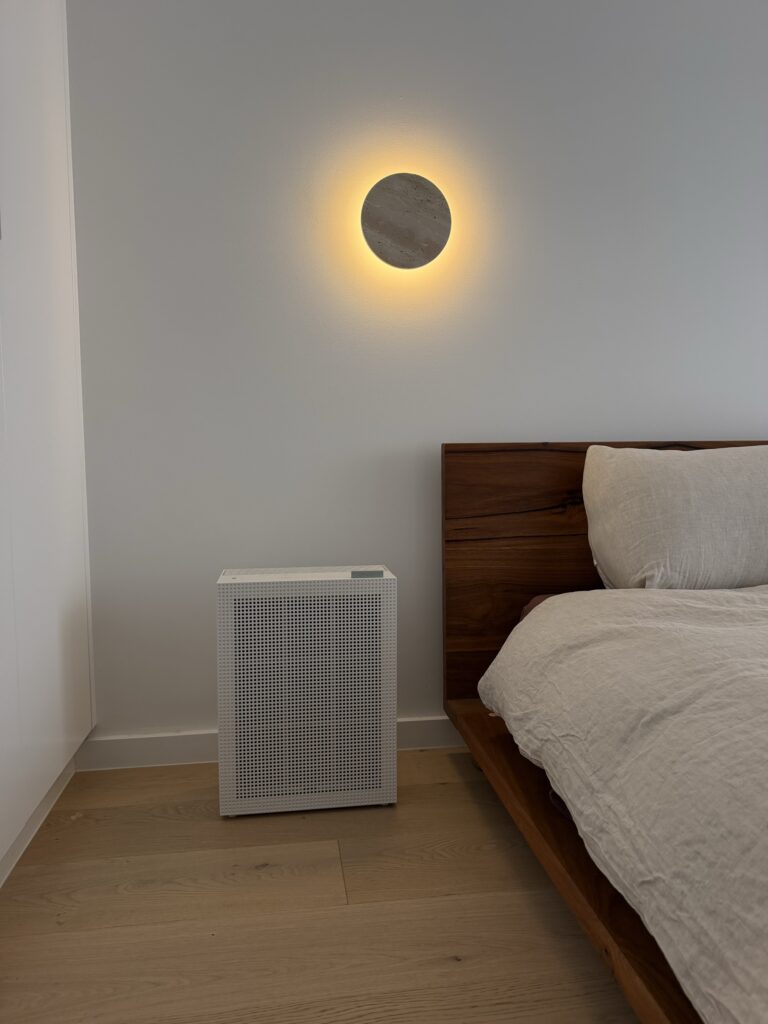
I measured my Airmega 150 with the Decibel X app on my phone, one metre from the purifier, in my bedroom in Palm Beach. On Silent the app recorded an average of 32.1 dBA and a maximum of 41.8 dBA over the reading. That is a guide, not a lab figure: a phone microphone isn’t a professional sound level meter, and the room’s own background noise sits under the purifier’s. It is still useful for one thing the spec sheets don’t tell you: Silent mode on the 150 is quiet enough that I sleep with it running in the room.
How quiet is quiet enough to sleep?
The World Health Organization’s Community Noise guidance (1995, with the same values carried into its 1999 guidelines) set a level of 30 dB LAeq for steady background noise inside bedrooms, and 45 dB LAmax for single noise events. A purifier on its quietest setting, a couple of metres from the bed, can sit around that level; one on a medium setting usually won’t.
Decibels are logarithmic. CHOICE notes that “an increase of 10dB is approximately equivalent to a doubling in loudness.” So 40 dB sounds roughly twice as loud as 30 dB, and the step from a purifier’s sleep setting to its next speed is often the difference between not noticing it and lying awake listening to it. Tone matters too: a steady low hum is easier to sleep through than a whine or a rattle.
Size up, run slow
Fan noise rises steeply with fan speed. That gives you the most useful rule in this guide: a purifier sized for a room bigger than yours can run on a lower setting to deliver the same clean air, and will usually be quieter doing it than a small purifier running flat out. If your bedroom is 15 m², a unit rated for about 20 m² on the US EPA’s two-thirds rule has headroom to run slower; one rated for exactly 15 m² has to run near the top of its range to hit the same target.
The trade-off is cost and size. A large-room purifier costs more and takes more floor space, and its quietest setting may still be a few decibels louder than a small unit’s quietest. But at the fan speed your room actually needs, the bigger unit is often the quieter one. That is why the Levoit Core 600S-P is on a quiet list.
Sizing table
| Bedroom | Floor area | Smoke CADR needed | Quiet choices with headroom |
|---|---|---|---|
| Nursery or study | 8 to 10 m² | ~60 to 70 cfm | Coway Airmega 100, Levoit Core 300 |
| Small bedroom | 10 to 12 m² | ~70 to 85 cfm | Coway Airmega 100, Airmega 150 |
| Main bedroom | 15 m² | ~110 cfm | Coway Airmega 150, Philips 3200 |
| Large bedroom or studio | 20 to 25 m² | ~145 to 180 cfm | Philips 3200, Levoit Core 600S-P |
Needed CADR is my calculation from the US EPA two-thirds rule (smoke CADR in cubic feet per minute of at least two-thirds of the floor area in square feet; 1 m² = 10.76 square feet) at a 2.4 m ceiling. For other rooms, use our CADR calculator.
Check all seven rooms, not just this one
38 checks, 29 free, ranked by impact. Sent as a 32-page PDF.
We'll email you the audit and a short series of practical guides. Unsubscribe in one click, any time. Privacy.
Sent. Taking you to your download...
The quietest air purifiers
1. Philips PureProtect 3200: quietest rated minimum
 Quietest on paper15 dB(A)minimum, IEC 60704 at 1.5 m
15 to 47.5 dB(A), measured to IEC 60704 at 1.5 m | CADR 520 m³/h (GB/T) | No ions or ozone (Philips) | 36 W
Check the Philips 3200 Price on Amazon →Amazon AU price: $498.00 · as of 22 Nov 2026, 5:43 am AEST DetailsThe 3200 has the lowest published minimum here, 15 dB(A), and it is the only one with a stated method: sound pressure to IEC 60704 at 1.5 metres. Philips says even its top speed of 47.5 dB(A) is quieter than normal conversation, which it puts at 60 dB. It also states the 3200 emits “no ions, chemicals or ozone”. Its CADR of 520 m³/h is measured to the Chinese GB/T standard, which isn’t comparable with the American AHAM figures used elsewhere, so I would put it in a bedroom or living room rather than trust the 135 m² on the box.
✓ Pros
- Lowest rated minimum (15 dB(A))
- Noise method and distance published
- No ions or ozone (Philips)
× Cons
- CADR on a GB/T basis, not AHAM
- Not Sensitive Choice approved
Buy this if…
you want the quietest rated purifier for a bedroom up to about 20 m², with nothing that emits ions.
2. Coway Airmega 150: best quiet bedroom purifier
 Bedrooms | I own this32.1 dBASilent mode at 1 m (my reading)
19.98 to 48.3 dB(A) (Coway, conditions not stated) | Smoke CADR 153 cfm, ~21 m² | No ioniser listed | 35 W | Sensitive Choice approved
Check the Airmega 150 Price on Amazon →Amazon AU price: $199.00 · as of 22 Nov 2026, 5:43 am AEST DetailsThis is the purifier in my bedroom, and the 32.1 dBA reading above is from it. Coway rates it from 19.98 to 48.3 dB(A) without stating the method, and publishes a smoke CADR of 153 cfm, which covers a bedroom of up to about 21 m² on the EPA rule. That headroom is the point: in a typical 12 to 15 m² bedroom it can do useful work on its lower settings. It draws 35 W, lists no ioniser, and is approved under the National Asthma Council’s Sensitive Choice program. For the full review, see my Coway Airmega 150 review.
✓ Pros
- The unit I sleep beside
- Headroom for a 15 m² bedroom
- No ioniser listed; Sensitive Choice approved
× Cons
- Coway doesn’t publish its noise method
- Top speed reaches 48.3 dB(A) (Coway)
- Deodorisation filter every 6 months
Buy this if…
the purifier will run in your bedroom every night and the room is up to about 20 m².
3. Coway Airmega 100: best for nurseries and small rooms
 Small rooms and nurseries20 dB(A)minimum (Coway spec sheet)
20 to 48 dB(A) | Smoke CADR 108 cfm, ~15 m² | Pre-filter + HEPA + deodorisation | 25 W
Check the Airmega 100 Price on Amazon →For a nursery, study or small bedroom, the Airmega 100 is the 150’s smaller sibling. Coway’s spec sheet gives 20 to 48 dB(A), a smoke CADR of 108 cfm (about 15 m² on the EPA rule), a combined pre-filter, HEPA and deodorisation filter rated at 12 months, and 25 W. Sensitive Choice announced its approval in a news item last updated in December 2025. In a 10 m² nursery it can do the job on a medium setting rather than flat out. For compact options sized by real CADR, see the best small air purifiers.
✓ Pros
- 20 dB(A) minimum
- Right-sized for nurseries
- No ioniser listed
× Cons
- Small rooms only (~15 m²)
- Costs more per unit of CADR than the 150
- One combined filter to replace
Buy this if…
the room is under about 12 m², so the 100 can run on low most of the time.
4. Levoit Core 300: quiet on a budget
 Budget24 dBSleep mode (Levoit AU listing)
24 to 48 dB (Levoit AU listing) | CADR 187 m³/h (test not stated), ~15 m² | No ioniser
Check the Levoit Core 300 Price on Amazon →Amazon AU price: $129.00 · as of 22 Nov 2026, 6:29 am AEST DetailsLevoit’s Australian listing quotes 24 dB in Sleep mode and 24 to 48 dB overall for the Core 300, with a CADR of 187 m³/h on a test it doesn’t name. That suits a bedroom of up to about 15 m², and less if you want it to run on low. It is a three-stage pre-filter, carbon and HEPA unit with no ioniser, sold by VeSync, Levoit’s distributor.
✓ Pros
- 24 dB in Sleep mode (Levoit)
- No ioniser
× Cons
- Noise and CADR test methods not stated
- Little headroom above 12 m²
- Thin carbon layer
Buy this if…
you want a quiet bedroom unit for under $200 and the room is small.
5. Levoit Core 600S-P: quiet in big rooms because it can run slow
 Big rooms, run slow26 dBminimum (Levoit Core 600S manual)
Core 600S AU manual: 26 to 55 dB, CADR 697 m³/h (410 cfm, ~57 m²), 49 W | 600S-P figures not published separately
Check the Core 600S-P Price on Amazon →Amazon AU price: $429.00 · as of 21 Nov 2026, 11:29 pm AEST DetailsLevoit’s Australian manual for the Core 600S gives 697 m³/h (410 cfm), about 57 m² on the EPA rule, and a noise range of 26 to 55 dB; Levoit doesn’t publish separate figures for the 600S-P sold here, so treat them as a close guide. In a 25 m² master bedroom or a studio apartment it has so much headroom that it can run on its lower settings where a small unit would need to run flat out, which is exactly the size-up, run-slow rule. Levoit’s US manual for the 600S and 600S-P describes an optional plasma function; the Amazon AU listing (model LAP-C601S-WCA) doesn’t mention one, but if yours has it, leave it off.
✓ Pros
- Big headroom: quiet at useful speeds
- 26 dB minimum (Core 600S manual)
× Cons
- Loud on top speed (55 dB)
- Takes floor space in a bedroom
- Some versions have a plasma function
Buy this if…
your bedroom is large, or it’s a studio where one purifier covers the whole space.
Comparison table
| Spec | Philips 3200 | Airmega 150 | Airmega 100 | Core 300 | Core 600S-P |
|---|---|---|---|---|---|
| Quietest (maker) | 15 dB(A) | 19.98 dB(A) | 20 dB(A) | 24 dB | 26 dB |
| Loudest (maker) | 47.5 dB(A) | 48.3 dB(A) | 48 dB(A) | 48 dB | 55 dB |
| Noise method stated | Yes, 1.5 m | No | No | No | No |
| CADR | 520 m³/h (GB/T) | 153 cfm smoke | 108 cfm smoke | 187 m³/h | 410 cfm |
| Room (EPA 2/3 rule) | Bedroom or living* | ~21 m² | ~15 m² | ~15 m² | ~57 m² |
| Power (max) | 36 W | 35 W | 25 W | Not verified | 49 W (600S) |
*The Philips GB/T CADR can’t be put through the EPA’s AHAM-based rule directly. Noise figures are the manufacturers’ own and, apart from Philips, the measurement method isn’t stated, so treat small differences as noise.
How to keep it quiet at night
Clean the room before bed, then turn it down. Run the purifier on a higher setting for half an hour with the door shut while you’re out of the room, then switch to Sleep or Silent when you go to bed. Most of the cleaning is done, and the quiet setting only has to keep up.
Use Sleep mode, not Auto, overnight. On Auto, the particle sensor can ramp the fan up in the night when you roll over or the dog walks in. Sleep or Silent holds a fixed low speed.
Move it away from your head. Every doubling of distance takes roughly 6 dB off what you hear in open space, less in a small room with hard surfaces. Two metres from the bed is noticeably quieter than beside the pillow. Keep the intake clear of walls and curtains so it isn’t straining.
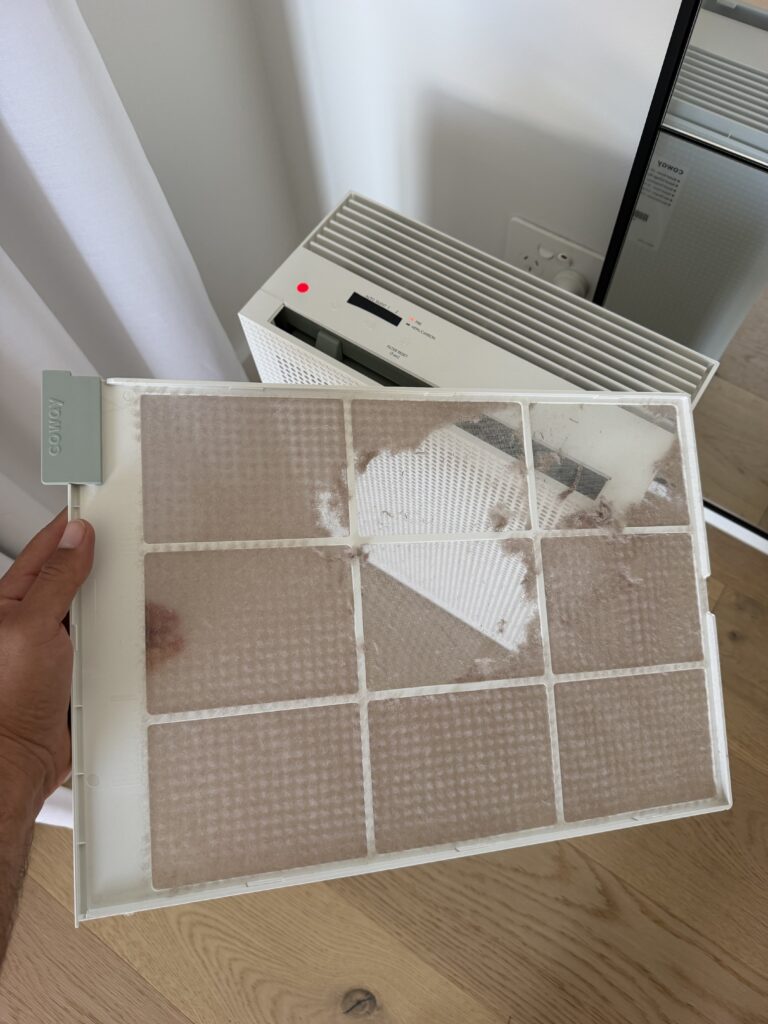
Keep the filters clean. A clogged pre-filter makes the fan work harder for the same airflow. Vacuum the pre-filter on schedule and replace the main filter when due; see the filter replacement guide.
What we left out
Breville Smart Air Viral Protect Max, which this page used to recommend: Breville doesn’t publish a noise figure or a test standard for its CADR, and it isn’t on the Sensitive Choice list. Silent ionisers and ozone units: they are quiet because they have little or no fan, and the US EPA warns to avoid air cleaners that intentionally produce ozone. See ozone and ioniser purifiers vs HEPA. Winix 5500-2: a strong living-room purifier (see the best HEPA air purifiers), but HouseFresh measured 58.9 dBA at under a metre on high, and its PlasmaWave stage needs switching off, so it isn’t my bedroom pick.
Which should you buy?
Quietest rated purifier for a bedroom: Philips PureProtect 3200. A bedroom purifier I know I can sleep beside: Coway Airmega 150. A nursery or small room: Coway Airmega 100. Under $200: Levoit Core 300. A large bedroom or studio: Levoit Core 600S-P on a low setting. For every bedroom option, see the best air purifiers for bedrooms; for a baby’s room, the best air purifiers for a baby’s room.
On a tighter budget? See the best air purifiers under $200, sized on real CADR for Australian bedrooms.
Final verdict
The quietest purifier is the one that can clean your room on a low setting. On paper that is the Philips PureProtect 3200, with the lowest and best-documented noise rating here. In practice, in my own bedroom, the Coway Airmega 150 on Silent measured 32.1 dBA at a metre, close to the WHO’s 30 dB bedroom guideline, and it is the purifier I sleep with in my own bedroom.
Prices change. Check Amazon AU before buying.
Frequently asked questions
What is the quietest air purifier in Australia?
On published figures, the Philips PureProtect 3200, rated from 15 dB(A) measured to IEC 60704 at 1.5 metres. In my own bedroom, the Coway Airmega 150 on Silent measured 32.1 dBA at one metre on a phone app.
How many decibels is quiet enough to sleep?
The WHO’s Community Noise guidance sets 30 dB LAeq for steady background noise inside bedrooms, and 45 dB for single noise events. A purifier on its quietest setting, a couple of metres from the bed, can get close to that.
Why is my air purifier louder than the box says?
The quietest figure is measured on the slowest fan speed. Philips measures at 1.5 metres; most brands don’t say where they measure. On a medium speed, or right next to your head, it will be louder.
Should I run my air purifier on Sleep or Auto at night?
Sleep or Silent. On Auto, the particle sensor can speed the fan up during the night. Run it higher before bed with the door shut, then switch to Sleep.
Is a bigger air purifier louder?
Not necessarily. A bigger purifier can clean the same room on a lower fan speed, so at the speed your room needs it is often quieter than a small unit on high.
What is the quietest air purifier for a baby’s room?
A small HEPA unit with a low minimum and no ioniser, such as the Coway Airmega 100 (20 dB(A) minimum, about 15 m²), placed away from the cot.
Are ionic air purifiers quieter?
Often, because they have little or no fan, but they don’t clean much air and can produce ozone. The US EPA warns to avoid air cleaners that intentionally produce ozone.
Does a dirty filter make an air purifier louder?
A clogged pre-filter makes the fan work harder for the same airflow. Vacuum the pre-filter on schedule and replace the main filter when it’s due.
- Philips: PureProtect 3200 AC3220 (15 to 47.5 dB(A), IEC 60704 at 1.5 m)
- Coway: Airmega 150 specifications (19.98 to 48.3 dB(A), CADR, power)
- Coway Airmega 100 specification sheet (retailer copy)
- Levoit Core 300: Amazon AU listing (24 to 48 dB, 24 dB in Sleep mode)
- Levoit Core 600S (LAP-C601S-WAUR) user manual, Australian model (copy)
- Levoit: PlasmaPro 600S-P user manual (US model LAP-C601S-WUSR, switchable plasma)
- HouseFresh: Winix 5500-2 review (AHAM CADR, PlasmaWave behaviour)
- Ausclimate: Winix Zero AUS-1050AZBU specification sheet
- WHO: Community Noise (Berglund and Lindvall, eds, 1995), bedroom guideline values
- CHOICE: a 10 dB increase is roughly a doubling of loudness
- US EPA: how to create a cleaner air room (2/3 CADR rule)
- AHAM Verifide: air cleaner CADR and the 2/3 rule
- US EPA: ozone generators that are sold as air cleaners
- US EPA: guide to air cleaners in the home
- Sensitive Choice: approved Coway air purifiers
- Sensitive Choice: Airmega 100 approval (news item, Dec 2025)
- Sensitive Choice: what the blue butterfly means

Former Royal Australian Navy Clearance Diver and TAG-E counter-terrorism operator. Founded Clean and Native to apply the same rigorous thinking to the home environment.
Full biography →The 7-Room Home Audit
Air is where most homes have their biggest free fix. The audit walks every room: 38 checks across air, water and EMF, ranked by impact against Australian guidelines.
- The rangehood habit that cuts gas cooking fumes
- Two-minute tests for exhaust fans, mould and stale bedrooms
- When a purifier helps, and the bedroom one I own
We'll email you the audit and a short series of practical guides. Unsubscribe in one click, any time. Privacy.
Sent. Taking you to your download...