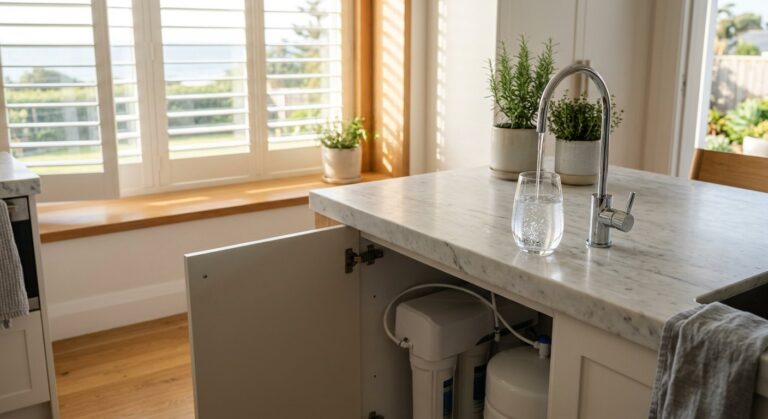
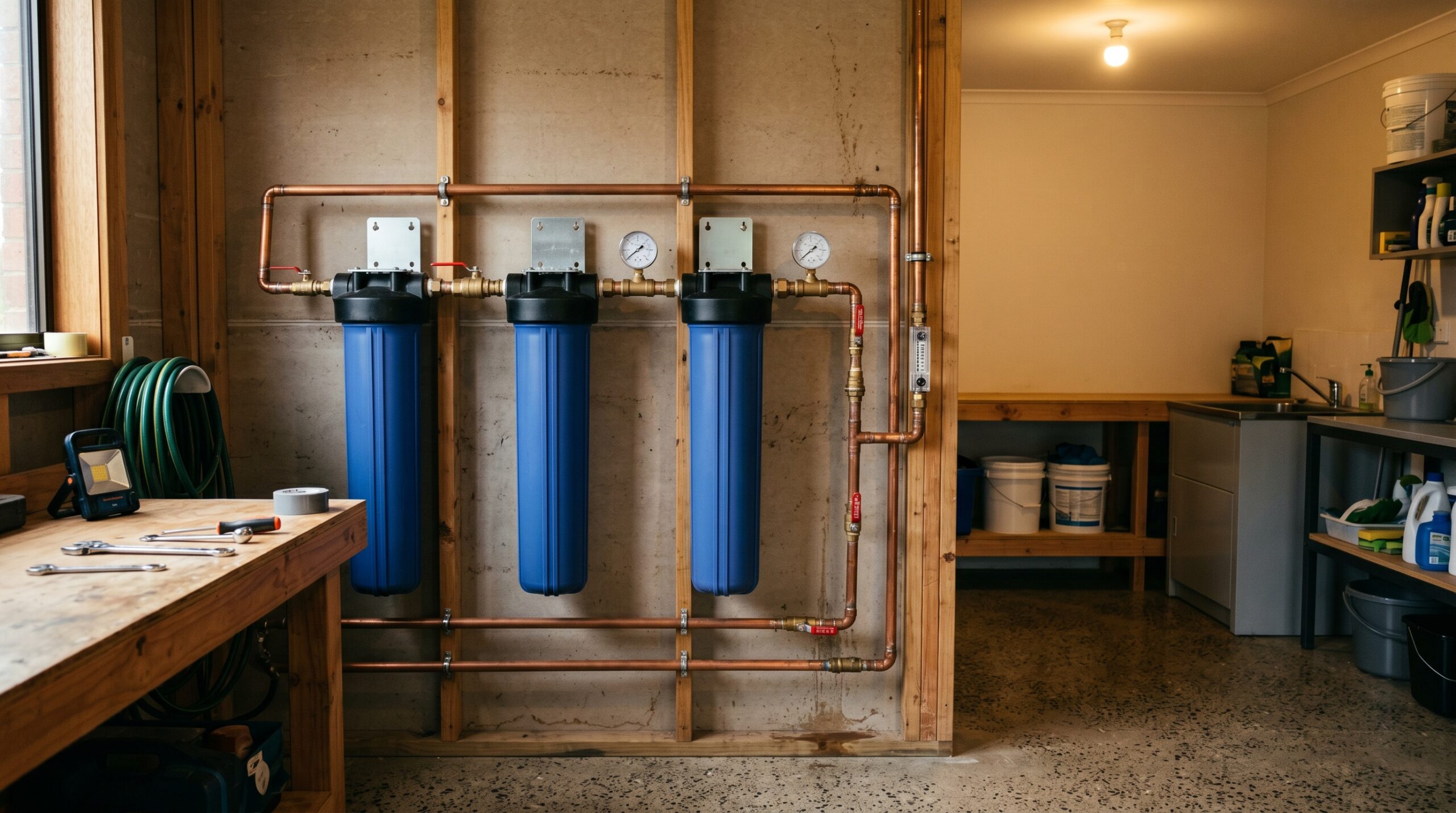
Pure Water Systems Whole House Water Filter Australia: The Complete Range Reviewed
Drafted with AI assistance and checked against published specifications and certifications. First-hand measurements appear only where stated. How we make content
The Pure Water Systems Twin UV Whole House System is the most complete whole-home water filtration solution available from an Australian supplier — NSF 42/53 certified, 3-stage filtration including UV at 75 litres per minute, covering bacteria, chemicals, and sediment in a single installation. If you are on mains water in Brisbane, Sydney, Adelaide, or Gold Coast and want whole-house protection, this is where the search ends.
Why Whole-House Filtration — and Who Actually Needs It
Most Australian households filter their drinking water with a benchtop jug or an under-sink reverse osmosis unit. Both are sensible. Neither solves the problem you are probably not thinking about: the 200+ litres per day that goes everywhere else.
You shower in unfiltered water. Your kids bathe in it. Your washing machine runs through it. In Brisbane, Sydney, Adelaide, and Gold Coast — all chloramine cities — that means chloramine is aerosolising in your shower steam every morning. Research published in Environmental Health Perspectives demonstrates that inhalation and dermal absorption during a 10-minute shower can deliver equivalent or greater chloramine exposure than drinking two litres of the same water. An under-sink RO unit does not touch that.
Point-of-entry (POE) filtration addresses the entire house, not just the kitchen tap. Every outlet — shower, bath, laundry, garden tap used for food growing — receives treated water from the moment it enters your property boundary. For households with young children, eczema sufferers, or anyone on a rainwater tank that may be collecting bird or possum contamination, the whole-house argument is not marginal. It is structural.
That said, whole-house filtration is not the right answer for everyone. If you are renting, it is impractical without landlord consent and a licensed plumber. If your primary concern is drinking water fluoride removal, an under-sink RO unit is more targeted and far cheaper. The decision tree below maps the choice clearly.
Who should buy a whole-house system
Families with children under 12, households with immunocompromised members, rural properties on tank or bore water, anyone in a chloramine city who showers in chemically treated water daily, and homeowners in postcodes affected by the PFAS contamination now mapped across Sydney, Perth, and Queensland defence corridors. For that last group, the PFAS Protect cartridge option is not a nice-to-have — it is the point.
Who can skip it
Renters without landlord permission, apartment dwellers without mains-entry access, and anyone whose sole concern is drinking water quality. An AquaTru countertop RO or Waterdrop D6 under-sink system covers drinking water at a fraction of the cost.
Australian Water Chemistry — Which System for Your City
Australia does not have a single water treatment profile. The disinfection type used by your utility determines which filtration technology you actually need — and this is the most important filter-selection fact most Australians never check.
Brisbane and South-East Queensland (chloramine)
SEQ Water treats the reticulated grid with chloramine — a combination of chlorine and ammonia that is more stable in long distribution pipelines but significantly harder to remove than free chlorine. Standard granular activated carbon (GAC) removes free chlorine at a reasonable rate but removes chloramine at approximately 1/40th the efficiency. A standard carbon block with a long contact time performs better. The Twin UV Whole House System uses a Diamond Flow carbon block rated to 10 microns, which provides meaningful chloramine reduction across the full flow rate of the home. The Town Water Package with GAC cartridge gives 50-70% chloramine reduction — adequate for many households, not complete. SEQ Water’s dam network is currently above 80% capacity (SEQ Water, May 2026), so seasonal drought concentration is not a current concern, but chloramine treatment is a permanent fixture of the SEQ grid.
Sydney (chloramine + PFAS)
Sydney Water treats with chloramine across most of the distribution network. UNSW researchers detected 31 PFAS compounds in Sydney drinking water samples in 2024 — a direct legacy of firefighting foam use at military and civilian airports including RAAF Richmond and Bankstown. The 3M PFAS litigation has brought this into mainstream awareness, but the contamination predates the lawsuits by decades. For Sydney households, the Twin Town Water Package with the PFAS Protect Fibredyne cartridge upgrade is the most targeted response. The Fibredyne 1-micron block is certified to remove 98% of five key PFAS compounds. That does not cover all 31 detected compounds — reverse osmosis is the only technology that addresses PFAS comprehensively — but it addresses the highest-concentration compounds and is far cheaper than whole-home RO. See our PFAS water filter roundup for more detail on the contamination map and filter options.
Melbourne (free chlorine)
Melbourne Water uses free chlorine, not chloramine. Standard GAC and carbon block filters remove free chlorine effectively. Melbourne’s Yarra Valley catchment delivers some of the softest water in Australia — TDS around 60 mg/L, hardness approximately 25 mg/L CaCO3. The main whole-house concern in Melbourne is sediment in older infrastructure and the occasional turbidity event. The Twin Town Water Package at $999 is the right product for Melbourne mains water. The Twin UV system is overkill unless the property also has a rainwater tank supplementing mains supply. Understand the difference between chloramine and chlorine treatment cities in Australia before you specify a filtration system.
Adelaide (chloramine + hard water)
Adelaide’s water is the toughest proposition in the country. SA Water treats with chloramine. TDS runs around 400 mg/L — the highest of any mainland capital. Hardness sits at approximately 140 mg/L CaCO3. The Twin UV system with its carbon block is the correct whole-house answer for Adelaide: it addresses chloramine more effectively than GAC, provides bacterial protection via UV, and the sediment pre-stage handles the particulate load from the Torrens and Murray sources. Hard water scale management (a water softener) is a separate problem the PWS systems do not solve, but filtration and softening are independent processes — you can run both.
Perth (chloramine + hard water)
Water Corporation treats Perth’s reticulated supply with chloramine. At approximately 180 mg/L CaCO3, Perth has the hardest tap water of any Australian capital. Rockingham, Mandurah, and the Kwinana industrial corridor also face elevated PFAS background levels from historical industrial activity. The Twin UV system is the most complete point-of-entry solution for Perth. Residents in high-PFAS postcodes who cannot access the full UV system budget should consider the Town Water Package with PFAS Protect cartridge as an interim measure.
Rural properties and tank water
Tank and bore water is not treated. It carries no chlorine, no chloramine — but also no barrier to E. coli, Cryptosporidium, giardia, and coliform bacteria from bird droppings, possum entry, and roof contamination. UV treatment is not optional on tank water — it is the minimum acceptable standard. The PWS Twin UV Whole House System is designed for exactly this application: the 3-stage sequence removes sediment and organics before the UV chamber so the lamp is not blocked by turbidity, then delivers 99.9999% bacterial kill across the full flow rate. The Twin Tank Water Package at $739 is the pre-filtration stage without UV — appropriate as a sediment and organics pre-treatment feeding into a separate UV unit if you already own one.
Product Deep-Dives: Every PWS Whole House System Reviewed
1. PWS Twin UV Whole House System — Top Pick
The Twin UV is not the cheapest whole-house system on this page. It is the only one that addresses all three contamination categories simultaneously: biological (UV at 99.9999% kill rate including E. coli), chemical (NSF 42/53 certified carbon block for chloramines, chlorine, VOCs, and taste/odour), and physical (dual-stage sediment from 50 micron down to 5 micron). Every other system reviewed here addresses two of those three categories at most.
Three-stage sequence
The system runs in this order: a 50-micron polyspun sediment pre-filter removes coarse particles and protects the carbon block from rapid fouling; a 5-10 micron Diamond Flow carbon block removes chlorine, chloramine, VOCs, and trihalomethanes while improving taste and odour; the UV chamber then delivers a minimum 30 mJ/cm2 UV dose at 75 litres per minute — the standard threshold for 99.9999% inactivation of E. coli and Cryptosporidium as per WHO drinking water guidelines. The stainless steel UV chamber with quartz thimble ensures the lamp operates at correct temperature across Australian climate ranges from sub-zero alpine mornings to 45-degree inland summers.
UV ballast counter
The digital UV ballast counter is a feature most budget UV systems omit. UV lamps degrade over time — output falls before the lamp visibly fails. The counter tracks operating hours so you replace the lamp at the manufacturer-specified interval (typically 9,000 hours, or approximately 12 months of continuous operation), not when it dies in the middle of winter and your tank water runs untreated for a week before you notice.
Pressure and flow specifications
Operating pressure range: 210-500 kPa. This covers standard Australian mains pressure (typically 300-500 kPa) and low-pressure rural tank gravity systems down to approximately 210 kPa. At 75 L/min, the system handles simultaneous demand from two showers, a dishwasher, and a washing machine without measurable pressure drop at the tap. That figure matters in a 4-bedroom home with teenagers.
NSF 42/53 certification
NSF/ANSI 42 covers aesthetic effects — chlorine taste and odour reduction. NSF/ANSI 53 covers health effects — removal of lead, cysts, VOCs, and other regulated contaminants. Both certifications require third-party laboratory testing to published reduction standards, not manufacturer self-certification. This is the certification standard referenced in the Australian Drinking Water Guidelines (ADWG 2022) for evaluating point-of-use and point-of-entry filtration equipment.
Who should use the discount code
Apply it at the Pure Water Systems checkout page.
Pure Water Systems — Whole House Range
See full whole-house water filter rankings →2. PWS Twin Big White Town Water Package 20″ — Best Value

The Town Water Package is a 20-inch Big White housing system — larger filter volume than the standard 10-inch housings used on most benchtop and under-sink units, which means longer cartridge life and lower pressure drop at high flow rates. The standard configuration ships with a 50-micron polyspun sediment cartridge in stage one and a GAC cartridge in stage two.
The PFAS Protect upgrade — why it matters for Sydney
The standard GAC cartridge does remove some PFAS compounds, but not at a certified, measurable rate. The PFAS Protect Fibredyne 1-micron carbon block is a different technology: compressed carbon block rather than granular activated carbon, with significantly higher contact time per litre of throughput. It is certified to remove 98% of five specified PFAS compounds — PFOA, PFOS, PFHxS, PFNA, and PFHpA — which represent the highest-concentration compounds detected in the UNSW 2024 Sydney Water analysis. For Penrith, Campbelltown, and western Sydney households downstream of RAAF Richmond, this is not an abstract benefit. See our Australia 3M PFAS lawsuit context for the full contamination history.
Chloramine performance in Brisbane and SEQ
The GAC stage in the standard Town Water Package gives 50-70% chloramine reduction — meaningful, but not complete. If your primary driver is chloramine removal for showers and baths (not just drinking water), the Twin UV System’s Diamond Flow carbon block outperforms the GAC stage materially. That said, a 50-70% reduction across all outlets still cuts total household chloramine exposure significantly compared to no whole-house filtration. For SEQ households wanting whole-home chloramine reduction on a $999 budget, this is a legitimate and honest answer.
Melbourne suitability
Melbourne’s free-chlorine treatment means the GAC stage performs at full rated efficiency. Combined with Melbourne’s very low TDS (~60 mg/L) and soft water chemistry, the Town Water Package delivers clean, well-treated water across the full house for $999 installed (plus plumber cost). The UV system is not warranted for Melbourne mains water unless the property also draws from a tank.
3. PWS Twin Big White Tank Water Package 20″

Tank and bore water presents a different challenge from mains water. There is no utility chlorination acting as a biological barrier. Bacteria, protozoa, and sediment from roof catchments, birds, possums, and aquifer contamination enter the supply at variable and unpredictable concentrations. The Tank Water Package addresses the pre-filtration requirement: coarse sediment removal down to the micron rating of the cartridge set, and organic matter reduction that would otherwise foul or reduce the efficiency of a downstream UV lamp.
This system is not a standalone solution for potable tank water. UV treatment is mandatory as the final stage for biological safety. The Tank Water Package is correctly positioned as the sediment and organics pre-filter feeding into the UV stage of the full Twin UV System, or into an existing UV unit if the property has one already installed. Buying the Tank Water Package alone and drinking the output unfiltered is not a safe practice and not what PWS recommends.
4. SHIELD WaterMark Dual-Stage Big Blue — Budget Comparison

The SHIELD system earns its place in this comparison for one reason: Australian WaterMark certification. WaterMark (AS/NZS 3497) is the mandatory plumbing product standard for any water filter installed on Australian mains plumbing. Systems without WaterMark certification cannot legally be installed by a licensed plumber in most states. The SHIELD Big Blue carries this certification, which means it can be installed, warranted, and — importantly — approved by a landlord for a rental property installation.
The honest assessment: at $499, you get WaterMark compliance, 2-stage filtration, and a recognised Australian approval. You do not get NSF 42/53 health effects certification, UV treatment, or PFAS protection. In Melbourne on free chlorine, this is an adequate system. In Brisbane or Sydney on chloramine, the carbon stage underperforms without a catalytic carbon or compressed block cartridge upgrade — which you can fit into the Big Blue housings, but which are not included at the base price. Factor that into your actual cost of ownership.
Full System Comparison Table
| System | Price | Stages | UV | PFAS | NSF/WM | Best For |
|---|---|---|---|---|---|---|
| PWS Twin UV | $2,499 | 3 | Yes (99.9999%) | No specific claim | NSF 42/53 | Complete protection — all cities + tank |
| PWS Twin Town + PFAS | $999 | 2 | No | Yes (98%, 5 cpds) | No | Sydney/Brisbane mains, PFAS concern |
| PWS Twin Tank Water | $739 | 2 | No | No | No | Rural pre-filtration upstream of UV |
| SHIELD Big Blue | ~$499 | 2 | No | No | WaterMark | Budget, Melbourne mains water |
True 5-Year Cost of Ownership
Competitor sites in this space show the unit price and stop. That is not the cost. The cost is upfront hardware, installation labour, and cartridge replacement across the life of ownership. Here is the honest breakdown — including the installation cost every competitor buries in fine print.
5-Year Total Cost of Ownership — Whole House Water Filtration, Australia
Upfront hardware + licensed plumber install ($300 estimated) + annual cartridge replacement over 5 years. Bottled water benchmark: 4L/day household at $1.00/L average.
5-year total = upfront hardware + $300 plumber install + (annual cartridge cost x 5). PWS Twin UV: $2,499 + $300 + ($180 x 5) = $3,699. PWS Town Water: $999 + $300 + ($120 x 5) = $1,899. SHIELD Big Blue: $499 + $300 + ($80 x 5) = $1,199. Bottled water: 4L/day x 365 x 5 x $1.00 = $7,300. Sources: Pure Water Systems AU, Amazon AU, industry average cartridge pricing. Bar fill #3A8A5A = top pick PWS Twin UV; #1A3326 = peer products; #999999 = benchmark/bottled water.
The bottled water comparison is not rhetorical. A household buying 4 litres of bottled water per day — a conservative estimate for a family of four — spends between $3,650 and $7,300 over five years depending on whether they buy 600mL bottles or 15-litre jugs. The PWS Twin UV System at $3,699 over five years delivers whole-house filtration at a cost that is roughly equivalent to the low end of bottled water expenditure — and it covers the shower, the laundry, and the garden tap, not just the kitchen glass.
Installation: What to Expect, What It Costs, and What Voids Your Warranty
All three PWS systems require installation by a licensed plumber for warranty coverage. This is not bureaucratic fine print — it reflects the reality that a whole-house point-of-entry filter installed incorrectly can reduce mains pressure to unsafe levels, bypass filtration during backflow events, or create plumbing non-compliance issues that affect home insurance coverage.
What a plumber actually does
The installation involves locating the mains water entry point (typically just after the meter and before the hot water system), cutting into the cold water line, installing isolation valves on either side of the filter housings, mounting the housings (which for 20-inch Big White systems weigh approximately 8-12 kg fully loaded), connecting the inlet and outlet ports, and running a basic pressure test. On a simple installation with accessible plumbing, this takes 1.5-2.5 hours.
Cost range
Budget $200-400 for a standard installation in a metropolitan area with accessible plumbing. Complex installations — concealed pipe runs, underslab access, or properties where the mains entry is remote from a suitable mounting location — can reach $500-700. Get two quotes. The first quote from any plumber will include a callout fee of $80-150; subsequent quotes are often free once the job scope is clear.
WaterMark compliance
Under the National Construction Code and state plumbing regulations, any device permanently connected to the mains water supply must carry WaterMark certification (AS/NZS 3497 or the relevant product standard). PWS systems comply. A licensed plumber installing a non-WaterMark-certified system on mains plumbing in Queensland, NSW, Victoria, South Australia, or Western Australia is committing a plumbing offence. This is the practical reason the SHIELD Big Blue’s WaterMark certification matters — it is the minimum legal baseline for a mains-connected installation, not a quality endorsement.
Cartridge replacement schedule
Sediment pre-filters in the 20-inch Big White housings typically last 6-12 months depending on source water turbidity. The carbon block or GAC stage runs 12 months under standard household demand. UV lamps are rated to approximately 9,000 hours — just over 12 months of continuous operation. Set a calendar reminder. A UV lamp that has expired is delivering no biological protection while the ballast counter shows it is still powered on. The digital ballast counter on the Twin UV System eliminates the guesswork — replace at the counter interval, not when something tastes wrong.
Last reviewed: May 2026 — Clean and Native
Ready to protect your whole house?
The PWS Twin UV Whole House System is the most complete point-of-entry water filter available from an Australian supplier — NSF 42/53 certified, 99.9999% UV bacterial kill, 75 L/min flow rate.
Frequently Asked Questions
For households in chloramine cities (Brisbane, Sydney, Adelaide, Gold Coast, Darwin), a whole-house system is worth the investment if you want chemical protection beyond just the kitchen tap — particularly for shower exposure to aerosolised chloramine. For rural properties on tank water, whole-house UV filtration is not optional if the water is consumed by any household member. For Melbourne households on free chlorine with no bacteria concerns, an under-sink filter for drinking water is often sufficient and more cost-effective.
Standard GAC cartridges provide limited, uncertified PFAS reduction. The PWS PFAS Protect Fibredyne cartridge is certified to remove 98% of five key PFAS compounds (PFOA, PFOS, PFHxS, PFNA, PFHpA) — the highest-concentration compounds detected in UNSW 2024 Sydney Water testing. Reverse osmosis removes PFAS more comprehensively (90-99% across a broader compound range) but requires a point-of-use installation rather than whole-house. See our PFAS water filter guide for a full technology comparison.
Hardware costs range from $499 (SHIELD Big Blue budget system) to $2,499 (PWS Twin UV complete system). Add $200-400 for a licensed plumber installation in most metropolitan areas. Annual cartridge costs run $80-180 depending on the system. Total 5-year ownership cost ranges from approximately $1,199 (SHIELD budget) to $3,699 (PWS Twin UV complete), compared to $3,650-7,300 for equivalent bottled water consumption by a family of four.
It is a 3-stage point-of-entry water filtration system from Australian supplier Pure Water Systems, comprising a 50-micron sediment pre-filter, a Diamond Flow 10-micron carbon block rated for chloramine and chlorine reduction (NSF 42/53 certified), and a UV disinfection chamber rated to 99.9999% bacterial kill at 75 litres per minute. It is designed for installation on the mains water entry to a residential property by a licensed plumber. Price is $2,499 AUD from purewatersystems.com.au.
Yes. SEQ Water treats the reticulated South-East Queensland grid with chloramine — a combination of chlorine and ammonia — rather than free chlorine. Chloramine is more stable in long distribution pipelines but is significantly harder to remove than free chlorine. Standard GAC filters remove chloramine at approximately 1/40th the rate they remove free chlorine. Catalytic carbon or compressed carbon block filters are required for effective chloramine reduction in Brisbane, Ipswich, Logan, and surrounding SEQ council areas.
No — not without voiding the warranty and potentially breaching state plumbing regulations. Under the National Construction Code and relevant state plumbing acts, any device permanently connected to the mains water supply must be installed by a licensed plumber to comply with WaterMark product standards. DIY installation also voids the Pure Water Systems 12-month warranty. Installation by a licensed plumber costs approximately $200-400 for a standard residential job.
Sediment pre-filters in 20-inch Big White housings typically last 6-12 months depending on source water turbidity. Carbon block or GAC cartridges run approximately 12 months under standard household demand (approximately 4-6 L/min average daily use). UV lamps are rated to approximately 9,000 hours of continuous operation — just over 12 months. The digital ballast counter on the PWS Twin UV System tracks UV lamp hours precisely so you replace at the correct interval rather than guessing.
The PWS Twin Big White Town Water Package with the PFAS Protect Fibredyne 1-micron cartridge upgrade is the most targeted whole-house response to Sydney’s PFAS contamination profile. It is certified to remove 98% of five key PFAS compounds. For complete PFAS removal across a broader compound range, an under-sink or countertop reverse osmosis unit at the kitchen tap (such as the AquaTru Classic) paired with a whole-house system is the most comprehensive approach. See our PFAS and the 3M lawsuit in Australia for background on Sydney’s contamination history.
The 12-month warranty on PWS systems covers manufacturing defects in the housing, fittings, UV chamber, and ballast electronics. Filter cartridges are consumables and are not covered under warranty — they are replaced at the scheduled interval regardless of defect. UV lamp failure within the rated 9,000-hour period would fall under the warranty; normal end-of-life lamp replacement does not.
Get the Australian Home Environment Checklist
30 checks across water, air and EMF. Most of them free. Ranked by impact.
No spam. Unsubscribe any time.

Former Royal Australian Navy Clearance Diver and TAG-E counter-terrorism operator. Founded Clean and Native to apply the same rigorous thinking to the home environment.
Full biography →