5G in Australia: EMF Risks & How to Protect Yourself
Drafted with AI assistance and checked against published specifications and certifications. First-hand measurements appear only where stated. How we make content
Australia’s 5G network is compliant with ARPANSA’s RPS S-1 standard, which sets the RF exposure limit at 1,000 µW/cm² at 2.4 GHz — a threshold based on thermal effects, not long-term precautionary science. If you want to know what your actual exposure is and what, if anything, to do about it, this guide gives you real numbers and real actions.
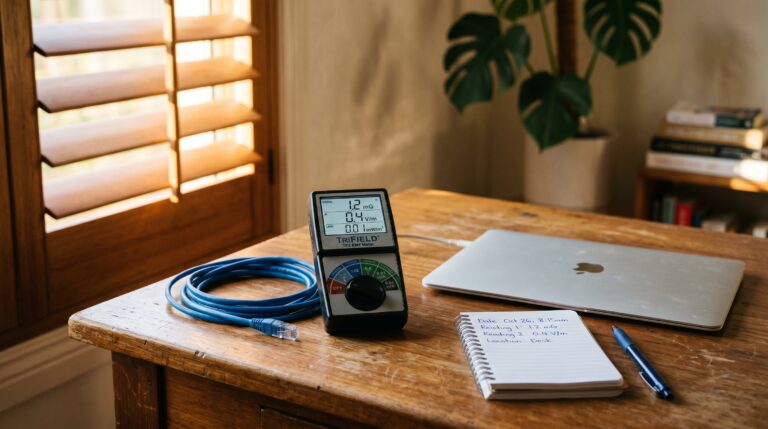
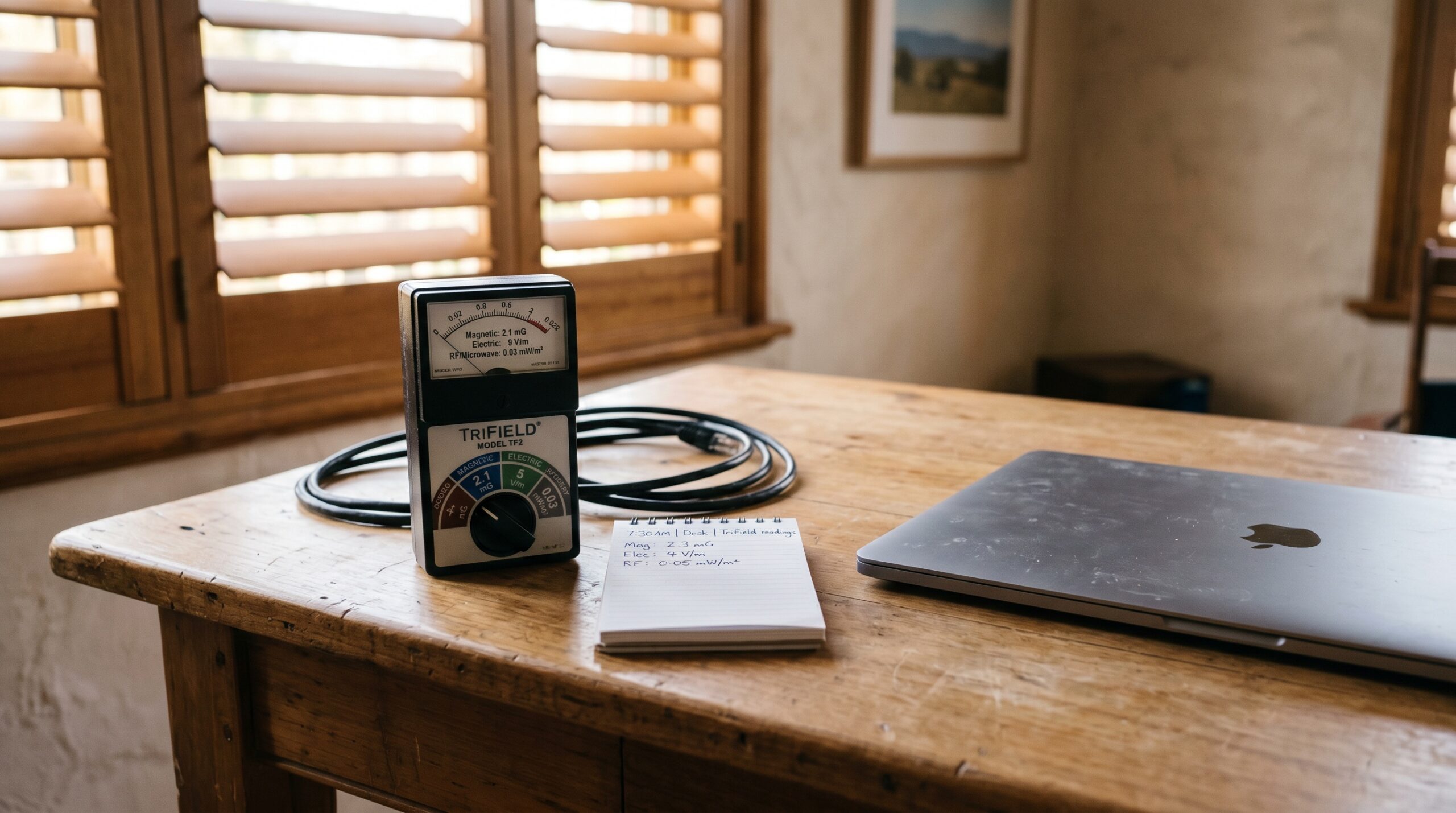
Note on methodology: I have not personally tested the Safe and Sound Pro II or the shielding products discussed here; that assessment is based on published manufacturer specifications and independent certification, not first-hand measurement. The only EMF meter I measure with first-hand is the TriField TF2, at Palm Beach QLD.
What Australian 5G Actually Emits — and How It Compares to Safety Limits
I spent eight years as a Royal Australian Navy Clearance Diver. That career teaches you to distinguish between actual risk and perceived risk — they are rarely the same number. So let’s start with the real numbers.
ARPANSA sets Australia’s RF exposure standard under RPS S-1, which adopts the ICNIRP 2020 guidelines. At 2.4 GHz — the frequency most relevant to Wi-Fi and many 5G sub-6 GHz bands — the general public limit is 1,000 µW/cm². At 3.5 GHz, the primary Australian 5G mid-band frequency used by Telstra, Optus, and TPG, the limit sits at approximately 450 µW/cm² under the frequency-scaled ICNIRP formula.
What does measured exposure actually look like? ARPANSA’s radiation literature survey and its Australian EMF measurement programme consistently find ambient RF in Australian urban environments running 0.001 to 0.1 µW/cm² — between 1,000 and 1,000,000 times below the RPS S-1 limit. Even within 50 metres of a 5G base station, measured exposure rarely exceeds 1 µW/cm² in residential contexts. The Australian Mobile Telecommunications Association (AMTA) notes that 5G’s higher frequencies and shorter propagation range mean the body’s surface absorption is shallower than 3G or 4G — the signal does not penetrate as deeply into tissue.
Here is where it gets more useful. The ARPANSA limit is a thermal safety limit. It is the level at which radiofrequency energy demonstrably heats biological tissue. It is not a precautionary limit. It does not account for long-term, low-level, non-thermal biological effects — an area where the science is actually unsettled. The BioInitiative Working Group, the Ramazzini Institute, and several peer-reviewed publications have raised concerns about effects at exposures orders of magnitude below thermal thresholds. ARPANSA monitors this literature. As of 2025 their position is that the evidence for harm below RPS S-1 is not sufficient to revise the standard.
That is not the same as “definitely safe at any level.” It means “we have not yet proven harm below the current limit.” Those two statements carry different implications for a household making decisions about what happens in a bedroom for eight hours every night.
Where Your Real Exposure Comes From — and Why 5G Towers Are Not the Main Event
The public conversation about 5G focuses almost entirely on towers. That is the wrong target. Inverse square law physics means RF intensity drops with the square of distance. A 5G tower 200 metres away delivers a fraction of the exposure that your phone pressed to your ear delivers at 0 centimetres.
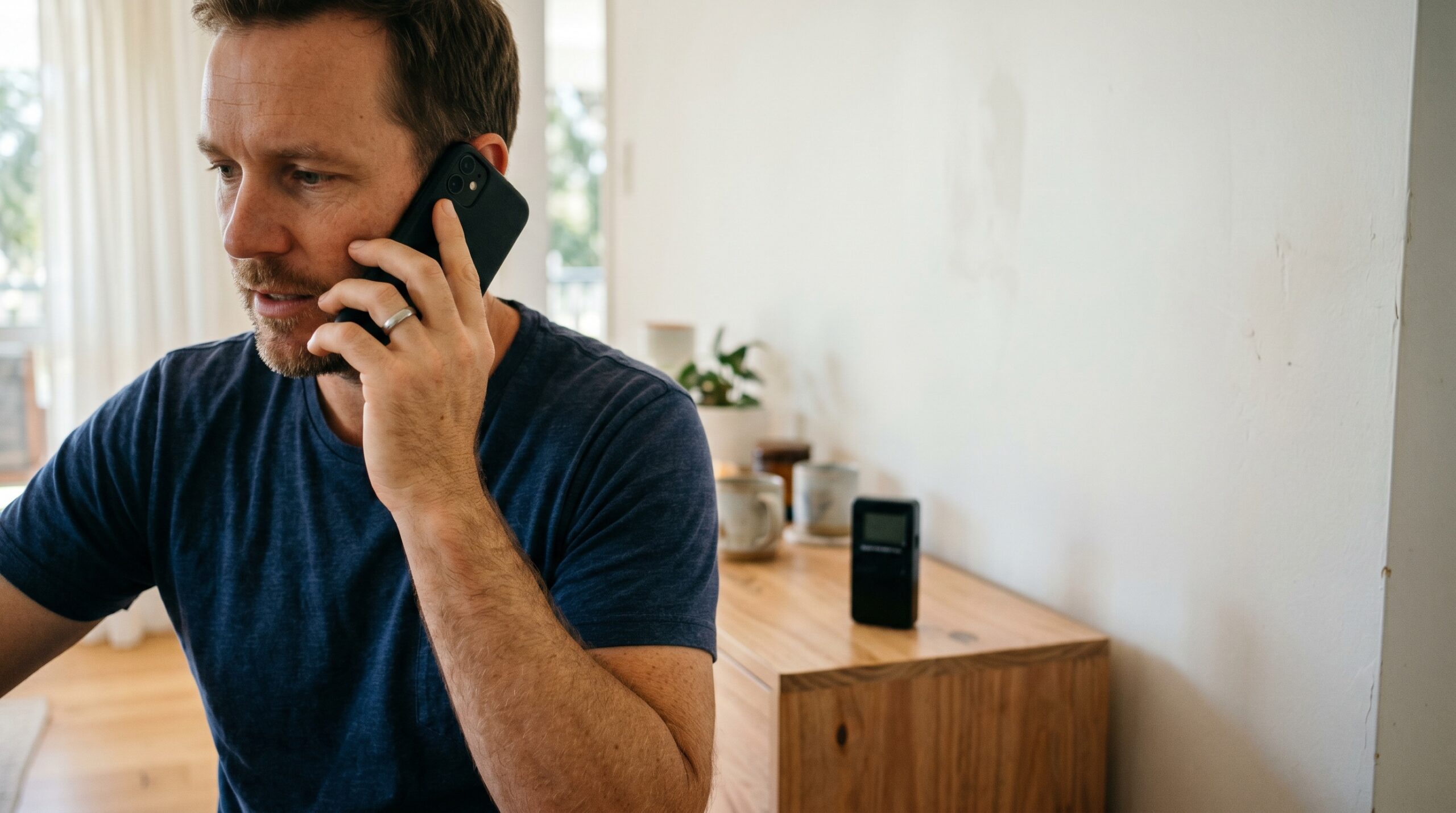
Australia’s ARPANSA SAR (Specific Absorption Rate) limit for mobile handsets is 2.0 W/kg, averaged over 10 grams of tissue. Most 5G handsets sold in Australia operate well below that in typical use, but peak SAR values during a call — especially in areas of poor signal where the phone boosts its transmit power — can approach the limit. When signal is poor, handsets automatically increase output power. That is when you get the highest handset-to-body exposure.
The exposure hierarchy in a typical Australian home looks like this. A phone held against your ear during a voice call produces the highest momentary RF exposure — typically 0.5 to 1.5 W/kg SAR depending on the handset and network signal quality. A Wi-Fi router at one metre distance delivers roughly 0.5 to 5 µW/cm². A 5G small cell tower at 50 metres delivers roughly 0.01 to 1 µW/cm². A macro 5G tower at 200 metres delivers below 0.01 µW/cm² in most Australian suburban environments.
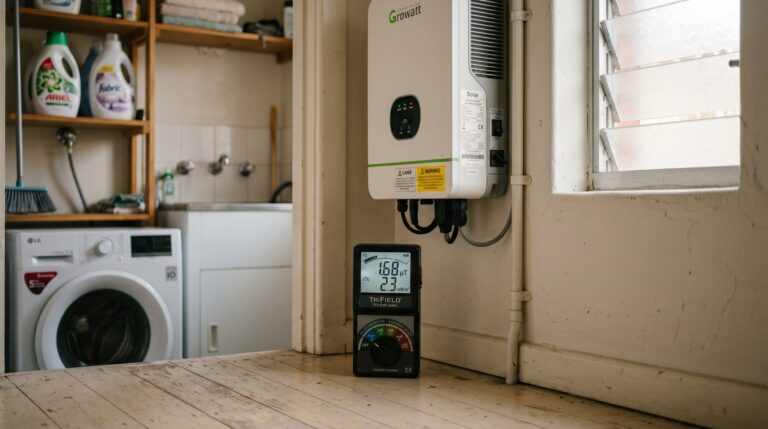
Smart meters are worth a separate mention. Australian smart meters operate on 900 MHz and transmit in short bursts — but those bursts produce peak readings 100 to 1,000 times higher than the time-average. If your smart meter is mounted on a wall shared with a bedroom or home office, the peak burst exposure during transmission can be measurably higher than ambient background. This is not reflected in time-averaged compliance figures, which can make it look lower than it functionally is during those burst windows.
The building biology standard — SBM-2015, which building biologists use as an independent precautionary reference — sets the sleeping area RF guideline at less than 0.1 mW/m² (equivalent to 0.01 µW/cm²). That is a precautionary level, not a safety limit, but it gives you a practical target if reducing exposure is your goal. Achieving it in most Sydney, Brisbane, or Melbourne homes requires addressing indoor sources first — towers are already below this level in most residential areas.
How Australian Standards Compare to International Precautionary Approaches
Australia adopts ICNIRP guidelines. This is the same framework used by the European Union, the United Kingdom, most of Asia, and much of South America. It is not a fringe standard — it represents the mainstream international scientific consensus on thermal safety limits.
Where Australia differs from some countries is in not adopting more precautionary limits. Switzerland, for example, applies “installation limits” for new base stations at 6.1 V/m at 900 MHz and similar scaled values at higher frequencies — roughly 10 to 100 times more conservative than ICNIRP for new infrastructure siting. Italy applies its own “precautionary” limits of 6 V/m in areas where people spend extended periods. These are policy choices, not purely scientific ones.
The United States applies FCC limits that are actually less restrictive than ICNIRP in some frequency ranges. The FCC limits at 1.5 GHz to 100 GHz run at 1,000 µW/cm² — comparable to ARPANSA. Russia and China apply limits closer to 10 µW/cm² for the general public, which are 100 times more conservative. These lower limits are based on older Soviet-era research into non-thermal biological effects — research that Western consensus bodies have largely not replicated but have also not fully dismissed.
None of this means Australia’s limits are wrong. It means they represent one informed policy position among several legitimate ones. If you are making household decisions — particularly for children, pregnant women, or people who spend extended periods in high-exposure environments — knowing that a precautionary position exists and what it looks like in practice is relevant information.
The building biology SBM-2015 standard gives you the most operational precautionary framework for a home environment. Sleeping area RF below 0.1 mW/m². Magnetic fields below 0.2 µT. AC electric fields below 5 V/m. These are not regulatory limits — they are practitioner guidelines for minimising chronic low-level exposure during sleep, when the body is in its highest recovery state. Achieving them is practical in most Australian homes with the right sequence of actions.
A Practical 5-Step EMF Reduction Protocol for Australian Homes
Reducing RF exposure is not complicated. It requires a sequence: measure, identify, eliminate, shield (only if necessary), verify. Skipping measurement and going straight to shielding is the most common expensive mistake. If your primary EMF source is inside the room, a canopy or Faraday enclosure reflects the signal and can increase exposure. Measure first. Always.
Step 1: Measure Your Actual Exposure
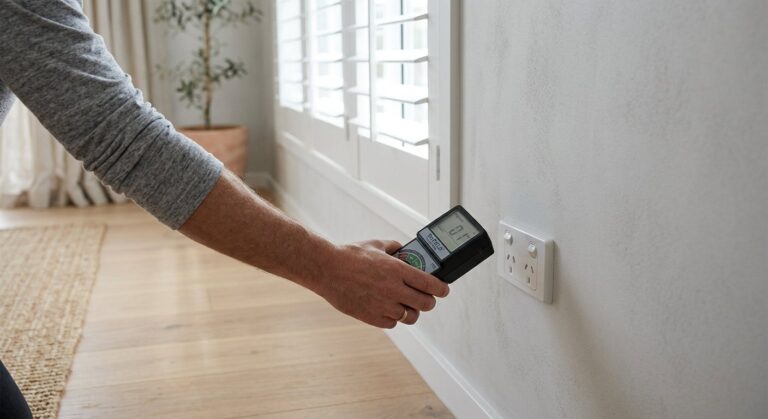
A calibrated RF meter gives you real numbers. Two meters are worth knowing about. The TriField TF2 measures AC magnetic, AC electric, and RF in one unit — it reads from 20 MHz to 6 GHz, which covers Wi-Fi (2.4 GHz and 5 GHz), 4G LTE, and 5G sub-6 GHz bands. It does not cover millimetre wave (mmWave) 5G above 24 GHz, but mmWave 5G has almost no residential penetration in Australia as of 2026 — it is used for dense urban hotspot deployments, not suburban networks.
The Safe and Sound Pro II is an RF-only meter with higher sensitivity and a mode-specific peak-hold function. For identifying pulsed sources like smart meters, it is more useful than the TriField because it captures burst peaks rather than averaging them away. At Palm Beach, I use the TriField TF2 for whole-room sweeps; the Safe and Sound Pro II is rated to capture burst peaks rather than averaging them, which the manufacturer positions for identifying specific devices and smart meter transmission patterns.
EMF Meters — Measure Before You Act
Full EMF meter comparison guide →Step 2: Eliminate the Highest-Exposure Sources First
Phone use is your biggest lever. Two changes cost nothing and deliver the largest exposure reduction available to you. First: use speakerphone or wired earphones — not Bluetooth — for voice calls. Air-tube earphones eliminate the conductive wire running to the ear canal. Second: put your phone on aeroplane mode at night. A phone searching for signal in a low-coverage bedroom can spike transmit power significantly. Aeroplane mode cuts RF output to zero.
For the bedroom specifically, a mechanical timer on the Wi-Fi router is the next highest-impact action. The HPM 24 Hour Analog Timer (Amazon AU ASIN B081JD8LXN, approximately $20) cuts router power during sleep hours without any app or smart home setup. Standard Wi-Fi routers emit continuous pulsed RF. Cutting them for eight hours reduces your cumulative overnight exposure substantially.
HPM 24 Hour Analog Timer
~$20 on Amazon AU • Cuts router RF during sleep • No app or smart home required
Step 3: Address Bedroom AC Electric Fields
This is separate from RF. Australian residential wiring emits AC electric fields at 50 Hz even when devices are switched off — as long as the circuit is live. In a bedroom, this means the cable running behind your bedhead can maintain a 5-50 V/m field at the pillow position throughout the night. The building biology guideline is below 5 V/m in sleeping areas.
A demand switch, installed by a licensed electrician on the bedroom circuit, cuts power to that circuit when no load is drawn — eliminating the field during sleep. Cost is typically $100 to $150 installed. It reinstates automatically when you switch on a light or device. This is one of the highest-impact low-cost interventions available and requires no ongoing maintenance.
Step 4: Reduce Smart Device Density in Sleeping Areas
Every smart speaker, smart TV, smart thermostat, and Wi-Fi-connected device in your bedroom is emitting pulsed RF on its own polling cycle. Most of these devices transmit every few seconds even when “idle.” Removing them from the sleeping area or switching them to a physical off state (not standby) is free. In a typical Brisbane or Sydney home with 6 to 10 smart devices, this can drop bedroom RF from 1-10 µW/cm² to below 0.1 µW/cm².
Step 5: Shield Only After Sources Are Addressed
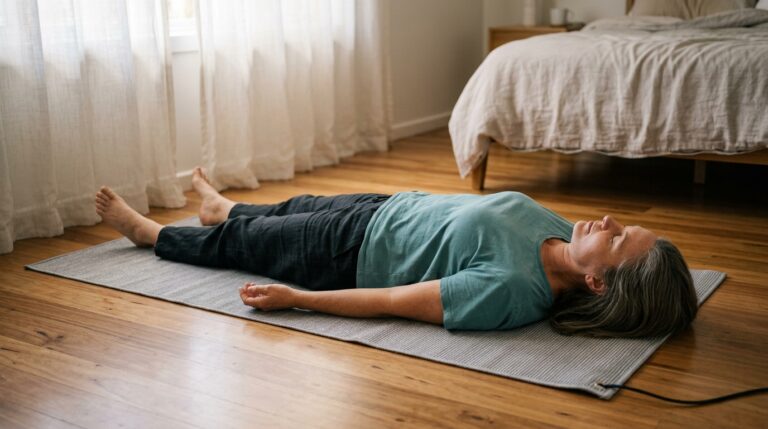
Shielding has a specific role: blocking external RF that you cannot eliminate at the source. This applies primarily to people living within 100 metres of a 5G small cell, within 50 metres of a smart meter array, or in dense urban environments where ambient RF from multiple infrastructure sources is actually elevated on a TriField measurement. An EMF bed canopy with 42 dB attenuation — available through SaferEMF AU — can reduce external RF penetrating a sleeping area. But if your primary sources are inside the room, a canopy reflects and concentrates them. This is the most expensive and most commonly misapplied EMF intervention. Measure. Eliminate internal sources. Then shield external residual.
5G mmWave in Australia: Is It Different?
Millimetre wave 5G operates above 24 GHz — in Australia, the 26 GHz band is the primary mmWave allocation, used by Telstra and Optus for ultra-high-density urban deployments. At these frequencies, the physics change significantly. Penetration depth into tissue is measured in fractions of a millimetre — the energy is absorbed almost entirely at the skin surface rather than deeper tissues. AMTA notes this shallower absorption profile directly.
Range is also dramatically shorter. A 26 GHz 5G small cell covers roughly 100 to 200 metres under line-of-sight conditions. It is blocked by walls, glass, trees, and rain. As of mid-2026, mmWave 5G in Australia is confined to specific stadium venues, CBD corridors in Sydney and Melbourne, and select transport hubs. It has essentially zero penetration into residential areas. The 5G your home is exposed to is overwhelmingly sub-6 GHz — primarily 3.5 GHz — which behaves much more like 4G LTE in terms of propagation and tissue interaction.
The practical implication: if you live in Penrith, Ipswich, Rockingham, or any suburban Australian location, mmWave 5G is not yet a relevant exposure source. Sub-6 GHz 5G is present and measurable, but as noted above, ambient levels are well within ranges already present from 4G infrastructure, which has been deployed since 2011. This is not new exposure territory for most Australians — it is an extension of an existing RF environment.
What to Do If You Live Near a 5G Tower — A Direct Answer
Measure it. Do not guess. A TriField TF2 reading at the bedhead position — with all indoor sources off — will tell you what your actual external RF contribution is. If it reads below 0.01 µW/cm², the tower is not a material exposure contributor. If it reads above 0.1 µW/cm², you have something worth addressing with targeted shielding of the window or wall facing the tower.
Most people who measure find their readings spike the moment they turn their Wi-Fi router back on, not because the tower is dominant but because they have been attributing indoor source readings to outdoor infrastructure. That is the value of measurement — it replaces anxiety with data.
If you are in an inner-Sydney apartment within 50 metres of a 5G small cell on a light pole, or in a Melbourne CBD flat with a rooftop array, external RF may be a genuine measured contributor. In that case, a shielding canopy rated to the relevant frequency range (confirm the canopy’s attenuation specification covers 3.5 GHz) with all internal sources eliminated is a defensible and practical intervention.
For 95% of Australian households — including suburban Brisbane, Perth, Adelaide, and most of regional Australia — the 5G tower is not the limiting factor in their RF exposure profile. Their phone, their router, and their bedroom smart speaker array are.
Last reviewed: May 2026 — Clean and Native
Frequently Asked Questions
Measured 5G RF exposure from tower infrastructure in Australian cities is typically 1,000 to 10,000 times below ARPANSA’s RPS S-1 safety limit. That limit is set at the thermal injury threshold. Evidence for harm at the levels Australians are currently exposed to from 5G infrastructure is not established. Non-thermal biological effects at lower levels remain an active area of research without definitive regulatory consensus.
ARPANSA’s RPS S-1 standard sets the general public RF limit at 1,000 µW/cm² at 2.4 GHz, scaled by frequency above that. At 3.5 GHz — the primary Australian 5G mid-band — the scaled limit is approximately 450 µW/cm². Australia adopts the ICNIRP 2020 framework, the same standard used across the European Union and United Kingdom.
Use a calibrated RF meter that covers the 3.5 GHz range. The TriField TF2 reads from 20 MHz to 6 GHz and covers sub-6 GHz 5G, Wi-Fi, and 4G bands. The Safe and Sound Pro II offers higher RF sensitivity with peak-hold for detecting pulsed sources. Measure with all indoor sources off first to establish your external RF baseline, then identify indoor sources by turning them on one at a time.
Sub-6 GHz 5G (primarily 3.5 GHz in Australia) does penetrate standard timber-frame and brick walls, though with significant attenuation. A brick wall typically reduces 3.5 GHz signal by 15 to 30 dB. mmWave 5G at 26 GHz is stopped by walls almost entirely, but mmWave is only deployed in dense urban commercial areas in Australia as of 2026 — not in residential suburbs.
Your phone, at contact with your body, produces far higher localised RF exposure than any 5G tower at typical residential distances. SAR during a voice call can approach 1.5 W/kg at the head — a function of direct proximity to the antenna. A 5G tower at 200 metres delivers measured ambient exposure well below 0.01 µW/cm² at the street in most Australian suburbs. Distance drives this difference, via inverse square law.
A shielding canopy rated to 3.5 GHz with sufficient attenuation (look for 40+ dB at that frequency) can reduce external 5G RF penetrating a sleeping area. They only work if the primary source is external to the canopy. If your phone, router, or smart devices are inside or near the canopy, it will reflect their emissions and can increase exposure. Remove all internal RF sources before considering external shielding.
No. Australia’s RPS S-1 standard matches ICNIRP 2020, which is the same framework used across the EU. Some European countries — Switzerland, Italy, Belgium — apply additional precautionary limits for infrastructure siting near residences that are more conservative than ICNIRP, but these are policy choices rather than different scientific standards. Australia does not currently apply additional siting restrictions beyond ICNIRP compliance.
Put your phone on aeroplane mode at night and move it out of the bedroom. This alone eliminates your closest-proximity RF source during the 7 to 9 hours you spend sleeping. A mechanical timer on your Wi-Fi router (approximately $20) to cut power during sleep hours is the next-highest-impact action. Both cost less than $25 combined and require no ongoing maintenance.
mmWave 5G at 26 GHz is absorbed at the skin surface and does not penetrate into deeper tissue the way lower frequencies do. It has significantly shorter range and is blocked by ordinary building materials. In Australia as of 2026, mmWave deployment is limited to select CBD corridors and venues in Sydney and Melbourne — it is not present in residential suburbs. Sub-6 GHz 5G at 3.5 GHz is the technology present near Australian homes.
Measure first. Most people who measure with a calibrated RF meter find their indoor sources (phone, router, smart speakers) produce higher readings than external 5G infrastructure. If measurement confirms elevated external RF from nearby infrastructure, targeted shielding of the relevant window or wall — after eliminating internal sources — is a practical response. Anxiety without measurement data is not actionable.
Get the Australian Home Environment Checklist
30 checks across water, air and EMF. Most of them free. Ranked by impact.
No spam. Unsubscribe any time.
Former Royal Australian Navy Clearance Diver and TAG-E counter-terrorism operator. Founded Clean and Native to apply the same rigorous thinking to the home environment.
Full biography →