Should You Test Your Water Before Buying a Filter? (Australia 2026 Guide)
Testing your tap water before buying a filter isn’t optional — it’s the step that determines whether your filter actually works. Without knowing your specific contaminants, you risk spending $600 on a system that leaves your biggest problem completely untouched. I have not personally tested the My Water Score lab kits or the 18-in-1 test strips discussed here; this assessment is based on published product specifications, NATA-certification standards, and independent data, not first-hand use. The only water product I measure first-hand is the EcoHero 5-Stage RO at my Palm Beach home.
Quick Verdict — Water Testing Australia 2026
You should test your water before buying a filter. A NATA-certified lab test reveals your actual contaminant profile — making it the only reliable way to match a filter to your specific water. For most Australian households on mains water, the My Water Score Mains Essentials kit ($419) is the definitive pre-purchase test. If you want a quick DIY indicator before committing, the 18-in-1 test strips ($23.99) give you a baseline in minutes.
| Option | What it tells you | Verdict |
|---|---|---|
| MWS Lab Test ($419) | NATA-certified full panel — 18+ heavy metals, chlorine, fluoride, water balance | Recommended |
| 18-in-1 DIY Strips ($23.99) | Quick indicator check: hardness, chlorine, lead, fluoride, pH — 18 parameters | Good starting point |
| No test at all | Guess-based filter selection | Avoid |
What your tap water report doesn’t tell you
Every water utility in Australia publishes an annual water quality report. Brisbane’s SEQ Water reports chlorine residuals within ADWG guidelines. Sydney Water reports fluoride at 0.9–1.0 mg/L. These reports are real — but they’re measuring water as it leaves the treatment plant, not as it arrives at your tap.
By the time water travels through kilometres of ageing distribution mains and your home’s internal plumbing, the profile can change substantially. Lead and copper leach from older fittings and solder joints, particularly in homes built before 1990. Iron and manganese from corroding pipes settle into uneven concentrations across suburbs — sometimes 10× higher at the end of a dead-end main than at the trunk line. Iron bacteria can colonise slow-flow sections and produce biofilm that never shows up in a utility report.
Seasonal variation adds another layer. Queensland’s SEQ grid switches between chlorine and chloramine disinfection based on source water and seasonal demand — a carbon filter that handles your water fine in winter may leave you with off-tasting chloramine-treated water in summer. The utility report averages across the year. Your palate doesn’t.
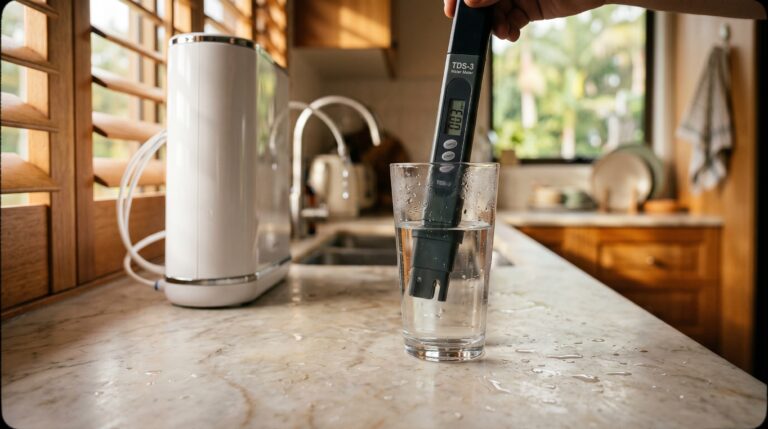
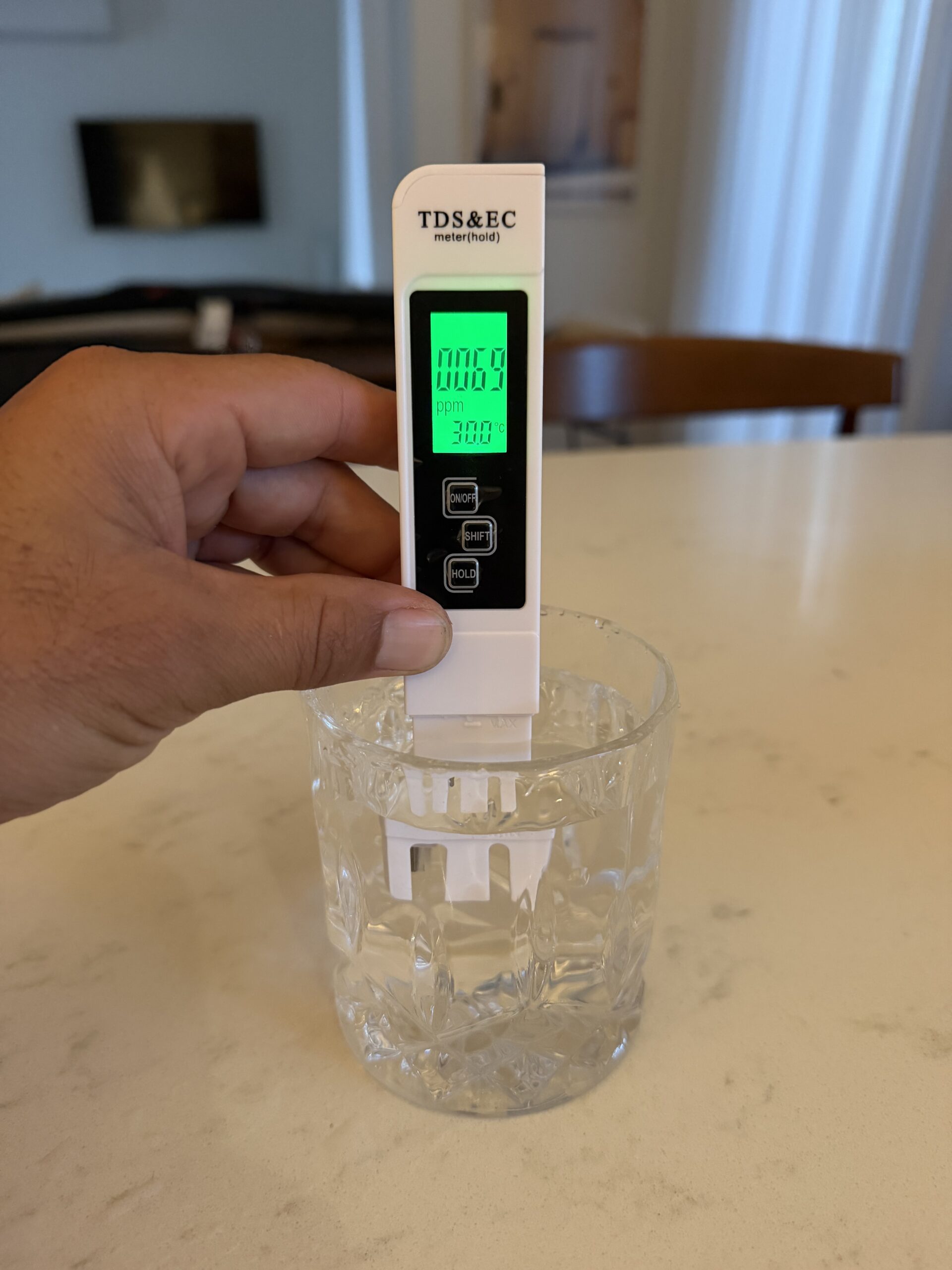
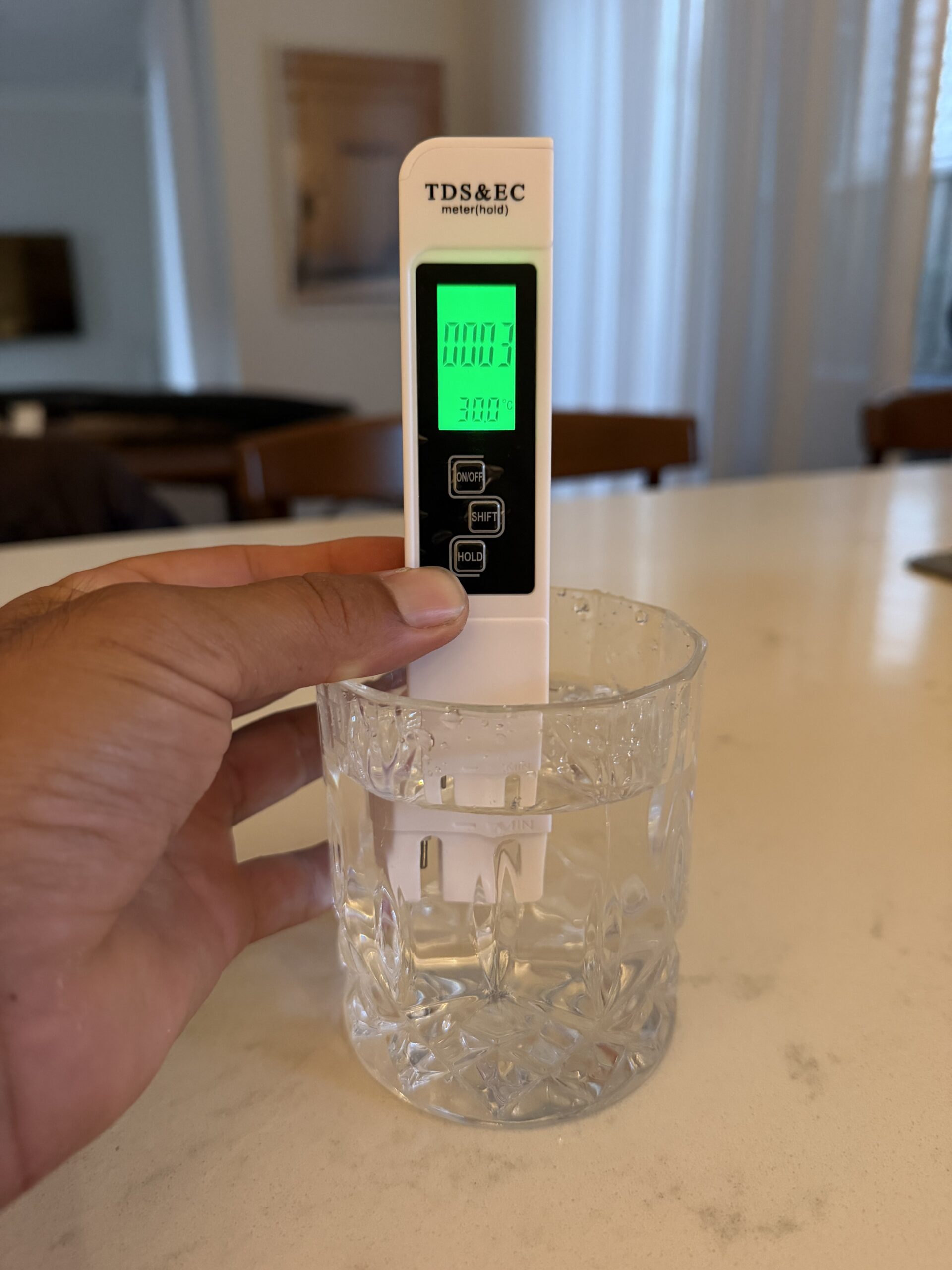
When I measured the tap water at my Palm Beach, QLD home with a TDS meter, the mains reading came in at 69 ppm TDS — within normal range for SEQ, but with seasonal chloramine peaks that standard carbon block couldn’t reliably handle. After installing a 5-stage RO system, post-filter TDS dropped to 3 ppm — a 95.7% reduction. Neither number appeared in any utility report. Both numbers determined which filter was worth buying. This is exactly why testing matters: the report tells you what the water authority is managing; a test tells you what you’re drinking.
PFAS contamination is the clearest example of the report-reality gap. Australia’s ADWG now includes health-based guidance values for PFOA and PFOS, but reporting is patchy — many utilities don’t test their distribution network at the point of use, only at the treatment plant. Independent PFAS contamination studies have found elevated levels in residential taps near industrial sites and airports well below any reported exceedance at the treatment stage. If you live near a defence base, airport, or industrial estate, a PFAS-specific test is the only way to know what’s in your glass.
The real cost of buying a filter without testing first
The most expensive filter you will ever buy is one that doesn’t fix your problem. A $450 gravity filter loaded with carbon will do nothing for fluoride — only reverse osmosis achieves 90–97% fluoride reduction. A standard GAC filter removes free chlorine effectively but handles chloramine at roughly 1/40th the rate — if you’re on Brisbane, Sydney, Adelaide, or Gold Coast mains water, that filter is doing almost nothing for disinfection taste. A $300 benchtop RO is overkill if your water is already soft Melbourne mains with trace chlorine — a $80 carbon block does the same job.
Here’s what “buying without testing” actually costs Australian households each year:
| Filter type | Removes fluoride? | Removes chloramine? | Removes heavy metals? |
|---|---|---|---|
| Standard GAC (Brita, most jugs) | ✗ No | ✗ Barely (1/40 rate) | Partial |
| Catalytic carbon block | ✗ No | ✓ Yes | Partial |
| Gravity filter (Berkey etc) | ✗ No (without PF-2) | ✓ Yes (Black Elements) | ✓ Yes |
| Reverse osmosis (NSF/ANSI 58) | ✓ 90–97% | ✓ Yes | ✓ Yes |
The point: every filter type has a specific contaminant profile it’s designed for. Without knowing what’s in your water, you cannot make an informed selection. A $23.99 test before a $600 filter purchase is the highest-return $23.99 you’ll spend this year — and a $419 professional lab test before a $1,500 whole-house system is even more non-negotiable. Read the full breakdown in our Australian water filtration guide for a complete comparison of filter technologies.
Lab test vs DIY test strips — which should you start with?
There are two ways to test your water at home: DIY test strips that give you a result in two minutes, and professional lab analysis that takes 5–7 days and gives you quantified results against Australian Drinking Water Guidelines. Both have a place — but the decision about which to use first comes down to what you’re planning to buy.
| DIY Test Strips | Professional Lab Test | |
|---|---|---|
| Cost | $15–$35 (125 strips) | $219–$599 |
| Time to result | 2 minutes | 5–7 business days |
| Parameters tested | 18 (indicator-level: hardness, chlorine, lead, fluoride, pH, nitrate, etc) | 50+ (quantified: full metals panel, PFAS, disinfection byproducts, microbiologicals) |
| Accuracy | Indicator only — tells you “present / elevated / safe range”, not exact mg/L | Quantified — exact mg/L compared against ADWG limits, NATA-certified |
| Detects PFAS? | No | Yes (PFAS bundle) |
| Best for | Monitoring after filter install; quick hardness/chlorine check; renters who won’t invest in full testing | Pre-purchase due diligence; filter performance verification; PFAS/heavy metal concern; buying a system over $400 |
Decision rule: If you’re about to spend $400 or more on a filter, a lab test is non-negotiable. The $419 test pays for itself in filter-selection certainty alone. If you’re renting, monitoring your existing filter’s performance, or just want a quick baseline before deciding whether to test further, start with DIY strips — they’ll tell you whether hardness, chlorine, or lead is obviously elevated, which is often enough to direct the next step.
The best water testing options for Australian homes (2026)
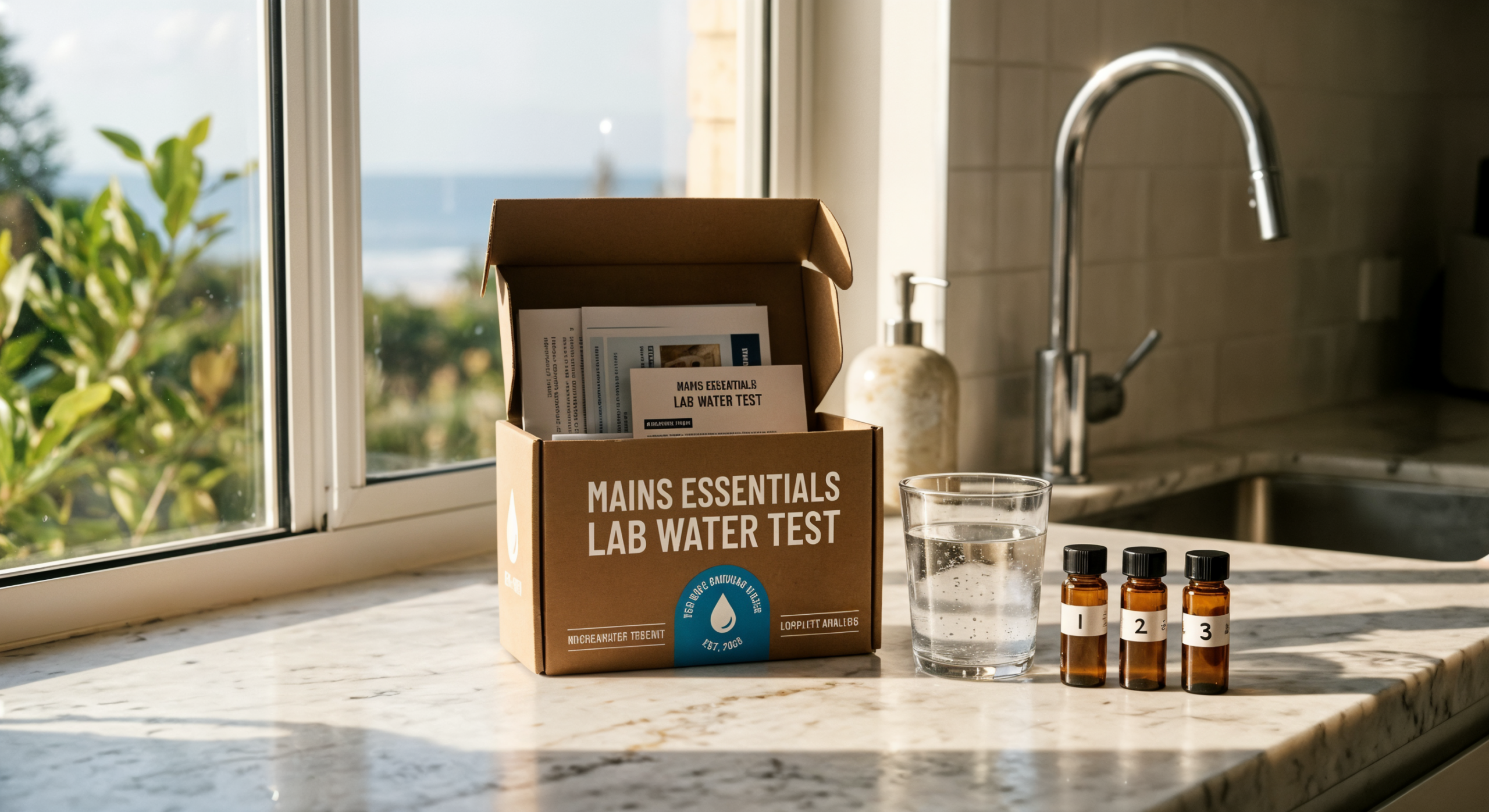
1. My Water Score — Mains Water Essentials Test & Kit ($419)

My Water Score — Mains Essentials Test & Kit
NATA-certified comprehensive lab analysis of 18+ heavy metals, water balance, chlorine, and fluoride — with sample collection kit included. Full results within 5–7 business days, benchmarked against Australian Drinking Water Guidelines.
$419 from My Water Score →My Water Score is the most rigorous consumer water testing service available in Australia for mains water. Every test is processed through a NATA-accredited laboratory — the same certification standard used by state health departments. You’re not getting an import strip result or a basic at-home kit; you’re getting the same analytical methodology a health regulator would use.
The Mains Essentials kit is purpose-built for households on treated town water. It tests 18 heavy metals (including lead, arsenic, cadmium, chromium, mercury), total hardness, water balance, free and total chlorine, chloramine, fluoride, pH, turbidity, and total dissolved solids. The collection kit provides pre-labelled sampling bottles and clear instructions — you take the samples from your cold tap (first-draw and after-flush protocols included), seal them in the pre-paid return mailer, and receive your Certificate of Analysis by email within 5–7 business days.
What separates MWS from cheaper mail-in services is the report format: every result is listed alongside the Australian Drinking Water Guideline limit, with a clear “within guideline / elevated / exceedance” classification. You don’t need a chemistry background to act on it. If lead is elevated, they recommend a filter that addresses lead specifically. If fluoride is at guideline (0.6–1.1 mg/L), they’ll tell you whether that matters given your household’s situation. It’s the kind of actionable intelligence that turns a test into a purchase decision.
We recommend this test before buying any filter over $400. A $419 test in front of a $1,200 RO system purchase is the best money you’ll spend on your home’s water — it’s the only way to verify the RO is actually solving your problem, and not just giving you very pure water you didn’t need to pay that much for.
Mains Essentials — Pros and Cons
Pros
- NATA-certified laboratory — same standard as state regulators
- 18+ heavy metals panel, not just a basic screen
- Results benchmarked against ADWG — no interpretation needed
- Collection kit included — no separate purchase required
- Actionable filter recommendations included with report
- Australian-based testing and support
Cons
- 5–7 day turnaround — not instant like strips
- $419 upfront cost — not suitable for renters who won’t buy a filter
- Does not include PFAS by default (requires the bundle upgrade at $599)
Buy if: you’re about to spend $400+ on a filter, you have any heavy metal concern, or you’re in a home built before 1990 and haven’t tested your tap water in the last three years. Check price →
2. 18-in-1 Drinking Water Test Strips ($23.99)
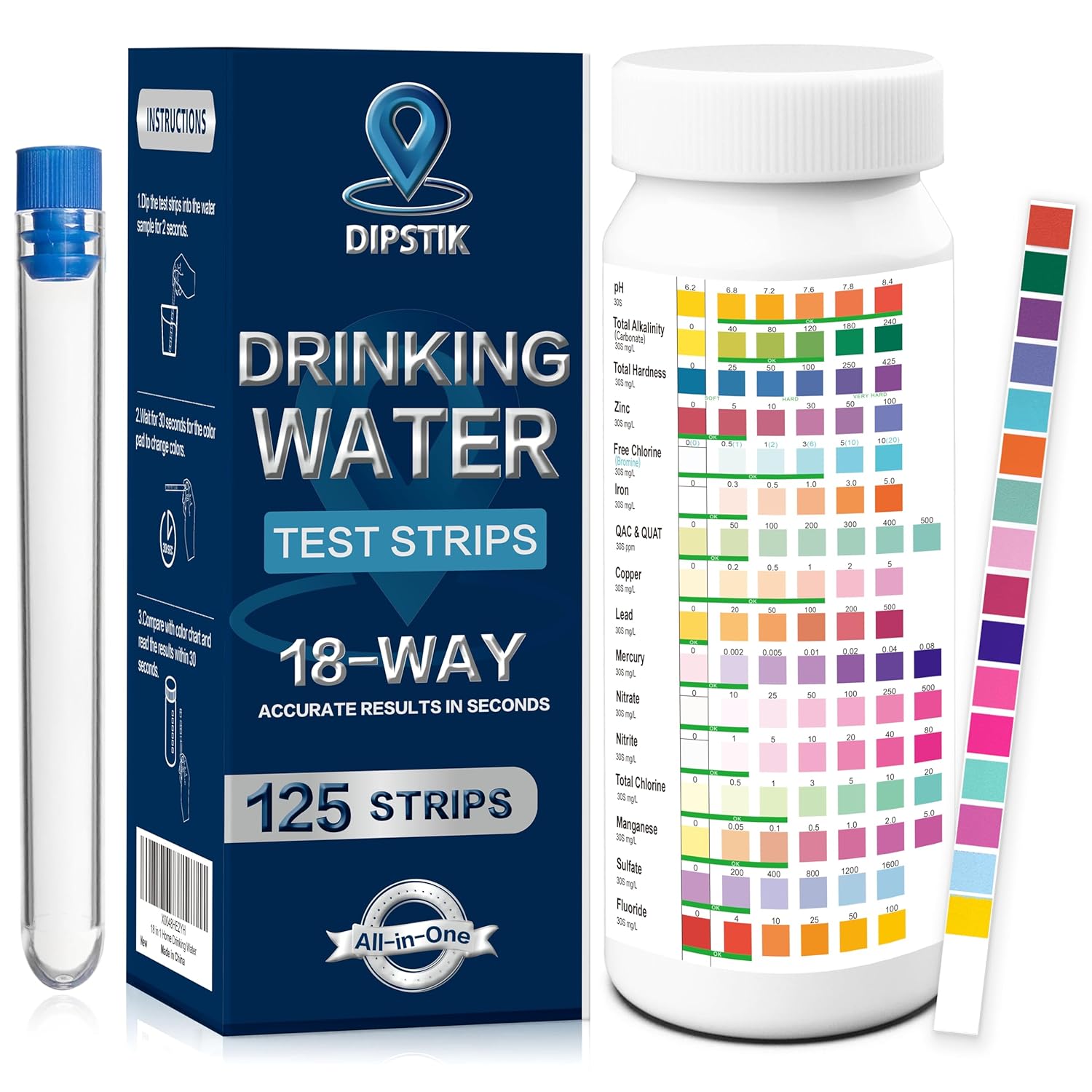
18-in-1 Drinking Water Test Kit — 125 Strips
Fast DIY check for 18 water quality parameters including hardness, chlorine, lead, iron, copper, fluoride, pH, nitrate and nitrite. Results in 60 seconds — 125 strips per pack for ongoing monitoring.
$23.99 on Amazon AU →With over 1,600 reviews at 4.2 stars on Amazon AU, these 18-in-1 test strips are the most practical entry point for Australian households who want a snapshot of their water quality before committing to a full lab test. Each strip tests for: total hardness, chlorine (free and total), lead, iron, copper, fluoride, pH, total alkalinity, nitrate, nitrite, carbonate, manganese, cyanuric acid, and total bromine — 18 parameters that cover the most common household concerns.
The strips work by dipping the strip into a tap water sample for the prescribed time, then comparing the colour change against the included chart. Results are indicative, not quantified — you’ll learn that your water is “hard” or that chlorine is “elevated”, but not the precise mg/L reading. For most people deciding between a basic carbon filter and a full RO system, that’s enough signal. Elevated lead on a strip means “get a lab test immediately and consider an RO or certified lead-reduction cartridge.” Moderate hardness means “a water softener might be worth considering.” Low TDS and normal chlorine means “a basic carbon block is probably sufficient.”
At 125 strips per pack and $23.99, you have strips for ongoing monitoring — testing monthly after installing a filter to confirm it’s still performing, testing seasonal variation, testing at different taps in your home. This makes them the better value tool post-purchase, not just pre-purchase. The strips will not detect PFAS — for that, you need the MWS PFAS bundle below.
18-in-1 Test Strips — Pros and Cons
Pros
- $23.99 for 125 strips — excellent ongoing monitoring value
- Results in 60 seconds — no waiting
- 18 parameters covers the main household concerns
- Great for post-install filter monitoring
- 4.2 stars, 1,600+ Amazon AU reviews
Cons
- Indicator-level only — no exact mg/L quantification
- Cannot detect PFAS, chloramine specifically, or bacteria
- Colour comparison can be subjective in bright light
- Not NATA-certified — results can’t be used for regulatory purposes
Buy if: you’re renting and won’t buy a major filter, you want to monitor an existing filter’s performance, or you want a quick baseline before deciding whether to invest in a full lab test. Check price →
3. My Water Score — PFAS + Mains Bundle ($599)
My Water Score — PFAS + Mains Bundle
Full mains water panel plus a comprehensive PFAS screen — the only consumer lab test in Australia that covers both heavy metals and PFAS contamination in a single collection kit. Essential for homes near airports, defence bases, or industrial areas.
$599 from My Water Score →PFAS (per- and polyfluoroalkyl substances) are the contaminants that standard water testing doesn’t catch — and standard filters don’t remove. Known as “forever chemicals,” they accumulate in the body and have been linked in Australian research to immune system disruption and increased cancer risk at sustained exposures. Australia’s ADWG introduced health-based guidance values for PFOA and PFOS in 2018, but testing in distribution networks remains inconsistent.
The MWS PFAS + Mains Bundle adds a full PFAS screen to the standard Mains Essentials panel — covering PFOA, PFOS, PFBS, PFHxS, PFNA, and other PFAS compounds against current ADWG guidance values. If you live within 10 kilometres of a military base, airport, firefighting training area, or industrial manufacturing site, this test is essential before buying any filter. Only reverse osmosis (NSF/ANSI 58 certified) reliably removes PFAS — if your results come back elevated, that narrows your filter decision significantly.
The $599 bundle includes the same collection kit and 5–7 day NATA-certified turnaround as the standard Mains Essentials test. The PFAS screen alone typically costs $180–$250 from commercial labs — getting both in one kit at $599 represents genuine value for households with any realistic PFAS exposure risk.
Buy if: you live within 10km of a defence base, airport, or industrial area — or if you’re in a known PFAS-affected catchment and need certainty before choosing a filter. Check price →
Ready to test your water?
Get your NATA-certified result before buying any filter. The Mains Essentials kit covers 18+ heavy metals, chlorine, and fluoride — everything you need to make an informed filter purchase.
How to read your water test results and choose the right filter
Once your lab results come back, the report will show each parameter alongside its ADWG guideline value and a clear status. Here’s how to interpret the most common findings and what they mean for your filter choice:
| Parameter | Result signals | Filter response |
|---|---|---|
| TDS <50 ppm | Very soft, low mineral water | Carbon block sufficient for taste; remineralise if drinking RO |
| TDS 50–150 ppm | Normal mains range (most AU capitals) | Depends on disinfection type — see chloramine row below |
| TDS 300–500 ppm | Hard water (Perth, Adelaide) | RO or water softener recommended; scale risk in kettles/appliances |
| Chloramine detected | Brisbane, Sydney, Adelaide, Gold Coast — standard disinfectant | Requires catalytic carbon or RO — standard GAC is inadequate |
| Fluoride 0.6–1.1 mg/L | Within ADWG guideline (deliberately added) | Only RO (90–97%) or activated alumina removes fluoride — no carbon filter works |
| Lead >0.01 mg/L | Old internal plumbing or fittings leaching | NSF/ANSI 53 certified lead-reduction filter or RO immediately |
| PFAS detected | Elevated PFAS — point-source contamination | RO (NSF/ANSI 58) only — no carbon or gravity filter is certified for PFAS removal |
Chloramine cities vs free chlorine cities: This is the single most important filter-selection fact for Australian households. Brisbane, Sydney, Adelaide, Gold Coast, and Darwin use chloramine as their primary disinfectant — a compound that standard GAC (Brita, most jug filters) removes at roughly 1/40th the rate of free chlorine. If you’re in a chloramine city and using a standard GAC filter, you’re getting almost no disinfection reduction. The correct response is catalytic carbon, compressed carbon block, or RO — whichever matches your budget and TDS profile. Melbourne, Hobart, Canberra, Townsville, and Cairns use free chlorine — standard carbon works fine in these cities.
Once you have your results in hand, our complete water filtration guide walks through every technology category — from benchtop carbon blocks to under-sink RO systems — with Australian pricing and honest performance data. If your results indicate you need RO and you want to see how the leading systems compare, our EcoHero 5-stage RO review covers real-world performance data from our own Palm Beach installation.
When to test again after installing a filter
Testing doesn’t end at purchase — it’s the start of an ongoing monitoring habit. Here’s when to retest:
- 90 days after installation: Confirm your filter is reducing the specific contaminants your initial test identified. A post-filter TDS reading with DIY strips is the minimum — a full lab test is ideal if you’re on a high-TDS feed water.
- After any filter cartridge change: New cartridges occasionally have off-gassing periods, and some lower-cost replacements don’t perform to spec. A quick strip test after the first week confirms performance.
- After any plumbing work: Disturbing pipes can mobilise settled sediment, biofilm, and pipe-wall material. Retest if anything was worked on within your home’s internal plumbing.
- If your water changes taste, smell, or appearance: Don’t ignore this. Changes in source water quality — from algal blooms, infrastructure failures, or seasonal variation — show up in taste before they appear in utility reports.
- Annually: One strip test per year maintains your baseline and catches seasonal variation. A full lab test every 2–3 years is good practice for homes on ageing plumbing.
Get your baseline before you buy
Every filter recommendation on this site starts with knowing your water. The My Water Score Mains Essentials test is the fastest way to get a NATA-certified result that actually informs a filter purchase.
Frequently asked questions
Is it worth testing water before buying a filter?
Yes — testing before buying is the only way to confirm which contaminants are actually present in your water. Without test data, you risk purchasing a filter that addresses the wrong problem. A $23.99 DIY strip test or $419 NATA-certified lab test before a $500–$1,500 filter purchase is one of the highest-return investments you can make.
What does a water quality test actually measure?
Depending on the test type: DIY strips measure 12–18 parameters at indicator level (present/elevated/safe). Professional lab tests measure 50+ parameters quantitatively — exact mg/L concentrations benchmarked against Australian Drinking Water Guidelines. PFAS tests measure specific PFAS compounds against ADWG health-based guidance values.
How accurate are DIY water test strips?
DIY test strips are accurate for presence/absence detection and broad range categorisation (e.g. “hardness elevated: 200+ mg/L”), but they do not provide quantified results. Colour-comparison accuracy depends on lighting conditions and the tester’s colour perception. For regulatory purposes or filter performance verification, only a NATA-certified lab test is acceptable.
Do I need to test if I’m on city mains water?
Yes — utility water quality reports measure at the treatment plant, not at your tap. Pipe condition, distance from the main, and your home’s internal plumbing all affect what comes out of your tap. In older homes particularly, lead and copper from fittings and solder are a real concern that the utility report won’t capture.
How often should I test my tap water?
For most households: one DIY strip test annually is a reasonable baseline. A full lab test every 2–3 years. After any plumbing work. After installing or changing a filter. If water tastes, smells, or looks different from usual.
Can I test for PFAS at home with strips?
No. PFAS detection requires laboratory analysis — the molecules are too small and chemically specific to detect with consumer test strips. The My Water Score PFAS + Mains Bundle ($599) is the most accessible consumer-facing lab test in Australia that includes a PFAS screen.
What does TDS mean on a water test result?
TDS stands for Total Dissolved Solids — it measures all dissolved minerals, salts, and metals in milligrams per litre (mg/L or ppm). In Australia, mains water typically reads 50–200 ppm TDS. Melbourne is very soft (~60 ppm), Brisbane moderate (~80–115 ppm), Adelaide and Perth hard (300–500+ ppm). A TDS reading alone doesn’t tell you which specific minerals or contaminants are present — for that, you need a full panel test.
Does boiling water remove PFAS, heavy metals, or fluoride?
No. Boiling kills bacteria and some pathogens, but it does not remove PFAS, heavy metals, fluoride, chloramine, or dissolved minerals. It can actually concentrate some contaminants by evaporating water volume. Boiling is not a substitute for filtration.
My water utility says it’s safe — do I still need to test?
Water utility compliance with ADWG doesn’t mean your tap water is contamination-free — it means the utility met guideline thresholds at the point of measurement (typically the treatment plant). Guideline values are also set as safety margins for population exposure, not zero-risk targets. Independent testing at your specific tap gives you the actual data for your home.
Get the Australian Home Environment Checklist
30 checks across water, air and EMF. Most of them free. Ranked by impact.
No spam. Unsubscribe any time.

Former Royal Australian Navy Clearance Diver and TAG-E counter-terrorism operator. Founded Clean and Native to apply the same rigorous thinking to the home environment.
Full biography →