Berkey Water Filter Australia 2026 Guide
Berkey has no official Australian distributor, no WaterMark certification, and its Black Elements fail chloramine — the primary disinfectant in Brisbane, Sydney, Adelaide, and the Gold Coast. For Australian buyers, AquaTru Classic RO (countertop, NSF certified, no plumbing) and EcoHero 5-Stage (under-sink) are the verified alternatives that solve Australia’s actual water chemistry.
| Filter | What it does | Verdict |
|---|---|---|
| AquaTru Classic RO | Countertop RO, NSF 42/53/58, removes chloramine, fluoride 94%, PFAS | Best Overall |
| EcoHero 5-Stage RO | Under-sink RO, highest throughput, full household daily volume | Best Under-Sink |
| Tappwater EcoPro | Catalytic carbon benchtop, chloramine removal, no plumbing, $149 | Best Value |
✓ Who This Guide Is For
- Brisbane, Sydney, Adelaide, and Gold Coast households who need certified chloramine removal
- Anyone who researched Berkey and found no official Australian distributor or ACL warranty
- Renters wanting a countertop or benchtop filter with no plumbing required
- Households needing confirmed fluoride removal — verified by NSF/ANSI 58, not just claimed
- Families in PFAS-affected suburbs: Williamtown NSW, Oakey QLD, Kwinana WA
✗ Who This Guide Is Not For
- Melbourne and Hobart households with free-chlorine mains — a basic carbon block filter handles your water for less money
- Buyers committed to the grey-market Berkey import route: this guide outlines the risks rather than enabling that purchase
- Households with tank or rainwater requiring heavy sediment pre-filtration — a whole-house system is a better starting point
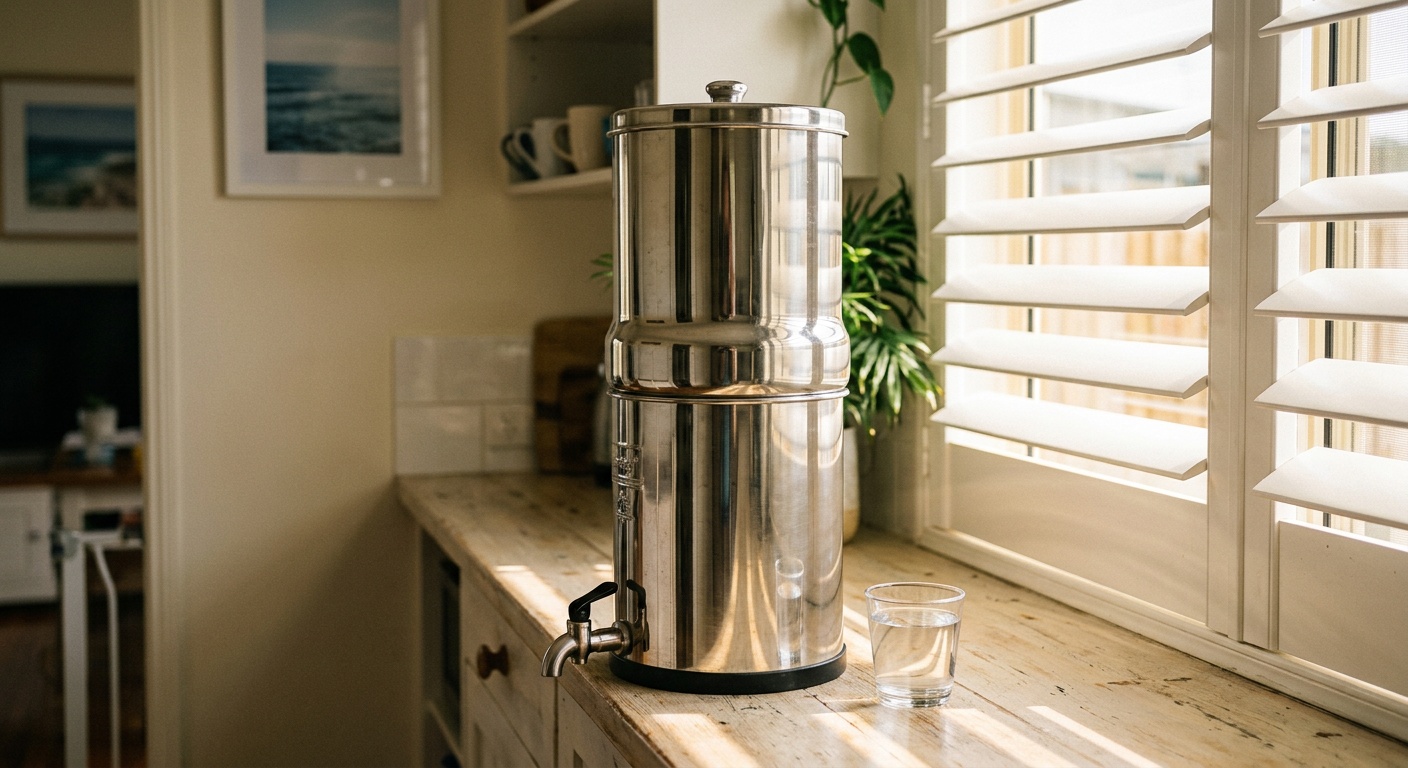
Berkey gravity filters are not sold through official channels in Australia, which creates real problems with warranty, filter authenticity, and replacement availability. This guide covers, based on published manufacturer specifications and independent certification data, what Berkey is rated to remove, where it falls short for Australian water chemistry, and which alternatives deliver verified performance with local certification and support. I have not personally tested the Berkey, AquaTru, Waterdrop, or Tappwater units discussed here; this assessment is based on published manufacturer specifications and independent certification (NSF/ANSI, WaterMark AS/NZS 3497), not first-hand measurement. The only water product I measure first-hand is the EcoHero 5-Stage RO.
Why Berkey Has No Official Presence in Australia
If you have been searching “Berkey water filter Australia” and landing on grey-market eBay listings or overseas Amazon storefronts offering to ship one here, you are not alone. Berkey (made by New Millennium Concepts, based in Texas) does not have an official Australian distributor, does not hold WaterMark certification to AS/NZS 3497, and has not submitted its Black Berkey Purification Elements for independent testing under Australian standards.
This matters more than it sounds. WaterMark certification is the Australian standard that verifies a water filtration product performs as claimed when connected to or used with Australian plumbing supplies. Without it, you have zero local warranty protection. If a filter element fails or your unit arrives damaged from a third-party seller, your only recourse is an international claim against a US-based company that has no obligation to Australian Consumer Law.
Berkey‘s situation in Australia mirrors its problems in other markets. In the United States, the Iowa Department of Natural Resources issued a warning in 2023 after testing showed some Berkey units did not meet the company’s own claimed performance specs. The EPA does not regulate gravity filters under the Safe Drinking Water Act, and Berkey’s NSF claims have been disputed — their Black Berkey elements are tested to “NSF/ANSI protocols” by internal or contracted labs, but the units themselves are not NSF-listed products. You will not find Berkey on the NSF International certified product database.
For Australian buyers, this creates a compounding problem: no WaterMark, no NSF listing, no TGA registration (which would apply if any therapeutic claims were made), and no local support. You are paying $350-450 AUD landed cost for a product with no verified performance data recognised by any Australian or international standards body.
What Berkey Actually Removes — and What It Misses in Australian Water
Berkey’s marketing claims are impressive on paper. The company states its Black Berkey elements remove greater than 99.9% of bacteria, 99.999% of viruses, and over 99% of chlorine, lead, and various organic compounds. Let us map these claims against what actually matters in Australian municipal water.
Australia’s drinking water is already disinfected at the treatment plant. According to the Australian Drinking Water Guidelines (ADWG 2024), all reticulated water supplies must meet microbial safety standards before reaching your tap. You are not filtering for bacteria or viruses in Brisbane, Sydney, Melbourne, or Perth — your water utility has already handled that. The Berkey’s headline pathogen removal claims solve a problem you do not have.
What you do need to address depends on your city:
| City | Disinfectant | Fluoride (mg/L) | Hardness (mg/L CaCO₃) | TDS (mg/L) | Key Concern |
|---|---|---|---|---|---|
| Brisbane / SEQ | Chloramine | 0.7-0.8 | 80-120 | 80-115 | Chloramine, fluoride, occasional PFAS |
| Sydney | Chloramine | 0.9-1.0 | 40-80 | 80-120 | Chloramine, fluoride, PFAS (western suburbs) |
| Melbourne | Free chlorine | 0.7-1.0 | ~25 | ~60 | Chlorine taste, fluoride |
| Adelaide | Chloramine | 0.7-0.9 | ~140 | ~400 | Chloramine, high TDS, hardness, fluoride |
| Perth | Free chlorine | 0.7-0.9 | ~180 | ~170 | Hardness, fluoride, PFAS (Rockingham, Kwinana) |
| Darwin | Chloramine | 0.5-0.7 | 40-80 | 60-100 | Chloramine, seasonal turbidity |
The Chloramine Problem
This is the single most important filter selection fact for Australian buyers, and where Berkey’s carbon-based filtration hits a wall. Four of Australia’s six largest cities — Brisbane, Sydney, Adelaide, and the Gold Coast — use chloramine, not free chlorine. Standard granular activated carbon (GAC) — the type of media in Berkey’s Black Elements — removes free chlorine effectively but removes chloramine at approximately 1/40th the rate. The contact time required for chloramine removal through GAC is so long that at typical gravity flow rates, meaningful removal is questionable.
If you live in Brisbane, Sydney, Adelaide, Gold Coast, or Darwin, a Berkey is fighting the wrong battle. You need catalytic carbon, compressed carbon block with extended contact time, or reverse osmosis to reliably remove chloramine. Berkey does not use catalytic carbon in its standard elements.
The Fluoride Problem
Berkey offers optional PF-2 fluoride reduction elements that sit below the Black Berkey elements. These use activated alumina, which can remove 80-95% of fluoride when conditions are right. The problem: flow rate, pH, and temperature all affect activated alumina performance, and Berkey’s PF-2 elements are not independently certified to NSF/ANSI 53 for fluoride reduction. You are trusting internal company testing, not third-party verification.
Carbon filters — including Berkey’s Black Elements without PF-2 add-ons — cannot remove fluoride. This is a chemistry fact, not an opinion. If fluoride removal is your priority, only reverse osmosis (90-97% removal) or properly staged activated alumina (80-95%) will get it done, and only RO has extensive independent certification behind it.
The PFAS Problem
According to the DCCEEW national register, PFAS contamination has been confirmed at 700+ sites across Australia. Suburbs like Williamtown (NSW), Oakey (QLD), Rockingham and Bullsbrook (WA), and Edinburgh (SA) have documented groundwater PFAS. Even reticulated water supplies in these areas may carry trace PFAS. Berkey claims some PFAS reduction, but again — no NSF/ANSI P473 (PFAS) certification. RO systems certified to NSF/ANSI 58 consistently achieve 90%+ PFAS rejection across the membrane.
Berkey vs Certified Alternatives: 5-Year Cost Comparison
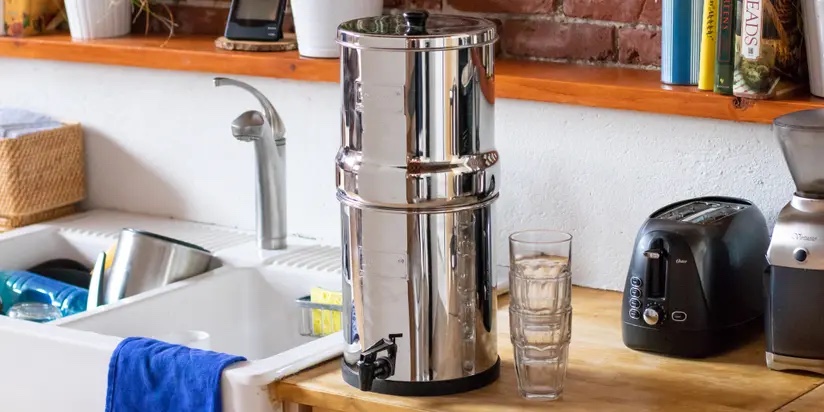
People choose Berkey because it seems cost-effective — no plumbing, no electricity, low filter replacement cost. Let us run the real numbers against certified alternatives and see whether that holds up over five years.
Assumptions: household of 2-3 people drinking approximately 4 litres per day (1,460 litres per year). All prices in AUD. Berkey pricing based on grey-market Australian landed cost (Amazon US with shipping or eBay AU).
| Product | Upfront Cost | Annual Filter Cost | 5-Year Total | Cost per Litre | Key Certs |
|---|---|---|---|---|---|
| Travel Berkey (grey market) | $380 | $90* | $830 | $0.11 | None (AU-recognised) |
| AquaTru Classic RO | $699 | $120 | $1,299 | $0.18 | NSF/ANSI 42, 53, 58, 401, P473 |
| Waterdrop D6 Under-Sink RO | $599 | $130 | $1,249 | $0.17 | NSF/ANSI 42, 53, 58 |
| Tappwater EcoPro (benchtop carbon) | $129 | $80 | $529 | $0.07 | NSF/ANSI 42 (chlorine only) |
| Bottled water (comparison) | $0 | $1,460 | $7,300 | $1.00-2.00 | FSANZ regulated |
*Berkey filter cost assumes replacement Black Berkey elements every 2 years at $180/pair (landed AU). PF-2 fluoride elements extra (~$120/pair, 12-month life), which adds ~$120/year and brings 5-year TCO to ~$1,430.
The Berkey looks cheap at first glance. But here is what the numbers hide: the moment you add PF-2 fluoride elements (which you need in every Australian city that fluoridates), your 5-year cost jumps from $830 to approximately $1,430 — and you still have no chloramine removal, no PFAS certification, and no local warranty. The AquaTru Classic at $1,299 over five years gives you NSF/ANSI 58-certified RO membrane rejection of fluoride, PFAS, chloramine, lead, and 80+ other contaminants.
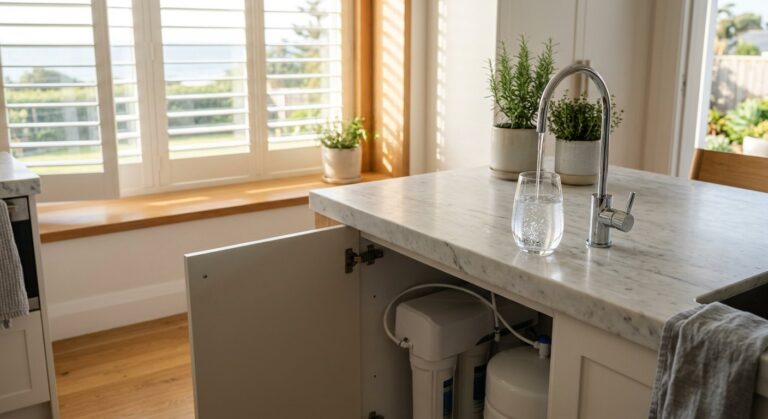
If you cannot modify your plumbing — renters in Sydney’s inner west, apartment dwellers in Brisbane’s South Bank, anyone in short-term leases — the AquaTru is the direct Berkey replacement. Sits on your benchtop, no plumbing required, plugs into a standard power outlet, and you take it when you move. If you own your home and can drill a hole in the benchtop, the Waterdrop D6 under-sink unit delivers higher flow rates and lower waste ratios at a similar 5-year cost.
Certified Alternatives to Berkey
Decision Tree: Which Filter Do You Actually Need?
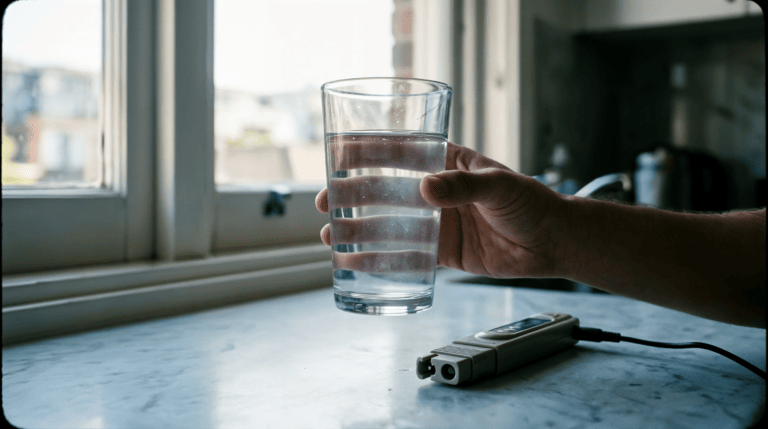
I’m Jayce Love, and I test my own tap water at Palm Beach, Queensland with a calibrated TDS meter and map those readings against SEQ Water’s published data. As a former Royal Australian Navy Clearance Diver, I learned that the right equipment for the conditions is everything — and the conditions in Australian municipal water are specific enough that a one-size-fits-all gravity filter does not cut it. Here is how to decide.
Question 1: Can you modify your plumbing?
No (renter, apartment, short-term lease): Countertop system. The AquaTru Classic RO sits on the bench, requires zero plumbing, and you take it with you when you move. This is the category where Berkey competes — and loses on certification.
Yes (homeowner, long-term lease with landlord permission): Under-sink RO. The Waterdrop D6 mounts under your sink, provides filtered water through a dedicated tap, and delivers higher flow rates than any countertop system. If you are in Adelaide (TDS ~400 mg/L) or Perth (hardness ~180 mg/L CaCO₃), an under-sink RO is particularly valuable because it reduces total dissolved solids that gravity and carbon filters cannot touch.
Question 2: Which city are you in?
Brisbane, Sydney, Adelaide, Gold Coast, Darwin — your water is treated with chloramine. Standard carbon filtration (Berkey, Brita, basic benchtop filters) removes chloramine at approximately 1/40th the rate of free chlorine. You need RO, catalytic carbon, or compressed carbon block with verified contact time. If chloramine removal is non-negotiable for you, RO is the only technology with consistent NSF/ANSI 58 certification behind it.
Melbourne, Hobart, Canberra, Toowoomba, Cairns, Townsville — your water uses free chlorine. Standard carbon filters handle chlorine well. A benchtop carbon filter like the Tappwater EcoPro is sufficient for taste and chlorine if fluoride and PFAS are not your concern. If fluoride removal is the goal, you still need RO — carbon cannot remove fluoride regardless of the disinfection type.
Question 3: What is your primary concern?
Fluoride removal: RO only. No carbon filter, no gravity filter, no KDF system removes fluoride to a meaningful degree. The AquaTru Classic achieves 93-97% fluoride rejection across its NSF 58-certified membrane. Activated alumina (Berkey PF-2) can reach 80-95% under ideal pH and flow conditions, but without independent certification, you are guessing.
PFAS removal: RO only. NSF/ANSI P473 certification is the benchmark. PFAS contamination is documented in suburbs around Williamtown (NSW), Oakey (QLD), Rockingham and Bullsbrook (WA), Edinburgh (SA), and Fiskville (VIC). If you live within these catchments, verified PFAS removal is not optional.
Chlorine taste and odour only: A quality carbon block filter is sufficient. The Tappwater EcoPro at $129 is the lowest-cost effective option for Melbourne, Hobart, and Canberra households who just want better-tasting water.
Gravity-Fed vs RO vs Benchtop Carbon for Australian Rentals
Renters make up approximately 30% of Australian households according to ABS 2023 Census data. If you are renting in Ipswich, Logan, or inner Brisbane — or in Penrith and western Sydney where water hardness and fluoride concentrations tend higher — you cannot drill holes in the benchtop or modify plumbing without landlord consent. This is where gravity-fed filters like Berkey have historically carved a niche. But the question is not “can it sit on my bench?” — it is “does it actually filter what is in my water?”
| Criterion | Berkey (Gravity-Fed) | AquaTru Classic (Countertop RO) | Tappwater EcoPro (Benchtop Carbon) |
|---|---|---|---|
| Plumbing required? | No | No | Attaches to tap (reversible) |
| Electricity required? | No | Yes (pump) | No |
| Chloramine removal | Poor (~1/40th rate) | Excellent (RO membrane) | Poor (standard carbon) |
| Free chlorine removal | Good | Excellent | Good |
| Fluoride removal | Only with PF-2 add-on (uncertified) | 93-97% (NSF 58) | No |
| PFAS removal | Claimed, not certified | Yes (NSF P473) | No |
| TDS reduction | No | Yes (80-95%) | No |
| AU certification | None | NSF 42, 53, 58, 401, P473 | NSF 42 |
| Best for | Off-grid, emergency, camping | Renters who want full contaminant removal | Melbourne/Hobart renters who only want better taste |
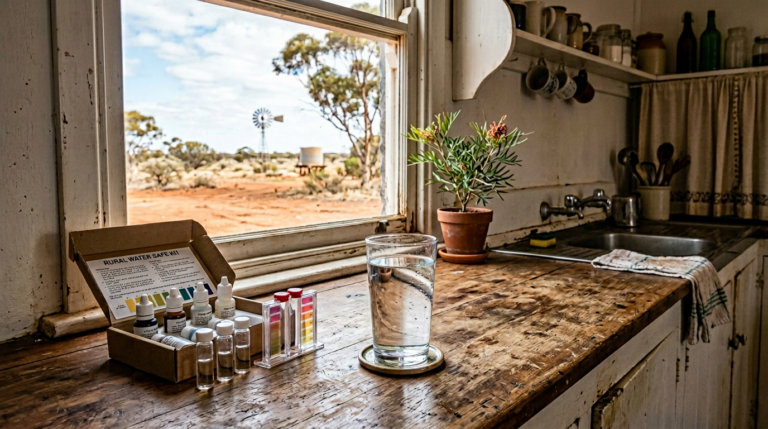
The honest use case for a Berkey is off-grid or emergency situations where you are filtering untreated water — rainwater tanks, creek water, or disaster scenarios. In those conditions, the pathogen removal capability is actually useful, and the lack of electricity is an advantage. If you have a rural property in Tasmania or a homestead in outback Queensland pulling from a rainwater tank, a gravity filter has a role.
But for the vast majority of Australians searching “Berkey water filter Australia,” you are on municipal water. You are in a rental in Brisbane, a unit in Sydney, a house in Perth. Your water is already microbiologically safe. What you need to remove is chloramine, fluoride, and potentially PFAS — and a Berkey is the wrong tool for all three. The AquaTru Classic does everything a Berkey does and more, with independent certification, and sits on your benchtop with the same zero-plumbing convenience.
Australian Water Quality by State: What Your Filter Actually Needs to Handle
Generic “tap water is bad” messaging helps nobody. Your filter choice should match the specific chemistry of your city’s supply. Here is what state water utilities actually report.
Queensland (SEQ Water — Brisbane, Gold Coast, Sunshine Coast, Ipswich, Logan)
SEQ Water’s Mt Crosby and North Pine treatment plants produce water with moderate hardness (80-120 mg/L CaCO₃), TDS of 80-115 mg/L, and fluoride added at 0.7 mg/L per Queensland Health requirements. Disinfection is chloramine. The key challenge for any filter in south-east Queensland is chloramine — it is persistent, does not off-gas like free chlorine, and requires catalytic carbon or RO to remove. A Berkey’s standard GAC elements will leave most of the chloramine in your glass.
New South Wales (Sydney Water — Sydney, Blue Mountains, Illawarra)
Sydney Water sources primarily from Warragamba Dam. The water is relatively soft (40-80 mg/L CaCO₃), fluoridated at 0.9-1.0 mg/L, and disinfected with chloramine. Western Sydney suburbs — Penrith, Blacktown, Liverpool — tend to show slightly higher TDS readings at the tap due to distribution network age and distance from the treatment plant. PFAS has been detected in groundwater near Williamtown RAAF base and in some western Sydney catchments. If you are in these areas, NSF P473-certified PFAS removal is worth pursuing.
Victoria (Melbourne Water)
Melbourne has some of Australia’s softest and lowest-TDS municipal water. The Yarra Valley catchment delivers water with hardness around 25 mg/L CaCO₃ and TDS around 60 mg/L. Disinfection is free chlorine, not chloramine — so standard carbon filters work well for chlorine taste in Melbourne. This is the one major Australian city where a quality carbon block filter is actually sufficient if fluoride is not your concern. If fluoride removal matters, you still need RO — Melbourne fluoridates at 0.7-1.0 mg/L.
South Australia (SA Water — Adelaide)
Adelaide has the hardest mainstream water of any capital city and the highest TDS at approximately 400 mg/L. Disinfection is chloramine. Adelaide water often draws from the Murray River during dry periods, which brings elevated salinity, organic compounds, and variable quality. A gravity filter like Berkey does nothing for TDS or hardness. Adelaide households benefit more from under-sink RO than any other capital city due to the combination of chloramine, hardness, high TDS, and fluoride.
Western Australia (Water Corporation — Perth)
Perth’s water is hard (~180 mg/L CaCO₃, TDS ~170 mg/L), free-chlorine-treated, and fluoridated. The Kwinana industrial corridor and Rockingham area have documented PFAS contamination from legacy industrial activity. Homes in these suburbs should prioritise NSF P473-certified filtration. Perth’s desalinated water (SSDP and PSDP plants) has lower TDS but is still free-chlorine-treated and fluoridated.
Certifications That Matter for Australian Water Filters
When you see a Berkey seller claim “independently tested to NSF standards,” that language is doing heavy lifting. Being tested to a protocol is not the same as being certified. Here is the hierarchy of certifications that actually mean something for Australian buyers.
| Certification | What It Verifies | Who Issues It | Berkey Status |
|---|---|---|---|
| WaterMark AS/NZS 3497 | Product meets Australian plumbing and filtration performance standards | SAI Global / JAS-ANZ accredited bodies | Not held |
| NSF/ANSI 42 | Aesthetic contaminants (chlorine taste, odour, sediment) | NSF International, WQA, IAPMO | Not listed |
| NSF/ANSI 53 | Health contaminants (lead, cysts, VOCs, fluoride) | NSF International, WQA, IAPMO | Not listed |
| NSF/ANSI 58 | RO system performance (TDS rejection, contaminant reduction) | NSF International | N/A (not RO) |
| NSF/ANSI P473 | PFOS and PFOA reduction | NSF International | Not listed |
| NSF/ANSI 401 | Emerging contaminants (pharmaceuticals, herbicides) | NSF International | Not listed |
The AquaTru Classic holds certifications to NSF/ANSI 42, 53, 58, 401, and P473. That is the full stack — aesthetic, health, RO performance, emerging contaminants, and PFAS. You can verify this on the NSF International product listing database. The Berkey has zero entries on that database. This is not a grey area.
WaterMark certification specifically matters if you are installing a filter into Australian plumbing (under-sink or inline). Countertop units like Berkey and AquaTru do not connect to plumbing, so WaterMark is less critical for them — but for under-sink systems like the Waterdrop D6, WaterMark compliance to AS/NZS 3497 confirms the product meets Australian plumbing code requirements. Any plumber who installs a non-WaterMark-certified product under your sink is technically non-compliant.
Final Verdict: What to Buy Instead of a Berkey in Australia
The Berkey is not a bad filter. It is a filter designed for the wrong application in Australian municipal water. It excels at removing pathogens from untreated water sources — a problem that 95% of Australians searching for one do not have. Where it falls short is the exact trio of contaminants that Australian city water presents: chloramine, fluoride, and PFAS.
Here is the simple recommendation:
Best countertop (no plumbing — renters): AquaTru Classic Smart Alkaline RO. NSF/ANSI 58 certified. Removes fluoride, chloramine, PFAS, lead, TDS. Sits on the bench. Take it when you move. At $0.18/L over five years, it is the most comprehensively certified countertop system available in Australia.
Best under-sink (homeowners): Waterdrop D6 Tankless RO. NSF/ANSI 42, 53, 58 certified. Tankless design saves space. Dedicated filtered water tap. Higher flow rate than any countertop or gravity system. Ideal for Adelaide (high TDS) and Perth (hard water + chloramine).
Budget option (free chlorine cities only — Melbourne, Hobart, Canberra): Tappwater EcoPro. NSF 42 certified carbon block. Effective for chlorine taste and sediment. Does not remove fluoride or PFAS. At $529 over five years, it is the lowest-cost legitimate option for cities using free chlorine.
The worst outcome of buying a certified RO system is you have verified clean water and spent $0.18/L for it. The worst outcome of buying a grey-market Berkey is you spent $380+ on a system that does not remove the primary contaminants in your water, has no warranty, and leaves chloramine and fluoride in every glass your family drinks.
Ready to filter your water properly?
The AquaTru Classic is the top-rated countertop RO for Australian homes — NSF 42, 53, 58, 401 and P473 certified. Removes fluoride, PFAS, chloramine, lead, and 80+ contaminants. No plumbing required.
Last reviewed: June 2026 — Clean and Native
Frequently Asked Questions
Not through official channels. Berkey (New Millennium Concepts) has no Australian distributor. Units available on eBay AU and some Amazon US listings ship internationally, but carry no local warranty and no WaterMark AS/NZS 3497 certification. You accept all risk of damage, counterfeit elements, and zero Australian Consumer Law protection.
Not effectively. Berkey’s Black Elements use granular activated carbon, which removes chloramine at approximately 1/40th the rate of free chlorine. Brisbane, Sydney, Adelaide, Gold Coast, and Darwin all use chloramine. For reliable chloramine removal, you need catalytic carbon, compressed carbon block, or reverse osmosis.
Only with the optional PF-2 fluoride elements, which use activated alumina. These are not independently certified to NSF/ANSI 53 for fluoride reduction. The standard Black Berkey elements alone cannot remove fluoride — no carbon filter can. Reverse osmosis achieves 90-97% fluoride removal with NSF/ANSI 58 certification.
No. Berkey’s marketing states elements are “tested to NSF/ANSI standards,” but the products are not listed on the NSF International certified product database. Being tested to a protocol by a contracted lab is not the same as holding certification, which requires ongoing factory audits and random product testing.
For countertop use with no plumbing, the AquaTru Classic RO is the closest equivalent — sits on the bench, no installation, and holds NSF/ANSI 42, 53, 58, 401, and P473 certifications. It removes fluoride, chloramine, PFAS, and heavy metals that Berkey cannot verifiably address.
Melbourne uses free chlorine (not chloramine) and has very soft water (TDS ~60 mg/L, hardness ~25 mg/L CaCO₃). A standard carbon block filter like the Tappwater EcoPro handles chlorine taste effectively in Melbourne. If you want fluoride removal, you still need RO — but Melbourne is the one city where a basic carbon filter actually matches most needs.
Approximately $830 AUD without fluoride elements ($380 unit + ~$90/year filters). With PF-2 fluoride elements, approximately $1,430 over five years. This is comparable to the AquaTru Classic RO at $1,299 over five years — which removes more contaminants with independent NSF certification.
Yes — this is Berkey’s genuine strength. For off-grid properties using untreated rainwater, the pathogen removal capability (bacteria and protozoa) is valuable, and the gravity-fed, no-electricity design works where mains power is unavailable. For this specific use case, Berkey is a reasonable option, though UV disinfection is the more widely verified approach for untreated water in Australia.
Adelaide benefits from RO more than any other Australian capital city. SA Water reports hardness around 140 mg/L CaCO₃, TDS around 400 mg/L (the highest of any capital), chloramine disinfection, and fluoride at 0.7-0.9 mg/L. Only RO addresses all four of these simultaneously. Gravity and carbon filters cannot reduce TDS or hardness.
Berkey claims some PFAS reduction but holds no NSF/ANSI P473 certification for PFOS or PFOA removal. If you live near documented PFAS contamination sites — Williamtown (NSW), Oakey (QLD), Rockingham (WA), Edinburgh (SA), or Fiskville (VIC) — use an NSF P473-certified RO system for verified PFAS rejection above 90%.
Get the Australian Home Environment Checklist
30 checks across water, air and EMF. Most of them free. Ranked by impact.
No spam. Unsubscribe any time.

Former Royal Australian Navy Clearance Diver and TAG-E counter-terrorism operator. Founded Clean and Native to apply the same rigorous thinking to the home environment.
Full biography →