AquaTru Carafe Australia 2026: Does It Work on 240V? Review & Alternatives
Drafted with AI assistance and checked against published specifications and certifications. First-hand measurements appear only where stated. How we make content
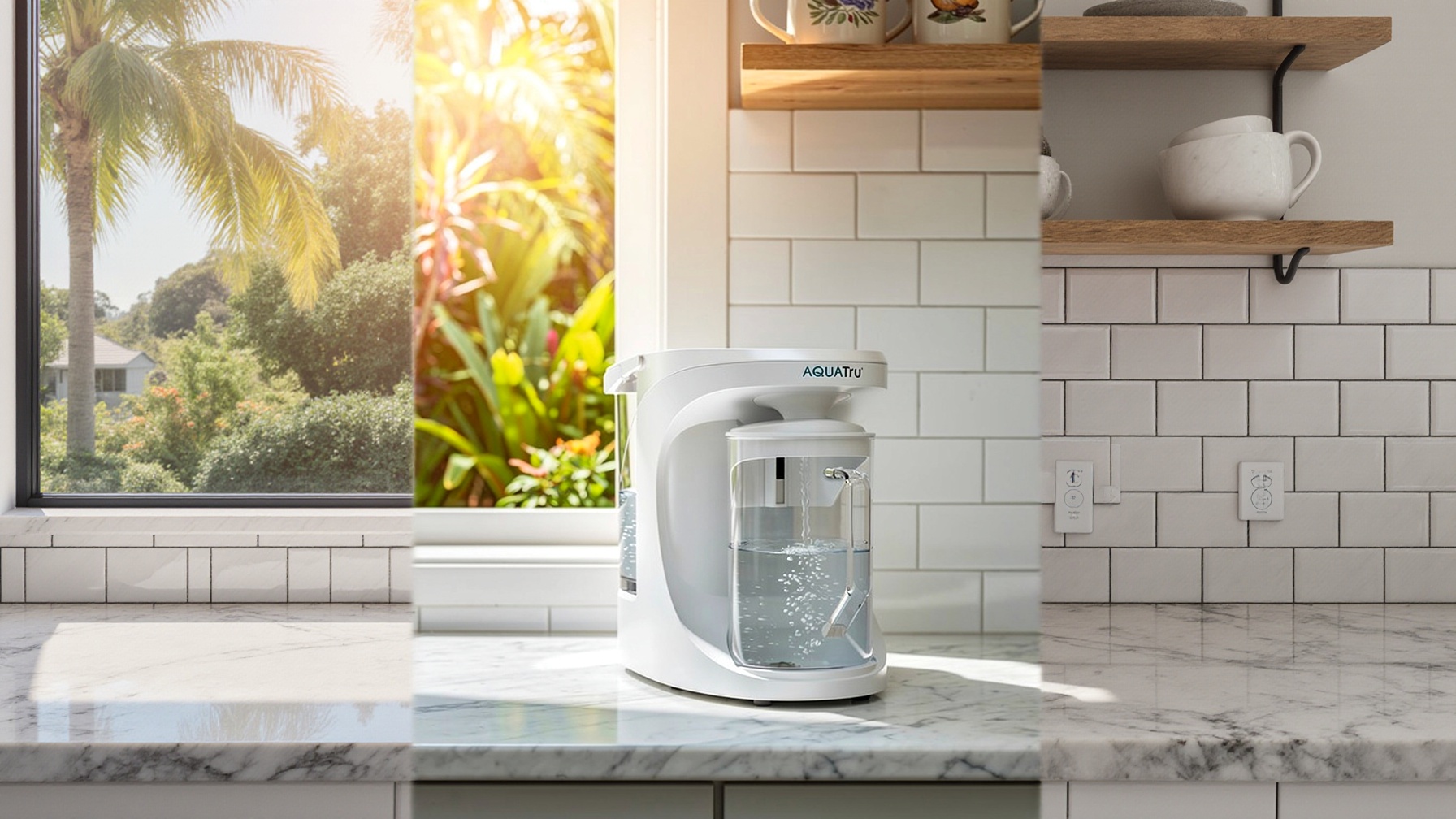
The AquaTru Carafe removes 93.5% of fluoride, 97.5% of PFOA/PFOS, and 97% of chlorine via 4-stage reverse osmosis in a no-plumbing countertop unit that stores purified water in borosilicate glass — not plastic. It is listed on Amazon AU (ASIN B0BT4FYHFJ) but carries a 120V rating: verify 240V compatibility before purchasing, or consider the AquaTru Classic Smart Alkaline (B0F9C7G3VD), which is confirmed 240V AU-compatible.
I’m Jayce Love, founder of Clean & Native. I’ve reviewed the AquaTru range for the Australian market using our documented testing methodology, cross-referencing certified contaminant removal data against ADWG limits and Australian water chemistry. The voltage question is the most critical Australia-specific issue with the Carafe — one most overseas reviews don’t address. This review covers it directly.
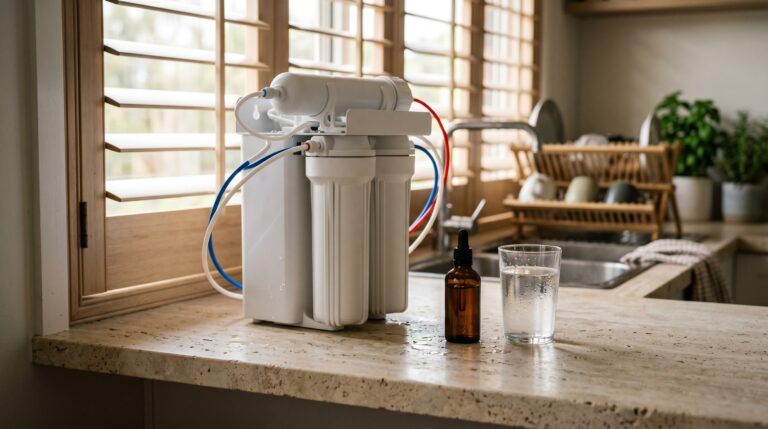
The AquaTru Carafe removes 93.5% of fluoride, 97.5% of PFOA/PFOS, and 97% of chlorine via 4-stage reverse osmosis — no plumbing required, and it stores purified water in a 1.9L borosilicate glass carafe rather than plastic. It is listed on Amazon AU (ASIN B0BT4FYHFJ) but is rated 120V: before purchasing, verify the Amazon AU listing ships a 240V-compatible unit or factor in a step-down transformer (~AU$40-60). If 240V compatibility matters most, the AquaTru Classic Smart Alkaline (B0F9C7G3VD) is the confirmed AU-compatible countertop RO alternative.
| AquaTru Carafe | AquaTru Classic Smart Alkaline | |
|---|---|---|
| ASIN (Amazon AU) | B0BT4FYHFJ | B0F9C7G3VD |
| AU Power | 120V — verify before buying | 240V confirmed |
| Storage | 1.9L borosilicate glass | 2.8L BPA-free plastic |
| Fluoride removal | 93.5% | 94%+ |
| PFOA/PFOS removal | 97.5% | 97%+ |
| Daily output | ~43 GPD (slower) | ~115 GPD |
| Filtration stages | 4-stage ultra-RO | 4-stage ultra-RO + alkaline |
| Certifications | NSF/ANSI 42, 53, 58, 401, 372 | NSF/ANSI 42, 53, 58, 401, 372 |
| Footprint | 33H × 19W cm (compact) | Wider countertop unit |
| Best for | 1-2 person, glass preference | Families, confirmed AU voltage |
The AquaTru Carafe in Australia: What You Need to Know First
The AquaTru Carafe is not sold through an Australian distributor. AquaTru’s own website ships only to the US and Canada. The unit available on Amazon AU is the same 120V US model. Whether Amazon AU ships this product with a transformer or whether it is safe to operate on Australian 240V is not confirmed in the product listing.
Contact the seller through the Amazon AU listing and ask: “Does this unit operate on 240V / 50Hz Australian mains power?” If yes, buy with confidence. If the answer is unclear, either purchase a step-down transformer (100-120V, rated at 50W or higher, ~AU$40-60 on Amazon AU) or order the AquaTru Classic Smart Alkaline (B0F9C7G3VD), which is confirmed 240V AU-compatible. Never plug a 120V appliance directly into an Australian 240V outlet without a transformer — it will damage the unit.
The AquaTru Carafe is listed on Amazon AU but rated 120V. Confirm voltage compatibility before purchasing — this is the only meaningful risk for Australian buyers.
Contaminant Removal: What the AquaTru Carafe Actually Filters
The AquaTru Carafe is certified by IAPMO against NSF/ANSI 42, 53, 58, 401, and 372 standards — the same five certifications as the AquaTru Classic. These are among the most rigorous water filter certifications available. The certified removal rates are relevant to specific Australian water quality concerns:
| Contaminant | Removal Rate | AU Relevance |
|---|---|---|
| Fluoride | 93.5% | Added in Brisbane, Sydney, Adelaide, Gold Coast, Darwin |
| PFOA / PFOS | 97.5% each | PFAS contamination at 80+ AU sites near airports/defence |
| Lead | 99.1% | Older AU homes with lead solder or brass fittings |
| Chlorine | 97% | Melbourne, Hobart, Canberra use free chlorine |
| Chloramine | Certified (NSF/ANSI 42) | Brisbane, Sydney, Adelaide, Gold Coast, Darwin use chloramine |
| Chromium-6 | 97.2% | Industrial areas, older infrastructure |
| Arsenic (pentavalent) | 96.7% | Some regional and bore water sources |
| Microplastics | Certified | Detected in AU mains water in multiple studies |
For Brisbane and SEQ residents: the Carafe addresses the two most significant local water concerns simultaneously. Brisbane mains water uses chloramine (which Brita and standard bench-top filters handle poorly) and is fluoridated at 0.7 mg/L. The AquaTru Carafe reduces chloramine to compliant levels and brings fluoride from 0.7 mg/L down to approximately 0.045 mg/L — a 93.5% reduction. Standard activated carbon jug filters remove zero fluoride and are largely ineffective against chloramine.
The AquaTru Carafe’s NSF/ANSI 58 fluoride certification (93.5% removal) is the clearest differentiator from carbon-only jug filters. No carbon filter can meaningfully reduce fluoride.
AquaTru Carafe vs AquaTru Classic: Which to Buy in Australia?
The filtration performance is essentially identical between both units — same NSF certifications, same 4-stage ultra-RO process, same contaminant removal rates. The choice comes down to storage material, volume, and the voltage question:
Choose the Carafe if: You want purified water stored in glass rather than plastic, your household is 1-2 people, bench space is tight, and you’ve confirmed 240V compatibility with the seller. The 1.9L glass carafe is a genuine quality-of-life advantage — no plastic leaching concern, and the glass carafe can be refrigerated independently.
Choose the Classic if: You’re uncertain about the Carafe’s voltage compatibility, your household draws more than ~2-3 litres of purified water per day (the Carafe’s 43 GPD output will struggle to keep up), or you want the alkaline mineral stage and WiFi filter tracking. The Classic Smart Alkaline (B0F9C7G3VD) is confirmed 240V AU-compatible and produces nearly three times the daily output at a lower filter cost per litre.
If you’re unsure about voltage and don’t have a strong preference for glass storage, the AquaTru Classic Smart Alkaline (B0F9C7G3VD) is the no-compromise AU choice.
AquaTru Carafe Review: The Product Cards
AquaTru Carafe (Model AT100)
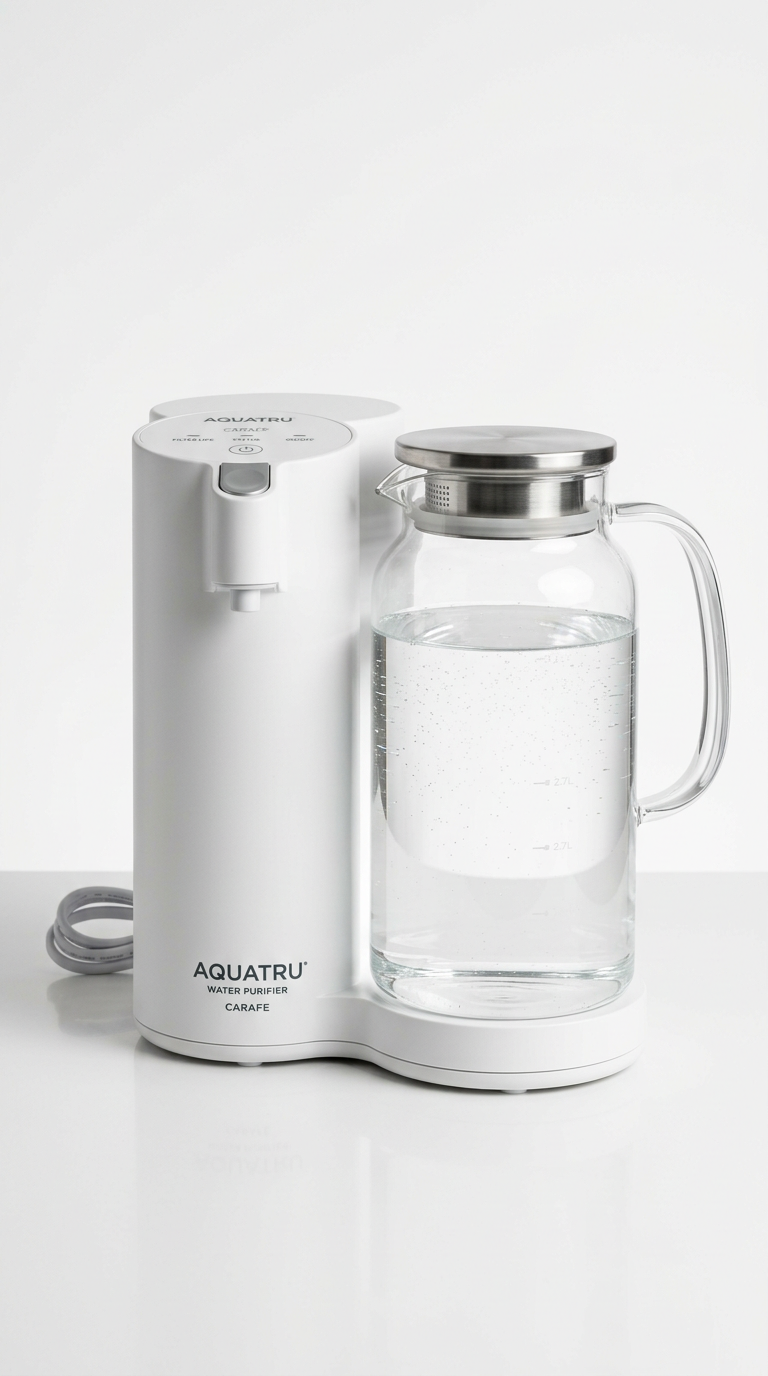
AquaTru Carafe (Model AT100)
4-stage ultra-RO removing 93.5% fluoride, 97.5% PFOA/PFOS, 97% chlorine. Stores purified water in borosilicate glass — no plastic contact. The catch: rated 120V, listed on Amazon AU but confirm voltage before purchasing.
Pros
- Glass carafe — no BPA plastic contact with purified water
- 93.5% fluoride removal (NSF/ANSI 58 certified)
- 97.5% PFOA/PFOS removal
- No plumbing — bench-to-drinking in 60 seconds
- 84 certified contaminants removed
- Compact: 33H × 19W cm
Cons
- Rated 120V — verify 240V AU compatibility before buying
- 1.9L carafe — slow for families (>2 people)
- No AU distributor — Amazon AU only
- Filter cost higher per litre than Classic
- ~43 GPD output (vs Classic’s 115 GPD)
AquaTru Classic Smart Alkaline — Confirmed AU Alternative
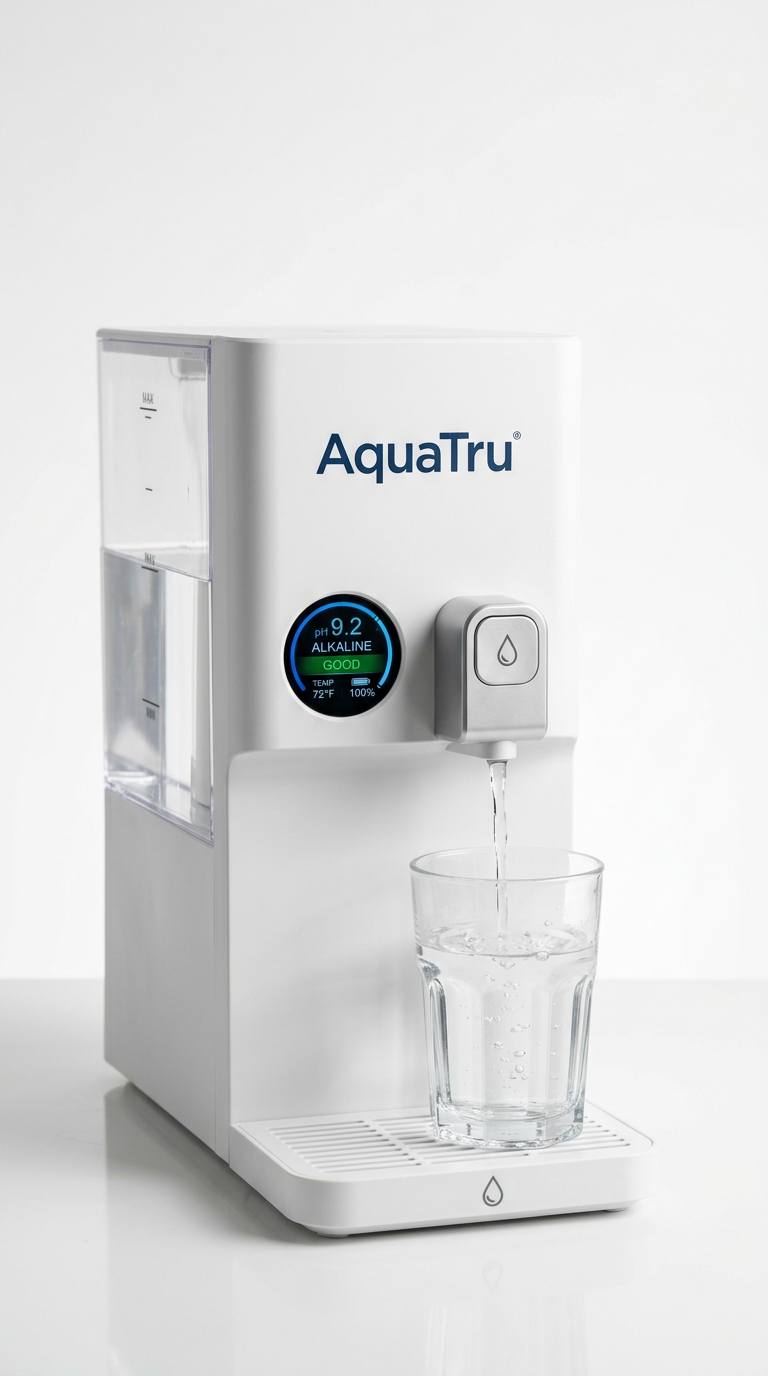
AquaTru Classic Smart Alkaline
Confirmed 240V AU-compatible countertop RO. 2.8L push-button tank, smart WiFi, alkaline mineral boost stage, and higher daily output than the Carafe. The straightforward choice for Australian families who want no-plumbing RO without the voltage question.
Pros
- 240V AU power confirmed
- 2.8L tank — suits families of 3-4
- Alkaline mineral boost stage
- Smart WiFi + filter life tracking
- Higher daily output (~115 GPD)
- Lower filter cost per litre than Carafe
Cons
- Plastic tank (BPA-free, not glass)
- Larger bench footprint than Carafe
- ~AU$100 more expensive than Carafe
Filter Replacement Costs: AquaTru Carafe in Australia
The AquaTru Carafe uses three filter types at different replacement intervals. The RO membrane (ASIN B0BW57C41L) is confirmed on Amazon AU. Pre-filter and VOC carbon filter pricing in AUD should be verified on the Amazon AU listing before purchasing, as the US website prices in USD:
| Filter | Lifespan | US Price | AU ASIN |
|---|---|---|---|
| Pre/Carbon Filter | 300 gal / ~6 months | USD $24.95 | Verify on Amazon AU |
| VOC Carbon Filter | 300 gal / ~1 year | USD $34.95 | Verify on Amazon AU |
| RO Membrane | 1,200 gal / ~2 years | USD $51.95 | B0BW57C41L |
Filter availability is a genuine consideration for AU buyers. If the pre-filter and VOC carbon filter are not stocked on Amazon AU, you would need to import them from the US — adding cost and lead time. Confirm all three filter ASINs are available on Amazon AU before committing to the Carafe. For a broader comparison of no-plumbing RO filters available in Australia with confirmed filter supply chains, see our complete Australian water filter guide.
Final Verdict
For most Australian households, the AquaTru Classic Smart Alkaline is the safer buy — but the Carafe is worth it if glass storage matters to you.
The Carafe’s 93.5% fluoride removal, 97.5% PFOA/PFOS removal, and borosilicate glass storage are genuine advantages. The voltage question is the only blocker — if the Amazon AU listing ships a 240V-compatible unit (confirm before purchasing), it’s a strong choice for 1-2 person households or anyone who wants purified water stored in glass. For families or anyone who can’t verify voltage, the AquaTru Classic Smart Alkaline on Amazon AU is the confirmed 240V alternative with higher daily output and a lower filter cost per litre.
Last reviewed: July 2026. Pricing and ASIN availability verified on Amazon AU at time of writing — confirm before purchase.
Frequently Asked Questions
Is the AquaTru Carafe available in Australia?
The AquaTru Carafe (ASIN B0BT4FYHFJ) is listed on Amazon AU and can be shipped to Australia. However, the unit is rated 120V AC. Before purchasing, confirm with Amazon whether the AU listing ships a 240V-compatible version or whether a step-down transformer (available for ~AU$40-60) is needed. AquaTru does not sell direct to Australia — there is no AU distributor as of July 2026.
Does the AquaTru Carafe remove fluoride?
Yes. The AquaTru Carafe removes 93.5% of fluoride, certified under NSF/ANSI 58 by IAPMO. This makes it effective for removing fluoride from Australian mains water (typical fluoride levels: 0.6-1.0 mg/L in Brisbane/SEQ, Sydney, Adelaide, and Perth). Carbon filters — including Brita and most bench-top filter jugs — cannot remove fluoride at all. Only reverse osmosis and activated alumina provide meaningful fluoride reduction.
How does the AquaTru Carafe work?
The AquaTru Carafe uses 4-stage ultra-reverse osmosis with no plumbing connection. You pour tap water into the 2.5L tap tank, the unit filters it through a pre-filter, VOC carbon filter, and RO membrane, and stores purified water in a 1.9L borosilicate glass carafe. The RO membrane applies pressure to force water through a semi-permeable membrane, rejecting dissolved contaminants including fluoride, PFAS, heavy metals, nitrates, and chloramine.
What does the AquaTru Carafe remove?
The AquaTru Carafe is certified to remove 84 contaminants, including: fluoride (93.5%), PFOA (97.5%), PFOS (97.5%), lead (99.1%), chromium-6 (97.2%), chlorine (97%), arsenic (96.7%), nitrates, chloramine (certified under NSF/ANSI 42), microplastics, and heavy metals. Certifications are from IAPMO against NSF/ANSI 42, 53, 58, 401, and 372 standards.
What is the difference between the AquaTru Carafe and the AquaTru Classic?
The Carafe stores purified water in a 1.9L borosilicate glass carafe and has a smaller bench footprint (33H x 19W cm). The Classic stores water in a 2.8L BPA-free plastic tank with a push-button dispenser. Both use the same 4-stage ultra-RO filtration and NSF certifications. The Classic produces more water per day (~115 GPD vs ~43 GPD) at a lower filter cost per litre. The Carafe’s advantage is glass storage — no plastic contact with purified water.
How often do the AquaTru Carafe filters need replacing?
Three filters at different intervals: pre/carbon filter every ~300 gallons (~6 months for average use), VOC carbon filter every ~300 gallons (~1 year), RO membrane every ~1,200 gallons (~2 years). The RO membrane replacement filter is listed on Amazon AU (ASIN B0BW57C41L). Pre-filter and VOC filter replacement pricing in AUD should be confirmed on Amazon AU before purchasing, as these are US-priced on the AquaTru website.
Does the AquaTru Carafe remove chloramine?
Yes. The AquaTru Carafe is certified under NSF/ANSI 42 which includes chloramine reduction. This is important for Australian cities using chloramine disinfection: Brisbane/SEQ, Sydney, Adelaide, Gold Coast, and Darwin all use chloramine rather than free chlorine. Standard carbon filters (Brita-style jug filters) remove chloramine at a fraction of the rate they remove free chlorine. The AquaTru’s RO membrane provides more reliable chloramine removal than carbon filtration alone.
Is the AquaTru Carafe better than a Brita jug for Australian water?
Significantly better for contaminant removal, but more expensive. A Brita jug uses activated carbon that cannot remove fluoride (at all), removes chloramine poorly (most Australian cities use chloramine), and does not remove PFAS, lead, arsenic, or nitrates. The AquaTru Carafe removes all of these via reverse osmosis. The tradeoff is cost: the AquaTru requires electricity and costs more upfront and in filter replacements.
Can I use an AquaTru Carafe without electricity?
No. The AquaTru Carafe requires 120V AC power to operate the pump that pressurises the RO membrane. Unlike gravity-fed filter jugs (Brita, Zero Water, Berkey), RO filtration requires applied pressure — it cannot function without electricity. If power-free water filtration is a requirement, a gravity-fed ceramic filter or a Berkey system is the alternative, though neither matches the AquaTru’s contaminant removal rates for fluoride, PFAS, or heavy metals.
Get the Australian Home Environment Checklist
30 checks across water, air and EMF. Most of them free. Ranked by impact.
No spam. Unsubscribe any time.

Former Royal Australian Navy Clearance Diver and TAG-E counter-terrorism operator. Founded Clean and Native to apply the same rigorous thinking to the home environment.
Full biography →