UV Water Sterilisers for Rainwater Tanks Australia 2026: Best Picks, Sizing Guide & Pre-Filter Requirements
Drafted with AI assistance and checked against published specifications and certifications. First-hand measurements appear only where stated. How we make content
Disclosure: Clean and Native earns a commission on qualifying purchases at no extra cost to you. Our picks are based on independent research — we never recommend products we wouldn’t use ourselves.
Related: Best tank water filters Australia 2026 · Best water filters for bacteria Australia · Best reverse osmosis systems Australia 2026
Quick Verdict — Which UV Steriliser for My Rainwater Tank?
A UV water steriliser is the most effective, lowest-maintenance technology for eliminating biological pathogens (bacteria, viruses, Giardia, Cryptosporidium) from rainwater tanks. Unlike chemical dosing (chlorination), UV leaves no taste or residue. Unlike filtration alone, UV inactivates protozoa including Giardia and Cryptosporidium that filter-resistant even to 1-micron sediment. For a standard Australian household on tank water, the UV Guard SLT30 (~$547) is the recommended whole-house system — NSF 55 Class A at 16 LPM covers a 4–6 person family with headroom for simultaneous demand. UV does not remove chemical contamination — if chemical contaminants are a concern, combine UV with activated carbon or RO.
- 1–3 people / kitchen tap: UV Guard SLT12 (~$260)
- 4–6 people / whole-house: UV Guard SLT30 (~$547) — recommended
- 6+ people / large property: UV Guard SLT40 ($672–786)
- Always required: 5-micron sediment pre-filter upstream of UV (dual 10+5 recommended)
- UV does not address: chemical contamination — combine with RO or carbon if needed
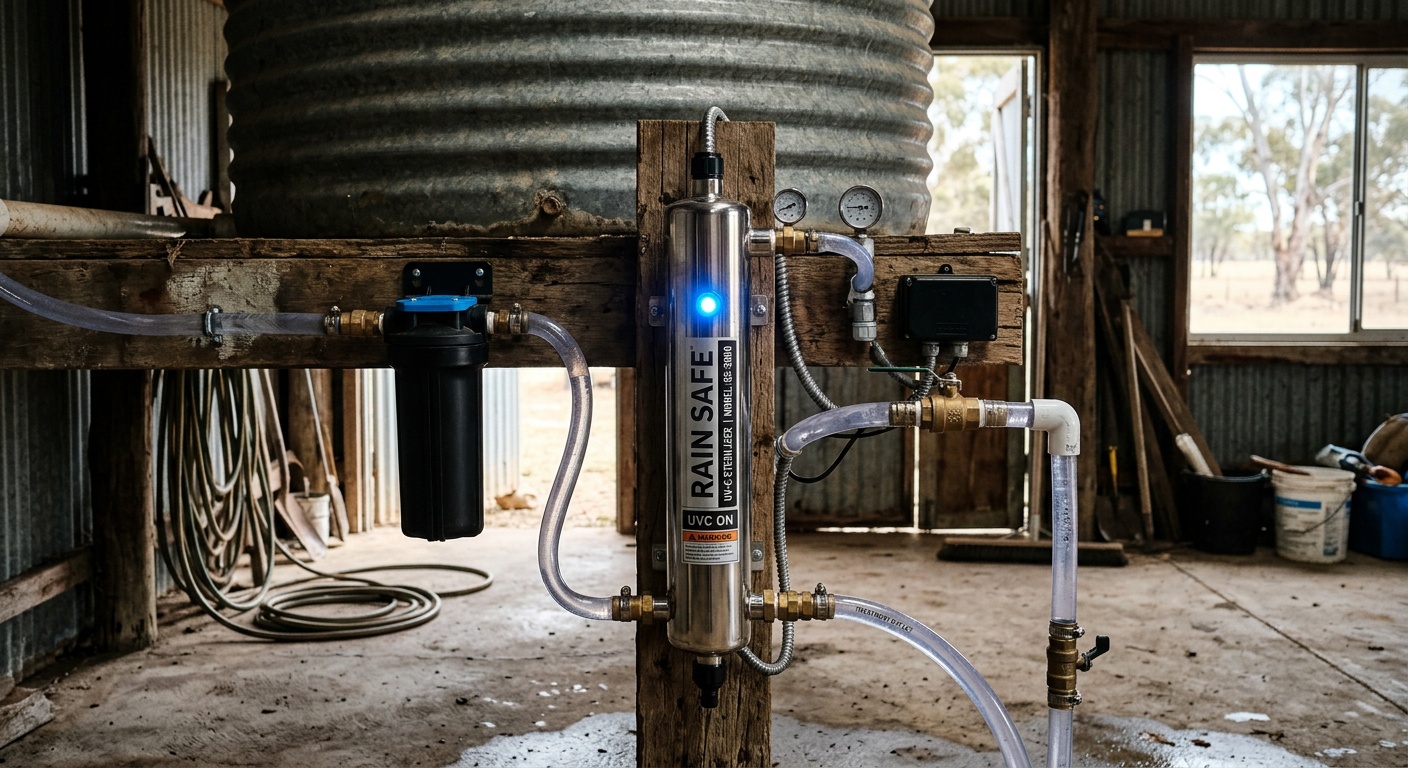
Rainwater tanks provide clean-looking water, but “clean looking” doesn’t mean pathogen-free. Approximately 34% of Australian households use rainwater tanks as a water source. The NHMRC rainwater quality guidelines (2011, updated guidance 2023) and the Australian Government Your Home technical guide both confirm E. coli, Campylobacter, Giardia, and Cryptosporidium as established contaminants in Australian tank water — entering via roof runoff, bird and possum faeces, and tank ingress from vermin. For tanks used as the primary drinking water supply — particularly in rural and semi-rural Queensland, NSW, Victoria, and Western Australia — UV sterilisation is the most effective single treatment step for biological safety.
Why Australian Rainwater Tanks Require UV Treatment
Rainwater tanks are not closed systems. Roof catchment collects water that has contact with bird and possum faeces, leaf litter, dead insects, air particulates, and tank sediment. While first-flush diverters (standard on compliant installations) reject the initial dirty runoff from each rain event, they don’t eliminate microbial contamination from ongoing inputs: bird droppings on the roof between rain events, tank ingress from vermin, algal growth in partially shaded tanks, and sediment accumulation.
The most significant pathogens in Australian rainwater tanks are E. coli (indicator of faecal contamination), Campylobacter, Salmonella, Giardia, and Cryptosporidium. Giardia and Cryptosporidium are protozoa — they are resistant to chlorination at normal drinking water doses and require either UV treatment (inactivation) or sub-1-micron filtration to remove. UV at ≥40 mJ/cm² (NSF 55 Class A dose) inactivates all of these pathogens to drinking water standard.
Pre-Filter Is Not Optional
UV sterilisation requires clear water to work — turbidity (cloudiness) from suspended particles blocks UV penetration and reduces effective dose. A 5-micron sediment pre-filter must be installed upstream of the UV unit. For drinking water, a dual-stage pre-filter system (10-micron followed by 5-micron) is recommended to protect the fine stage and extend filter life. Rainwater without pre-filtration will under-dose the UV lamp within weeks as biofilm and sediment accumulate inside the UV chamber.
Understanding NSF 55 Class A vs Class B — What the Certification Means
Not all UV sterilisers are equal — the NSF/ANSI Standard 55 for ultraviolet microbiological water treatment systems defines two classes:
| NSF Class | UV Dose | Cryptosporidium? | Use Case |
|---|---|---|---|
| Class A ★ | ≥40 mJ/cm² | ✓ Yes | Primary drinking water treatment |
| Class B | 16 mJ/cm² | ✗ No | Pre-treated/already-safe water only |
For rainwater tank use, always specify NSF 55 Class A. Class B systems (16 mJ/cm²) inactivate bacteria but are not rated for Giardia or Cryptosporidium — the two protozoa most common in Australian tank water. Class A (≥40 mJ/cm²) is effective against all three pathogen categories: bacteria, viruses, and protozoa. All UV Guard SLT-series units (SLT12, SLT30, SLT40) carry NSF 55 Class A certification.
UV Guard SLT Range — Full Comparison
| Model | AU Price | Max Flow | Power | UV Dose | Best For |
|---|---|---|---|---|---|
| UV Guard SLT12 | ~$260 | 8 LPM | 12–14W | ≥40 mJ/cm² | 1–3 people, kitchen tap |
| UV Guard SLT30 ★ | ~$547 | 16 LPM | 30W | ≥40 mJ/cm² | 4–6 people, whole-house |
| UV Guard SLT40 | $672–786 | 27 LPM | 40W | ≥40 mJ/cm² | 6+ people, large property |
UV Guard SLT12 — Best for Small Households
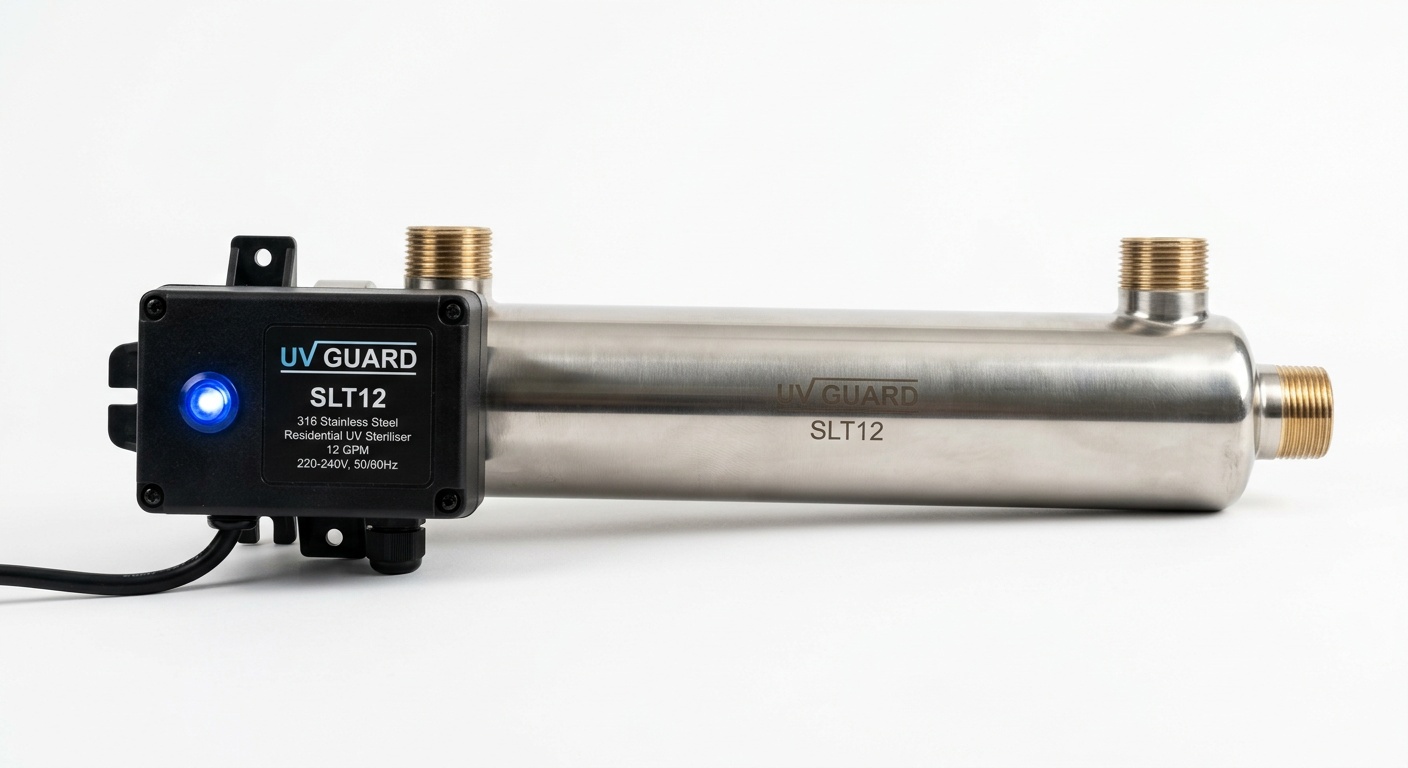
UV Guard SLT12 UV Water Steriliser
The SLT12 is UV Guard’s entry model — suitable for small households (1–3 people) drawing ≤8 LPM from the tank. NSF 55 Class A certified for ≥40 mJ/cm² dose, which ANSI confirms inactivates 99.9%+ of bacteria, viruses, Giardia, and Cryptosporidium. Annual UV lamp replacement required (~$50–70 for genuine UV Guard lamp). Requires 5-micron pre-filter upstream — do not install without sediment pre-filtration.
Pros
- NSF 55 Class A certified — meets the gold standard for residential drinking water UV
- ≥40 mJ/cm² dose inactivates Cryptosporidium and Giardia
- 12–14W power draw — runs cheaply 24/7
- AU-stocked brand with local replacement lamps
- Compact — fits under-sink or inline with standard plumbing
Cons
- 8 LPM max — inadequate for large households or irrigation
- Requires 5-micron pre-filter (additional cost)
- Annual lamp replacement needed
- Does not address chemical contamination — UV only kills biological pathogens
UV Guard SLT30 — Best Whole-House Choice
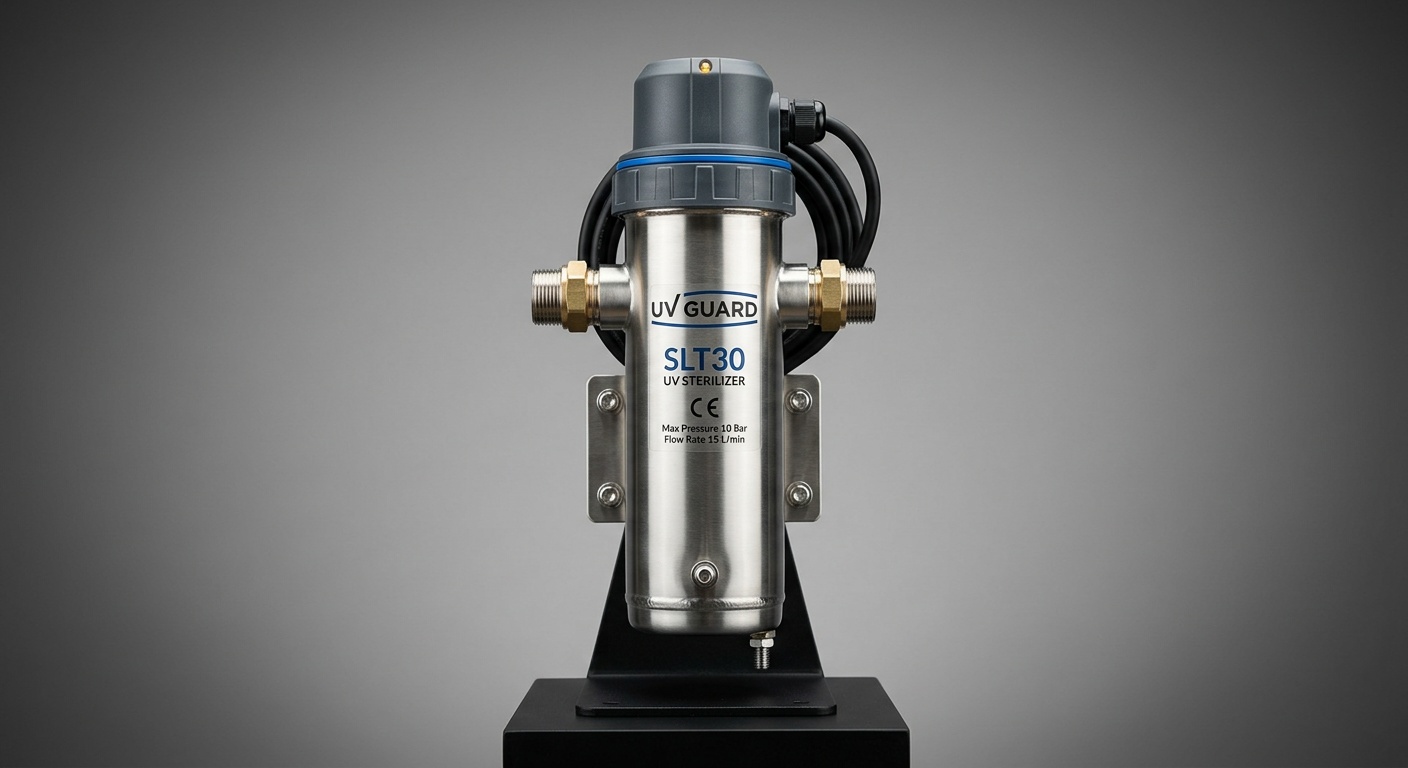
UV Guard SLT30 UV Water Steriliser
The SLT30 is UV Guard’s whole-house residential model — rated for 4–6 person households with flow requirements up to 16 LPM. NSF 55 Class A at ≥40 mJ/cm², meeting Australian Health Department requirements for drinking water UV treatment. Larger UV lamp (30W) provides the dose margin needed for high-flow whole-house installation. Includes flow-rate indicator to alert when pre-filter is restricting flow. Annual lamp replacement required (genuine UV Guard SLT30 lamp ~$90–110).
Pros
- 16 LPM — covers whole-house simultaneous demand (shower + kitchen + laundry)
- NSF 55 Class A at ≥40 mJ/cm² — the standard for drinking water disinfection
- Flow-rate indicator — alerts when pre-filter needs replacement
- 30W lamp provides dose margin for higher flow rates
- AU stocked, genuine lamps readily available
- Widely installed across rural and semi-rural AU — established service network
Cons
- ~$547 + installation — higher entry cost than SLT12
- 30W continuous draw — higher running cost than SLT12
- Requires 5-micron sediment pre-filter
- Annual lamp replacement at ~$90–110
- UV does not remove chemical contaminants (heavy metals, pesticides)
UV Guard SLT40 — Best for Large Properties

UV Guard SLT40 UV Water Steriliser
The SLT40 is UV Guard’s highest-capacity residential model — rated for large families (6+ people) or properties with high simultaneous demand. 27 LPM covers whole-house flow including irrigation demand. NSF 55 Class A at ≥40 mJ/cm² maintained at full 27 LPM. Annual replacement lamp required. Best suited to acreage properties, rural homesteads, or large families fully dependent on tank water.
Pros
- 27 LPM — handles simultaneous demand of large household + outdoor irrigation
- NSF 55 Class A maintained at full 27 LPM flow
- 40W lamp with large dose margin — most reliable for high-turbidity tank conditions
- Best suited to acreage/rural homesteads
Cons
- $672–786 — premium price for residential use
- 40W continuous draw — higher running cost
- Overkill for standard 4-bedroom household with ≤16 LPM demand
- Larger physical footprint
How to Size a UV Steriliser for Your Rainwater Tank
The critical sizing figure is peak simultaneous flow rate (LPM) — the maximum flow the system needs to treat at any moment while maintaining ≥40 mJ/cm² UV dose. Under-sizing means water passes through the UV chamber too fast for full dose delivery, defeating the treatment purpose.
| Household Size | Estimated Peak Flow | Recommended Model |
|---|---|---|
| 1–2 people, single bathroom | 6–8 LPM | SLT12 |
| 3–4 people, 2 bathrooms | 10–14 LPM | SLT30 |
| 5–6 people, 2–3 bathrooms | 14–18 LPM | SLT30 |
| 6+ people / acreage | 20–27 LPM | SLT40 |
Size up, not down — if your flow estimate sits near the boundary of two models, choose the larger. A UV system operating at the upper edge of its flow rating delivers dose at the minimum certified level; any pre-filter restriction, sediment accumulation, or pressure surge can push it below 40 mJ/cm². An oversized unit maintains Class A dose under real-world variable flow conditions.
Pre-Filter System for UV Sterilisation — What You Need
The minimum pre-filtration for UV treatment is a single 5-micron sediment filter. In practice, for Australian rainwater tanks — which carry leaf litter, insect debris, roof sediment, and organic matter — a dual-stage pre-filter system is the recommended setup:
- Stage 1: 10-micron sediment cartridge — removes large particles, protects Stage 2
- Stage 2: 5-micron sediment cartridge — polishes water to UV-safe turbidity
- Stage 3: UV steriliser (SLT12 / SLT30 / SLT40)
- Optional Stage 4: Activated carbon block — removes taste, odour, and organic compounds if present
The carbon stage is placed after UV (not before) when included — UV followed by carbon allows the carbon to polish taste without the carbon media becoming a biological reservoir. If the tank water has taste or chemical concerns (herbicide runoff, bushfire ash), adding a quality carbon block after the UV stage is recommended.
Annual Maintenance — UV Lamp Replacement
UV lamps degrade over time — output decreases to approximately 60–70% of rated intensity after 9,000 hours (roughly 12 months of continuous operation). At that point, the lamp may still glow but no longer delivers ≥40 mJ/cm² Class A dose. Manufacturers universally recommend annual replacement regardless of whether the lamp appears to be working.
Annual Maintenance Cost Estimate
SLT12: ~$50–70/year (lamp) + pre-filter cartridges (~$30–50/year) = ~$80–120/year total. SLT30: ~$90–110/year (lamp) + pre-filter cartridges (~$40–60/year) = ~$130–170/year total. Always use genuine UV Guard replacement lamps — third-party lamps may have different UV-C output and invalidate NSF 55 Class A rating.
Frequently Asked Questions
Is rainwater from a tank safe to drink without treatment?
Not reliably. The NHMRC rainwater quality guidelines and Australian Government Your Home guide both identify E. coli, Campylobacter, Giardia, and Cryptosporidium as confirmed contaminants in Australian tank water, entering via roof runoff, bird droppings, and possum activity. Tank water quality varies significantly by roof type, tank age and condition, and first-flush diverter presence. UV treatment is the minimum recommended level of treatment before drinking or cooking.
Does UV sterilisation kill Giardia and Cryptosporidium?
Yes — when UV dose is at NSF 55 Class A level (≥40 mJ/cm²). Both Giardia cysts and Cryptosporidium oocysts are resistant to standard chlorination doses but are effectively inactivated by UV-C light. This is the primary technical advantage of UV over chlorination for rainwater tank treatment — chlorine alone at domestic doses does not reliably inactivate Cryptosporidium.
How often does a UV lamp need replacing?
Annually — UV lamps degrade to ~60–70% of rated output after approximately 9,000 hours of continuous operation. At that point the lamp still glows but no longer delivers the ≥40 mJ/cm² Class A dose. The lamp should be replaced every 12 months regardless of visual appearance. Use genuine UV Guard replacement lamps — third-party alternatives may not match the UV-C output specifications and could invalidate NSF 55 Class A certification.
Do I need a pre-filter before the UV unit?
Yes — a 5-micron sediment pre-filter is mandatory, not optional. UV sterilisation requires clear, low-turbidity water to penetrate effectively. Rainwater with suspended particles (common in tanks without pre-filtration) blocks UV penetration and creates shadow zones where pathogens pass without full dose. A dual-stage pre-filter (10-micron + 5-micron) is recommended for typical Australian rainwater quality.
Does UV treatment remove chemical contamination from tank water?
No — UV only inactivates biological pathogens. It has no effect on heavy metals, pesticides, herbicides, petrochemicals, or other chemical contaminants. If chemical contamination is a concern (roof coatings, nearby agricultural activity, bushfire ash runoff), combine UV with an activated carbon stage (for organic compounds) or RO (for a broad-spectrum chemical reduction). For most Australian residential rainwater tanks, biological contamination is the primary concern — UV alone is appropriate.
What is NSF 55 Class A and why does it matter for UV sterilisers?
NSF/ANSI Standard 55 Class A certifies that a UV system delivers ≥40 mJ/cm² UV dose — the level required to inactivate bacteria, viruses, Giardia, and Cryptosporidium to drinking water standard. Class B (16 mJ/cm²) is for pre-treated water only — not appropriate for rainwater tank primary treatment. All three UV Guard SLT models recommended here carry NSF 55 Class A certification. Always confirm Class A (not just “NSF 55”) when purchasing a UV system for primary rainwater treatment.
What size UV steriliser do I need for a family of 4?
For a family of 4 in a typical Australian home with 2 bathrooms, estimated peak simultaneous flow is 10–14 LPM — within the SLT30’s 16 LPM capacity. The SLT30 is the recommended whole-house model for 4-person households. The SLT12 (8 LPM) is under-sized for a whole-house installation at this occupancy — adequate only for a single kitchen tap point-of-use installation.
Can I use a UV steriliser without electricity?
No — UV sterilisers require continuous electrical supply to operate the UV lamp. For off-grid properties, the UV unit must be connected to a 240V inverter or mains-equivalent solar-plus-battery system. The SLT12 draws 12–14W continuously; the SLT30 draws 30W. A properly sized inverter from a solar/battery system is typically the off-grid solution. Manual chemical dosing (chlorine or silver-based treatment) is the only viable non-electrical alternative for off-grid rainwater treatment.
Where should I install the UV steriliser in my plumbing system?
The UV steriliser should be installed after the pressure pump and pre-filter stages, and before the point of use. For whole-house installation: tank outlet → pressure pump → pre-filter (10+5 micron) → UV steriliser → distribution to house. For point-of-use kitchen tap installation: install on the cold water line serving the kitchen sink only. Install vertically where possible (lamp horizontal operation is specified by some models; check the UV Guard installation guide for SLT orientation). Keep the UV lamp accessible for annual replacement.
Get the Australian Home Environment Checklist
30 checks across water, air and EMF. Most of them free. Ranked by impact.
No spam. Unsubscribe any time.
Former Royal Australian Navy Clearance Diver and TAG-E counter-terrorism operator. Founded Clean and Native to apply the same rigorous thinking to the home environment.
Full biography →