Is Rainwater Safe to Drink in Australia 2026?
Rainwater collected from a properly maintained roof and tank system is generally safe to drink in most parts of Australia, according to the NHMRC Australian Drinking Water Guidelines (ADWG) and enHealth guidance — but “generally safe” depends entirely on your roof material, catchment location, tank condition, and whether you filter before consumption. Without testing and appropriate treatment, rainwater can contain lead leached from old flashings, faecal coliforms from bird and possum droppings, and — if you live within 5 km of a defence base or major airport — measurable PFAS contamination.
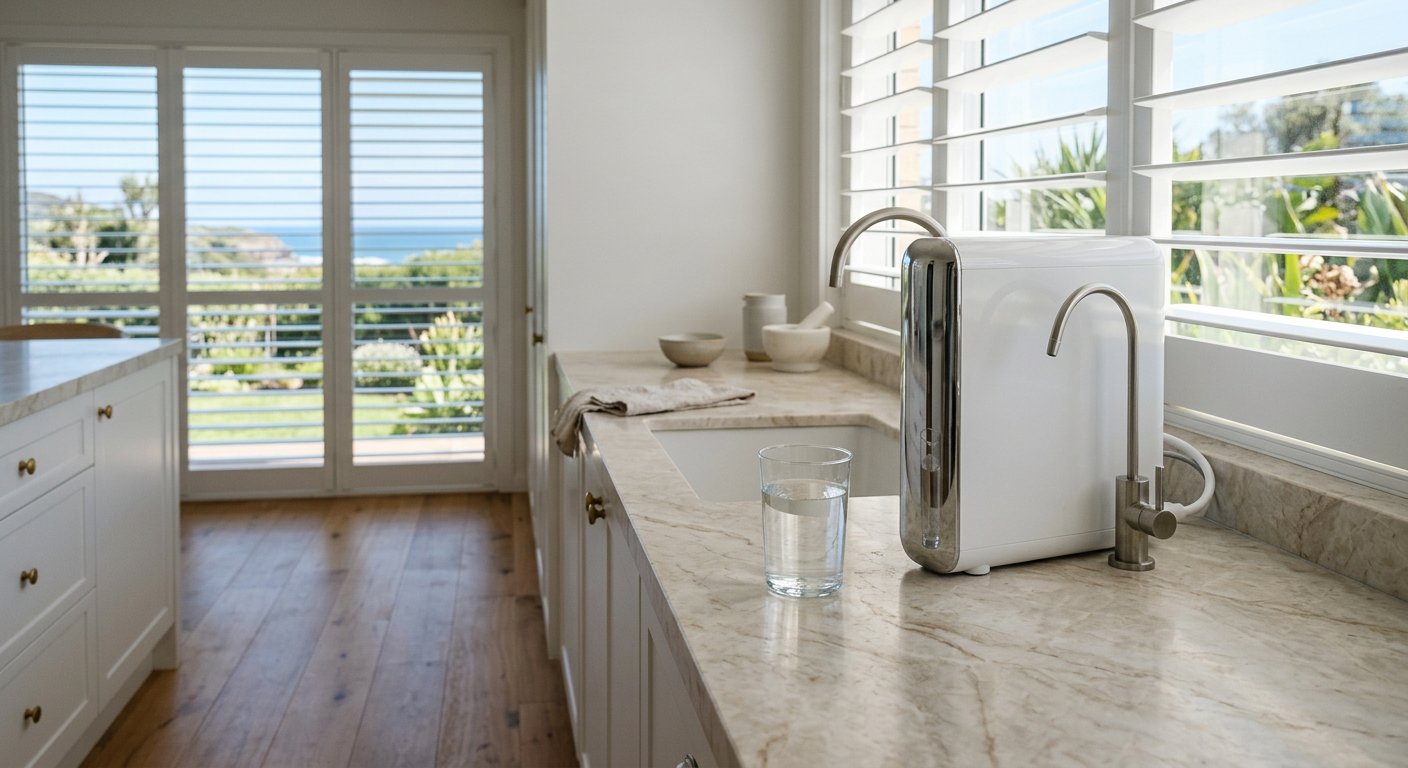
Rainwater is safe to drink for most healthy adults in Australia when the roof is clean, the tank is maintained, and a first-flush diverter is installed — but it is NOT safe without filtration for immunocompromised people, infants, or homes near industrial sites or defence bases. The NHMRC’s 2024 ADWG update and enHealth’s Guidance on Use of Rainwater Tanks both recommend a minimum of sediment + UV treatment for drinking supply, and reverse osmosis if PFAS or heavy metals are a concern. A countertop RO system like the AquaTru Classic ($699, NSF/ANSI 58 certified) removes 99%+ of lead, PFAS, bacteria, and particulates from rainwater with zero plumbing modification — making it the most practical solution for rural and peri-urban households relying on tank water.
| Contaminant Risk | Minimum Treatment | Verdict |
|---|---|---|
| Microbial (E. coli, Giardia, Crypto) | UV steriliser or 1-micron + UV | Recommended for all households |
| Lead (roof flashings, solder) | Reverse osmosis (>95% removal) | Essential if pre-1990 roof |
| PFAS (near airport/defence base) | Reverse osmosis (>98% removal, NSF P473) | Non-negotiable within 5 km radius |
Key catches
- No Australian state or territory mandates rainwater quality testing for private households — you are responsible for your own supply
- Sediment filters and carbon filters alone will NOT remove bacteria, viruses, lead, or PFAS — you need UV (microbial) or RO (chemical + microbial)
- PFAS contamination from AFFF firefighting foam has been confirmed at 700+ sites across Australia according to the DCCEEW national register — many are near residential rainwater catchments
What the NHMRC and enHealth Actually Say About Drinking Rainwater
Most online guides either oversimplify or overcomplicate the regulatory position on rainwater in Australia. Here is what the two relevant national bodies actually state, as of the 2024 ADWG revision that remains current through 2026.
The NHMRC Australian Drinking Water Guidelines (ADWG 2024) do not prohibit drinking untreated rainwater. They explicitly acknowledge that millions of Australians — particularly in rural and regional areas — rely on rainwater as their primary or sole drinking water source. However, the ADWG framework is built around a risk-management approach: identify hazards in your catchment, assess the likelihood of contamination, and apply barriers (first-flush diversion, filtration, disinfection) proportional to the risk.
The enHealth Guidance on Use of Rainwater Tanks (updated 2010, still referenced by all state health departments as of 2026) is more prescriptive. It recommends that immunocompromised individuals, young children, and elderly people should not consume untreated rainwater. For healthy adults in urban and suburban areas, enHealth states that the risk from properly maintained rainwater systems is “low” — but it defines “properly maintained” with specific criteria: intact roof surfaces free of lead flashing, regular gutter cleaning, a first-flush diverter, screened tank inlets, and ideally UV disinfection or boiling before consumption.
Neither document classifies rainwater as “unsafe.” Both classify it as “unregulated” — meaning the burden of testing and treatment falls entirely on you, the householder. That is the critical difference between rainwater and mains supply. Sydney Water, for example, operates a catchment-to-customer risk management framework under the ADWG (documented here) that tests for 70+ parameters continuously. Your rainwater tank has no such monitoring. You are the water authority.
The Five Contaminants You Must Test For (and Why Most People Miss Three of Them)
If you are relying on rainwater for drinking, you are exposed to five categories of contamination. Most tank owners know about two of them (bacteria and sediment) and miss the other three entirely. Here is the complete risk profile, ranked by how commonly they affect Australian rainwater supplies.
1. Microbial Contamination — Faecal Coliforms, E. coli, and Protozoa
This is the contaminant that gets the most attention, and for good reason. According to a 2011 Monash University study of 300 rainwater tanks across south-east Australia, 18% tested positive for E. coli and 30% exceeded the ADWG aesthetic guideline for heterotrophic plate count. The primary sources are bird droppings, possum faeces, and insect carcasses entering through unscreened overflows or during heavy rain events that overwhelm the first-flush diverter.
Giardia and Cryptosporidium are the more dangerous protozoan risks — both are present in Australian wildlife faeces and both cause severe gastrointestinal illness. A single possum roosting on your roof can introduce enough Cryptosporidium oocysts to contaminate a 5,000-litre tank. These organisms are chlorine-resistant at normal dosing levels, which is why UV sterilisation (minimum 40 mJ/cm² dose) or sub-micron filtration (0.5-micron absolute) is the correct treatment, not just chlorine tablets dropped into the tank.
2. Lead — The Silent Contaminant From Your Own Roof
Lead contamination in Australian rainwater is far more common than most people realise, and it does not come from the rain itself. It comes from your roof. Specifically: lead flashings around chimneys, skylights, and parapet walls; lead-based solder on copper guttering (common in pre-1990 installations); and — less commonly — old lead-based paint on roofing surfaces.
The ADWG sets the guideline value for lead in drinking water at 0.01 mg/L (10 µg/L). A 2016 Macquarie University study testing 500 rainwater tanks in the Sydney basin found that 8.4% exceeded this guideline, with the highest concentrations found in homes built before 1980. Lead accumulates in tank sediment and re-suspends during heavy rain or when the tank is drawn down to low levels.
You cannot taste, smell, or see lead in water. It does not change the colour at concentrations below 0.5 mg/L. The only way to know is a laboratory test — a basic heavy metals panel from a NATA-accredited lab costs $60-$120 and takes 5-7 business days. If you have a pre-1990 roof and you have not tested, you are drinking water that has an 8.4% chance of exceeding safe lead levels. That is not a risk worth taking, especially for children — there is no safe level of lead exposure for developing brains, according to the NHMRC.
3. PFAS — If You Live Near a Defence Base or Major Airport
Per- and polyfluoroalkyl substances (PFAS) are the contaminant most rainwater guides ignore entirely. They should not. PFAS contamination from aqueous film-forming foam (AFFF) used in firefighting training has been confirmed at 700+ sites across Australia, according to the DCCEEW national PFAS investigation register. Many of these sites are defence bases and major airports surrounded by residential areas where households rely on rainwater.
If you live within 5 km of Williamtown RAAF Base (NSW), Oakey Army Aviation Centre (QLD), Edinburgh RAAF Base (SA), Faulconbridge Naval Depot (NSW), or any of the dozens of other confirmed PFAS-contaminated sites, your rainwater supply is at elevated risk. PFAS are airborne — they enter rainwater via atmospheric deposition, not just groundwater contamination. A 2019 study by the University of Queensland confirmed measurable PFAS concentrations in rainwater collected within 3 km of the Amberley RAAF Base in Ipswich, south-east Queensland.
The ADWG health guideline values (2024 revision) are: PFOS 0.07 µg/L and PFOA 0.56 µg/L. Testing is expensive ($200-$350 per sample at NATA-accredited labs), but if you are in a known PFAS zone, it is the single most important test you can run. Standard carbon filtration does NOT adequately remove PFAS. Only reverse osmosis (>98% removal, NSF/ANSI P473 certified) or granular activated carbon specifically rated for PFAS (at very high contact times) provides reliable reduction.
4. Heavy Metals Beyond Lead — Zinc, Copper, and Cadmium
Galvanised steel (Zincalume) roofs leach zinc into rainwater, particularly in the first 2-3 years after installation or when the coating is weathered. Copper guttering releases copper ions. Both metals exceed ADWG aesthetic guidelines in a significant percentage of Australian tank water samples. While zinc and copper are not as acutely dangerous as lead, chronic exposure above guideline values (zinc: 3 mg/L; copper: 2 mg/L) causes gastrointestinal distress and, in extreme cases, liver and kidney damage.
Cadmium, a byproduct of galvanised steel degradation, is the more concerning trace contaminant. The ADWG guideline is just 0.002 mg/L. First-flush diverters dramatically reduce metal loading because the highest concentrations occur in the first 1-2 mm of rainfall — the “first flush” that washes the roof. A properly sized first-flush diverter (minimum 20 litres per 100 m² of roof area) can reduce heavy metal concentrations by 80-90%, according to a 2013 University of South Australia study.
5. Pesticide and Herbicide Drift
If your property is adjacent to agricultural land or within 500 m of orchards, vineyards, or broadacre cropping, airborne pesticide drift can contaminate your rainwater. This is a particular concern in the Adelaide Hills, Hunter Valley, Sunraysia (Mildura), and Queensland’s Lockyer Valley. Glyphosate, 2,4-D, and organophosphates have all been detected in Australian rainwater samples near agricultural areas.
Testing for pesticide residues is the most expensive panel ($300-$500+), and the ADWG guidelines vary by compound. Activated carbon block filtration is effective for most pesticides, but if your water also contains lead or PFAS, reverse osmosis is the single technology that addresses all three contaminant categories simultaneously.
Rainwater Testing Protocol — Step by Step for Australian Households
Knowing what to test for is useless without knowing how to test properly. Here is the exact protocol I follow, adapted from the enHealth guidance and NATA laboratory requirements.
Step 1: Decide Which Tests You Need
Not every household needs every test. Use this decision framework:
| Your Situation | Required Tests | Approx. Cost (NATA Lab) |
|---|---|---|
| All rainwater drinkers (baseline) | E. coli + coliforms + pH + TDS | $40-$80 |
| Pre-1990 roof, lead flashings visible | Add heavy metals panel (Pb, Cu, Zn, Cd) | $60-$120 |
| Within 5 km of defence base/airport | Add PFAS (PFOS + PFOA minimum) | $200-$350 |
| Adjacent to agricultural land | Add pesticide screen | $300-$500 |
| Comprehensive (all risks) | Full panel: micro + metals + PFAS + pesticides | $500-$800 |
Step 2: Collect the Sample Correctly
A contaminated sample bottle or poor collection technique gives you worthless results. NATA-accredited labs supply sterile sample containers — usually a 500 mL sterile bottle for microbial and a 250 mL acid-washed bottle for metals. Collect from the tap or outlet you normally drink from, not directly from the tank. Run the tap for 30 seconds before collecting. Do not touch the inside of the bottle or lid. Refrigerate the sample immediately and deliver to the lab within 24 hours (microbial samples degrade rapidly at room temperature).
Step 3: Interpret Your Results Against ADWG Guidelines
When results come back, compare against these ADWG health guideline values (2024 revision):
| Parameter | ADWG Guideline Value | What Exceeding It Means |
|---|---|---|
| E. coli | 0 CFU/100 mL (none detected) | Faecal contamination confirmed — do not drink without disinfection |
| Lead (Pb) | 0.01 mg/L | Remove lead source (flashings) + install RO |
| PFOS | 0.07 µg/L | Switch to alternative supply or install RO |
| PFOA | 0.56 µg/L | Same as PFOS |
| Copper (Cu) | 2 mg/L (aesthetic: 1 mg/L) | Replace copper guttering or add first-flush diverter |
| pH | 6.5 – 8.5 | Low pH accelerates metal leaching — consider neutralising filter |
Step 4: Retest Annually (Minimum)
One clean test does not mean your water is safe forever. Contamination sources change — a new bird colony establishes on your roof, a neighbour starts spraying herbicide, or a heavy storm event overwhelms your first-flush diverter. EnHealth recommends testing at least annually, and after any significant weather event (cyclone, extended drought followed by heavy rain, or bushfire with ash fallout on your catchment area). Bushfire ash is a particularly underappreciated risk — it deposits heavy metals and PAHs (polycyclic aromatic hydrocarbons) on roofs across enormous areas. After the 2019-20 Black Summer fires, multiple NSW and Victorian rainwater tanks tested positive for elevated lead and manganese from ash deposition.
Tank Maintenance — The Six Non-Negotiable Actions
Filtration cannot fix a fundamentally contaminated system. If your tank maintenance is poor, even the best RO unit will be overwhelmed by sediment, bacterial load, and organic matter. Here are the six actions the enHealth guidance and every state health department agree on.
1. Install and maintain a first-flush diverter. This is the single highest-impact maintenance action for rainwater quality. A first-flush diverter captures the initial 20-40 litres of runoff from each rain event — the water that carries the majority of bird droppings, dust, pollen, and metal particulates off your roof. Without one, every contaminant sitting on your roof surface between rain events goes straight into your tank. Size it at a minimum of 20 litres per 100 m² of roof area. Empty and clean it after every rain event, or install a self-draining model.
2. Screen all tank inlets. Use 1 mm stainless steel mesh on all inlets, overflows, and breather holes. This keeps mosquitoes out (critical for dengue and Ross River virus control in Queensland, NT, and northern WA), prevents frogs, lizards, and insects from entering, and stops leaf litter from decomposing in your tank. Queensland Health mandates mosquito-proof screening on all rainwater tanks under the Public Health Act 2005.
3. Clean gutters twice per year — minimum. Decomposing leaf matter in gutters produces tannins (brown discolouration), lowers pH (accelerating metal leaching from galvanised surfaces), and provides a growth medium for bacteria and mould. In areas with heavy tree canopy — the Blue Mountains west of Sydney, the Adelaide Hills, or Tamborine Mountain in the Gold Coast hinterland — quarterly gutter cleaning is more appropriate.
4. Inspect and de-sludge the tank every 2-3 years. Sediment accumulates on the tank floor over time — a mixture of fine particles, organic matter, and in some cases heavy metal precipitates. A tank that has never been de-sludged after 10 years can have 5-10 cm of sediment, which re-suspends during heavy drawdown and contaminates the water column. Professional tank cleaning services charge $200-$500 depending on tank size and access. Alternatively, fit a tank vacuum siphon (around $80-$150) for DIY cleaning.
5. Inspect the roof catchment for lead flashings and degraded surfaces. Walk the roof annually (or hire a roofer) and look for exposed lead flashings, cracked or peeling coatings on Colorbond/Zincalume, and deteriorated solder joints on copper guttering. If you find lead flashings, replace them with non-lead alternatives (aluminium or Wakaflex). This is a one-time cost of $200-$800 depending on the extent of flashings, and it permanently eliminates the primary source of lead contamination in Australian rainwater systems.
6. Divert the first rain after drought or bushfire. After an extended dry period (more than 30 days without rain), the first rainfall event will carry a concentrated load of dust, animal droppings, pollen, and potentially bushfire ash. Manually divert or drain your first-flush system before allowing collection, or simply let the first 30 minutes of rain bypass the tank entirely by disconnecting the downpipe. This single action can reduce contaminant loading by 90%+ for that event, according to data from the CRC for Water Sensitive Cities.
When Filtration Is Non-Negotiable — and Which Technology to Use
Tank maintenance and first-flush diversion handle the bulk of contamination risk. But there are four scenarios where filtration is not optional — it is the only thing standing between you and a health outcome you cannot reverse.
Scenario 1: Immunocompromised household members, infants, or elderly. The enHealth guidance is explicit: these groups should not consume untreated rainwater under any circumstances. A healthy adult’s immune system can typically handle low-level microbial exposure from a well-maintained tank. A chemotherapy patient, a newborn, or a 90-year-old cannot. Minimum treatment: 1-micron absolute sediment filter + UV steriliser (40 mJ/cm²). Better: sediment + UV + RO.
Scenario 2: Confirmed or suspected lead contamination. If your test shows lead above 0.01 mg/L, or if you have visible lead flashings and have not tested, filtration is mandatory. Carbon filters do not remove lead reliably at the concentrations found in rainwater. Only reverse osmosis (>95% lead removal, NSF/ANSI 58 certified) provides consistent reduction below guideline values.
Scenario 3: PFAS risk zone. If you live within 5 km of Williamtown (NSW), Oakey (QLD), Edinburgh (SA), Katherine (NT), East Sale (VIC), or any confirmed PFAS site on the DCCEEW register, reverse osmosis is the only technology that removes PFAS to below ADWG guideline values. Carbon block can reduce PFAS at high contact times, but the removal rate degrades rapidly as the carbon exhausts — RO provides consistent >98% removal through the life of the membrane (typically 2-3 years).
Scenario 4: Sole-source supply in a remote area. If rainwater is your only water supply and there is no alternative during system failure, a multi-barrier treatment train (sediment + carbon + UV + RO) provides the most comprehensive protection against all contaminant categories simultaneously. The cost is justified because the consequence of system failure is zero drinking water.
Filtration Technology Comparison for Rainwater
| Technology | Removes | Does NOT Remove | Best Use Case |
|---|---|---|---|
| Sediment filter (5-20 µm) | Dirt, rust, large particles | Bacteria, chemicals, metals, PFAS | Pre-filter only — never sole treatment |
| Carbon block (1 µm) | Taste, odour, chlorine, some pesticides | Bacteria, lead, PFAS, fluoride | Taste improvement on clean supply |
| UV steriliser (40 mJ/cm²) | Bacteria, viruses, protozoa (99.99%) | Chemicals, metals, PFAS, turbidity | Microbial disinfection (needs clear water input) |
| Reverse osmosis (NSF 58) | Lead >95%, PFAS >98%, bacteria, fluoride 90-97%, pesticides | Nothing significant at drinking-water concentrations | Comprehensive protection — the only single technology covering all 5 contaminant categories |
The bottom line is clear: if you want one system that handles every contaminant category found in Australian rainwater — microbial, lead, PFAS, other metals, and pesticides — reverse osmosis is the only single technology that does it. Everything else requires stacking multiple technologies, which increases complexity, maintenance, and cost.
Cost-Benefit Analysis: Filtration vs. Bottled Water vs. Mains Connection
Money is the reason most people delay making a decision about their rainwater quality. So let’s remove the ambiguity with actual numbers.
| Option | Upfront Cost | Annual Running | 5-Year Total | Cost/Litre |
|---|---|---|---|---|
| Untreated rainwater (tank only) | $0 | ~$100 (maintenance) | $500 | $0.07 |
| AquaTru Classic RO (countertop) | ~$699 | ~$120 (filters) | ~$1,299 | $0.18 |
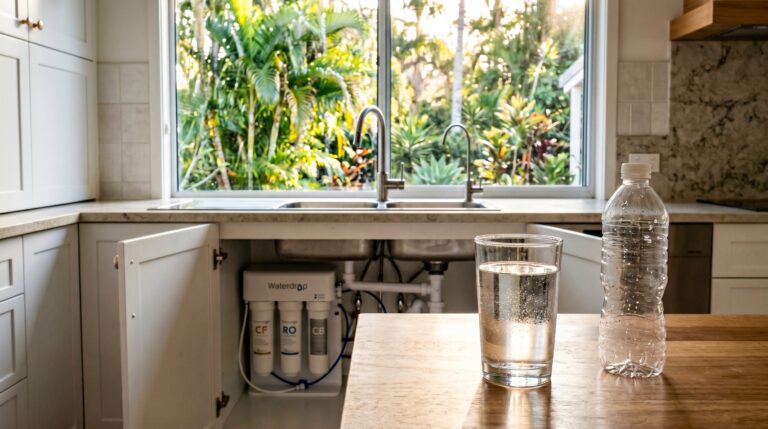
| Waterdrop D6 RO (under-sink) | ~$599 | ~$100 (filters) | ~$1,099 | $0.15 |
| Bottled water (2 adults, 4L/day) | $0 | ~$730 (at $2/L) | $3,650 | $2.00 |
| Mains water connection (rural) | $5,000-$20,000+ | $300-$600 (usage) | $6,500-$23,000+ | Variable |
The numbers are unambiguous. A countertop RO system costs $0.18/litre over five years — roughly 11 times cheaper than bottled water and a fraction of the cost of connecting to mains. For rural properties where a mains connection would cost $10,000-$20,000+ in civil works alone, a $699 countertop RO pays for itself inside two years compared to bottled water — and it removes contaminants that bottled water companies are not even required to test for in Australia.
Water Corporation WA has extended rainwater-saving incentives through winter 2026 (media release here), encouraging more Perth households to install tanks and use rainwater for non-potable purposes. But if you are going to collect rainwater anyway, spending $699 once to make it safe to drink is the highest-return investment you can make in your household water independence. Without that treatment, every glass you drink is unregulated, untested water passing through whatever your roof puts into it.
Region-Specific Risks — What to Watch for in Your State
Australia is not uniform. Your rainwater risk profile changes significantly depending on where you collect it. Here is a state-by-state breakdown of the most relevant local factors.
Queensland: SEQ Water serves Brisbane, the Gold Coast, and surrounding councils with chloraminated mains supply — but the hundreds of thousands of QLD properties on tank water (particularly in the Sunshine Coast hinterland, Scenic Rim, Lockyer Valley, Toowoomba surrounds, and Far North Queensland) face specific risks including elevated microbial contamination from tropical bird species, higher organic loading from subtropical vegetation, and PFAS exposure near Amberley RAAF Base (Ipswich) and Oakey Army Aviation Centre (Darling Downs). QLD Health mandates mosquito-proof screening on all tanks under the Public Health Act 2005.
New South Wales: The Sydney basin’s rainwater risks are dominated by lead from older roof stock (pre-1980 housing), PFAS contamination around Williamtown RAAF Base (Hunter Valley) and Faulconbridge Naval Depot (Blue Mountains), and bushfire ash deposition for properties west of the Great Dividing Range and in the Blue Mountains corridor. According to the Macquarie University study, Sydney basin tanks had the highest lead exceedance rate of the 500 tanks sampled nationally. Penrith and the western Sydney suburbs are particularly affected due to older housing stock with lead flashings.
South Australia: Adelaide mains water is chloraminated and among the hardest in Australia (~140 mg/L CaCO₃, TDS ~400 mg/L), making rainwater an attractive alternative for taste alone. However, the Adelaide Hills wine-growing region produces pesticide drift risk, and Edinburgh RAAF Base is a confirmed PFAS site. Rainwater acidity in SA is slightly lower than eastern states (more alkaline dust), which reduces metal leaching — but does not eliminate it.
Victoria: Melbourne’s mains supply is free chlorine (not chloramine), with very soft water (~25 mg/L CaCO₃, TDS ~60). Victorian rainwater tank owners face bushfire ash deposition risk across a wide area — the 2019-20 Black Summer fires contaminated rainwater tanks across East Gippsland and the Alpine region. East Sale RAAF Base is a confirmed PFAS site affecting surrounding tank water users.
Western Australia: Perth’s mains water is chloraminated and hard (~180 mg/L CaCO₃, TDS ~170). The Water Corporation’s 2026 rainwater incentive program encourages tank installations, but WA’s dry climate means long periods between rainfall events — increasing the contamination loading in first-flush water when rain finally arrives. PFAS contamination has been identified at the Pearce RAAF Base site north of Perth. Rockingham and Kwinana corridor properties face additional industrial contaminant risk from atmospheric deposition.
Northern Territory: Katherine’s PFAS contamination (from Tindal RAAF Base) is one of Australia’s most publicised cases. Darwin’s mains supply uses chloramine. Rural NT properties on rainwater face extreme microbial risk from the tropical climate — E. coli contamination rates in NT tank water studies exceed 30% in wet season. UV sterilisation is considered essential, not optional, in tropical Australia.
The Decision Tree — Do You Need to Filter Your Rainwater?
Three questions. That is all it takes to determine whether you need filtration, and if so, which type.
Question 1: Is anyone in your household immunocompromised, elderly, or under 5 years old?
Yes → You need, at minimum, a 1-micron sediment filter + UV steriliser. If lead or PFAS risk exists, add RO. No exceptions — the enHealth guidance is explicit on this point.
Question 2: Does your roof have lead flashings, or is your property within 5 km of a confirmed PFAS site?
Yes to either → You need reverse osmosis. Carbon block and UV will not remove lead or PFAS. Test first to confirm, but do not wait for results to start using RO if you suspect contamination.
Question 3: Are you a healthy adult with a post-1990 roof, a first-flush diverter, screened inlets, and clean gutters, drinking from a tank you inspect annually?
Yes to all → Your risk is low, and the enHealth guidance considers this “acceptable” for healthy adults. However, an annual microbial test ($40-$80) is still recommended. A UV steriliser adds an extra barrier at minimal ongoing cost ($20-$40/year for UV lamp replacement).
If you answered “no” to question 3 — meaning you lack a first-flush diverter, have not inspected your roof, or do not clean your gutters regularly — fix the maintenance issues first. Filtration on top of a poorly maintained system is treating symptoms, not causes.
Final Verdict
Rainwater in Australia is not inherently dangerous. Millions drink it safely every day. But “safe” is conditional — it depends on your roof, your tank, your location, and your willingness to test and maintain your system. The NHMRC and enHealth frameworks both treat rainwater as an unregulated supply where the householder bears full responsibility. That responsibility is not difficult or expensive to meet, but it cannot be ignored.
If you do one thing after reading this article, get a baseline water test from a NATA-accredited lab. It costs $40-$80 for microbial, $60-$120 if you add metals. If your results are clean and your system is well-maintained, you can drink with confidence. If they are not — or if you are in a PFAS zone, have a pre-1990 roof, or have vulnerable household members — a countertop RO system like the AquaTru Classic removes every contaminant category for $0.18/litre over five years, with zero plumbing changes. That is cheaper than bottled water and more comprehensive than any mains supply in Australia.
Your roof is your catchment. Your tank is your reservoir. You are the water authority. Act like it.
Ready to make your rainwater safe to drink?
The AquaTru Classic is the top-rated countertop RO for Australian rainwater households — NSF/ANSI 58 certified, removes lead, PFAS, bacteria, and pesticides with zero plumbing modification. At $0.18/litre over 5 years, it is 11× cheaper than bottled water.
Last reviewed: August 2026 – Clean and Native
Frequently Asked Questions
Is it legal to drink rainwater in Australia?
Yes. There is no law in any Australian state or territory prohibiting the consumption of rainwater from your own tank. However, no government body tests or certifies private rainwater supplies — the NHMRC ADWG and enHealth guidance place full responsibility for water quality on the householder.
Does a Brita filter make rainwater safe to drink?
No. Brita jug filters use standard granular activated carbon (GAC), which reduces taste and odour but does not remove bacteria, lead, PFAS, or protozoa such as Giardia and Cryptosporidium. For rainwater treatment, you need a minimum of UV sterilisation (microbial) or reverse osmosis (comprehensive).
How often should I test my rainwater tank?
At least annually for E. coli and coliforms, according to enHealth guidance. Additionally, test after any significant weather event — extended drought followed by rain, cyclone, or bushfire with ash fallout. If you have lead flashings or live near a PFAS site, test for those contaminants at least once, ideally annually.
Can I give rainwater to my baby?
The enHealth guidance recommends against giving untreated rainwater to infants. Boiling or UV treatment addresses microbial risk, but does not remove lead or PFAS. If you have any doubt about chemical contamination, use RO-filtered water or commercially bottled water for infant formula preparation.
Does boiling rainwater make it safe?
Boiling for one minute kills bacteria, viruses, and protozoa effectively. However, boiling does not remove chemical contaminants — it actually concentrates lead, PFAS, and heavy metals by evaporating water while the contaminants remain. Boiling is appropriate for microbial risk only.
What is a first-flush diverter and do I need one?
Get the Australian Home Environment Checklist
30 checks across water, air and EMF. Most of them free. Ranked by impact.
No spam. Unsubscribe any time.

Former Royal Australian Navy Clearance Diver and TAG-E counter-terrorism operator. Founded Clean and Native to apply the same rigorous thinking to the home environment.
Full biography →Similar Posts
Aussie Scientists Build Portable Water Filter
Australia’s portable water filtration market is growing fast, driven by bushfire emergencies, remote travel, and drought conditions that can strip safe…
Does Reverse Osmosis Remove Minerals? What Australian Homes Need to Know
Yes, reverse osmosis removes minerals from water — including calcium, magnesium, and potassium. This is one of the most searched questions about RO…
Adelaide Drinking Water Quality 2026: What’s in Your Tap Water
Adelaide’s tap water has a reputation for taste — and the chemistry explains why. River Murray dependence, chloramine, and TDS up to 450mg/L in some zones. What the 2024 SA Water data actually shows.
Best Water Filter to Replace Bottled Water Australia 2026
A home water filter that meets NSF/ANSI 58 certification removes more contaminants than any bottled water brand sold in Australia — and costs less…
Pure Water Systems Luxe Collection Dual Action Review: The Under-Sink Filter for PFAS and Chloramine
The Pure Water Systems Luxe Collection combines 0.1-micron ultrafiltration with activated carbon block to remove PFAS, chloramine, and heavy metals without stripping beneficial minerals. Manufacturer-rated for six months of use under an Australian sink.
Best Benchtop Water Filter for Fluoride Australia 2026: What Actually Works
Premium Grounding vs Better Earthing Australia — direct comparison of the two leading Australian grounding mat brands. Premium Grounding wins on certifications and commission (15%); Better Earthing wins on product range. Covers mats, sheets, and earthing shoes.