When to Replace Air Purifier Filters Australia 2026
Your air purifier’s HEPA filter should be replaced every 12 to 18 months under normal Australian urban conditions, but that timeline drops to as little as 6 months if you run the unit heavily during bushfire smoke season (October to March) or live in a high-dust area like western Sydney or inner Brisbane. Carbon filters saturate faster — typically 6 to 12 months — and pre-filters need washing every 2 to 4 weeks to keep the expensive HEPA stage working properly.
Replace HEPA filters every 12-18 months in urban Australia, every 6-9 months in bushfire-prone or high-dust regions, and carbon filters every 6-12 months regardless of location. Calendar-based replacement alone is unreliable because Australian conditions vary dramatically — a unit running 24/7 during a Black Summer smoke event accumulates more particulate in 8 weeks than a Melbourne bedroom unit sees in a year. Pre-filters are the cheapest maintenance action: wash them fortnightly, and you extend HEPA life by months. Genuine replacement filters cost more upfront but maintain certified filtration efficiency; generic filters often lack independent testing and may bypass the housing seal.
| Filter Type | Replacement Interval | Verdict |
|---|---|---|
| HEPA (H13) | 12-18 months (urban) / 6-9 months (bushfire zone) | Replace — never wash |
| Activated Carbon | 6-12 months | Replace — saturated carbon off-gasses |
| Pre-filter (mesh/foam) | Wash every 2-4 weeks | Recommended — extends HEPA life |
Key catches
- Manufacturer “filter life” estimates assume 8-12 hours/day use in low-pollution environments — not 24/7 use during Australian smoke season
- Generic/third-party HEPA filters often lack EN 1822 or equivalent certification — you may get H11 performance at H13 prices
- A saturated carbon filter does not just stop working — it can release trapped VOCs back into your air (off-gassing)
- Washable HEPA filters exist but degrade to roughly H11 efficiency after 3-5 wash cycles according to independent testing
Why Manufacturer Timelines Do Not Work for Australian Conditions
Every air purifier ships with a recommended filter replacement schedule. Samsung says 6-12 months. IQAir says 4-5 years for their HyperHEPA. Breville says 12 months. These numbers are not wrong — they are just not written for you. They are written for a controlled indoor environment with moderate pollution, temperate climate, and 8-12 hours of daily operation.
That is not how Australian households use air purifiers. If you live in a bushfire-prone region — anywhere from the NSW Northern Rivers down to East Gippsland, most of coastal QLD, or the Adelaide Hills — you run your purifier 24/7 for weeks or months during smoke season (October to March). According to the Australian Centre for Disease Control, indoor air quality directly affects health outcomes, and PM2.5 from bushfire smoke is the primary seasonal driver for Australian households purchasing air purifiers.
The math is simple. A filter rated for 2,160 hours of use (roughly 12 months at 6 hours/day) will hit that threshold in 90 days if you run it around the clock. During Black Summer 2019-2020, Canberra recorded AQI readings above 2,000 — hazardous by any standard. Sydney’s western suburbs, Penrith and Campbelltown especially, saw weeks of PM2.5 above 200 µg/m³ against the WHO guideline of 15 µg/m³ (annual average). Your filter absorbed all of that. Calendar months do not reflect actual filter load.
The correct metric is cumulative operating hours multiplied by average PM2.5 exposure. A purifier running in a Melbourne apartment with AQI consistently below 50 will last its full rated life. The same unit running in a Penrith home with windows cracked during a smoke event will saturate in a fraction of the time.
HEPA Filter Replacement: What Actually Determines Lifespan
A true HEPA filter (H13 grade per EN 1822) captures 99.97% of particles at 0.3 micrometres. That efficiency rating applies when the filter is new. As the filter loads with trapped particulate, two things happen simultaneously: filtration efficiency temporarily increases (the particle cake acts as an additional filter layer) and airflow resistance increases (the fan has to work harder to push air through). Eventually, the resistance overwhelms the fan motor’s capacity. That is when you notice reduced airflow, louder operation, or your purifier’s air quality sensor stubbornly refusing to drop to “good.”
Here is the problem for Australian households. A filter that has been running at maximum capacity during a 6-week smoke event in NSW or Victoria is not gently loaded — it is packed with fine combustion particulate. PM2.5 from bushfire smoke is significantly smaller and denser than household dust, pet dander, or pollen. It embeds deeper into the HEPA media and creates higher pressure drop per gram of captured material than the larger particles most manufacturer testing accounts for.
Replacement Indicators You Can Actually Observe
The best manufacturers, including Breville with the Protect Max, include particulate sensors that estimate filter life remaining as a percentage. These sensors measure pressure differential across the filter — essentially, how hard the fan is working compared to baseline. When the reading drops below 10-15%, it is time to order a replacement. If your unit does not have a sensor, watch for these physical signs:
- Visible discolouration — A new H13 HEPA filter is white or off-white. If it is uniformly grey, dark grey, or brown, the media is loaded. Pull the filter and inspect it under good light.
- Reduced airflow at max speed — Hold your hand 30cm from the outlet. If the airflow at Speed 3 feels like what Speed 1 used to feel like, the filter is restricting.
- Persistent odour on startup — A musty or stale smell when the unit starts up, particularly in Brisbane, Cairns, or coastal NSW where humidity sits above 60% for months. This indicates biological growth on the loaded filter surface.
- Unit running louder than usual — The fan motor is compensating for increased back-pressure. A Breville Protect Max at 24 dB on Sleep Mode that now sounds closer to 35-40 dB has a loaded filter.
- PM2.5 sensor never reaches “good” — If your unit’s sensor perpetually reads moderate or poor despite running for hours in a closed room, the filter is either saturated or bypassing.
Australian Climate Zone Replacement Schedule
| Climate Zone | Examples | HEPA Life | Key Driver |
|---|---|---|---|
| Bushfire-prone coastal | Blue Mountains, East Gippsland, Adelaide Hills, Noosa hinterland | 6-9 months | Extended 24/7 operation during smoke events |
| Urban high-traffic | Parramatta, inner Brisbane, inner Melbourne, Kwinana (Perth) | 10-14 months | Vehicle emissions PM2.5 + industrial particulate |
| Tropical humid | Cairns, Darwin, Townsville, Mackay | 10-12 months | Mould spore load + high humidity degrading media |
| Suburban low-pollution | Outer Melbourne, Hobart, Canberra (non-smoke), coastal Sunshine Coast | 14-18 months | Low baseline PM2.5, moderate daily use |
| Rural/agricultural | Darling Downs, Riverina, Mildura, WA wheatbelt | 8-12 months | Harvest dust, soil particulate, seasonal burning |
Carbon Filter Saturation: The Silent Failure You Cannot See
Your HEPA filter traps particles. Your activated carbon filter adsorbs gases and volatile organic compounds (VOCs) — formaldehyde from new furniture, cooking fumes, paint off-gassing, bushfire smoke odour, and cleaning product chemicals. Adsorption is a chemical process: gas molecules bind to the carbon’s microscopic pore structure. Once those pores are full, the carbon is saturated. And here is the part most people miss: a saturated carbon filter does not simply stop working. It can begin releasing previously trapped compounds back into your air. This process is called desorption or off-gassing.
You will not see carbon saturation the way you see a grey HEPA filter. The carbon granules look the same whether they are fresh or exhausted. The only reliable indicators are smell and time. If you start noticing cooking odours lingering longer than they used to, or a chemical/stale smell when the purifier runs, the carbon is done.
Why Carbon Saturates Faster in Australian Homes
Three Australian-specific factors accelerate carbon depletion:
1. Bushfire smoke VOCs. Bushfire smoke is not just particulate. According to NSW Department of Planning and Environment data, bushfire smoke contains measurable concentrations of benzene, formaldehyde, acrolein, and polycyclic aromatic hydrocarbons (PAHs). These are the exact compounds carbon media is designed to capture. A severe smoke season can exhaust a carbon filter in 3-4 months that would normally last 12.
2. New-build off-gassing. Australia’s construction boom means millions of Australians live in homes built within the last 10 years. Engineered timber flooring, MDF cabinetry, polyurethane finishes, and synthetic carpet all emit formaldehyde and other VOCs for years after installation. A carbon filter in a 2-year-old home in a new development in Oran Park (western Sydney), Pimpama (Gold Coast), or Tarneit (western Melbourne) will saturate faster than the same filter in a 30-year-old brick home.
3. Tropical humidity effects. In Darwin, Cairns, and Townsville, high ambient humidity (regularly above 70%) competes with VOCs for adsorption sites on the carbon. Water vapour occupies pore space that would otherwise capture gas molecules. This effectively reduces carbon capacity by 20-40% in tropical environments — a fact rarely mentioned in manufacturer documentation.
Carbon Filter Replacement Schedule
| Environment | Carbon Filter Life | Reason |
|---|---|---|
| Standard urban home (Melbourne, Hobart, Canberra) | 10-12 months | Low baseline VOC, moderate cooking |
| New-build home (<5 years old) | 6-9 months | Continuous formaldehyde/VOC off-gassing from materials |
| Bushfire season (heavy use) | 3-6 months | Benzene, formaldehyde, PAHs from smoke |
| Tropical high-humidity (Darwin, Cairns) | 6-8 months | Humidity competing for adsorption sites |
| Pet household (2+ animals) | 6-9 months | Ammonia and biological VOCs from pet waste/dander |
Pre-Filter Maintenance: The Cheapest Way to Extend HEPA Life
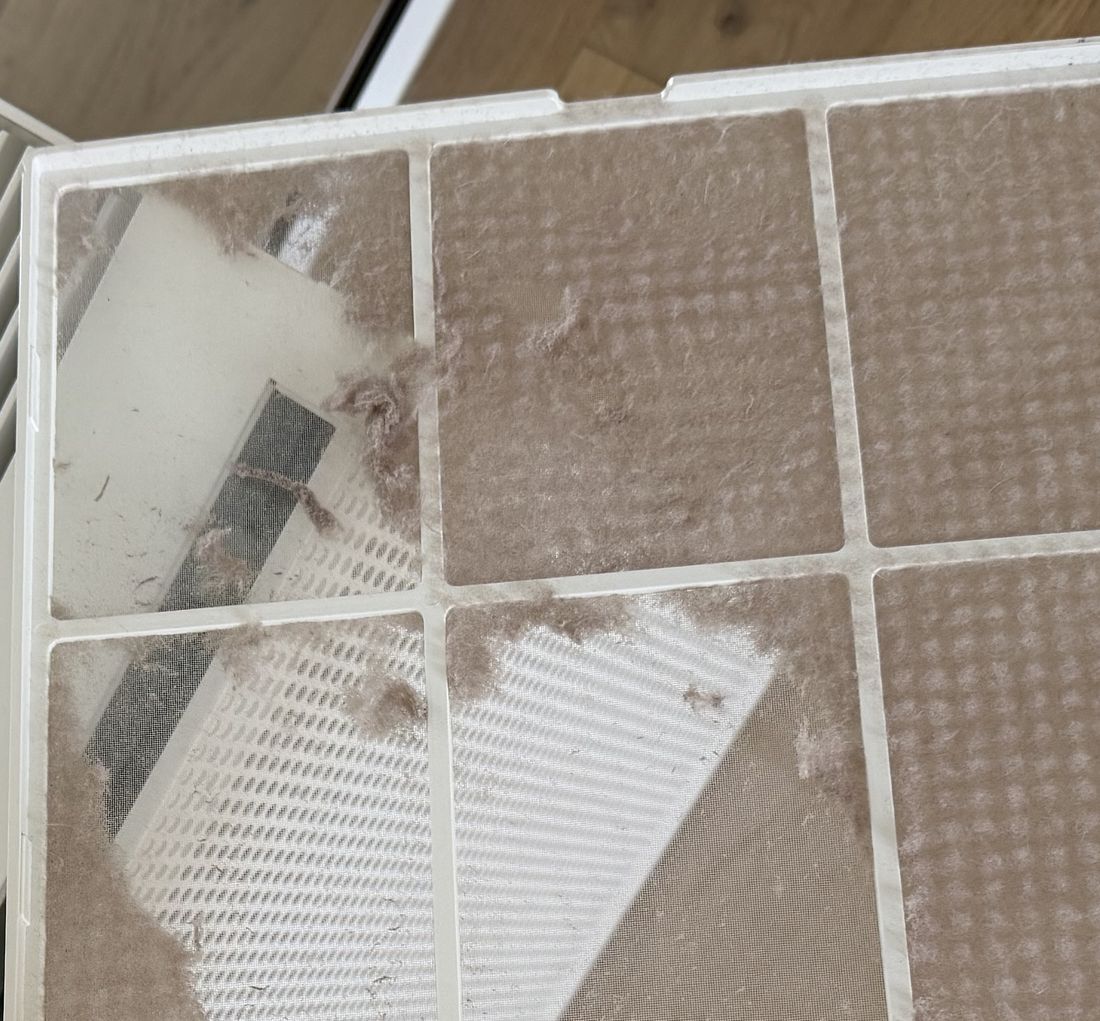
If there is one maintenance action that pays for itself every time, it is washing the pre-filter. The pre-filter is the first line of defence — a coarse mesh or foam layer that catches large particles like pet hair, dust bunnies, fabric lint, and pollen grains before they reach the HEPA media. Every large particle caught by the pre-filter is a particle that does not clog a HEPA fibre. Given that a genuine Breville Protect Max HEPA replacement filter costs upwards of $80-100 AUD and a pre-filter wash costs you 60 seconds and some tap water, the economics are obvious.
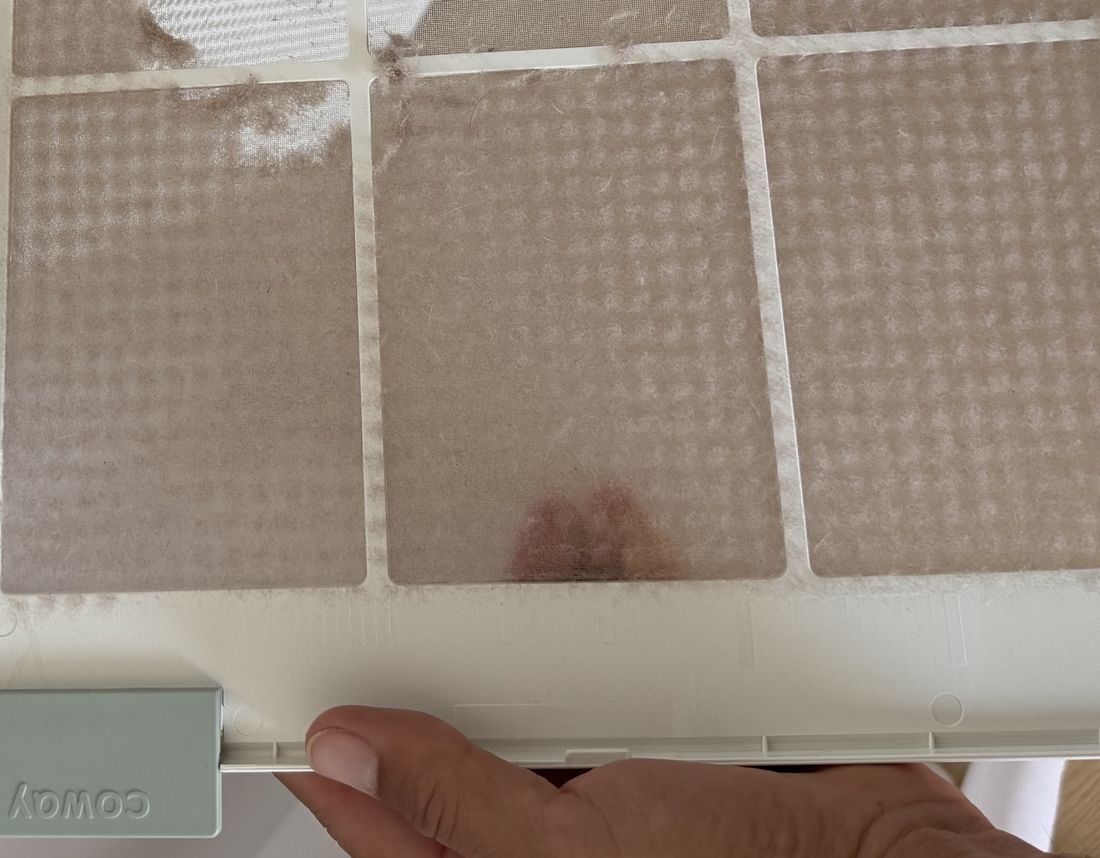
How to Wash a Pre-Filter Correctly
Most people get this wrong, and wrong technique damages the mesh. Here is the correct process:
- Remove the pre-filter. Power off the unit and unplug it. Remove the outer panel or filter housing per your model’s manual. The pre-filter is usually the outermost layer — a dark mesh or foam sheet.
- Vacuum first. Use a brush-head vacuum attachment on low suction to remove loose dust. This prevents turning dust into mud in step 3.
- Rinse under lukewarm water. Hold the filter under a running tap. Never use hot water (it can warp foam cells and shrink mesh) and never use detergent or soap (residue creates airflow restriction and may off-gas when the filter dries).
- Air dry completely. This is the step people skip. A damp pre-filter placed back into an enclosed purifier housing creates a perfect environment for mould growth — especially in Brisbane, Darwin, and Cairns where ambient humidity is already high. Allow 24-48 hours of air drying in a well-ventilated area. If you have a second pre-filter, rotate them.
- Inspect for damage. If the mesh has tears, holes, or is losing structural shape after multiple washes, replace it. A damaged pre-filter lets large particles through to the HEPA stage — defeating the purpose entirely.
Washing Frequency by Environment
Every 2 weeks: Households with pets (especially dogs or cats that shed), homes near construction sites, rural properties with unsealed driveways or nearby farmland.
Every 3-4 weeks: Standard suburban homes without pets, apartment living in inner Melbourne or Sydney, units with lower daily run times (8-12 hours).
Weekly during events: Active bushfire smoke, dust storms (common in western NSW, SA, and WA), or renovation/construction inside the home. During these periods, the pre-filter loads rapidly. Washing weekly keeps the HEPA stage protected.
Genuine vs Generic Replacement Filters: The Real Cost Comparison
This is where most people make the decision that costs them more in the long run. A genuine Breville Protect Max H13 HEPA replacement filter costs roughly $80-120 AUD depending on the model and whether the carbon stage is integrated or separate. A “compatible” third-party filter on Amazon AU might be $30-50. The price difference is tempting. Here is why it is a false saving for most households.
What You Lose with Generic Filters
1. Filtration grade is unverified. A genuine H13 HEPA filter is tested to EN 1822 standard, capturing 99.97% of particles at 0.3 µm (the most penetrating particle size). Generic filters often claim “HEPA-grade” or “True HEPA” without specifying EN 1822 compliance. Independent tests of popular generic HEPA filters have shown actual efficiency ranging from H10 (85%) to H12 (99.5%) — a massive gap when you are relying on the filter to protect against bushfire PM2.5.
2. Housing seal integrity fails. The filter has to seat precisely in the purifier housing to prevent bypass — unfiltered air leaking around the filter edges instead of passing through the media. Genuine filters are manufactured to the exact dimensions and gasket specification of the unit. Generic filters frequently have slight dimensional differences or use lower-quality gasket material. Even a 1-2mm gap allows unfiltered air through, and your PM2.5 sensor may read “good” while a significant percentage of air is actually bypassing the filter entirely.
3. Carbon quality varies dramatically. Activated carbon is not all the same. Carbon manufactured from coconut shell (used in quality filters) has roughly twice the adsorption capacity per gram compared to coal-based carbon. Generic combined HEPA/carbon filters often use minimal carbon weight (50-80g vs 200-300g in genuine units) or lower-grade carbon with fewer active pore sites.
5-Year Cost Comparison: Genuine vs Generic
| Factor | Genuine (Breville) | Generic Third-Party |
|---|---|---|
| Per-filter cost | ~$100 AUD | ~$40 AUD |
| Effective HEPA life (urban) | 12-14 months | 8-10 months (lower media density) |
| Replacements in 5 years | ~4-5 | ~6-8 |
| 5-year filter cost | $400-500 | $240-320 |
| EN 1822 H13 verified? | Yes | Rarely / unverified |
| Housing seal guaranteed? | Yes | No |
| Warranty preserved? | Yes | May void manufacturer warranty |
The genuine filter costs roughly $100-180 more over 5 years. That works out to about $0.05-0.10 per day for confirmed H13 filtration, guaranteed seal, and an intact warranty. If you bought a $500-800 air purifier specifically to protect your family’s lungs during smoke season, saving $30 per filter on an unverified generic undermines the entire investment.
When Generic Filters Are Acceptable
There is one scenario where a generic filter makes sense: if you use the purifier only for light duty in a low-pollution suburban environment (outer Melbourne, Hobart, coastal Sunshine Coast) and your primary concern is dust and pet dander rather than PM2.5 or VOCs. In that context, even H11 efficiency (95%) captures most visible particles, and the lower cost is a reasonable tradeoff. For anyone in a bushfire-prone area, or anyone who bought the purifier specifically for health protection — stick with genuine.
Washable HEPA Filters: Do They Work in Australia?
Some manufacturers market washable or “permanent” HEPA filters. The appeal is obvious — never buy a replacement filter again. But the data does not support the marketing for households with serious air quality concerns.
A HEPA filter works because its fibres are arranged in a precise, randomised mat that creates a tortuous path for air. Particles are captured through three mechanisms: interception (particles follow airflow and touch a fibre), impaction (particles are too heavy to change direction with the air and slam into fibres), and diffusion (the smallest particles move erratically and contact fibres). When you wash a HEPA filter, you physically displace and damage those fibres. The mat structure loosens. Fibre gaps widen.
Independent testing of washable HEPA filters — including studies referenced in ASHRAE Journal technical bulletins — shows that after 3-5 wash cycles, filtration efficiency degrades from H13 (99.97% at 0.3 µm) to roughly H11 territory (95% at 0.3 µm). That sounds acceptable until you calculate the difference: at H13, 3 out of every 10,000 particles pass through. At H11, 500 out of every 10,000 pass through. That is a 167-fold increase in particle penetration.
In an Australian context, this matters most during bushfire smoke events. PM2.5 from combustion is overwhelmingly in the 0.1-1.0 µm range — exactly the particle sizes most affected by fibre degradation from washing. A washed “HEPA” filter running during a smoke event in Penrith, Katoomba, or the Blue Mountains is letting through orders of magnitude more combustion particulate than a fresh genuine H13 filter.
Washable vs Replaceable: Decision Matrix
| Criterion | Washable HEPA | Replaceable H13 HEPA |
|---|---|---|
| Initial filtration (new) | H13 (if rated) | H13 |
| After 3-5 washes | ~H11 (95%) | N/A — replaced fresh |
| Annual running cost | $0 (wash only) | $80-120 per filter |
| Bushfire smoke protection | Degrades significantly | Consistent H13 |
| Mould risk (tropical AU) | High — must dry 48h+ | Low — dry filter from packaging |
| Best for | Low-pollution, budget-conscious, dust only | Health-focused, bushfire zones, allergy/asthma |
For anyone with asthma, young children, or who lives in a bushfire-prone area, washable HEPA filters are not the right choice. The $80-120 annual cost of a genuine replacement filter is your assurance of consistent H13 performance every single day.
How to Order the Right Replacement Filter in Australia
Ordering the wrong filter is more common than you would expect. Most manufacturers sell multiple purifier models with different filter dimensions, and a filter that is physically close in size but not exact will either not fit or will create bypass gaps. Here is the process to get it right every time.
Step 1: Identify Your Exact Model Number
Check the sticker on the back or bottom of your purifier. The model number is not the product name — “Breville the Smart Air Purifier” does not tell you enough. You need the specific model code (e.g., LAP500, LAP300). This code determines the exact filter part number.
Step 2: Cross-Reference the Filter Part Number
Every genuine filter has a part number. For Breville, these are printed on the filter packaging and listed on the Breville Australia website. For Levoit, the filter part number corresponds to the purifier model (Core 400S uses the Core 400S-RF replacement, for example). For Winix, the replacement filter for the 5500-2 is the Winix 5500-2 replacement filter set.
Step 3: Buy from a Verified Australian Retailer
Your options for purchasing genuine replacement filters in Australia include:
- Amazon AU — The largest selection of genuine replacement filters with next-day delivery in metro areas. Verify the seller is either the brand’s official Amazon store or “Ships from and sold by Amazon.com.au” to avoid grey-market stock.
- Manufacturer direct — Breville.com.au, Levoit AU store, Winix Australia. Reliable but sometimes slower shipping and higher pricing.
- The Good Guys / Harvey Norman / JB Hi-Fi — Stock genuine filters for brands they sell. Useful for same-day pickup but limited range. Rarely stock filters for older models.
Avoid eBay for HEPA filters. The filter may be genuine but old stock that has been stored in non-climate-controlled conditions. HEPA media can degrade if stored in high humidity for extended periods — and there is no way to verify storage conditions on eBay.
Step 4: Stock One Spare
Order your replacement filter before you need it. When a smoke event hits — and in Australia, it will hit — you do not want to be waiting 3-7 days for a filter delivery while your saturated HEPA filter runs at half capacity. Keep one genuine HEPA and one carbon filter (if separate) stored in original sealed packaging in a cool, dry location. Sealed HEPA filters have an indefinite shelf life if the packaging remains intact.
Complete Maintenance Schedule: Your Annual Air Purifier Calendar
I test air purifiers from my base in Palm Beach, QLD, and as a former Navy Clearance Diver I approach maintenance the same way I approach dive equipment — systematic checks on a fixed schedule, no guesswork. Here is the annual maintenance calendar I use and recommend for Australian households.
| Month | Action | Why |
|---|---|---|
| September | Pre-season filter inspection. Order spare HEPA + carbon if not in stock. | Bushfire season starts October. Stock sells out during smoke events. |
| October-March | Wash pre-filter weekly during active smoke. Monitor filter life indicator. | Heavy 24/7 operation accelerates all filter wear. |
| April | Post-smoke-season HEPA inspection. Replace if visibly grey/brown or filter life below 20%. | Filter loaded from summer use. Replace before winter mould/cold season. |
| May-August | Standard fortnightly pre-filter wash. Wipe exterior sensor intake monthly. | Lower ambient particulate but closed-house winter operation + heating = VOCs. |
| June (annually) | Replace carbon filter if not done post-summer. Check gasket seal. | Carbon saturated from summer VOC load. Gasket compression loosens over time. |
| August | Brisbane/SEQ and coastal NSW: pollen season pre-check. Start daily use. | Spring pollen season peaks September-November in QLD and northern NSW. |
This schedule assumes a standard Australian household running the purifier 12-16 hours daily with extended 24/7 use during smoke events. If you run your unit only occasionally or live in a consistently low-pollution area (inner Hobart, coastal Wollongong), you can extend HEPA replacement to 18 months and carbon to 12 months.
Final Verdict
Filter replacement is not a maintenance afterthought — it is the entire reason your air purifier works. A $700 Breville Protect Max with a saturated HEPA filter is doing less for your indoor air quality than a $30 box fan with a fresh filter taped to the front. The filter is the machine. Everything else is a fan and a housing.
For most Australian households, the replacement cadence is: pre-filter wash every 2-4 weeks, carbon filter every 6-12 months, HEPA filter every 12-18 months — and cut all those timelines by 30-50% if you use the purifier heavily during bushfire smoke season. Use genuine replacement filters from the manufacturer. Buy them on Amazon AU for the best combination of price, availability, and delivery speed. Keep one spare set sealed and stored before October every year.
The cost of running a quality air purifier with genuine filters works out to roughly $0.25-0.35 per day over 5 years. That is less than a cup of coffee for H13-grade air in every room where you sleep and breathe. Without fresh filters, you are running a noisy fan that circulates the same contaminated air you were trying to escape. Do not let that happen.
Last reviewed: August 2026 – Clean and Native
Ready to replace your filter?
The Breville Protect Max is our top-rated air purifier for Australian homes — H13 HEPA certified, 24 dB sleep mode, built-in air quality sensor with filter life tracking. Genuine replacement filters are available on Amazon AU with fast delivery.
Frequently Asked Questions
How often should I replace my air purifier HEPA filter in Australia?
Every 12-18 months under normal urban conditions. If you run the purifier 24/7 during bushfire smoke season (October-March) in NSW, Victoria, or QLD, replace the HEPA filter every 6-9 months based on visible discolouration and airflow reduction.
Can I wash a HEPA filter instead of replacing it?
You can wash some HEPA filters marketed as washable, but filtration efficiency degrades from H13 (99.97% at 0.3 µm) to roughly H11 (95%) after 3-5 wash cycles. That is a 167-fold increase in particle penetration. For bushfire smoke protection or health-sensitive households, always use replaceable H13 filters.
How do I know when my carbon filter is saturated?
You cannot visually assess carbon saturation — the granules look the same new or exhausted. The indicators are: cooking odours lingering longer than they used to, a stale or chemical smell from the purifier on startup, and elapsed time exceeding 6-12 months of regular use.
Are generic replacement HEPA filters as good as genuine ones?
Usually not. Generic filters often lack independent EN 1822 certification, may have dimensional differences that create bypass gaps in the housing seal, and frequently use less carbon media. They cost 50-60% less per filter but may need replacing 30-40% sooner. For health-critical applications, genuine filters are the better investment.
How often should I wash the pre-filter on my air purifier?
Every 2-4 weeks under normal conditions. Wash weekly during active bushfire smoke events, dust storms, or if you have pets. Use lukewarm water only — no detergent — and allow 24-48 hours to air dry completely before reinstalling to prevent mould growth inside the housing.
Does running my air purifier on a higher speed wear out the filter faster?
Yes. Higher fan speed pushes more air volume through the filter per hour, which means more particulate captured per hour. A purifier running on Speed 3 (max) will load the HEPA filter approximately 2-3 times faster than the same unit running on Speed 1. During smoke events, high speed is necessary — but it means the filter saturates sooner.
Where can I buy genuine Breville air purifier replacement filters in Australia?
Amazon AU stocks genuine Breville replacement filters with fast metro delivery. You can also purchase directly from Breville.com.au or from major Australian retailers like The Good Guys and Harvey Norman. Verify the seller is Breville’s official store or “Ships from Amazon.com.au” to avoid grey-market stock.
Can a saturated carbon filter release chemicals back into my air?
Yes. This process is called desorption or off-gassing. When activated carbon reaches full adsorption capacity, previously captured VOCs can be released back into the air — especially if the filter is exposed to higher temperatures or humidity changes. This is why timely carbon filter replacement is critical, not optional.
Does humidity affect HEPA filter lifespan in tropical Australia?
High ambient humidity (above 60-70%, common in Darwin
Get the Australian Home Environment Checklist
30 checks across water, air and EMF. Most of them free. Ranked by impact.
No spam. Unsubscribe any time.

Former Royal Australian Navy Clearance Diver and TAG-E counter-terrorism operator. Founded Clean and Native to apply the same rigorous thinking to the home environment.
Full biography →Similar Posts
Best Air Purifier for Mould Australia 2026: HEPA vs UV vs Activated Carbon
best air purifier for mould Australia — Clean & Native’s Australian guide covering everything you need to know, with evidence-based recommendations.
Find My Air Purifier – Which One Is Right for You?
Answer 3 questions and get a personalised air purifier recommendation for your Australian home — matched to your concern, room size, and budget.
How I Fixed My Sleep Environment: Water, Air, and EMF in My Palm Beach Home
Sleep quality improves measurably when you address bedroom water TDS (200+ ppm baseline), airborne VOCs/PM2.5 (35+ μg/m³ while sleeping), and AC electric…
Best Air Purifier for Large Rooms Australia 2026: Ranked by CADR, ACH, and Running Cost
The best air purifier for large rooms in Australia in 2026, ranked by verified CADR, air changes per hour, and annual running cost. Covers Breville Protect Max, Winix Zero Pro, and Dyson BP04.
Bushfire Smoke Hits VIC & NSW: Protect Your Indoor Air
Bushfire smoke in Victoria and NSW delivers PM2.5 concentrations that routinely exceed 500 µg/m³ — more than 20 times the NEPM 24-hour standard of 25…
Best Air Purifier Melbourne 2026: Smoke, Pollen and Thunderstorm Asthma
best air purifier Melbourne 2026 — Clean & Native’s Australian guide covering everything you need to know, with evidence-based recommendations.