Safe and Sound Pro II Review Australia 2026: The Bedroom RF Meter, Assessed
Drafted with AI assistance and checked against published specifications and certifications. First-hand measurements appear only where stated. How we make content
How this assessment was made. I have not used the Safe and Sound Pro II. I own a TriField TF2, and the TF2 readings on this page are mine, photographed in my home in Palm Beach, QLD. The Pro II is assessed from Safe Living Technologies’ product page and operation manual, its Amazon Australia listing and SaferEMF’s listing, checked on 31 Oct 2026. Clean and Native may earn a commission on some links.
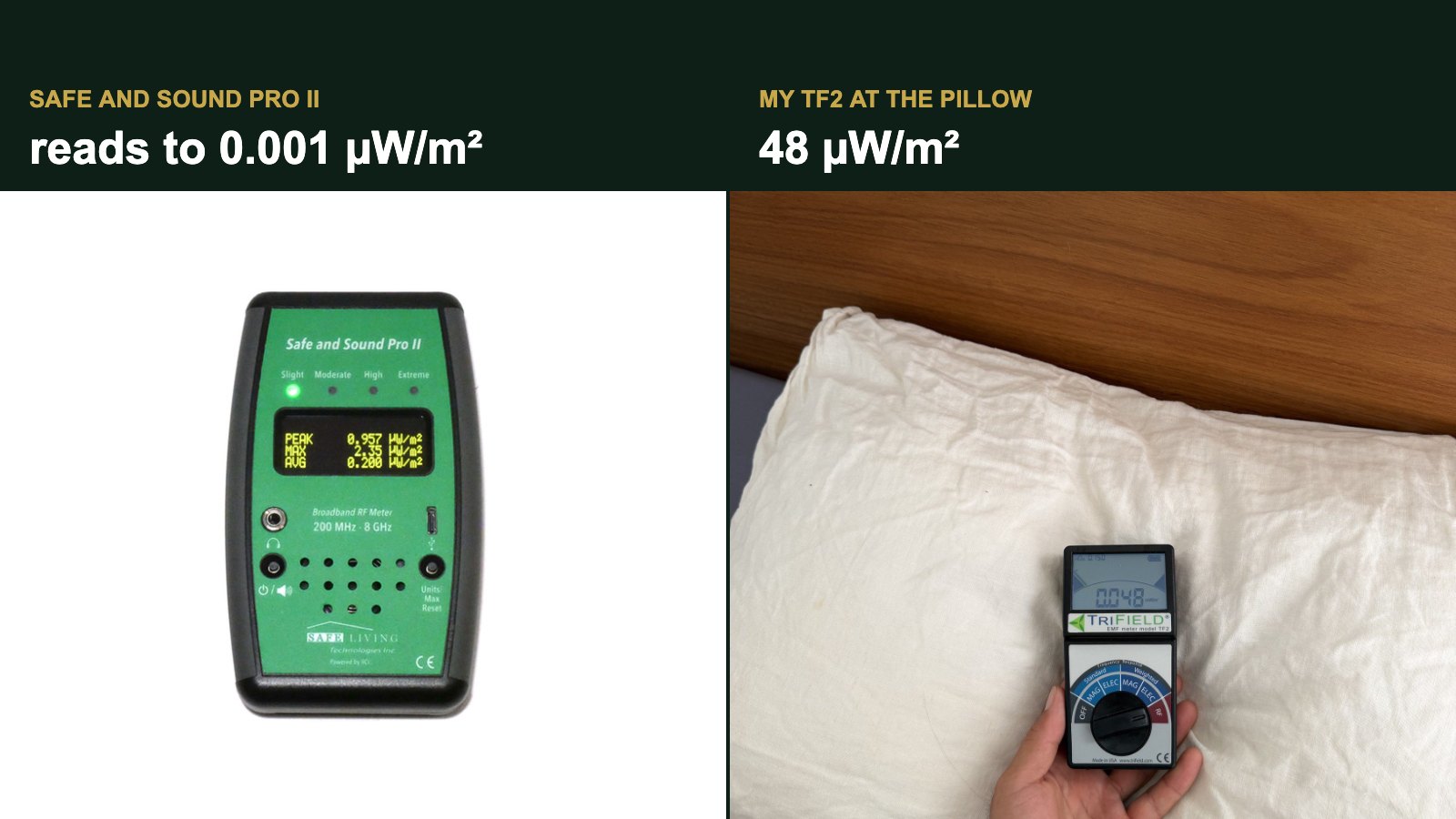
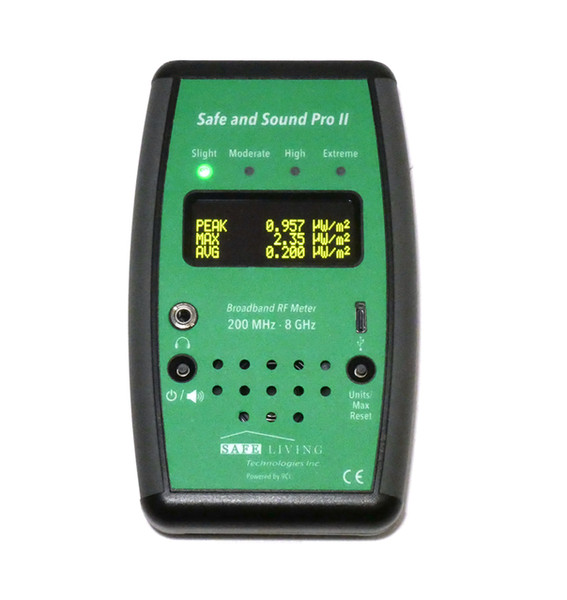
The Safe and Sound Pro II is the RF meter to use if your question is how low the wireless signal really is where you sleep. It reads from 200 MHz to 8 GHz, its display goes down to 0.001 µW/m² (Safe Living Technologies gives 0.005 µW/m² as the bottom of its measuring range), and its range is linear from 0.1 µW/m² upwards, which is the building biology “no concern” line for sleeping areas. It measures RF only, its accuracy is ±6 dB, and it costs $569.95 on Amazon AU, $499 from SaferEMF on the Gold Coast, or $99 to hire for three days. If you want one meter for the whole house, including wiring and appliance fields, buy a TriField TF2 instead.
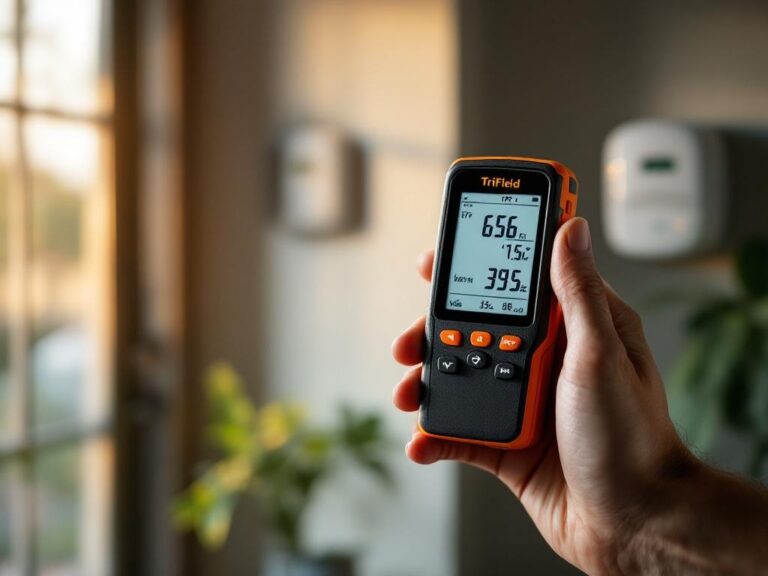
I bought a TF2 to measure my own house, and it showed me its limit quickly: at my pillow it reads 0.048 mW/m², which is 48 µW/m², and below 1 µW/m² it cannot show anything at all. Clearance diving teaches you to learn where an instrument stops being useful before you trust it. For a bedroom checked against building biology guidance, the TF2 stops too early. That gap is the whole case for the Pro II.
A specialist RF meter that reads far lower than all-round meters. Worth it for bedroom RF; not a whole-house meter. Prices checked 31 Oct 2026.
| Where | Notes | Price |
|---|---|---|
| Amazon AU | Sold by Safe Living Technologies, the maker; current rechargeable version | $569.95 |
| SaferEMF | Gold Coast stockist, 2-year warranty | $499 |
| SaferEMF hire | 3 days, plus a $400 refundable deposit | $99 |
 Linear from0.1 µW/m²display to 0.001 µW/m²
RF only, 200 MHz to 8 GHz | ±6 dB from 400 MHz to 7.2 GHz | PEAK, MAX and AVG in µW/m² or V/m | Rechargeable, USB-C | 2-year warranty | $569.95 Amazon AU, sold by the maker (31 Oct 2026)
Check the Pro II Price on Amazon →✓ The Pro II is for you if
- You want to know whether your bedroom or a child’s room is genuinely low in RF
- You are moving a bed, cot or router and want to see the difference
- You want to hear which source is which (Wi-Fi, phone, smart meter) by sound
- You only need it for a few days: hiring is $99
× Look elsewhere if
- Your concern is power lines, wiring or a switchboard: it does not measure those fields
- You want one meter for every field type: the TriField TF2 covers all three
- You want an overnight data log: it has none
- You need mmWave 5G (24 GHz and above): it stops at 8 GHz
Why I am reviewing a meter I don’t own
Because my own meter can’t answer the question most people buy an RF meter for. The TriField TF2’s RF display steps in 0.001 mW/m², which is 1 µW/m². The German building biology guidelines for sleeping areas (SBM-2008) put “no concern” below 0.1 µW/m² and “slight” between 0.1 and 10 µW/m². A TF2 showing 0.000 could be in either band. A Pro II shows the number.
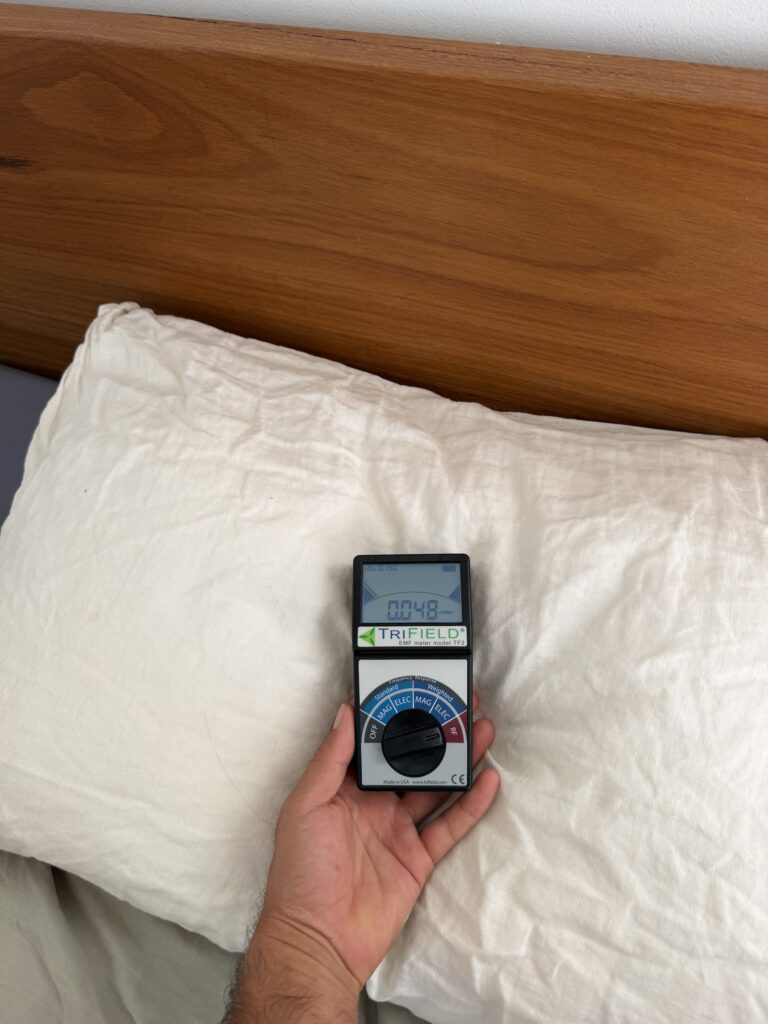
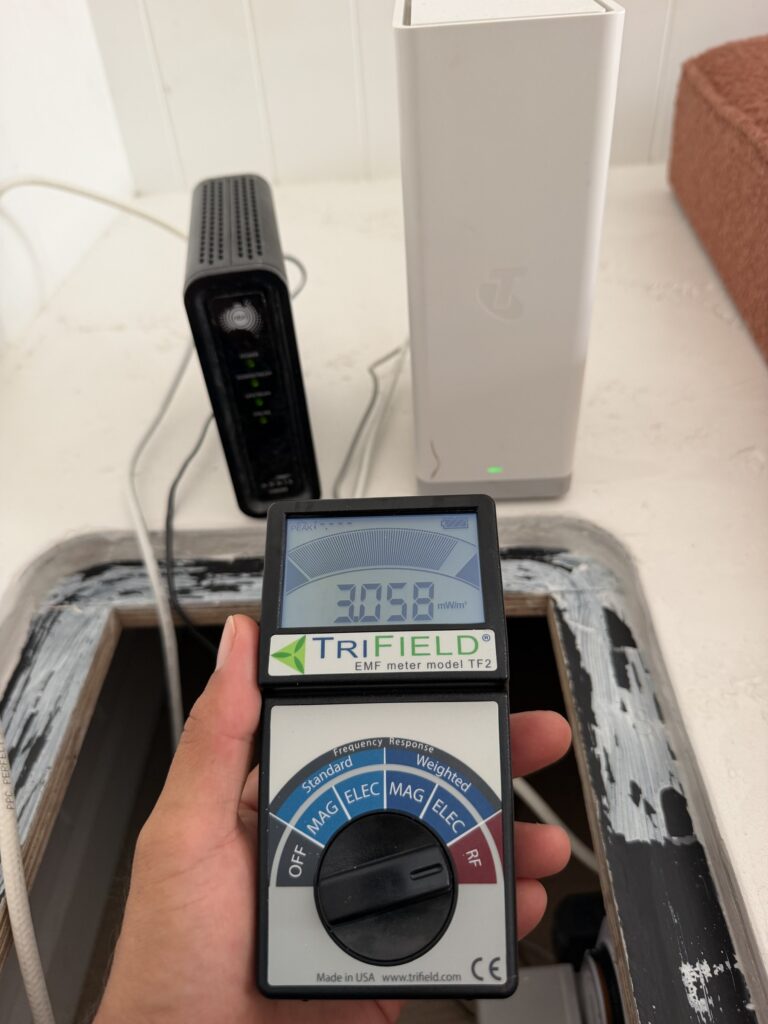
In my case the pillow reading of 48 µW/m² is already in the SBM “severe” band (10 to 1,000 µW/m²), so the TF2 told me what I needed: there was something to fix. The Pro II earns its price after the fix, when you want to know how far down you have actually got. My TF2 readings and photos are in the TriField TF2 review.
Specifications
These are for the current rechargeable version with a USB-C port, which is the one on Amazon AU (listed from 8 June 2026). Older units run on AA batteries. Where this page quotes the manual, it is the manual for the AA version, whose frequency and linear ranges match the rechargeable product page.
| Spec | Safe and Sound Pro II | Source |
|---|---|---|
| Fields measured | RF only | SLT |
| Frequency range | 200 MHz to 8 GHz; ±6 dB true response from 400 MHz to 7.2 GHz | SLT manual, Amazon AU |
| Measurement range | 0.005 to 3,180,000 µW/m²; linear from 0.1 to 1,000,000 µW/m², reduced tolerance outside that | SLT manual |
| Display | 4-line OLED: PEAK, MAX and AVG, in µW/m² or V/m; shows down to 0.001 µW/m² | SLT, Amazon AU |
| Accuracy | ±6 dB, tested by a third-party lab (Nemko Canada); individually calibrated with a certificate | SLT |
| Speed | Samples at 200 kHz; responds in under 5 µs, including 5G pulses | SLT |
| Indicators | Four LED colours (green, yellow, orange, red; the manual labels them Slight, Moderate, High, Extreme). Green flashes at the lowest level and red flashes faster as levels rise. Speaker with 3 volume levels, 3.5 mm headphone jack | SLT manual, SLT |
| Power | Built-in rechargeable batteries, USB-C; 12 to 15 h per charge (SLT, SaferEMF), Amazon AU listing says up to 24 h; runs continuously on USB power | SLT, SaferEMF, Amazon AU |
| Warranty | 2 years | SLT, SaferEMF |
| Price | $569.95 Amazon AU (sold by SLT); $499 SaferEMF; US$399 in the US | Retailers, 31 Oct 2026 |
What its numbers really mean
The linear range is the number that matters. Safe Living Technologies rates the Pro II as linear from 0.1 to 1,000,000 µW/m², with “reduced tolerance” down to 0.005 µW/m² and up to 3,180,000 µW/m². The bottom of the linear range sits exactly on the building biology “no concern” line. So a Pro II reading of 0.05 µW/m² tells you the room is very low, but the exact figure below 0.1 is less certain than one above it. For deciding whether a bedroom is in the lowest band, that is good enough; for quoting two decimal places, it is not.
±6 dB is a factor of four. In power density, 6 dB is close to four times. A true 100 µW/m² could read anywhere from about 25 to 400 µW/m² and still be within specification, and the ±6 dB figure applies only from 400 MHz to 7.2 GHz. That sounds loose, and for absolute numbers it is. For comparing the same spot before and after a change, with the same meter held the same way, it does not matter much, and that is how most people use it.
PEAK, MAX and AVG. The manual defines PEAK as the highest instantaneous level, MAX as the highest PEAK since you last reset it, and AVG as the time-averaged power density. Building biology guidance uses peak readings. Regulatory limits are averaged: ARPANSA’s general public reference level for 2 to 300 GHz is 10 W/m² (10,000,000 µW/m²) averaged over 30 minutes. Wi-Fi and phones transmit in short bursts, so their peak can sit far above their average. When you compare a Pro II reading with a guideline, compare peak with peak, or average with average.
The LED scale vs building biology
The coloured LEDs are the fastest way to read the Pro II, but they do not line up exactly with the building biology bands. The thresholds below are from Safe Living Technologies’ product page, referenced to 2.4 GHz; the advice is from the manual, which says its levels reflect building biology standards (SBM-2015 uses the same sleeping-area RF bands as the 2008 table shown here):
| Pro II LED | Level (µW/m², at 2.4 GHz) | SLT’s advice | SBM-2008 sleeping band |
|---|---|---|---|
| Green, flashing | Under 1 | Best and ideal conditions | “No concern” below 0.1, “slight” above |
| Green, solid | 1 to 10 | Good for sleeping areas | “Slight” |
| Yellow | 10 to 100 | Reduce for long-term exposure | “Severe” |
| Orange | 100 to 1,000 | Limit time at this level | “Severe” |
| Red, solid | 1,000 to 10,000 | Move away | “Extreme” |
| Red, slow flash | 10,000 to 100,000 | Move away | “Extreme” |
| Red, fast flash | Over 100,000 | Move away | “Extreme” |
Two things follow. A flashing green LED does not by itself mean the building biology “no concern” band; for that you need the display to show under 0.1 µW/m². And a solid green, which the manual calls good for sleeping areas, is the SBM “slight” band. Read the number, not just the colour.
My TF2 readings on the Pro II scale
To make the scale concrete, here are my own TF2 RF readings converted to µW/m² and placed on the Pro II’s LED steps. This is a translation of numbers, not a Pro II measurement: the two meters have different antennas and accuracy (the TF2 is specified at ±20% at 1 GHz), so a Pro II in the same spot would not read exactly the same.
| Where (my house) | TF2 reading | In µW/m² | Pro II LED step |
|---|---|---|---|
| Close range to the modem and NBN box | 4.380 mW/m² | 4,380 | Red, solid |
| Close range to the router | 3.058 mW/m² | 3,058 | Red, solid |
| Same room, 2 to 3 m from the router | 0.521 mW/m² | 521 | Orange |
| Hallway | 0.124 mW/m² | 124 | Orange |
| Bed, at the pillow | 0.048 mW/m² (peak 0.150) | 48 (peak 150) | Yellow (peak in orange) |
| Living room couch | 0.032 mW/m² | 32 | Yellow |
None of my readings reached the green steps, which is the point: the green range is below what the TF2 can show. My router runs on a timer, off from 9 pm to 6 am, which is covered in the router timer guide. Even the highest of these is more than 2,000 times below ARPANSA’s 10 W/m² reference level (which is a 30-minute average, and lower below 2 GHz); the comparison above is against precautionary guidance, not a safety limit. For RF, ARPANSA says there is no established scientific evidence of adverse health effects from low-level RF below its limits.
How to use it properly
1. Hold it away from you. The manual says to keep the meter at least 30 cm from your body, which otherwise blocks and reflects the signal. 2. Sweep in all directions. Move it slowly through every direction to find the highest MAX, and treat it as directional. 3. Reset MAX at each spot. A short press of MAX RESET clears it; hold it for three seconds to switch between µW/m² and V/m. 4. Wait for the bursts. Smart meters and phones check in intermittently, so give each spot a minute or two before writing down the MAX. 5. Listen. Each source has its own sound signature, and Safe Living Technologies publishes a sound library so you can learn Wi-Fi from DECT from a smart meter. 6. Change one thing and re-measure the same spot, held the same way.
The bedroom method step by step is in the EMF bedroom audit guide. For the router itself, see router safe distance.
Limitations
✓ Pros
- Reads far below all-round meters: display to 0.001 µW/m², linear from 0.1
- PEAK, MAX and AVG at once, in µW/m² or V/m
- Sound signatures to identify sources
- Fast enough for 5G pulses (under 5 µs)
- Rechargeable over USB-C; 2-year warranty
× Cons
- RF only: no magnetic or electric fields
- ±6 dB accuracy, and only from 400 MHz to 7.2 GHz
- No data logging: MAX holds only the highest peak
- Misses mmWave 5G (above 8 GHz) and FM below 200 MHz
- $499 to $570, more than a TF2
It measures one thing. Wiring, switchboards, power lines and appliances produce low-frequency magnetic and electric fields, which the Pro II cannot see at all. In my house the biggest magnetic field I measured was at the gas oven door (49.8 mG on the TF2); a Pro II would show nothing there. It forgets. There is no log; MAX holds only the single highest peak since you last reset it, so it is a spot-check tool. (The manual for the older AA version adds that it switches itself off after 30 minutes on battery, and runs continuously on USB power.) For an overnight record, the GQ EMF-390 logs every second, though without a published accuracy figure. Version confusion. Older units run on AA batteries. Their manual gives the same frequency and linear ranges; buy the current rechargeable listing (below) so the battery and charging details on this page apply.
Buying one in Australia
| Where | Price (31 Oct 2026) | Notes |
|---|---|---|
| Amazon AU | $569.95 | Sold by Safe Living Technologies, the maker. Current rechargeable version. One rating so far |
| SaferEMF (Gold Coast) | $499 | 2-year warranty; ships from the Gold Coast |
| SaferEMF hire | $99 for 3 days | Plus a $400 refundable deposit. The cheapest way to check one bedroom once |
Watch for an older Amazon AU listing of the Pro II (about $562, sold by a third party) whose description is for a different model, the Classic II. If you buy on Amazon, use the listing sold by Safe Living Technologies. If you only want to check one or two rooms, hire it: $99 for three days answers the question, and the $400 deposit is refunded when it goes back.
Prices change. Check the retailer before buying.
Pro II vs the alternatives
| Meter | Fields | Lowest RF reading | Logging | Price |
|---|---|---|---|---|
| Safe and Sound Pro II | RF only | 0.001 µW/m² display; linear from 0.1 | No | $499 to $570 |
| TriField TF2 (my meter) | Magnetic, electric, RF | 1 µW/m² | No | ~$289 Amazon AU |
| GQ EMF-390 | Magnetic, electric, RF | 0.02 µW/m² (no accuracy figure) | Yes, every second | ~$183 Amazon AU |
If you can only buy one meter, the TF2 covers more of the house. If your concern is bedroom RF, the Pro II answers it and the TF2 cannot. The sensible pairing is a TF2 to own and a Pro II hired for three days. The full head-to-head is in TF2 vs Safe and Sound Pro II, and every meter is compared in the best EMF meters in Australia. The Acoustimeter AM-10 is the other meter in this class; see TF2 vs Acoustimeter.
Verdict
The Safe and Sound Pro II does one job, and it is the job the all-round meters can’t do: tell you how low the RF is where you sleep. Its linear range reaches down to the building biology “no concern” line, it shows peak and average together, and its sound makes finding the source quick. Its ±6 dB accuracy, missing log and RF-only design are real limits, and they are why I would pair it with a TF2 rather than replace one. Buy it if bedroom RF is your concern and you will use it more than once. Hire it for $99 if you want one answer. Buy a TriField TF2 instead if you want one meter for the whole house.
Buy this if…
your main concern is RF in a bedroom or nursery, and you want to measure against building biology guidance rather than guess.
Frequently asked questions
Is the Safe and Sound Pro II worth it?
If your concern is RF where you sleep, yes: it reads far lower than all-round meters like the TriField TF2, with a linear range from 0.1 µW/m². If you want one meter for wiring and appliance fields as well, the TF2 is better value. To check one bedroom once, hire a Pro II from SaferEMF for $99.
Where can I buy the Safe and Sound Pro II in Australia?
On Amazon AU from Safe Living Technologies for $569.95, or from SaferEMF on the Gold Coast for $499 (checked 31 Oct 2026). SaferEMF also hires it for $99 for three days plus a $400 refundable deposit.
Does the Safe and Sound Pro II measure 5G?
It measures low-band and mid-band 5G, including Australia’s 3.5 GHz 5G, within its 200 MHz to 8 GHz range. It does not measure mmWave 5G at 24 GHz and above.
How accurate is the Safe and Sound Pro II?
±6 dB from 400 MHz to 7.2 GHz, which in power density is about a factor of four either way. Each unit is individually calibrated, according to Safe Living Technologies. It is accurate enough for comparing rooms and before-and-after changes, not for precise absolute numbers.
What do the Safe and Sound Pro II lights mean?
At 2.4 GHz: flashing green under 1 µW/m², solid green 1 to 10, yellow 10 to 100, orange 100 to 1,000, and red from 1,000, flashing faster as levels rise. The building biology “no concern” band is under 0.1 µW/m², so read the display as well as the LED.
Does the Safe and Sound Pro II measure electric or magnetic fields?
No. It measures RF only. For fields from wiring, switchboards and appliances you need a meter such as the TriField TF2 or a gauss meter.
Safe and Sound Pro II or TriField TF2?
The TF2 for one meter covering all three field types; the Pro II for bedroom RF, where the TF2 cannot read below 1 µW/m². Many people own a TF2 and hire a Pro II once.
- Amazon AU: Safe Living Technologies Safe and Sound Pro II RF Meter (price, seller, listed specifications, 31 Oct 2026)
- Safe Living Technologies: New Safe and Sound Pro II RF Meter, Rechargeable (specifications, LED thresholds, battery, warranty)
- Safe Living Technologies: Safe and Sound Pro II operation manual, AA-battery version (display modes, measuring technique, ranges, LED labels)
- SaferEMF: Safe and Sound Pro II (Australian price, hire, warranty)
- AlphaLab: TriField TF2 owner’s manual (RF range and resolution)
- Baubiologie Maes / IBN: Building Biology Evaluation Guidelines for Sleeping Areas, SBM-2008
- ARPANSA: Standard for Limiting Exposure to Radiofrequency Fields, 100 kHz to 300 GHz (RPS S-1)
- ARPANSA: mobile phone base stations (health effects below the RF standard limits)
Get the Australian Home Environment Checklist
30 checks across water, air and EMF. Most of them free. Ranked by impact.
No spam. Unsubscribe any time.

Former Royal Australian Navy Clearance Diver and TAG-E counter-terrorism operator. Founded Clean and Native to apply the same rigorous thinking to the home environment.
Full biography →