Waterdrop G3P800 vs AquaTru Classic: Australia 2026
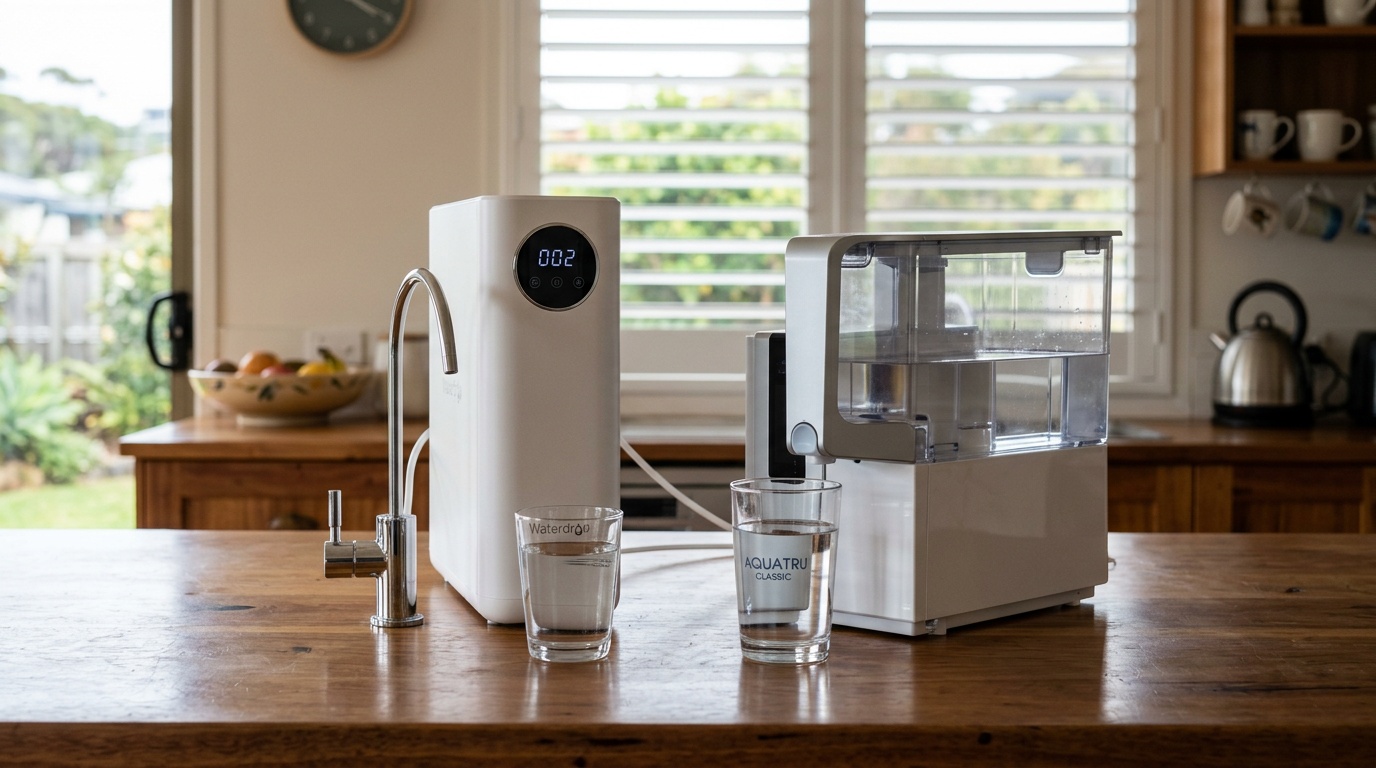
If you’re choosing between the Waterdrop G3P800 and the AquaTru Classic for your Australian home, the decision comes down to one question: can you — or do you want to — modify your plumbing? The G3P800 is a tankless under-sink RO system with a higher flow rate and better water efficiency. The AquaTru Classic is a countertop unit that needs zero installation — you plug it in and pour. Both are reverse osmosis systems capable of removing fluoride, chloramine, lead, and PFAS. Both have been evaluated against our documented methodology using manufacturer specs, NSF certification data, and verified Australian availability.
The Waterdrop G3P800 is the better system for Australian homeowners who can install under-sink plumbing — it delivers a higher flow rate (800 GPD), wastes less water (3:1 drain ratio vs the AquaTru’s 4:1), and provides on-demand filtered water from a dedicated tap. The AquaTru Classic is the better system for renters, apartment dwellers, and anyone who moves frequently — it requires zero plumbing modification, sits on a benchtop, and can be relocated in under two minutes. Both systems use reverse osmosis membranes certified to NSF/ANSI 58, which means both remove fluoride (90-97%), chloramine, PFAS, lead, and heavy metals from Australian tap water.
Key catches
- The G3P800 requires drilling a hole in your benchtop for the dedicated tap — not suitable for renters or lease-restricted properties
- The AquaTru Classic has a small reservoir (approx 3L purified tank) — not ideal for large households or continuous-demand cooking
- Neither brand has an Australian service centre — warranty claims go through US-based support channels
- Both systems are overkill for Melbourne, Hobart, or Canberra households who only want chlorine taste removed (a carbon block filter would suffice for those free chlorine cities)
✓ Who Should Buy the Waterdrop G3P800
- Homeowners in Brisbane, Sydney, Adelaide, Gold Coast, or Darwin (chloramine cities) who want permanent under-sink RO
- Families of 3+ who need high-volume on-demand filtered water without waiting for a tank to refill
- Anyone who wants a dedicated filter tap integrated into their kitchen benchtop
- Households prioritising water efficiency — 3:1 drain ratio saves significant water over the AquaTru’s 4:1
× Who Should Buy the AquaTru Classic
- Renters who cannot drill into benchtops or modify plumbing under lease terms
- Apartment dwellers with limited under-sink space or body corporate restrictions
- People who move frequently — the AquaTru unplugs and goes with you in a box
- Small households (1-2 people) where the 3L purified reservoir is sufficient for daily drinking
- If you need high flow for a family of 4+, the G3P800 or a larger under-sink RO is the better fit
Head-to-Head Specification Comparison
Before you read another word of opinion, here are the raw numbers side by side. Every spec below comes from manufacturer-published data and NSF certification records — not marketing claims. This is the table that actually answers the question.
| SPECIFICATION | WATERDROP G3P800 | AQUATRU CLASSIC | WHAT THIS MEANS FOR YOU |
|---|---|---|---|
| Type | Under-sink, tankless | Countertop, with reservoir | G3P800 is permanent; AquaTru is portable |
| Flow Rate | 800 GPD (~2.1 L/min) | ~0.08 L/min (batch fill) | G3P800 fills a glass in seconds; AquaTru takes 12-15 min per batch |
| Installation | Under-sink + benchtop tap (drill required) | Plug-and-play, no tools | Renters: AquaTru. Homeowners: G3P800 |
| Drain-to-Pure Ratio | 3:1 (75% recovery) | 4:1 (80% recovery claimed) | G3P800 wastes less water per litre produced — significant over 5 years in Perth or Adelaide where water costs are higher |
| NSF/ANSI 58 Certified | Yes | Yes | Both independently verified for RO contaminant reduction |
| Chloramine Removal | Yes (RO membrane) | Yes (RO membrane) | Both work in Brisbane, Sydney, Adelaide, Gold Coast, Darwin — unlike standard GAC filters which fail at chloramine |
| Fluoride Removal | 90-97% (RO) | 90-97% (RO) | Carbon filters cannot remove fluoride — only RO or activated alumina can |
| PFAS Removal | >98% (NSF/ANSI 58) | >98% (NSF/ANSI 58) | According to Duke University (2020), NSF 58 RO systems remove 99%+ PFAS — both qualify |
| Strontium Removal | 94% | 96% | AquaTru has a slight edge on strontium — both figures are manufacturer-reported |
| Nitrate Removal | 33% | Higher (manufacturer claim) | AquaTru outperforms on nitrate — relevant for bore water or rural AU properties |
| Filter Stages | 7 (CF + CB + RO) | 4 (Pre-filter + Pre-carbon + RO + Post-carbon VOC) | More stages ≠ better. Both deliver comparable RO-grade output |
| Purified Reservoir | None (tankless, on-demand) | ~3L purified tank | G3P800 never runs dry; AquaTru can run dry mid-cook if not refilled |
| Smart Features | TDS monitor, filter life indicator | LED filter life indicator | G3P800’s real-time TDS readout lets you verify performance — useful for hard-water cities like Adelaide (~400 mg/L TDS) and Perth (~170 mg/L) |
| Dimensions | Under-sink unit + small tap | 36 × 28 × 33 cm (benchtop) | G3P800 hides under the sink. AquaTru takes valuable benchtop space |
| AU Warranty Support | US-based (Waterdrop) | US-based (AquaTru) | Neither brand has an Australian service centre — warranty claims require international communication |
Now let’s break each system down in detail so you know exactly what you’re getting — and what you’re giving up.
Waterdrop G3P800: The Case for Under-Sink Permanence
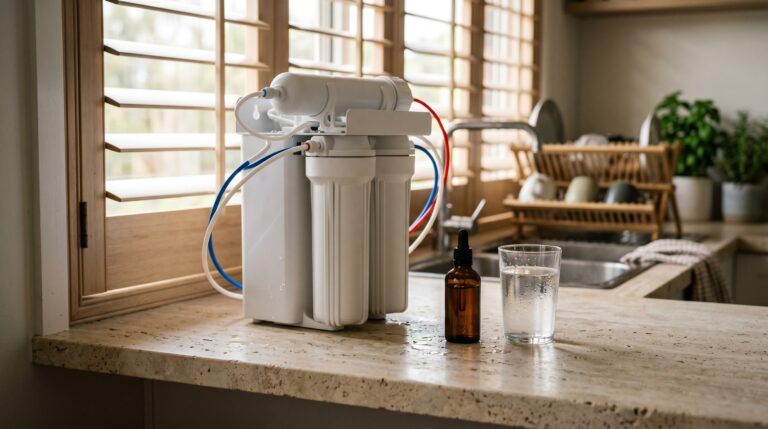
The Waterdrop G3P800 exists for people who want to forget their water filter is there. Once installed under your sink, it delivers reverse osmosis water on demand through a dedicated tap — no waiting, no refilling, no countertop real estate consumed. That 800 GPD (gallons per day) flow rate translates to roughly 2.1 litres per minute, according to Waterdrop’s published specifications. You turn the tap, and filtered water comes out at close to mains pressure. For a family of four in Brisbane or Sydney filling water bottles, cooking pasta, and rinsing produce, this on-demand access is the defining advantage.
The water efficiency story matters most in Australian cities where water is expensive. The G3P800’s 3:1 pure-to-drain ratio means for every 3 litres of purified water, 1 litre goes down the drain. Traditional under-sink RO systems waste at ratios of 1:3 or even 1:4 — meaning the G3P800 is roughly 3-4 times more water-efficient than older-generation RO units. In Perth, where Water Corporation charges tiered pricing above 150 kL/year, or in Adelaide with SA Water’s escalating volumetric charges, that difference compounds across a year.
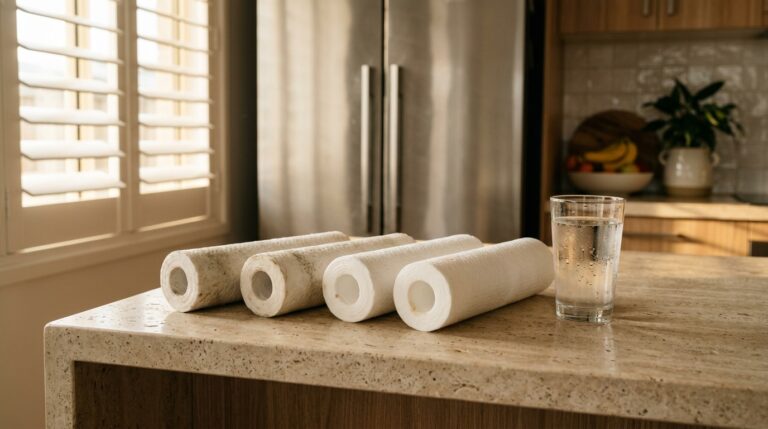
The seven-stage filtration is Waterdrop’s marketing language, but the stages that matter are: the sediment pre-filter (protects the membrane), the carbon block pre-filter (removes chloramine — critical for Brisbane, Sydney, Adelaide, Gold Coast, and Darwin), and the RO membrane itself (does the heavy lifting on fluoride, PFAS, lead, and heavy metals). The post-filtration stages polish taste. According to Waterdrop’s NSF/ANSI 58 certification data, the system removes TDS to single-digit readings from municipal water. The built-in TDS monitor lets you verify this yourself — particularly useful if you’re in Adelaide where incoming TDS of ~400 mg/L means the membrane is working harder than in Melbourne where TDS is only ~60 mg/L.
The catch? Installation. You need to connect to the cold water supply line under your sink, drill a hole in the benchtop for the dedicated filter tap, and route a drain line to your waste pipe. A competent DIYer can do this in 30-60 minutes. But if you’re renting, this is almost certainly a dealbreaker. Most Australian lease agreements prohibit drilling into benchtops without written landlord consent.
Pros
- 800 GPD flow — fills a glass in seconds, never runs dry mid-cook
- 3:1 drain ratio — wastes significantly less water than older RO units
- Hides entirely under-sink — no benchtop footprint at all
- Built-in TDS monitor verifies live membrane performance
- Lower 5-year cost per litre than bottled water by 10×
Cons
- Requires drilling a benchtop hole for the dedicated tap — renters cannot use this
- Professional or DIY plumbing connection required (30–60 min)
- No AU service centre — warranty support is US-based
- Drain water exits via waste pipe — cannot repurpose like AquaTru reject water
Buy This If…
- You own your home and can drill into your benchtop
- You have a family of 3+ and need high-volume on-demand filtered water daily
- You live in Adelaide or Perth where water efficiency translates to real bill savings
- You want a permanent, invisible solution you will never think about again
AquaTru Classic: The Case for Zero-Installation Portability
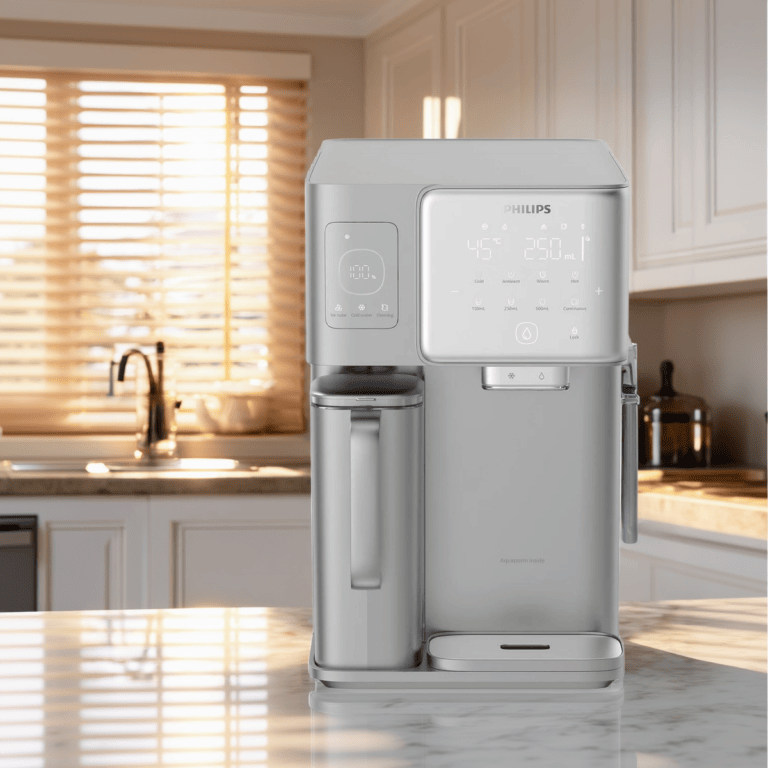
The AquaTru Classic solves a specific problem that affects millions of Australians: you want reverse osmosis water quality, but you rent, you live in an apartment with body corporate restrictions, or you move every 12-24 months. According to ABS Census data, approximately 30% of Australian households are renters. For these households, drilling into a landlord’s stone benchtop is not an option. The AquaTru Classic plugs into a power outlet, you fill the upper reservoir with tap water, and the internal pump forces it through a 4-stage filtration process including an RO membrane. No plumber. No tools. No lease violations.
The portability advantage is real and undervalued. If you move from a Brisbane apartment to a Sydney sharehouse to a Perth rental over three years — which is common for professionals under 35 — your AquaTru comes with you every time. The G3P800 stays bolted under the old kitchen sink. You would need to buy a new one, or pay a plumber to deinstall and reinstall it. The AquaTru Classic fits in a moving box.
Filtration performance is comparable to the G3P800 on the contaminants that matter most to Australian households. The RO membrane removes fluoride at 90-97% (the only technologies that can do this are RO and activated alumina — carbon filters cannot touch fluoride, regardless of what the marketing says). According to manufacturer-published data, the AquaTru Classic achieves 96% strontium removal vs the G3P800’s 94%, and outperforms on nitrate removal — relevant if you’re in a rural or semi-rural area drawing from bore water. For PFAS, both systems deliver >98% removal per NSF/ANSI 58 certification standards. According to a 2020 Duke University study, NSF 58-certified RO systems remove 99%+ of PFAS compounds, while standard pitcher filters with NSF/ANSI 53 certification range from 0-73% PFAS reduction.
The limitations are practical, not chemical. The AquaTru Classic’s purified reservoir holds approximately 3 litres. A household of 3-4 people drinking the recommended 2L per day each will drain that reservoir multiple times daily, and each refill cycle takes 12-15 minutes. If you’re filling a large pot for pasta or batch-cooking, you’ll need to plan ahead. The drain-to-pure ratio is 4:1 — meaning for every 4 litres of tap water you pour in, roughly 1 litre is rejected as concentrate. That is less efficient than the G3P800’s 3:1 ratio, but the reject water goes into a visible container you can pour onto garden plants, which is more practical than piping waste down a drain.
The other constraint is benchtop space. At 36 × 28 × 33 cm, the AquaTru Classic occupies real estate on your kitchen bench. In a small apartment kitchen — which is most apartment kitchens in Sydney, Melbourne, and Brisbane — that footprint matters. The G3P800, by contrast, hides entirely under the sink.
Pros
- Zero installation — plug in, pour in tap water, done
- Fully portable — moves with you between rentals in a single box
- Removes fluoride (90–97%), chloramine, PFAS, lead — same RO membrane tech as G3P800
- Reject water collects visibly — can water plants instead of wasting down a drain
- Slightly better strontium and nitrate removal than G3P800 per manufacturer data
Cons
- Only ~3L purified reservoir — a family of 4 will drain it multiple times daily
- Each refill cycle takes 12–15 min — not on-demand like the G3P800
- 4:1 drain ratio — less water-efficient than G3P800’s 3:1
- 36×28×33 cm benchtop footprint — noticeable in small apartment kitchens
- No real-time TDS monitor — no way to verify membrane performance between filter changes
Buy This If…
- You rent or live in an apartment and cannot modify plumbing
- You move frequently and want a filter that travels with you
- You are 1–2 people and a 3L reservoir is adequate for daily needs
- You want RO-grade fluoride and PFAS removal without calling a plumber
Australian Water Context: Why This Decision Matters More Here
This comparison matters more for Australian households than it does for American or European ones, because of two factors that are unique to Australian municipal water: widespread chloramine disinfection and universal fluoridation.
Chloramine is the hidden filter killer. Brisbane and south-east QLD (SEQ Water), Sydney (Sydney Water), Adelaide (SA Water), Perth (Water Corporation WA), and Darwin all use chloramine as their primary disinfectant. Standard granular activated carbon (GAC) — the media inside Brita jugs and most basic jug filters — removes free chlorine effectively but removes chloramine at approximately 1/40th the rate, according to carbon filtration research published in water treatment engineering literature. A filter correctly sized for free chlorine removal lets most chloramine pass straight through. This is the single most important filter-selection fact for Australian consumers, and most comparison reviews written from the US ignore it entirely because most US cities use free chlorine.
Both the Waterdrop G3P800 and the AquaTru Classic solve this problem. Reverse osmosis membranes, combined with the carbon pre-filtration stages in both systems, effectively remove chloramine. If you live in Melbourne, Hobart, Canberra, Townsville, Cairns, or Toowoomba — cities that use free chlorine — a simpler carbon block filter would handle chlorine taste and odour. You may not need RO at all unless fluoride or PFAS removal is your primary concern.
Fluoride removal requires RO. According to the ADWG (Australian Drinking Water Guidelines), most Australian municipal water supplies are fluoridated at 0.6-1.0 mg/L. Carbon filters — including catalytic carbon, activated carbon, and carbon block — cannot remove fluoride. Only reverse osmosis (90-97% removal) or activated alumina (80-95% removal) can do so. Both the G3P800 and AquaTru Classic use RO membranes, making them the only practical countertop or under-sink options for fluoride-conscious Australian households.
For households in Adelaide (~400 mg/L TDS, ~140 mg/L CaCO₃ hardness) and Perth (~170 mg/L TDS, ~180 mg/L CaCO₃ hardness), the G3P800’s built-in TDS monitor provides a tangible advantage: you can see your incoming TDS and confirm the membrane is performing. When a membrane begins to degrade — which happens faster in hard-water cities — TDS readings climb before taste changes, giving you an early warning to replace the membrane. The AquaTru’s LED filter life indicators estimate remaining life based on volume, not actual water quality measurement.
5-Year Cost Comparison: Total Ownership in AUD
Upfront price is only one-third of the total cost of owning a water filter. Filter replacements and water waste are the hidden costs that separate a good purchase from a regret. The table below calculates total 5-year ownership cost assuming a household consumption of 4 litres per day (1,460 litres per year), which aligns with the NHMRC recommended daily intake for a household of two adults.
| COST FACTOR | WATERDROP G3P800 | AQUATRU CLASSIC |
|---|---|---|
| Upfront Price (est. AU) | ~$699-$899 | ~$599-$749 |
| Annual Filter Replacement | ~$120-$160/yr (CF + CB filters every 6 months, RO every 24 months) | ~$100-$140/yr (pre-filter every 6 months, RO + VOC every 12-24 months) |
| 5-Year Filter Total | ~$600-$800 | ~$500-$700 |
| 5-Year Total Ownership | ~$1,299-$1,699 | ~$1,099-$1,449 |
| Cost per Litre (5-year avg) | ~$0.18-$0.23/L | ~$0.15-$0.20/L |
| Water Wasted (5-year total at 4L/day) | ~2,433L (3:1 ratio) | ~1,825L (4:1 ratio, but reject water can be repurposed) |
| Bottled Water Equivalent (at $2/L) | $14,600 saved vs bottled | $14,600 saved vs bottled |
At $2 per litre for bottled water — a conservative average across Coles and Woolworths for popular brands — either system pays for itself within the first year and saves over $14,000 across five years. Even at the G3P800’s higher upfront cost, the per-litre cost of $0.18-$0.23 is roughly one-tenth the price of bottled water. The AquaTru is slightly cheaper per litre due to its lower upfront price and marginally lower filter costs.
The hidden cost difference is water waste. The G3P800’s 3:1 pure-to-drain ratio sounds worse than the AquaTru’s 4:1 ratio, but the AquaTru’s reject water collects in a visible container you can use for watering plants or mopping floors. The G3P800’s drain water goes directly into the waste pipe under your sink — you never see it, and you can’t repurpose it. In drought-affected regions of south-east QLD, western Sydney (Penrith, Blacktown), or Perth’s Rockingham corridor, that difference in water stewardship may matter to you.
Warranty, Support, and the Australian Consumer Law Factor
This is where both products share a genuine weakness that no US-based comparison review will mention. Neither Waterdrop nor AquaTru has an Australian service centre, authorised Australian distributor, or local warranty processing facility. Both brands ship from the US or via third-party Amazon AU sellers. Warranty claims require contacting US-based support teams, often across incompatible time zones, and potentially shipping units back internationally at your cost.
Australian Consumer Law (ACL) does apply to purchases made through Amazon AU. Under the ACL, products sold in Australia must be of acceptable quality and fit for purpose, regardless of where the manufacturer is based. If a unit fails within a reasonable period, you have consumer guarantee rights against the Australian seller (which may be Amazon AU itself or a third-party marketplace seller). However, enforcing these rights against an overseas manufacturer can be slow and frustrating compared to dealing with a local brand like Australian-based RO system suppliers who offer local support and WaterMark-certified products.
Neither the Waterdrop G3P800 nor the AquaTru Classic carries WaterMark certification (AS/NZS 3497), which is the Australian standard for plumbing-connected water treatment devices. WaterMark is required by the Plumbing Code of Australia for any device permanently connected to mains water. The G3P800 connects to your cold water line under the sink — strictly speaking, this should be WaterMark-certified for compliance. The AquaTru Classic is not permanently connected to plumbing (you fill it manually), so WaterMark does not apply.
If WaterMark compliance matters to you — and it should if you’re a homeowner concerned about insurance implications — consider a locally supplied under-sink RO system with WaterMark certification. The full RO system rankings include WaterMark-certified options.
Decision Tree: Which System Should You Buy?
Three questions. That’s all it takes.
Your 3-Question Decision Tree
| 1. | Can you modify your plumbing? No → AquaTru Classic (countertop, zero install, renter-safe) Yes → proceed to question 2 |
| 2. | Do you need on-demand high-flow RO water? Yes (family of 3+, cooking, bottle-filling) → Waterdrop G3P800 No (1-2 people, drinking only) → either works, but AquaTru is cheaper |
| 3. | Which city are you in? Brisbane, Sydney, Adelaide, Gold Coast, Darwin → either system (both handle chloramine) Melbourne, Hobart, Canberra → ask yourself if you actually need RO. If your concern is only chlorine taste, a carbon block filter is cheaper and simpler |
Final Verdict
For Australian homeowners who can install under-sink plumbing: buy the Waterdrop G3P800. The 800 GPD tankless design, 3:1 water efficiency, and built-in TDS monitor make it the superior long-term system for families in chloramine cities. It hides under the sink, delivers RO water on demand, and you never have to refill a tank.
For Australian renters or anyone who cannot modify plumbing: buy the AquaTru Classic. It delivers genuine NSF 58-certified RO filtration — including fluoride, chloramine, and PFAS removal — with zero installation, zero tools, and total portability. It is the only countertop RO system worth recommending for the 30% of Australian households that rent.
The worst outcome is you buy one, decide RO isn’t for you, and return it within Amazon’s return window. The more likely outcome is you stop buying bottled water and save over $2,500 per year.
Ready to filter your water?
Both the Waterdrop G3P800 and AquaTru Classic are NSF/ANSI 58 certified reverse osmosis systems that remove fluoride, chloramine, PFAS, and lead from Australian tap water. Choose based on your living situation — not marketing claims.
Last reviewed: July 2026 – Clean and Native
Frequently Asked Questions
Does the Waterdrop G3P800 remove chloramine from Brisbane tap water?
Yes. The G3P800 uses a carbon block pre-filter combined with an RO membrane, which effectively removes chloramine. Brisbane and all SEQ Water-supplied suburbs use chloramine as the primary disinfectant. Standard GAC filters like Brita remove chloramine at approximately 1/40th the rate of free chlorine, making them ineffective in Brisbane.
Can the AquaTru Classic remove fluoride from Australian tap water?
Yes. The AquaTru Classic uses a reverse osmosis membrane that removes fluoride at 90-97%, according to NSF/ANSI 58 certification standards. Carbon filters cannot remove fluoride — only RO or activated alumina can. Most Australian municipal water is fluoridated at 0.6-1.0 mg/L per the ADWG.
Does the Waterdrop G3P800 need WaterMark certification in Australia?
Under the Plumbing Code of Australia, any device permanently connected to mains water should carry WaterMark certification (AS/NZS 3497). The G3P800 connects to the cold water supply under the sink, which technically requires WaterMark. Neither the G3P800 nor the AquaTru Classic currently holds WaterMark certification.
Which RO filter wastes less water — G3P800 or AquaTru?
The G3P800 has a 3:1 pure-to-drain ratio (75% recovery), while the AquaTru operates at approximately 4:1. However, the AquaTru’s reject water collects in a visible container that can be reused for watering plants, whereas the G3P800’s waste goes directly down the drain.
Can I install a Waterdrop G3P800 in a rental property?
In most cases, no. Installation requires drilling a hole in the benchtop for the dedicated filter tap and connecting to the cold water supply line. Most Australian residential lease agreements prohibit modifications to benchtops without written landlord consent. The AquaTru Classic is the renter-friendly alternative — it requires no tools or plumbing modification.
Do I need an RO filter if I live in Melbourne?
Melbourne Water uses free chlorine (not chloramine), and Melbourne has very soft water (~25 mg/L CaCO₃, TDS ~60 mg/L). If your only concern is chlorine taste, a standard carbon block filter will work effectively and costs significantly less than RO. You only need RO if you want to remove fluoride (~1.0 mg/L in Melbourne) or PFAS.
Do both the G3P800 and AquaTru remove PFAS?
Yes. Both systems are NSF/ANSI 58 certified. According to a 2020 Duke University study, NSF 58-certified RO systems remove 99%+ of PFAS compounds. Standard pitcher filters with NSF/ANSI 53 certification range from 0-73% PFAS reduction — significantly less effective.
Is there Australian warranty support for Waterdrop or AquaTru?
Neither brand has an Australian service centre or authorised local distributor. Warranty claims go through US-based support teams. However, purchases made through Amazon AU are covered by Australian Consumer Law (ACL), which provides consumer guarantee rights regardless of where the manufacturer is based.
How often do I need to replace filters on the AquaTru Classic?
According to AquaTru’s published maintenance schedule, the mechanical pre-filter requires replacement every 6 months, the pre-carbon filter every 6 months, the RO membrane every 24 months, and the post-carbon VOC filter every 12 months. These intervals assume average household use. In hard-water cities like Adelaide or Perth, pre-filters may need more frequent replacement.
How much benchtop space does the AquaTru Classic take up?
The AquaTru Classic measures approximately 36 × 28 × 33 cm. In a standard apartment kitchen in Sydney, Melbourne, or Brisbane, this occupies a meaningful portion of available bench space. The Waterdrop G3P800, by contrast, installs entirely under the sink and uses only the footprint of a small dedicated tap on the benchtop.
Get the Australian Home Environment Checklist
30 checks across water, air and EMF. Most of them free. Ranked by impact.
No spam. Unsubscribe any time.

Former Royal Australian Navy Clearance Diver and TAG-E counter-terrorism operator. Founded Clean and Native to apply the same rigorous thinking to the home environment.
Full biography →