HolyH2O Trinity Review (2026): What the Fluoride Lab Report Actually Shows
Drafted with AI assistance and checked against published specifications and certifications. First-hand measurements appear only where stated. How we make content
The HolyH2O Trinity is a three-stage benchtop gravity filter that HolyH2O says cut fluoride from 2.0 mg/L to 0.01 mg/L (99.5%) in testing it publishes from AS Enviro, an ISO/IEC 17025 accredited lab. It needs no plumbing or power, adds calcium and magnesium back, and costs from $199 for the 12 L size, or about $169 with the code HOLYJAYCELOVE. It is the strongest no-plumbing fluoride option we have found for renters. It is not certified to an NSF standard for fluoride, and HolyH2O publishes no litre rating for the cartridge.
Buy it if you rent, want less fluoride, chlorine or chloramine taste, and will not run a plumbed reverse osmosis system. Look elsewhere if you need certified performance or water with almost nothing dissolved in it.
Price checked 11 Nov 2026: 12 L $199, 16 L $275, 22 L $325. Code HOLYJAYCELOVE takes 15% off orders over $50 and applies automatically through our link.
See the Trinity at HolyH2OOur rating
- Fluoride result: strong
- Evidence quality: good, not certified
- Renter friendly: excellent
- Running cost: about $315 a year
How the HolyH2O Trinity Works
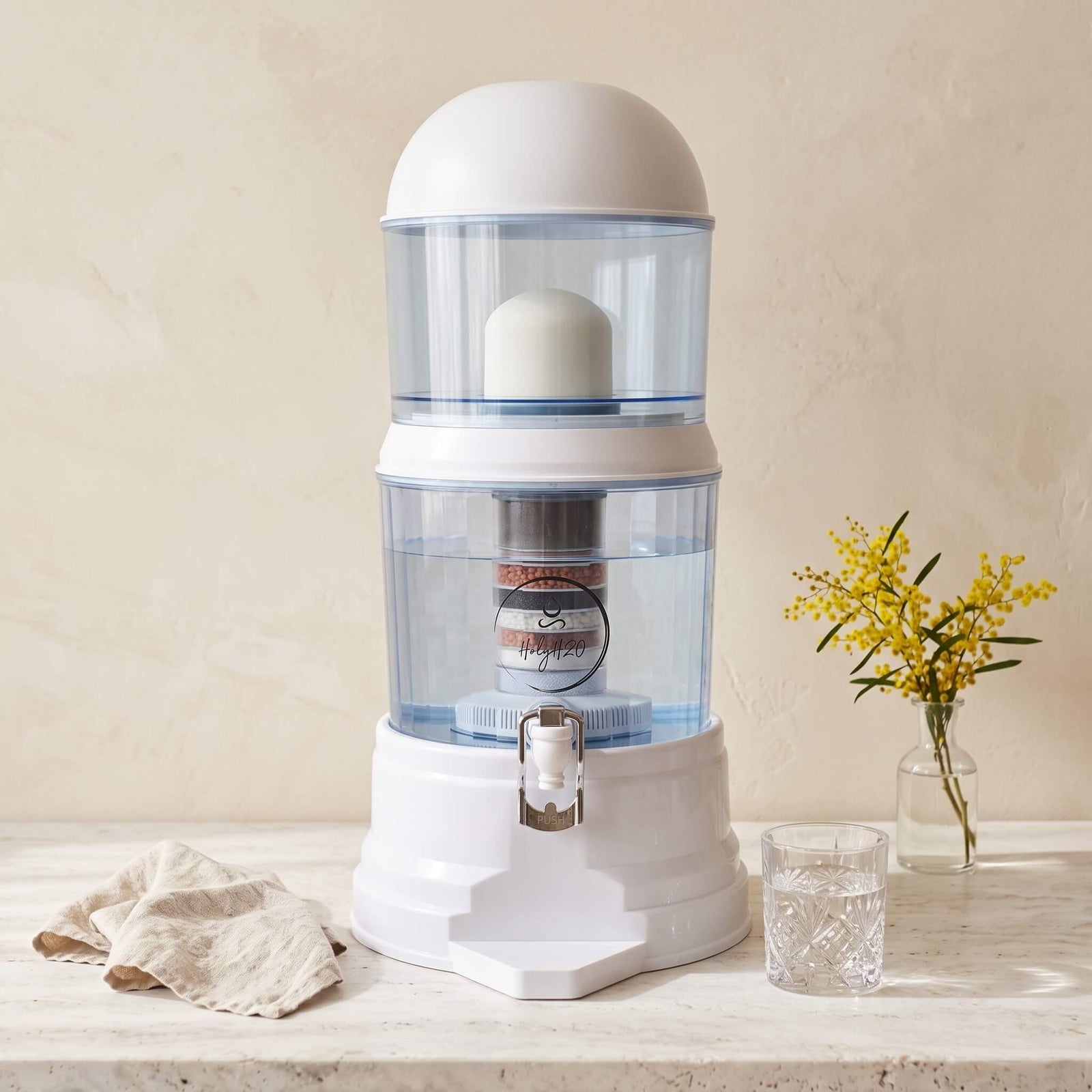
The Trinity is a gravity filter. You pour tap water into the top tank, and gravity pulls it down through three stages into the bottom tank, where you draw it off through the tap. Nothing connects to your plumbing and it uses no power, which is why it suits rentals.
- Stage 1 · upper tankCeramic pre-filterCatches sediment, rust and fine particles first so the cartridge below does not clog. HolyH2O quotes about 8 to 10 months of life.
- Stage 2 · main cartridgeActivated alumina, KDF and carbonActivated alumina takes up fluoride. KDF (copper-zinc) works on chlorine and some metals. Activated carbon takes out taste, odour and by-products such as chloroform. HolyH2O says to change it every 4 to 6 months.
- Stage 3 · lower tankMineral stonesVolcanic stone and ceramic balls add calcium and magnesium back. HolyH2O says this can raise pH by up to 2.0.
Layout drawn from HolyH2O’s product images and stage descriptions. Not to scale.
The design matters for fluoride. Activated alumina is one of the few household media that reduce fluoride, but it needs contact time. Slow gravity flow through a dense cartridge gives the media far more contact time than a tap-mounted filter or a quick-pour jug. That is why the Trinity can claim a fluoride result most benchtop carbon filters cannot.
What the HolyH2O Trinity Lab Report Shows
HolyH2O publishes a contaminant chart from testing run to NSF/ANSI 42, 53 and 401 test methods. The chart credits AS Enviro, an ISO/IEC 17025:2017 accredited laboratory, “and/or” its own laboratory using EPA-approved HACH methods. Here are the headline results, with the influent (what went in) and the eluent (what came out).
Trinity lab results: percentage reduced
From HolyH2O’s published test chart. Grey bars are the results that did not come close to full removal.
Values: influent to eluent, mg/L. “>” and “<” figures are as reported in HolyH2O’s chart, where the result was below the lab’s detection limit.
Three things stand out:
- Fluoride. The test started at 2.0 mg/L, above the 1.5 mg/L guideline and well above fluoridated supplies. The NHMRC recommends fluoridating at 0.6 to 1.1 mg/L, and the Australian Drinking Water Guidelines cap it at 1.5 mg/L. A filter that takes 2.0 down to 0.01 has headroom at normal tap levels.
- Chloramine. 99.0% from 3.0 mg/L is relevant for much of Sydney and Brisbane’s grid, where chloramine is the disinfectant. Many carbon jugs are not rated for chloramine at all. See our chloramine vs chlorine guide.
- Nitrate and salts. Nitrate fell only 34.5% and sulfate 7.8%. The Trinity is not a fix for bore water with high nitrate or salt. That needs reverse osmosis.
What the Report Does Not Prove
As a former Navy Clearance Diver, I read a test report for what it leaves out as much as for its headline number. Here is what is missing from this one.
- No certification. Testing to NSF/ANSI methods is not the same as being certified by NSF, IAPMO or WQA, which means repeated testing and factory audits. HolyH2O’s NSF document covers material safety of the carbon media, not fluoride performance.
- No volume. The chart says results reflect the filter’s rated lifespan, but does not say how many litres were run through it. Activated alumina loses fluoride capacity as it fills, and with no litre rating you cannot tell when it stops working.
- No date. The chart is undated, so you cannot match it to the current cartridge.
- Mixed labs. The chart credits AS Enviro “and/or” its own laboratory without saying which results came from which. Only the accredited lab’s results carry independent weight.
- PFAS is unproven. The PFOA and PFOS influent values listed are below the lab’s own detection limit, so the “>99.9%” PFAS figures cannot be relied on. If PFAS is your concern, use a filter certified to NSF/ANSI 58 or P473. See our PFAS guide.
- Results vary. HolyH2O says so itself: performance depends on source water and use.
Do not judge it with a TDS meter. The mineral stage adds calcium and magnesium, so total dissolved solids can stay the same or rise after filtering. My own tap water reads 69 ppm on an uncalibrated TDS meter. A low reading proves a reverse osmosis system is working, but it says nothing useful about a remineralising filter like this one. To check fluoride, use a fluoride test kit or send a sample to a lab.
Which Trinity Size to Buy
HolyH2O sizes the Trinity by tank volume: 12 L for one or two people, 16 L for most families and 22 L for larger households. All three stand about 60 to 64 cm tall, so measure under your overhead cupboards first. There is also an 8 L glass version at $425, which uses a single all-in-one cartridge swapped every 3 to 4 months and skips the ceramic and mineral stages. The picker below covers the three main sizes.
Trinity 12 L
See the Trinity 12 L at HolyH2OAssumes about 3 L per person a day for drinking, tea, coffee and cooking. The Australian Drinking Water Guidelines assume 2 L a day for drinking alone. Prices checked 11 Nov 2026.
Price, Refills and the Lifetime Guarantee
| Item | Price | With HOLYJAYCELOVE |
|---|---|---|
| Trinity 12 L | $199 | $169.15 |
| Trinity 16 L | $275 | $233.75 |
| Trinity 22 L | $325 | $276.25 |
| Cartridge combo 3-pack (all three stages) | $175 | $148.75 |
| Combo 3-pack, Subscribe & Save | $157.50 per delivery | Not tested with the code |
| Stage 2 cartridge alone (fluoride and KDF) | $80 | $68 |
HolyH2O prices checked 11 Nov 2026. The code takes 15% off orders over $50.
Two terms are worth reading before you buy:
- The lifetime guarantee depends on a subscription. HolyH2O says the Trinity is covered for life while an eligible cartridge subscription stays active. Cancel the refills and the guarantee goes with them.
- The 100-day guarantee is for unused products. HolyH2O’s refund policy offers a 100-day money-back guarantee on items returned unused, in original packaging, with the return approved first and shipped at your cost. Used Trinity units and wet cartridges cannot be returned. So treat it as time to change your mind before setting it up, not a 100-day test drive.
HolyH2O gives replacement intervals in months rather than litres: the Stage 2 fluoride and KDF cartridge every 4 to 6 months, and the ceramic pre-filter and mineral stones every 8 to 10 months. Bought separately at list price, that works out at roughly $320 to $440 a year. The simpler route is the Subscribe & Save combo every 6 months, which is $315 a year. HolyH2O ties the lifetime guarantee to an active cartridge subscription. A big household will wear the Stage 2 cartridge out faster, so lean towards the 4-month end.
Trinity vs the Alternatives
| Filter | Type | Fluoride evidence | Plumbing / power | Price |
|---|---|---|---|---|
| HolyH2O Trinity | Gravity, remineralising | Lab test, 2.0 to 0.01 mg/L (not certified) | None / none | From $199 |
| Waterdrop C1S | Countertop reverse osmosis | Fluoride listed in marketing; no fluoride test result or certification | None / power | $379.22at Amazon AU · as of 19 Nov 2026, 11:43 pm AEST Details on Amazon AU |
| Culligan ZeroWater jug | Ion exchange jug | Certified to NSF/ANSI 53 for fluoride (IAPMO) | None / none | $54.24at Amazon AU · as of 19 Nov 2026, 8:43 pm AEST Details on Amazon AU |
| Big Berkey (PF-2 fluoride filters extra) | Gravity | Manufacturer claim only | None / none | $662.28at Amazon AU · as of 19 Nov 2026, 8:43 pm AEST Details on Amazon AU |
I own the Waterdrop C1S. It took my tap water from 69 to 7 ppm TDS, but it needs power, sends some water to drain, and Waterdrop publishes no fluoride-specific test result for it. The ZeroWater jug has the strongest certification for fluoride, but jug filters exhaust quickly and the 7-cup jug holds far less than a Trinity. The Trinity sits between them: more evidence than the Berkey, more capacity than a jug, and no plumbing or power. Our benchtop fluoride filter guide ranks all of them, and the best gravity water filters page covers other gravity options.
Check all seven rooms, not just this one
38 checks, 29 free, ranked by impact. Sent as a 32-page PDF.
We'll email you the audit and a short series of practical guides. Unsubscribe in one click, any time. Privacy.
Sent. Taking you to your download...
Should You Remove Fluoride at All?
That is your call, and this review does not argue it either way. Australia’s health authorities support community water fluoridation for dental health: the NHMRC’s 2017 public statement recommends it at 0.6 to 1.1 mg/L. Some households still prefer to reduce it, often for a baby’s formula, personal preference, or because they already get fluoride from toothpaste. If you do remove it, keep fluoride toothpaste in the routine and ask your dentist, especially for children. Our fluoride guide covers the evidence in more detail, and the fluoride levels by state page shows what is in your tap water.
When the Trinity Is the Wrong Tool
The Trinity is built for treated mains water. It is not sold as a microbiological filter, and HolyH2O makes no bacteria or virus claim for it, so do not rely on it for untreated rainwater, creek or bore water. The ceramic stage is a particle barrier, not a certified pathogen filter. If you are on a tank, deal with microbial safety first, usually with UV or a certified filter, and see our rainwater drinking safety guide. The lab chart also shows nitrate and dissolved salts coming through largely untouched, so bore water with high nitrate or salt needs reverse osmosis instead.
How to Tell When the Cartridge Is Spent
The Trinity has no indicator, and activated alumina gives no taste warning when it stops taking up fluoride. Chlorine taste returning is a sign the carbon is done, but fluoride can come through before that happens. Two habits help. First, write the date on the Stage 2 cartridge when you fit it and change it at 4 months if your household is large or 6 months if it is small. Second, test the filtered water with a fluoride test kit a few weeks before the change is due. If the reading is creeping up towards your tap level, change it early.
Checklist Before You Order
- Measure the space. All sizes are 60 to 64 cm tall and about 29 to 32 cm wide. Check clearance under overhead cupboards, with room to lift the lid and pour.
- Pick the size with the picker above. If in doubt between two sizes, go up; a bigger top tank means fewer refills.
- Decide on refills. The lifetime guarantee only applies with an active cartridge subscription. If you would rather buy cartridges as you go, budget for list prices.
- Keep the packaging until you are sure. The 100-day guarantee only covers unused items returned in original condition.
- Use the code. HOLYJAYCELOVE takes 15% off orders over $50 and applies automatically through our links.
Who the Trinity Suits
Buy it if you
- Rent, or cannot drill a bench or run a plumbed reverse osmosis system
- Want lower fluoride without wasting water or using power
- Are on chloraminated water in much of Sydney or the Brisbane grid
- Prefer water with minerals left in
- Have bench space about 30 to 32 cm square and up to 64 cm high
Look elsewhere if you
- Need certified fluoride or PFAS performance (choose an NSF/ANSI 58 reverse osmosis system)
- Are on bore water with high nitrate or salt
- Want water on tap instantly without refilling a tank
- Do not want to keep a refill subscription for the guarantee
For a renter who wants fluoride, chlorine and chloramine down without a plumber, the Trinity has the best published evidence of any benchtop gravity filter we have looked at. Its weaknesses are on paper rather than in the result: no certification, no litre rating and a guarantee tied to refills. Budget about $315 a year for cartridges, and change Stage 2 every 4 to 6 months.
Code HOLYJAYCELOVE: 15% off orders over $50, applied automatically through our link.
Check Trinity sizes and priceFrequently Asked Questions
Does the HolyH2O Trinity remove fluoride?
In the test chart HolyH2O publishes (credited to AS Enviro and/or HolyH2O’s own laboratory), fluoride fell from 2.0 mg/L to 0.01 mg/L, a 99.5% reduction, using an activated alumina stage. That is a lab test result, not an NSF certification, and HolyH2O does not publish how many litres the cartridge can treat before fluoride removal drops.
Does the Trinity remove chloramine?
HolyH2O’s lab chart shows chloramine reduced from 3.0 mg/L to 0.03 mg/L, a 99.0% reduction. That makes it a reasonable choice for much of Sydney and the Brisbane, Ipswich, Logan and Moreton Bay grid, where chloramine is used.
Is the HolyH2O Trinity NSF certified?
No. It was tested to NSF/ANSI 42, 53 and 401 methods by an accredited lab, and its carbon media passed an NSF material safety test, but the system is not certified by NSF, IAPMO or WQA for contaminant reduction.
Which Trinity size should I buy?
HolyH2O recommends 12 L for one or two people, 16 L for most families and 22 L for larger households. All sizes are about 60 to 64 cm tall, so check the clearance under your cupboards.
Is there a HolyH2O Trinity discount code?
Yes. HOLYJAYCELOVE takes 15% off orders over $50, which brings the 12 L Trinity from $199 to $169.15. It applies automatically when you arrive through a Clean and Native link.
Can I return the Trinity if I don’t like it?
HolyH2O offers a 100-day money-back guarantee on unused products in original packaging. Its refund policy says used Trinity units and used cartridges cannot be returned.
Sources
- HolyH2O, Trinity product page and contaminant test chart (AS Enviro)
- HolyH2O, Refund policy
- NHMRC, Public statement: water fluoridation and human health
- NHMRC, Australian Drinking Water Guidelines
- Clean and Native, fluoride levels by state and how we test
We have not lab-tested the Trinity ourselves. This review is based on HolyH2O’s published test chart, product information and policies, checked 11 Nov 2026, plus our own TDS readings from the Waterdrop C1S, which we own. Last updated: November 2026.

Former Royal Australian Navy Clearance Diver and TAG-E counter-terrorism operator. Founded Clean and Native to apply the same rigorous thinking to the home environment.
Full biography →The 7-Room Home Audit
Your tap water is one room. The audit covers all seven: 38 checks across water, air and EMF, 29 of them free, ranked by impact against Australian guidelines.
- Morning tap flush: the free lead fix most homes skip
- How to read your utility's water quality report
- Renting or owning: the two reverse osmosis filters I use at home
We'll email you the audit and a short series of practical guides. Unsubscribe in one click, any time. Privacy.
Sent. Taking you to your download...