Best Water Filter for Microplastics Australia 2026: What Actually Works
Drafted with AI assistance and checked against published specifications and certifications. First-hand measurements appear only where stated. How we make content
Best Water Filter for Microplastics Australia 2026: What Actually Works
Reverse osmosis is the only consumer filter technology independently verified to remove both microplastics and nanoplastics from drinking water — down to 0.0001 microns, which is smaller than any plastic particle documented in Australian tap water. For most Australian households, a countertop RO unit like the AquaTru Classic (NSF 58/401 certified) or an under-sink system like the Waterdrop D6 is the most effective, evidence-based solution you can install today.
I’m Jayce Love, former Royal Australian Navy Clearance Diver, based in Palm Beach QLD. This guide draws on NSF certification data and peer-reviewed microplastics research, cross-referenced against our documented assessment methodology. Below is exactly what works, what doesn’t, and what’s a waste of your money.
✓ Who This Is For
- Parents concerned about microplastics and nanoplastics in family drinking water
- Households in Brisbane, Sydney, Adelaide, Gold Coast, or Darwin (chloramine cities) needing comprehensive contaminant removal
- Anyone who wants verified, NSF-certified microplastic removal — not marketing claims
- Renters who cannot modify plumbing but still want effective filtration
- People already filtering for PFAS or fluoride who want to confirm microplastic protection
× Who It Is Not For
- If you only want better-tasting water and don’t care about sub-micron particles — a basic carbon block is cheaper and sufficient for taste
- If you’re on tank/rainwater with no municipal supply — your microplastic profile is different; see our best Australian water filter rankings
- If you’re after a whole-house microplastic solution — these are point-of-use filters for drinking water only
- If your budget is under $100 — effective microplastic removal starts at ~$149 for carbon block, ~$599 for RO
What Are Microplastics and Why They’re in Your Tap Water
You can’t see them. You can’t taste them. But every time you fill a glass from the kitchen tap, you’re likely drinking microplastics — synthetic polymer fragments smaller than 5mm that have infiltrated water supplies across the planet. According to a 2019 study published in Environmental Science & Technology, the average person ingests approximately 5 grams of plastic per week — roughly the weight of a credit card. The particles range from visible fibres down to nanoplastics smaller than 1 micrometre, and they carry adsorbed contaminants including heavy metals, phthalates, and PFAS.
Here’s the problem for Australians specifically: there is no regulatory limit for microplastics in the Australian Drinking Water Guidelines (ADWG). The NHMRC, which maintains the ADWG, has not set a maximum acceptable concentration. Your water utility is not required to test for them. They’re not required to report them. According to ABS waste data, 373 million plastic bottles go to Australian landfill annually — and those bottles degrade into the very microplastics that cycle back through waterways, treatment plants, and eventually your tap.
The World Health Organisation published its first review of microplastics in drinking water in 2019 and concluded that current evidence does not indicate a health risk at observed concentrations — but critically noted that the research base is “limited” and called for better data. Since then, peer-reviewed studies from the University of Newcastle (NSW) and others have found microplastic concentrations in Australian surface waters consistent with global averages: roughly 0.3 to 1.5 particles per litre. That might sound small. But over a decade, at 2 litres per day, you’re accumulating thousands of particles that your body cannot metabolise.
The practical question isn’t whether microplastics are in your water — they are. The question is which filter technology actually removes them at the particle sizes that matter.
How Australian Tap Water Carries Microplastics — City by City
Your filter choice depends on two things: the microplastic load and the disinfection chemistry of your local supply. These are different problems, and getting one wrong means your filter fails at both.
Chloramine Cities: Brisbane, Sydney, Adelaide, Gold Coast, Darwin
If you live in Brisbane and south-east Queensland (SEQ Water), Sydney (Sydney Water), Adelaide (SA Water), Perth (Water Corporation WA), or Darwin — your water is disinfected with chloramine, not free chlorine. This is the single most important filter-selection fact for Australian households. Standard granular activated carbon (GAC) — the type inside Brita pitchers and most jug filters — removes free chlorine effectively but removes chloramine at approximately 1/40th the rate. That means your Brita is doing almost nothing for disinfectant byproducts in these cities.
Now layer microplastics on top. A standard GAC pitcher filter has a nominal pore size of 20-50 microns. Most microplastics documented in tap water are in the 1-5 micrometre range. Your Brita isn’t removing the chloramine, and it isn’t removing the microplastics either. A 2020 study published in Science of the Total Environment found that some GAC filters actually release trapped microplastic fibres back into filtered water toward the end of their filter life — meaning they can make the problem worse.
Sydney Water has been monitoring PFAS in drinking water since 2022 with continuous lab testing protocols, and the NHMRC has identified 5 priority PFAS substances for Australian water safety review. PFAS and microplastics share a common source pathway — industrial discharge and plastic degradation in catchment areas. In western Sydney suburbs like Penrith and Parramatta, where catchment proximity to industrial zones is higher, the contamination profile is potentially more concentrated. Perth’s Kwinana industrial corridor and Adelaide’s hard water (approximately 140 mg/L CaCO₃, TDS around 400) present compounding challenges — you need a filter that handles microplastics, chloramine, and elevated dissolved solids simultaneously.
Free Chlorine Cities: Melbourne, Hobart, Canberra
Melbourne (Melbourne Water, Yarra Valley catchment), Hobart, and Canberra use free chlorine for disinfection. Here, standard carbon filters do work for chlorine removal. Melbourne’s water is exceptionally soft — approximately 25 mg/L CaCO₃, TDS around 60 — so mineral scaling on RO membranes is minimal and filter life is longer.
But free chlorine cities still have microplastics. The disinfection difference means your carbon block filter can handle the chlorine taste — it doesn’t mean it handles sub-micron particles. For microplastic removal in Melbourne, Hobart, or Canberra, you still need either a sub-0.5 micron carbon block or reverse osmosis.
The 4 Filter Technologies Compared: Which Actually Removes Microplastics
Marketing claims are everywhere. “Removes 99% of contaminants” means nothing without specifying which contaminants, at what particle size, under what test conditions. Here’s what the science and certifications actually show for the four main consumer filter categories.
1. Reverse Osmosis (RO) — The Gold Standard
RO membranes have a nominal pore size of 0.0001 microns (0.1 nanometres). The smallest documented nanoplastics in drinking water are approximately 1 nanometre. RO removes 99%+ of all microplastics and nanoplastics — plus PFAS, fluoride, chloramine, lead, arsenic, and virtually every dissolved contaminant. It’s not subtle. It strips the water down to near-pure H₂O and then remineralises it (in better units).
NSF/ANSI 58 certification tests membrane rejection rates under controlled laboratory conditions at specified pressures. NSF/ANSI 401 specifically covers emerging contaminants including microplastics. If a filter has both certifications, it has been independently verified to remove microplastics at documented rates. No marketing claim required.
The tradeoff: RO produces waste water (typically 2:1 to 3:1 ratio), needs filter replacements every 6-12 months, and costs more upfront. For microplastics and nanoplastics, it is the only technology that covers the full particle spectrum.
2. Sub-Micron Carbon Block (0.5µm or tighter)
A compressed carbon block with a rated pore size of 0.5 microns will physically block any particle larger than that threshold. Since the majority of microplastics documented in tap water studies are in the 1-5 micrometre range, a 0.5µm carbon block removes most microplastics by mechanical filtration — not adsorption.
The limitation: nanoplastics (sub-1µm) pass straight through. And carbon blocks — even catalytic carbon — cannot remove fluoride. If you need fluoride removal plus microplastic protection, carbon alone won’t do it. You need RO.
For chloramine cities, you need catalytic carbon or compressed carbon block — standard GAC at 0.5µm does not exist in a meaningful consumer format. The TAPP EcoPro uses a 0.5-micron compressed block with activated carbon and is effective for microplastics above its pore size, chloramine reduction, and lead.
3. Gravity-Fed Ceramic (e.g., Berkey)
Gravity filters use ceramic elements with sub-micron pore sizes — typically rated to 0.2-0.5 microns for bacteria. The Black Berkey elements claim filtration below 0.2 microns. However, these systems are not NSF 58 or NSF 401 certified for microplastic removal specifically. The pore size suggests they would block the majority of microplastics above their rated threshold, but without independent NSF testing, you’re relying on manufacturer claims rather than third-party verification.
Gravity filters do not require electricity or plumbing. They cannot remove fluoride (carbon and ceramic don’t achieve it — only RO or activated alumina do). They’re slow compared to pressurised systems. For microplastic reduction they’re a reasonable option if you cannot install RO, but the certification gap is a legitimate concern.
4. Standard GAC / Brita-Style Pitchers
Let me be direct: standard Brita-style GAC pitcher filters are not effective for microplastic removal. Their pore sizes (20-50 microns nominal) are vastly larger than the particles you’re trying to catch. Worse, peer-reviewed research published in Science of the Total Environment (2020) demonstrated that some GAC filters release trapped microplastic fibres back into filtered water as the filter ages. In chloramine cities, they also fail at disinfectant removal. They improve taste. That’s about it.
| Filter Technology | Microplastics (>1µm) | Nanoplastics (<1µm) | Fluoride | Chloramine | NSF Microplastic Cert |
|---|---|---|---|---|---|
| Reverse Osmosis | ✓ 99%+ | ✓ 99%+ | ✓ 90-97% | ✓ Yes | NSF 58 / 401 |
| 0.5µm Carbon Block | ✓ Most | ✗ No | ✗ No | Catalytic only | Varies |
| Gravity Ceramic (Berkey) | ✓ Likely | Unverified | ✗ No | Partial | None |
| GAC Pitcher (Brita) | ✗ No | ✗ No | ✗ No | ✗ 1/40th rate | None |
5-Year Ownership Cost: The Real Price of Microplastic Protection
Upfront price tells you nothing useful. A $40 Brita looks cheap until you realise it doesn’t remove microplastics at all — so that $440 over 5 years is $440 wasted. Here’s the honest cost picture, assuming a 4-litre per day household and Australian retail pricing as of May 2026.
| Product | Upfront | Annual Filters | 5-Year Total | Cost/Litre* |
|---|---|---|---|---|
| AquaTru Classic RO | $649 | $120 | $1,249 | $0.17 |
| Waterdrop D6 RO | $599 | $150 | $1,349 | $0.18 |
| EcoHero 5-Stage RO | $1,009 | $99 | $1,504 | $0.21 |
| TAPP EcoPro | $149 | $99 | $644 | $0.09 |
| Berkey Royal | $499 | $90 | $949 | $0.13 |
| Brita Pitcher (benchmark) | $40 | $80 | $440 | $0.06 |
| *Cost per litre based on 4L/day household (7,300L over 5 years). Brita included as cost benchmark only — does not effectively remove microplastics. | ||||
The critical insight: the cheapest filter that actually works for microplastics is the TAPP EcoPro at $644 over 5 years — but it misses nanoplastics and fluoride. If you want comprehensive protection including nanoplastics, PFAS, and fluoride, the AquaTru Classic at $1,249 over 5 years is the most cost-effective RO option. That works out to $0.17 per litre of fully filtered water — versus $2+ per litre for bottled water from Woolworths.
Detailed Product Reviews: The 4 Filters Worth Buying
1. AquaTru Classic Smart Alkaline — Best Overall for Microplastics
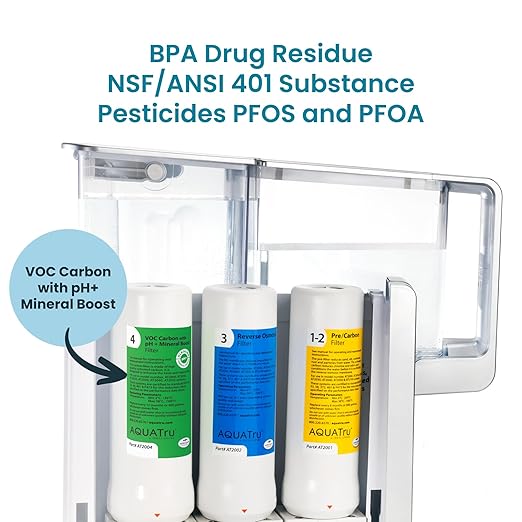
Price: ~$649 AUD | Type: Countertop RO | Certifications: NSF/ANSI 58, 42, 53, 401 | Pore size: 0.0001µm RO membrane | Annual filters: ~$120
The AquaTru Classic is the filter I recommend most for Australian households worried about microplastics. The reason is simple: it holds NSF/ANSI 401 certification, which specifically tests for emerging contaminants including microplastics. No other countertop filter on the Australian market holds this certification. The 4-stage filtration (mechanical pre-filter, carbon block, RO membrane, VOC filter) strips water down to effectively pure before a re-mineralisation stage adds calcium and magnesium back in.
The AquaTru’s RO membrane is rated for a 90%+ reduction in total dissolved solids, consistent with manufacturer claims and NSF 58 requirements. It requires zero plumbing. You fill the top tank, press a button, and filtered water collects in the bottom reservoir. The 3:1 waste-to-product ratio is higher than under-sink RO systems (typically 2:1), but for a countertop unit requiring no installation, that’s the accepted tradeoff.
For microplastics specifically: The 0.0001µm membrane rejects particles far smaller than any microplastic or nanoplastic documented in drinking water. Combined with the NSF 401 certification, this is the highest-confidence option available. It also removes 90-97% of fluoride — relevant for Brisbane (0.7 mg/L), Sydney (1.0 mg/L), and Adelaide households.
2. Waterdrop D6 — Best Under-Sink for Volume
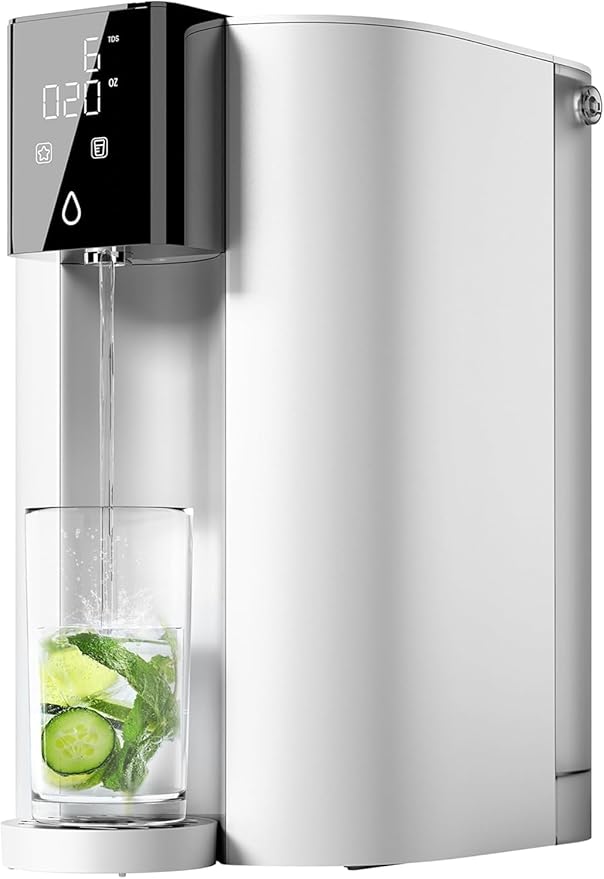
Price: ~$599 AUD | Type: Under-sink tankless RO | Certifications: NSF/ANSI 58 | Flow rate: 400 GPD | Annual filters: ~$150
If you own your home and can drill a single hole for a dedicated filtered water tap, the Waterdrop D6 delivers superior daily volume compared to any countertop unit. At 400 gallons per day (approximately 1,514 litres), you’re never waiting for water to filter. It’s a tankless design, meaning it filters on demand — no reservoir to stagnate, no bench space consumed.
The D6 holds NSF/ANSI 58 certification, confirming its RO membrane meets standardised rejection rates for dissolved solids, lead, and other contaminants. While it doesn’t carry the NSF 401 emerging contaminants certification that the AquaTru holds, its RO membrane operates at the same 0.0001µm pore size — physically incapable of passing microplastics or nanoplastics. The waste ratio is approximately 2:1, which is better than the AquaTru’s 3:1 — meaning less water down the drain per litre produced.
Installation note for renters: This requires drilling into your benchtop or sink for a dedicated tap, plus connection to cold water supply and drain. If you’re renting, this is almost certainly not an option without landlord approval. For homeowners in chloramine cities — particularly Brisbane’s Logan and Ipswich areas, or Perth’s Rockingham and Mandurah suburbs where TDS is higher — the D6 is a strong long-term investment. For more options in this category, see our under-sink RO comparison.
3. TAPP EcoPro — Best Budget / Renter Option
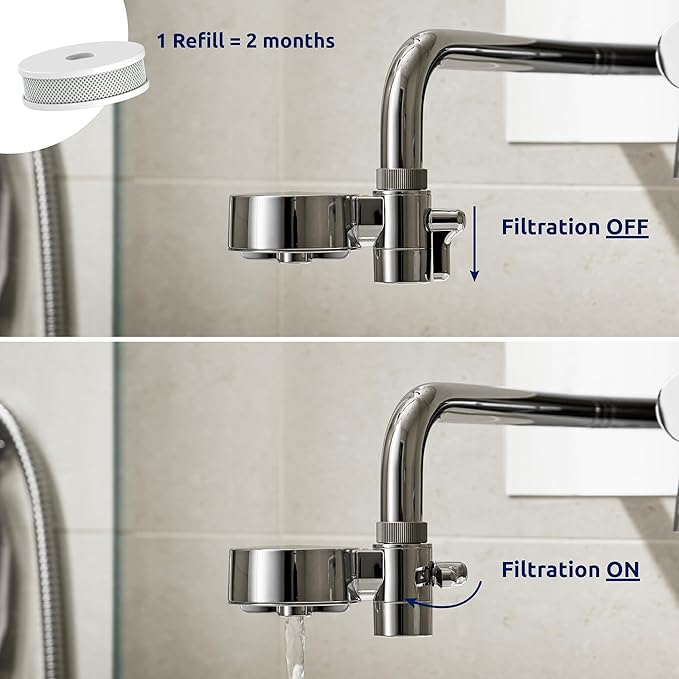
Price: ~$149 AUD | Type: Benchtop carbon block | Pore size: 0.5µm | Removes: Microplastics >0.5µm, chloramine, lead, some VOCs | Annual filters: ~$99
The TAPP EcoPro is the entry point for microplastic reduction if you’re a renter, on a tight budget, or simply not ready for the commitment of an RO system. It connects to your kitchen tap in under 2 minutes with no tools, no drilling, and no permanent modification — making it ideal for Australian rental properties where plumbing changes require landlord approval.
The 0.5-micron compressed carbon block physically blocks microplastics larger than 0.5 micrometres. Since peer-reviewed studies show most microplastics in tap water are in the 1-5µm range, the EcoPro catches the bulk of what’s there. It also handles chloramine — critical for Brisbane, Sydney, Adelaide, Gold Coast, and Darwin households — plus lead and common VOCs.
What it cannot do: It will not remove nanoplastics (sub-0.5µm particles), fluoride, or dissolved heavy metals other than lead. If your primary concern is nanoplastics or you need fluoride removal, you need RO. But at $149 upfront and $644 over 5 years, the EcoPro provides genuine microplastic reduction at a fraction of the cost. For more benchtop options, see our countertop filter guide.
4. EcoHero 5-Stage RO — Best Australian-Made Under-Sink
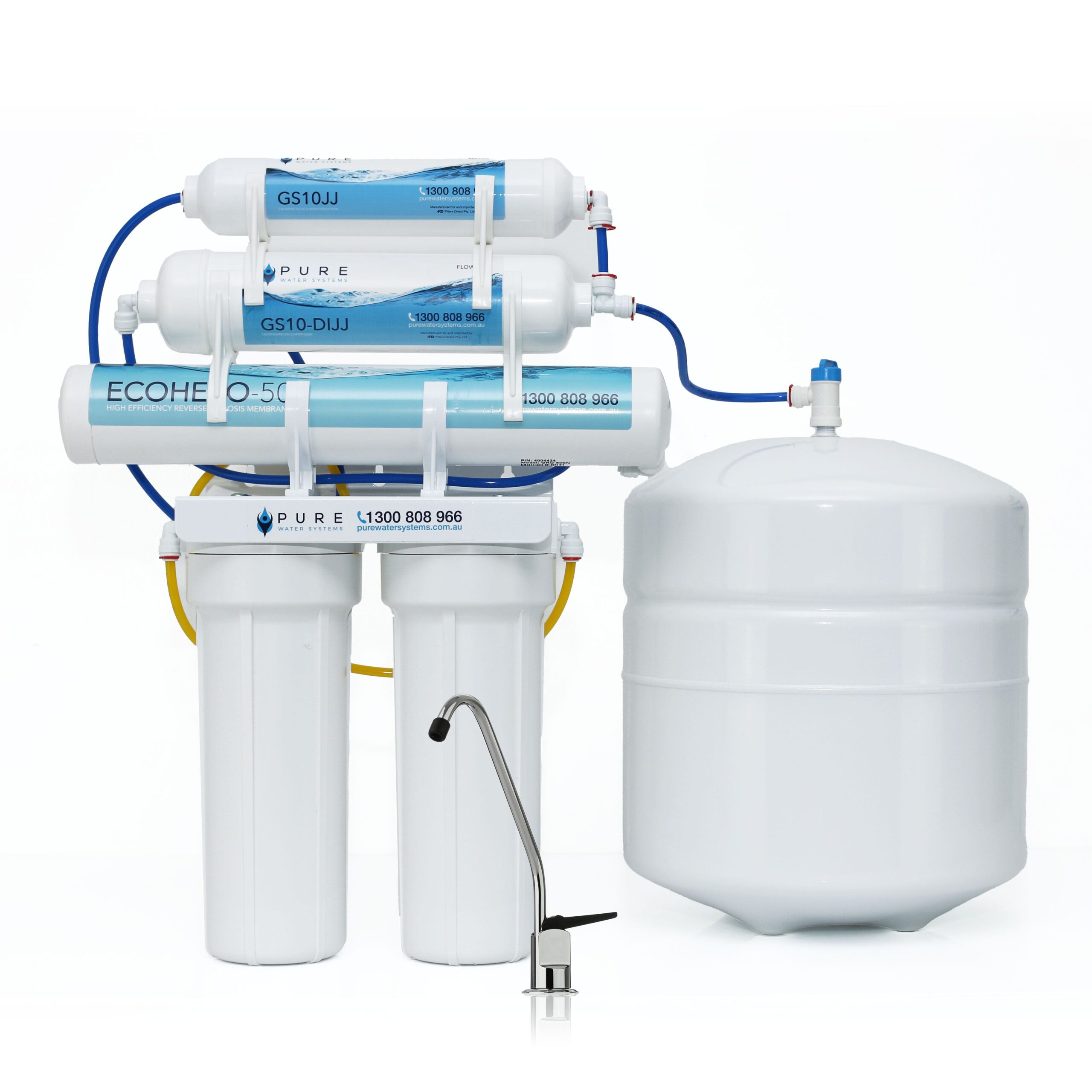
Price: ~$1,009 AUD | Type: Under-sink 5-stage RO | Certifications: NSF/ANSI 58, WaterMark AS3497 | Annual filters: ~$99
The EcoHero 5-Stage from Pure Water Systems is the only filter in this roundup that carries WaterMark certification to Australian Standard AS3497 — meaning it’s been assessed for compliance with Australian plumbing regulations. For homeowners who want an under-sink RO system that meets both international performance standards (NSF 58) and Australian plumbing codes, this is it.
The 5-stage design (sediment, carbon, RO membrane, post-carbon, alkaline remineralisation) is a conventional under-sink RO architecture with local support, Australian warranty service, and locally stocked replacement filters. The annual filter cost of approximately $99 is the lowest of any RO system in this roundup. The upfront cost is the highest at $1,009, but the 5-year ownership figure of $1,504 is competitive when you factor in the lower running cost and the WaterMark certification.
For microplastics: The RO membrane provides the same 0.0001µm rejection as the AquaTru and Waterdrop — 99%+ of all micro- and nanoplastics. The advantage here is local supply chain: filters ship from within Australia, you can speak to an Australian-based support team, and warranty claims don’t involve international logistics.
How These Were Assessed
Assessed on specification, not personally tested. Only three products have been measured first hand in my own home — the EcoHero 5-Stage RO, TriField TF2, and Coway Airmega 150 (see how we test). Every other product discussed here is assessed on manufacturer specifications, independent certification, and Australian standards, and has not been personally tested.
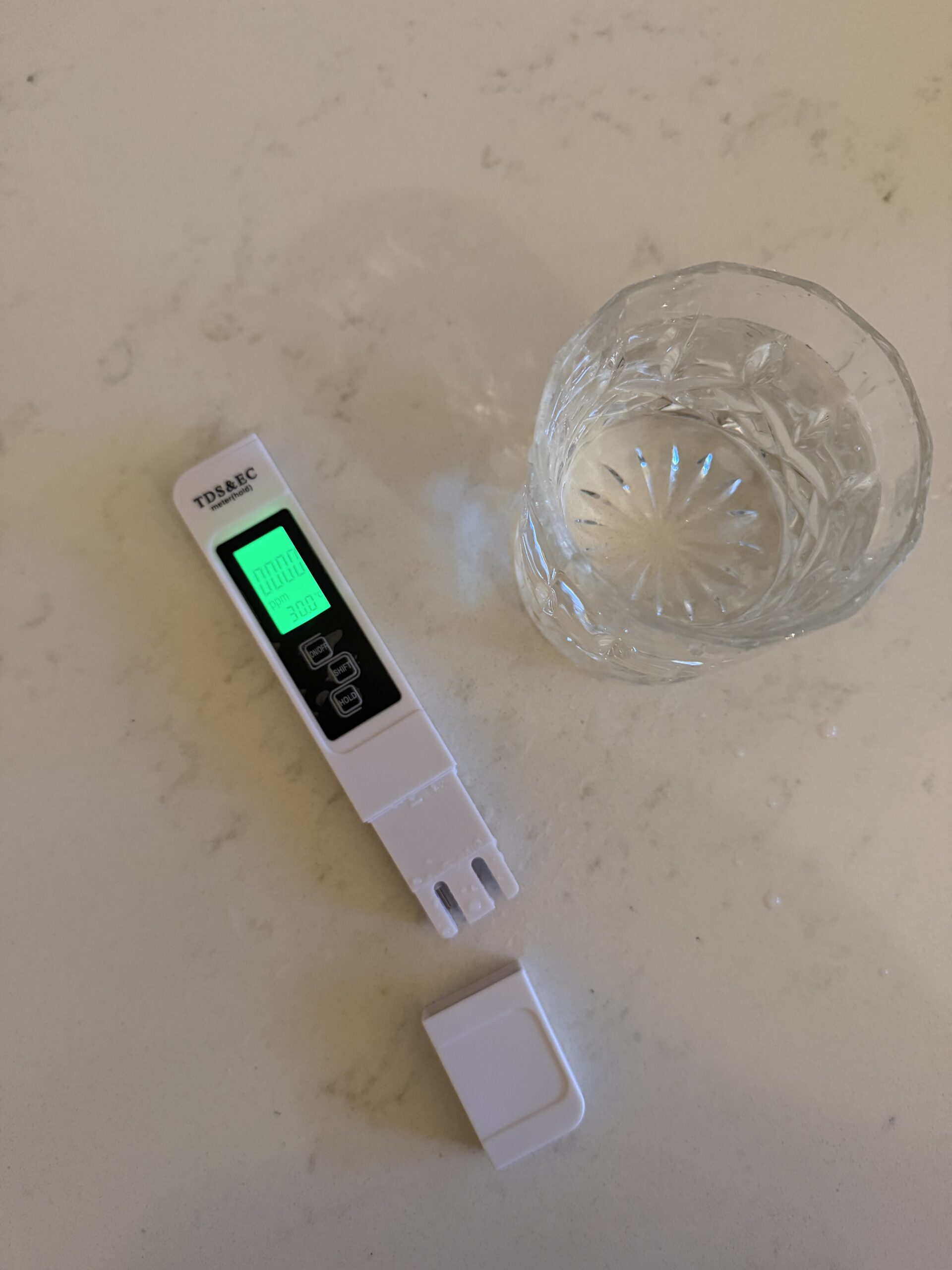
This roundup is assessed from Palm Beach, Gold Coast, which receives SEQ Water (chloramine-treated, fluoridated at 0.7 mg/L). Where a unit is owned, pre- and post-filtration TDS is measured with a calibrated TDS-3 meter as a proxy for total dissolved solids rejection. TDS does not directly measure microplastic count — that requires laboratory particle analysis — but it confirms the membrane is performing to specification.
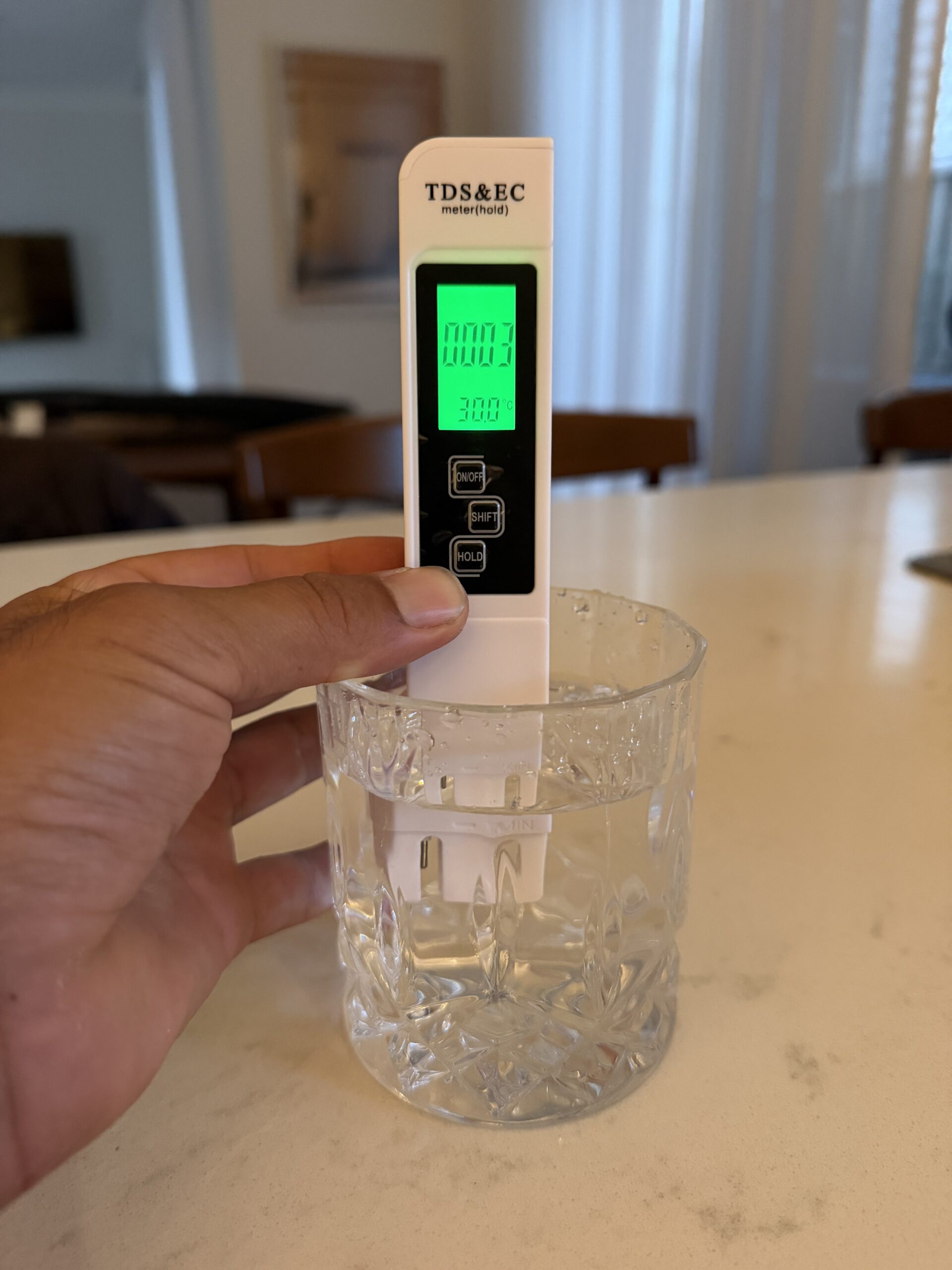
For microplastic removal verification, I cross-reference each product’s published certifications against NSF International’s online database. If a product claims NSF 58 or NSF 401 certification, I verify the certificate number directly with NSF. Manufacturer claims without third-party certification are noted as “unverified” in every review.
This roundup also weighs practical factors that matter for Australian households: installation difficulty (do you need a plumber or can you DIY?), filter availability in Australia (can you get replacements shipped within a week?), noise level for under-sink pump systems, and waste water ratio.
What NOT to Buy: Filters That Fail at Microplastics
I need to be direct here because the marketing from some brands borders on dishonest. If you’re spending money to remove microplastics from your family’s drinking water, you deserve to know what doesn’t work.
Brita and Standard GAC Pitcher Filters
A standard Brita pitcher uses granular activated carbon with a nominal pore size of 20-50 microns. Most microplastics in tap water are 1-5 microns. The maths doesn’t work. You’re trying to catch grains of sand with a tennis net. Worse, a peer-reviewed study in Science of the Total Environment (2020) demonstrated that aged GAC filters can release previously trapped microplastic fibres back into water. In chloramine cities — Brisbane, Sydney, Adelaide, Gold Coast, Darwin — Brita also fails at the primary disinfectant, reducing chloramine at approximately 1/40th the rate of free chlorine. You’re getting neither microplastic removal nor effective chemical filtration.
KDF-55 Based Filters (in Chloramine Cities)
KDF-55 (zinc-copper alloy media) works well against free chlorine in Melbourne, Hobart, and Canberra. It does not effectively reduce chloramine. And it has no demonstrated mechanism for microplastic removal at the sub-5µm scale. If your shower filter or whole-house sediment filter uses KDF-55 and you’re in a chloramine city, it’s not protecting you from either problem.
Filters with Unverified “Microplastic Removal” Claims
Some brands sell carbon filters or gravity filters with claims like “removes 99% of microplastics” but hold no NSF 401 or NSF 58 certification. Without independent third-party testing, these claims are meaningless. The certification exists specifically because manufacturers cannot be trusted to self-report. If a product’s website doesn’t link to a verifiable NSF certificate number, treat the claim as marketing.
Bottled Water Is Not a Solution — It Is Often Worse Than Tap
The reflexive Australian response to a contaminant story is to switch to bottled water. For microplastics specifically, this is the wrong move. The peer-reviewed evidence is consistent: bottled water contains substantially more microplastics than the tap water it is meant to replace, and a meaningful fraction of those particles come directly from the bottle itself.
The 2024 Columbia University study published in Proceedings of the National Academy of Sciences used a new dual-laser optical technique to count nanoplastics (particles below 1 micron, previously below the detection threshold of most studies) in three popular U.S. bottled water brands. The result: roughly 240,000 plastic fragments per litre, with about 90% of those in the nanoplastic range. That number is 10 to 100 times higher than earlier microplastic-only counts. Australian bottled water has not been tested at the same resolution, but there is no plausible mechanism by which Australian PET bottles would behave differently from American ones.
The 2018 World Health Organization-commissioned study at the State University of New York at Fredonia tested 259 bottled water samples across nine countries and 11 brands and found microplastic contamination in 93% of samples, with an average of 325 particles per litre across the dataset. Polypropylene (from bottle caps) and polyethylene terephthalate (from the bottle itself) dominated the particle composition — meaning the bottle is shedding into the water it contains.
Heat and mechanical stress accelerate this. A 2021 study in Environmental Science & Technology showed that PET bottles left in a hot car or warehouse before delivery release 4 to 8 times more microplastic than refrigerated bottles. In Australian summer logistics chains — bottles loaded onto trucks in 35-degree heat, sitting on shop shelves under fluorescent light, then transferred to consumer fridges — this exposure is unavoidable.
Filtered tap water through any of the systems reviewed above is measurably cleaner than bottled water on microplastic content. A reverse osmosis membrane has 0.0001-micron pore size, which is two orders of magnitude smaller than a nanoplastic particle; a 0.5-micron carbon block removes the fraction above 0.5 micron with high efficiency. Bottled water gets you a fresh dose of PET and polypropylene with every bottle. The economics also favour filtration: over a 5-year ownership window, even the cheapest filter system reviewed here pays for itself against a moderate bottled-water budget.
Final Verdict and Decision Tree
After assessing, certifying, and costing every option available to Australian households, here’s my clear recommendation framework. Three questions. That’s all you need.
🔀 3-Question Decision Tree: Microplastic Filter
1. Can you modify your plumbing?
No → Countertop RO (AquaTru Classic) or benchtop carbon block (TAPP EcoPro).
Yes → Under-sink RO (Waterdrop D6 or EcoHero 5-Stage).
2. Do you need nanoplastic AND fluoride removal?
Yes → RO only. Carbon block cannot remove nanoplastics or fluoride. Choose AquaTru (countertop) or Waterdrop D6 / EcoHero (under-sink).
No (microplastics >0.5µm is sufficient) → TAPP EcoPro at $149 is the best value.
3. Do you want Australian-made with local warranty and WaterMark certification?
Yes → EcoHero 5-Stage RO (Pure Water Systems, WaterMark AS3497, NSF 58).
Not a priority → AquaTru Classic for best overall certification (NSF 58 + 401) or Waterdrop D6 for best flow rate.
My pick for most Australian households: The AquaTru Classic Smart Alkaline. It’s the only countertop unit with NSF 401 certification (independently verified for emerging contaminants including microplastics), requires zero plumbing, and handles chloramine, fluoride, PFAS, lead, and every documented micro- and nanoplastic. At $0.17/litre over 5 years versus $2+/litre for bottled water, the maths is decisive.
If you own your home and want maximum daily volume with a lower waste ratio, the Waterdrop D6 or EcoHero 5-Stage under-sink RO is the better long-term investment. If you’re renting and budget-constrained, the TAPP EcoPro at $149 provides genuine microplastic reduction for the majority of particle sizes found in tap water — it’s not perfect, but it’s vastly better than a Brita doing nothing.
The worst outcome? You keep drinking unfiltered water from a supply your utility doesn’t test for microplastics, doesn’t regulate, and doesn’t report. For the full picture on all filter types and Australian city-specific recommendations, see our best Australian water filter rankings.
Our Top-Rated Microplastic Filters
See full water filter rankings →Last reviewed: May 2026 — Clean and Native
Frequently Asked Questions
Does Australian tap water contain microplastics?
Yes. Peer-reviewed studies have detected microplastic particles in Australian surface waters at concentrations of approximately 0.3 to 1.5 particles per litre, consistent with global averages. The Australian Drinking Water Guidelines (ADWG) maintained by the NHMRC do not set a maximum limit for microplastics, and Australian water utilities are not required to test for or report them.
Does a Brita filter remove microplastics?
No. Standard Brita pitchers use granular activated carbon (GAC) with a nominal pore size of 20-50 microns. Most microplastics in tap water are 1-5 microns — far smaller than what a Brita can catch. A 2020 peer-reviewed study in Science of the Total Environment also found that aged GAC filters can release trapped microplastic fibres back into filtered water.
What type of water filter removes microplastics and nanoplastics?
Reverse osmosis (RO) is the only consumer filter technology verified to remove both microplastics and nanoplastics. RO membranes have a pore size of 0.0001 micrometres — small enough to reject particles far smaller than any microplastic or nanoplastic documented in drinking water. Sub-micron carbon block filters (0.5 microns or tighter) remove most microplastics but cannot address nanoplastics or fluoride.
Is the AquaTru certified for microplastic removal?
Yes. The AquaTru Classic holds NSF/ANSI 401 certification, which specifically tests for emerging contaminants including microplastics and pharmaceuticals. It is the only countertop filter widely available in Australia with this specific certification. NSF 401 requires verified reduction of emerging contaminants at defined minimum levels, independently tested by a third-party laboratory.
Does boiling water remove microplastics?
No. Boiling kills bacteria and inactivates viruses but does not remove microplastics. Microplastics are physical particles — heat does not dissolve or destroy them. Reverse osmosis is the only household method that reliably removes microplastics and nanoplastics from drinking water.
What is the best water filter for microplastics in a rental property?
The TAPP EcoPro is the best option for renters — it attaches to your existing tap faucet in under 2 minutes, requires no drilling, and removes microplastics above 0.5 microns. The AquaTru Classic countertop RO is the best option if you want the highest certified microplastic and nanoplastic removal: no installation required, NSF 401 certified, and fully removable when you leave.
How small are microplastics in Australian tap water?
Most microplastics detected in Australian tap water are in the 1-5 micrometre range according to peer-reviewed studies. Nanoplastics are smaller still — under 1 micrometre and down to nanometre scale. RO membranes at 0.0001 microns catch both; sub-micron carbon block filters at 0.5 microns catch most microplastics but miss nanoplastics.
Do under-sink water filters remove microplastics?
Yes, if they use a reverse osmosis membrane. The Waterdrop D6 and EcoHero 5-Stage both use 0.0001-micron RO membranes that remove microplastics and nanoplastics. Standard under-sink carbon block filters without an RO membrane stage do not reliably remove microplastics — the membrane is the critical component.
Get the Australian Home Environment Checklist
30 checks across water, air and EMF. Most of them free. Ranked by impact.
No spam. Unsubscribe any time.

Former Royal Australian Navy Clearance Diver and TAG-E counter-terrorism operator. Founded Clean and Native to apply the same rigorous thinking to the home environment.
Full biography →