Dirty Electricity in Australian Homes 2026
Dirty electricity — technically called high-frequency voltage transients (HFVT) or microsurge electrical pollution — is measurable electromagnetic interference on your home’s 50 Hz mains wiring, typically in the 2 kHz to 150 kHz range. In 2026, Australia’s rapid solar inverter rollout (now at 43% renewable grid penetration according to the Clean Energy Regulator) combined with LED dimmers, smart meters, and switch-mode power supplies has made dirty electricity a growing and measurable problem in Australian homes — one you can quantify with the right meter and address systematically.
| Approach | What It Does | Verdict |
|---|---|---|
| Measurement first (TriField TF2 / AM radio) | Identifies which circuits and devices generate DE | Recommended — always start here |
| Source removal (swap dimmers, relocate inverters) | Eliminates DE at its origin — free or low cost | Recommended — highest ROI |
| Plug-in DE filters (Greenwave, Stetzerizer) | Shunts HF transients to neutral/ground per circuit | Conditional — only after source reduction |
The correct sequence for dirty electricity is identical to every other EMF problem: measure, reduce sources, then filter the residual. Most Australian homes with high DE readings can cut them by 60-80% just by swapping triac LED dimmers for 0-10V types, replacing cheap switch-mode chargers, and isolating solar inverter circuits. Plug-in filters are a valid final step — but if you skip source identification, you are treating symptoms while the cause keeps running.
Key catches
- No Australian regulatory standard specifically addresses DE (2-150 kHz) — ARPANSA limits cover RF and ELF only, not intermediate frequencies
- Solar inverters are now the #1 source of DE in Australian homes — 43% grid penetration means this affects millions of households
- Building Biology SBM-2015 is the only practitioner guideline with DE thresholds — <50 mV "no anomaly", >200 mV “extreme anomaly”
- A $20 AM radio can detect DE before you buy any specialised meter
What Dirty Electricity Actually Is — and Why Australian Homes Are Getting Worse
Your home’s wiring is designed to carry a clean 50 Hz sine wave at 230 volts. That is the standard frequency of mains power across Australia, as defined by AS/NZS 61000.2.2 (electromagnetic compatibility). Dirty electricity occurs when high-frequency transients — voltage spikes and harmonics typically between 2 kHz and 150 kHz — ride on top of that 50 Hz signal. These transients radiate from your wiring like an unintentional antenna, creating electromagnetic fields throughout your home that your wiring was never designed to emit.
The physics is simple. Any device that chops, switches, or converts mains power at high speed injects harmonics back onto the circuit. A triac dimmer, for example, cuts the sine wave 100 times per second to reduce voltage to an LED. Each cut generates a burst of high-frequency noise. A solar inverter converts DC from your panels to AC for the grid, switching at frequencies between 10 kHz and 50 kHz. Every switching cycle injects transients onto your house wiring and potentially onto the neighbourhood distribution network.
Why is 2026 different? According to the Clean Energy Regulator, Australia now has 43% renewable grid penetration, with over 3.6 million rooftop solar installations. Each of those installations includes an inverter switching at kilohertz frequencies. Add the near-universal adoption of LED lighting (most using cheap internal switch-mode drivers), smart meters transmitting at 900 MHz with switching power supplies, and the proliferation of USB chargers, laptop power bricks, and variable-speed motor drives in modern appliances — and the result is measurably more high-frequency noise on Australian mains wiring than a decade ago.
This is not speculation. Building biologists using calibrated microsurge meters routinely measure 200-2,000+ GS (Graham-Stetzer) units in homes with solar inverters and LED dimmers, compared to 20-50 GS units in homes without these devices. The Building Biology Standard SBM-2015 classifies readings above 100 GS units (approximately 50 mV) as a “slight anomaly” and above 1,000 GS units (approximately 500 mV) as an “extreme anomaly” warranting remediation.
The 7 Biggest Sources of Dirty Electricity in Australian Homes
Every dirty electricity problem has a source. Before you spend a dollar on filters, you need to identify which devices in your home are generating the transients. Here are the seven most common culprits in Australian homes in 2026, ranked roughly by the magnitude of DE they typically produce.
1. Solar Inverters (the #1 Source in 2026 Australia)
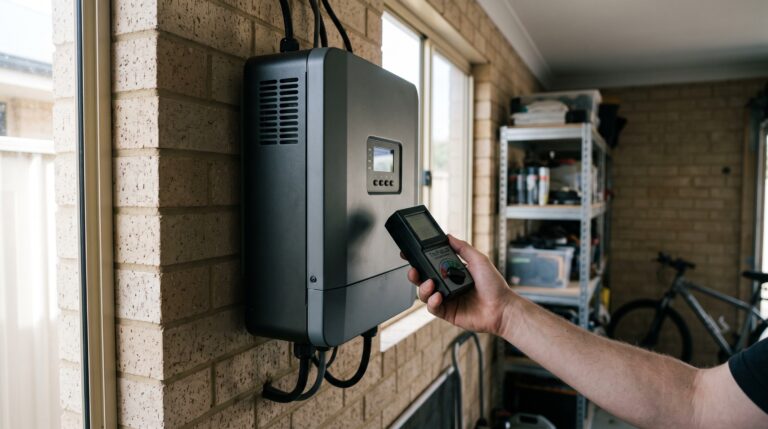
Your rooftop solar system’s inverter is almost certainly the single largest source of dirty electricity in your home. String inverters (Fronius, SMA, Goodwe — the brands installed on most Australian rooftops) switch DC to AC at frequencies between 16 kHz and 50 kHz. Every switching cycle injects harmonics onto your house wiring. Microinverters (Enphase) switch at even higher frequencies but generate less total harmonic distortion per unit — however, with one per panel, the aggregate can still be significant.
The Australian Standard AS/NZS 4777.2:2020 sets harmonic limits for grid-connected inverters, but these limits address power quality for the grid — not the intermediate-frequency transients that radiate from your internal wiring. A compliant inverter can still produce substantial dirty electricity inside your home. If your inverter is mounted on the wall of your bedroom or living area, the wiring run between inverter and switchboard is effectively a radiating antenna for high-frequency noise.
2. Triac (Leading-Edge) LED Dimmers
The cheap trailing-edge or triac dimmers sold at Bunnings for $15-$30 are the second most common source of DE in Australian homes. They work by chopping the AC sine wave, and the chopping point generates a burst of harmonics from 2 kHz upward. At 50% brightness, a single dimmed LED circuit can increase DE readings on the entire circuit by 200-500 GS units. If you have six dimmed downlight circuits — common in a modern Australian home — the cumulative effect is enormous.
3. Smart Meters (Ausgrid, Energex, Jemena)
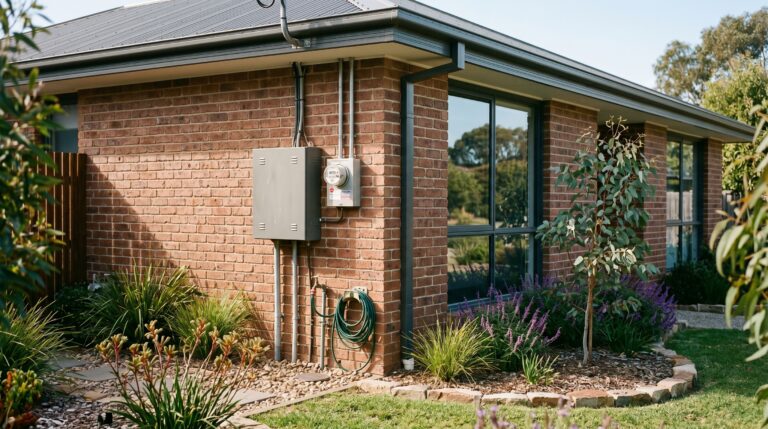
Australian smart meters operate at 900 MHz for data transmission, but they also contain internal switch-mode power supplies that generate DE on the mains wiring they are connected to. The RF transmission is a separate issue (covered in our complete EMF guide). The DE component comes from the meter’s internal electronics running continuously on your mains connection. Energex meters in south-east Queensland and Ausgrid meters in Sydney are the two most common types — both generate measurable DE, typically 50-200 GS units on the circuit nearest the meter.
4. Switch-Mode Power Supplies (Chargers, Adapters, Power Bricks)
Every USB charger, laptop power adapter, LED driver, and phone charger in your home uses a switch-mode power supply (SMPS). These convert 230V AC to low-voltage DC by switching at frequencies between 20 kHz and 200 kHz. Each one generates a small amount of DE, but the average Australian household now has 15-25 SMPS devices plugged in simultaneously. The aggregate contribution is significant — typically 100-300 GS units from chargers alone. Cheap no-name chargers from online marketplaces are the worst offenders; quality brands like Anker and Apple generate measurably less HF noise.
5. Variable-Speed Motor Drives (Inverter Aircon, Pool Pumps)
Modern inverter-type reverse-cycle air conditioners (Daikin, Mitsubishi, Fujitsu) use variable-frequency drives (VFDs) to control compressor speed. These are significantly more energy-efficient than fixed-speed units, but the VFD generates dirty electricity on the circuit it is connected to. Similarly, variable-speed pool pumps (increasingly popular in Queensland and WA for their energy savings) inject HF transients onto the pool pump circuit, which can propagate through the switchboard to other circuits.
6. Compact Fluorescent Lamps (CFLs) — Still Present in Many Homes
While LED replacement has accelerated, millions of Australian homes still have CFLs in some fittings. Each CFL contains an electronic ballast that switches at 25-50 kHz. Per lamp, CFLs generate more DE than most LEDs with integrated drivers. If you still have CFLs, replacing them with quality LED globes (not dimmed via triac dimmer) is a net win for both DE and energy efficiency.
7. Neighbourhood Grid Noise (External Source)
Dirty electricity does not respect property boundaries. If your neighbour has a 10 kW solar system, a commercial premises nearby uses industrial motor drives, or your local distribution transformer is heavily loaded, HF transients can enter your home through the mains connection. This is the one source you cannot eliminate internally — but you can filter it at the switchboard.
How to Measure Dirty Electricity in Your Home
You would not treat a water contamination problem without testing the water first. The same principle applies to dirty electricity. Without measurement, every decision is a guess — and expensive guesses at that, given whole-home DE filter systems can cost $2,000-$5,000 installed. Here is the measurement sequence I recommend, from lowest cost to most comprehensive.
Step 1: The $5 AM Radio Test (Free If You Already Own One)
This is the quick-and-dirty screening test. Tune a portable AM radio to a frequency with no broadcast station (around 530 kHz or 1,600 kHz). Hold it near your switchboard, near wall wiring runs, and near suspect devices. Dirty electricity produces a distinctive buzzing or crackling sound through the AM radio — the louder the buzz, the higher the DE levels. This is a qualitative test, not a quantitative one, but it will immediately tell you which circuits and devices are the worst offenders in your home. Solar inverters typically produce a loud, aggressive buzz on AM radio. Triac dimmers produce a harsh crackling when adjusted.
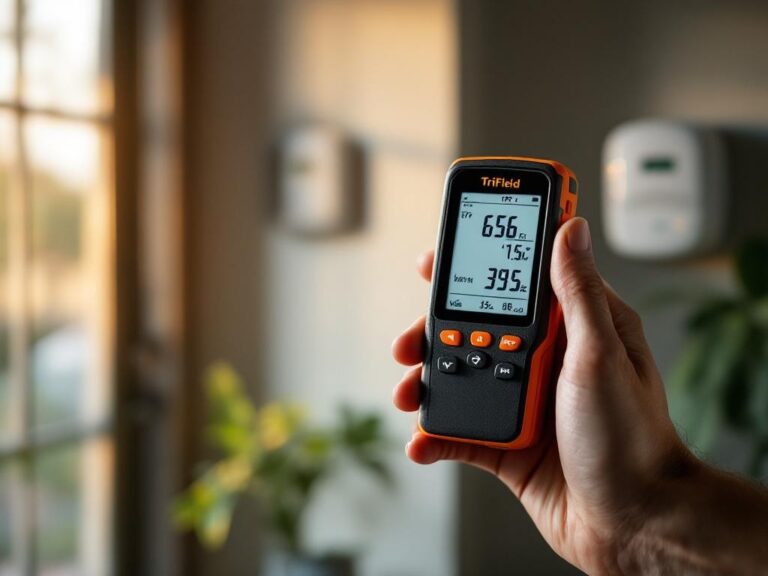
Step 2: TriField TF2 EMF Meter (AC Magnetic + AC Electric Modes)
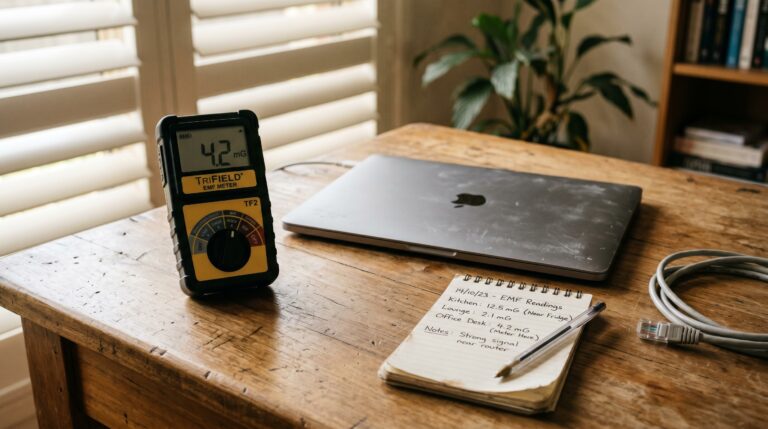
The TriField TF2 is not a dedicated dirty electricity meter — it measures ELF magnetic, ELF electric, and RF fields. However, its AC magnetic mode responds to harmonics above 50 Hz, and you can use it to identify circuits with elevated magnetic field readings that correlate with DE. If you are already measuring RF and AC magnetic fields in your bedroom (which you should be — see our EMF measurement guide), the TF2 gives you useful DE screening data as a bonus.
The TF2 costs approximately $250 on Amazon AU and measures all three field types, making it the best starting point for any Australian household concerned about EMF exposure broadly — not just dirty electricity.
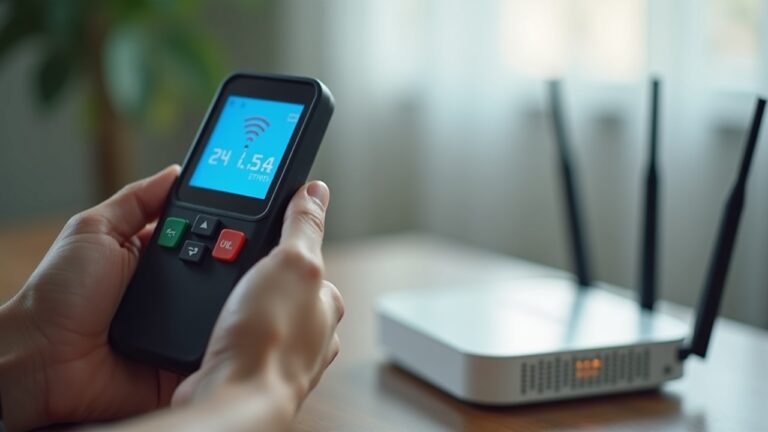
Step 3: Dedicated Microsurge Meter (Stetzerizer or Greenwave)
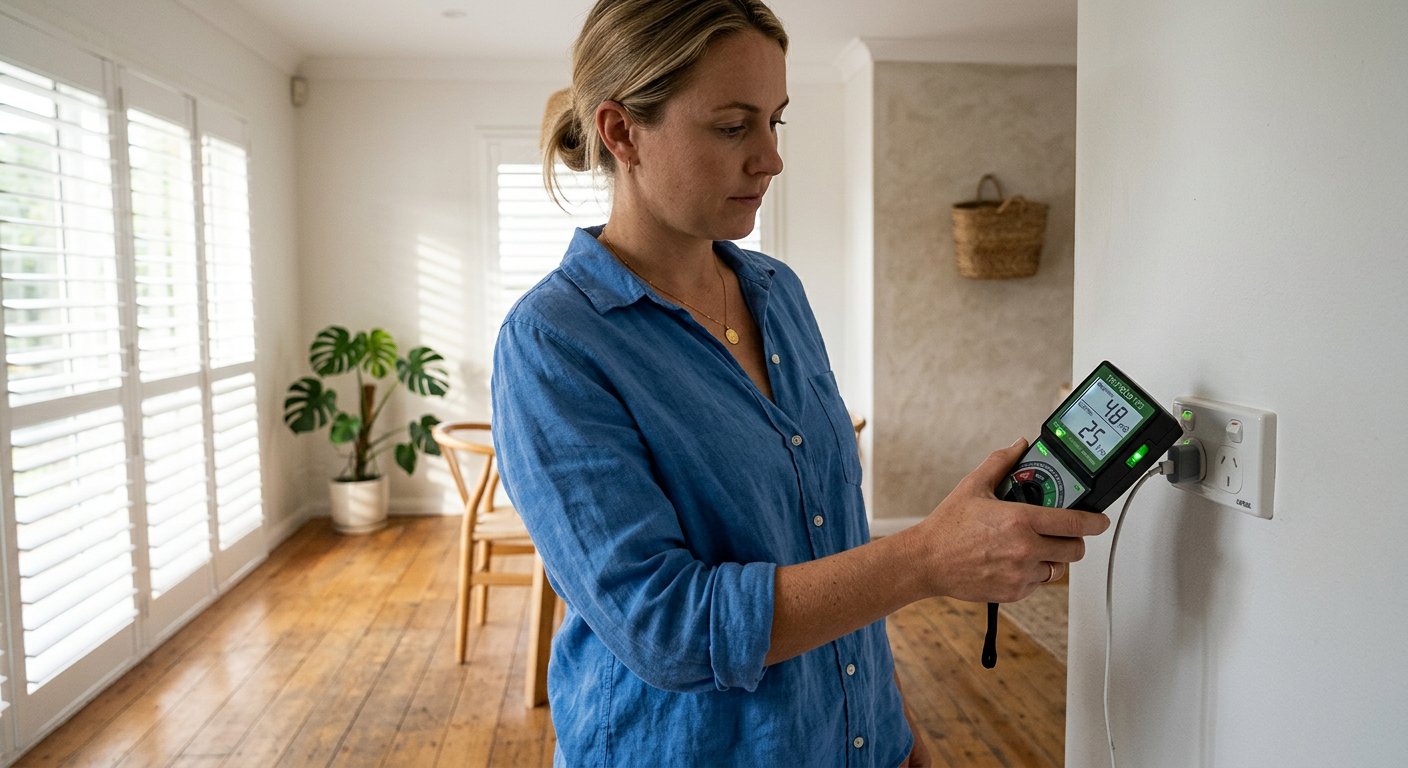
For quantitative DE measurement, you need a dedicated microsurge meter. The two main options are the Stetzerizer Microsurge Meter (reads in GS units) and the Greenwave Broadband EMI Meter (reads in millivolts, mV). Both plug into a standard GPO and measure the amplitude of high-frequency noise on that circuit. The Greenwave meter is generally preferred by building biologists for its millivolt scale, which correlates more directly with the Building Biology SBM-2015 thresholds:
| SBM-2015 Category | Millivolts (mV) | Approx GS Units | Assessment |
|---|---|---|---|
| No anomaly | <50 mV | <25 GS | Ideal — no action needed |
| Slight anomaly | 50–100 mV | 25–50 GS | Worth investigating sources |
| Severe anomaly | 100–500 mV | 50–1,000 GS | Source reduction recommended |
| Extreme anomaly | >500 mV | >1,000 GS | Immediate remediation warranted |
The measurement process is systematic. Plug the meter into every GPO in the room, record the reading, then systematically switch off circuits at the switchboard to identify which circuit contributes the most DE. The circuit with the solar inverter connection will almost always show the highest readings. This circuit-by-circuit approach takes about 30 minutes for a typical three-bedroom Australian home and gives you an actionable map of where your DE is coming from.
Step 4: Professional Power Quality Analysis (For Complex Cases)
If your readings remain high after source reduction and plug-in filtering, a power quality analyser (Class A per IEC 61000-4-30) provides laboratory-grade data on harmonic distortion, voltage transients, and inter-harmonic frequencies. These instruments cost $5,000-$20,000 to purchase, but can be rented from specialist firms like Zenith Rental in Australia. A 48-hour recording captures the full pattern of DE in your home — including grid-sourced noise that only appears during peak solar export periods (typically 10am-2pm).
The Australian Regulatory Gap: Why No One Is Measuring This
Here is the uncomfortable truth: no Australian regulatory body currently sets exposure limits for dirty electricity in the 2-150 kHz frequency range in residential settings. This is not a conspiracy — it is a genuine gap between two sets of standards that were never designed to overlap.
ARPANSA’s exposure limits (based on ICNIRP 2020 guidelines) cover two frequency bands: extremely low frequency (ELF) below 300 Hz, and radiofrequency (RF) above 100 kHz. The 2-150 kHz band where most dirty electricity sits falls in a regulatory no-man’s land. ARPANSA’s RF reference level at 2.4 GHz is 1,000 µW/cm² — a thermal safety limit. Their ELF magnetic field limit at 50 Hz is 1,000 µT. Neither limit is designed to address high-frequency transients on mains wiring.
The Australian Standard AS/NZS 61000 series (electromagnetic compatibility) addresses conducted emissions from devices, but from a power quality and equipment interference perspective — not from a biological exposure perspective. A device can be fully AS/NZS 61000 compliant and still generate significant dirty electricity on your home wiring.
The TGA (Therapeutic Goods Administration) has not assessed dirty electricity as a health concern. The NHMRC has not issued any specific guidance on intermediate-frequency EMF exposure in residential settings. The Building Biology Standard SBM-2015 (a German practitioner guideline widely used by Australian building biologists) is the only framework that provides residential thresholds for DE — but it has no legal standing in Australia.
What does this mean for you? It means no government authority is going to test your home for dirty electricity. No standard will tell your electrician what level of DE is “too high.” You need to measure it yourself, apply the precautionary Building Biology thresholds, and make informed decisions based on your own readings — the same approach we recommend for all EMF concerns in Australian homes.
How to Reduce Dirty Electricity: The Correct Sequence
The approach to dirty electricity is identical to every other EMF issue I cover on this site: measure, reduce sources, then shield or filter the residual. Skip the first two steps and you are burning money. Here is the systematic approach, in order of cost-effectiveness.
Step 1: Remove or Replace Source Devices (Free to Low Cost)
This is where most of the improvement happens, and it costs the least. Based on the sources identified in your measurement phase:
Triac dimmers → 0-10V or DALI dimmers ($30-$80 per dimmer): Swap leading-edge (triac) dimmers for trailing-edge or 0-10V protocol dimmers that produce dramatically less HF noise. Clipsal, HPM, and Schneider all make trailing-edge dimmers compatible with Australian GPO plate systems. A licensed electrician can swap a dimmer in 15 minutes per circuit. This single change typically reduces DE by 200-500 GS units per dimmed circuit.
Cheap SMPS chargers → quality brand chargers ($20-$40 each): Replace no-name USB chargers and power adapters with quality units from Anker, Apple, or Samsung that have better internal filtering. Unplug chargers when not in use — a plugged-in SMPS generates DE even with no load. A Jackson 24hr mechanical timer (~$20) on your bedside charger strip eliminates overnight DE from chargers automatically.
CFL globes → quality LED globes ($5-$15 each): If you still have compact fluorescent lamps, replace them with LED globes that have good integrated drivers. Philips and Osram LEDs consistently measure lower DE than cheap generic brands.
Solar inverter circuit isolation: Ask your electrician whether your solar inverter is connected to a dedicated circuit or shares a circuit with bedroom or living area GPOs. In many Australian installations, the inverter feed runs through the main switchboard, and transients propagate to every circuit. A competent electrician can install an EMI filter (line reactor) at the switchboard on the inverter circuit for $200-$500 installed. This contains the inverter’s harmonics to its own circuit.
Step 2: Demand Switches for Sleeping Areas (~$100-$150 Installed)
A demand switch (also called an automatic circuit disconnector or ACD) is installed by a licensed electrician on your bedroom circuit. When no loads are drawing current — typically at night when everything is off — the demand switch cuts power to that circuit entirely, eliminating not only AC electric fields from wiring but also any dirty electricity riding on that circuit. At approximately $100-$150 installed per circuit, this is one of the highest-impact-per-dollar EMF interventions available. Your electrician needs to ensure the bedroom lighting is on the same circuit as the bedroom GPOs for this to work effectively.
Step 3: Plug-In DE Filters (After Source Reduction)
Plug-in dirty electricity filters work by shunting high-frequency transients from the active conductor to neutral/ground through a capacitor network. The two most common brands available in Australia are:
Stetzerizer filters: Each filter plugs into a standard Australian GPO and reduces DE on that circuit. Typical improvement is 30-70% reduction per circuit. You need one filter per GPO (some circuits need two). A typical three-bedroom home might need 10-20 filters at approximately $40-$60 each, so total cost is $400-$1,200.
Greenwave filters: Similar principle to Stetzerizer, with a slightly different capacitor network. Available through SaferEMF Australia. Performance is comparable — the best choice depends on which is available and which your building biologist recommends based on your specific harmonic profile.
Important caveat: Plug-in filters address the symptoms, not the cause. If you install 15 Stetzerizer filters without first swapping your triac dimmers and isolating your solar inverter circuit, you are fighting an ongoing source of DE with passive filtration. The filters will reduce readings, but you will need more of them, and the source is still generating transients that stress the filter capacitors continuously. Source reduction first, then filter the residual.
Step 4: Whole-Home (Switchboard-Level) Filtering ($2,000-$5,000 Installed)
For homes with persistent DE from external grid sources — common in areas with high neighbourhood solar penetration like south-east Queensland suburbs (Kenmore, Indooroopilly, Bulimba) and Perth’s northern suburbs (Joondalup, Wanneroo) — a whole-home EMI filter installed at the switchboard can attenuate incoming harmonics. These are essentially industrial-grade line filters (conforming to IEC 61800-3) adapted for residential use. Installation must be done by a licensed electrician, and the filter needs to be rated for your home’s maximum load (typically 63A single-phase in Australia).
Whole-home filters were previously difficult to source in Australia. According to SaferEMF, dedicated residential whole-home DE filter systems have only recently become available in the Australian market. Expect to pay $2,000-$5,000 installed, depending on your switchboard configuration and the filter capacity required. This is the last step — not the first.
Dirty Electricity and Health: What the Evidence Actually Shows
I am not going to tell you that dirty electricity causes cancer, and I am not going to tell you it is completely harmless. Both claims are unsupported by the current state of evidence. Here is what the research actually says, without spin.
The most-cited study is Milham and Morgan (2008), published in the American Journal of Industrial Medicine, which reported a dose-response relationship between GS unit readings in California schools and teacher cancer incidence. The study found teachers in classrooms with GS readings above 2,000 had a cancer risk ratio of 1.26 compared to teachers in lower-DE classrooms. This is a single observational study with methodological limitations the authors themselves acknowledged — including potential confounders like proximity to high-voltage transmission lines.
Havas (2006, 2008) published multiple papers associating dirty electricity with symptoms including headaches, fatigue, difficulty concentrating, and tinnitus — collectively termed electromagnetic hypersensitivity (EHS). These studies used pre/post filter installation designs, where symptoms were self-reported before and after Stetzerizer filters were installed. The limitation: most studies were not blinded, and the placebo effect in EHS symptom reporting is well-documented.
On the regulatory side, ARPANSA’s position (last updated 2023) is that “there is no established evidence that exposure to low-level electromagnetic fields from everyday sources causes health effects.” This position addresses RF and ELF broadly but does not specifically address intermediate-frequency (2-150 kHz) transients on mains wiring. The NHMRC has not issued specific guidance on dirty electricity. The WHO’s International Agency for Research on Cancer (IARC) classified ELF magnetic fields as “possibly carcinogenic” (Group 2B) in 2002 but has not assessed intermediate-frequency fields separately.
The Building Biology approach — which Clean and Native follows — is precautionary. The SBM-2015 thresholds are set at levels well below any demonstrated health effect, applying the same precautionary logic used in drinking water standards: keep exposure as low as reasonably achievable (ALARA), especially in sleeping areas where exposure duration is longest (6-8 hours per night).
My position: Dirty electricity is measurable. The sources are identifiable. The fixes are simple and often free. Whether DE at typical residential levels causes health effects is an open scientific question — but reducing an unnecessary electromagnetic exposure in your sleeping environment, especially when the fixes overlap with good electrical practice (better dimmer technology, fewer vampire loads, cleaner solar integration), costs you nothing in terms of downside. Measure, reduce sources, sleep in a cleaner electromagnetic environment. The worst outcome is you save some electricity and extend the life of your electronics.
DE Reduction Cost-Benefit: What You Will Actually Spend
One of the biggest gaps in every competitor article on dirty electricity is honest pricing. Here is what each intervention actually costs for a typical three-bedroom Australian home, ranked by cost-effectiveness.
| Intervention | Cost (AUD) | Typical DE Reduction | Who Does It |
|---|---|---|---|
| AM radio screening | $0–$5 | Identifies sources | You |
| Unplug unused chargers + mechanical timer | $0–$20 | 100–300 GS units | You |
| Replace triac dimmers (×6) | $180–$480 + electrician | 200–500 GS per circuit | Licensed electrician |
| Demand switch on bedroom circuit | $100–$150 | Eliminates DE on circuit overnight | Licensed electrician |
| TriField TF2 meter | ~$250 | Quantifies RF + ELF + DE indicators | You |
| Inverter circuit EMI filter | $200–$500 | Isolates inverter harmonics | Licensed electrician |
| Plug-in DE filters (×10-20) | $400–$1,200 | 30–70% per circuit (after source reduction) | You (plug in) |
| Whole-home switchboard filter | $2,000–$5,000 | Attenuates external grid noise | Licensed electrician |
For most Australian homes, the total cost of meaningful DE reduction is $200-$700: a mechanical timer, dimmer swaps, a demand switch, and an inverter circuit filter. You get 80% of the result for 10-15% of the maximum possible spend. The remaining 20% of improvement (plug-in filters and whole-home filtration) follows the law of diminishing returns — pursue it only if your post-source-reduction measurements justify it.
Solar Inverters and Dirty Electricity: Australia’s Specific Problem
Australia has a unique dirty electricity problem that no other country faces at the same scale. With over 3.6 million rooftop solar installations and 43% renewable grid penetration (Clean Energy Regulator, 2026), the density of grid-tied inverters per kilometre of distribution network is among the highest in the world. This is excellent for decarbonisation and actually terrible for power quality at the household level.
A standard 5 kW residential string inverter (Fronius Primo, SMA Sunny Boy, Goodwe DNS series) switches at a carrier frequency of 16-20 kHz, with harmonics extending to 100+ kHz. During peak solar production (10am-2pm on a clear day), the inverter is operating at maximum output and injecting the most HF noise onto your wiring. This is why midday DE readings in solar homes are often 3-5× higher than evening readings.
The problem compounds in high-solar-density suburbs. In south-east Queensland — suburbs like Kenmore, Chapel Hill, and Indooroopilly where 40-60% of homes have rooftop solar — each home’s inverter noise propagates through the shared distribution transformer to every other home on the same transformer. You can have a home with no solar installation and still have elevated DE readings because your neighbours’ inverters are injecting noise onto the shared low-voltage network.
Perth’s northern suburbs (Joondalup, Wanneroo, Butler) face the same issue, compounded by WA’s midday solar export oversupply problem that forces inverters into curtailment modes — rapid on/off switching that generates transient bursts worse than steady-state operation.
What you can do about inverter DE:
- EMI filter on inverter circuit ($200-$500 installed): A line reactor or LC filter installed at the switchboard on the inverter feed attenuates harmonics before they propagate to other circuits. This is the most cost-effective intervention for solar DE.
- Inverter placement: If your inverter is mounted on an exterior wall shared with a bedroom, the wiring run acts as a radiating antenna. Ask your electrician about relocating the inverter to a garage or laundry wall — or at minimum, ensure the wiring run does not pass through bedroom wall cavities.
- Battery systems with hybrid inverters: Some hybrid inverters (e.g., the Tesla Powerwall 2 gateway) include better internal filtering than standalone string inverters. If you are adding a battery, this is a secondary benefit worth considering.
- Microinverters vs. string inverters: Enphase microinverters generate less total harmonic distortion per unit but are installed at each panel. The aggregate DE depends on system size and wiring topology — there is no blanket answer, only measurement.
The 3-Question Decision Tree for Australian Homeowners
If the detail above feels overwhelming, here is the simplified decision framework. Three questions, and you know what to do next.
Question 1: Have you measured?
No → Start with the AM radio test (free). If that reveals buzzing near your switchboard or dimmer circuits, buy a TriField TF2 (~$250) for quantitative screening, or rent a dedicated microsurge meter for $50-$100/week from a building biology supplier.
Question 2: Do you have solar?
Yes → Your inverter circuit is almost certainly your biggest DE source. Get an EMI filter installed on the inverter feed at the switchboard ($200-$500). This should be your first electrician call.
No → Focus on dimmer swaps (triac to trailing-edge) and unplugging unused chargers. These are your likely primary sources.
Question 3: Is your primary concern your bedroom?
Yes → A demand switch on your bedroom circuit ($100-$150 installed) eliminates DE, AC electric fields, and magnetic fields from wiring while you sleep. Combine with airplane mode on your phone (free) and a Jackson mechanical timer (~$20) on your bedside charger strip. Total cost under $200 for the cleanest possible sleep environment.
No → Systematic source reduction across all circuits, then plug-in filters on circuits that remain elevated. Whole-home switchboard filter only if grid-sourced DE persists after internal source reduction.
Last reviewed: July 2026 – Clean and Native
Final Verdict: Start With Measurement — the TriField TF2 Is the Only Meter You Need.
Measures AC magnetic, AC electric, and RF in one device. Without real readings, every dirty electricity decision is a guess. Former Navy Clearance Diver Jayce Love uses the TF2 as the first-line screening tool for every home assessment at Clean and Native.
Frequently Asked Questions
What is dirty electricity in simple terms?
Dirty electricity is high-frequency electrical noise (2-150 kHz) that rides on your home’s 50 Hz mains wiring. It is generated by devices that switch or chop power rapidly — solar inverters, LED dimmers, chargers, and variable-speed motors — and it radiates from your wiring as electromagnetic interference.
Does Australia have regulations for dirty electricity exposure?
No. ARPANSA’s exposure limits cover ELF (below 300 Hz) and RF (above 100 kHz) but not the 2-150 kHz intermediate frequency band where dirty electricity sits. The Building Biology Standard SBM-2015 provides practitioner thresholds but has no legal standing in Australia.
Does my solar system cause dirty electricity?
Yes. Every grid-tied solar inverter switches DC to AC at 16-50 kHz, injecting high-frequency transients onto your mains wiring. According to the Clean Energy Regulator, Australia’s 3.6 million rooftop solar installations make solar inverters the single largest source of residential dirty electricity nationally.
How do I test for dirty electricity at home?
Start with a portable AM radio tuned to a dead frequency (530 or 1,600 kHz) — buzzing near wiring indicates DE. For quantitative measurement, use a dedicated microsurge meter (Stetzerizer or Greenwave) plugged into each GPO. A TriField TF2 EMF meter (~$250 on Amazon AU) provides useful screening data across all EMF types including DE indicators.
Do Stetzerizer filters actually work?
Yes, plug-in DE filters (Stetzerizer or Greenwave) reduce high-frequency noise on the circuit they are plugged into by 30-70%, measurable with a microsurge meter. However, they address symptoms, not causes. Source reduction (swapping dimmers, isolating inverter circuits) should always come first for the most cost-effective result.
Can dirty electricity from my neighbour’s solar panels affect my home?
Yes. In high-solar-density suburbs — common in south-east Queensland and Perth’s northern suburbs — inverter noise propagates through the shared distribution transformer to every home on the same low-voltage network. A whole-home switchboard filter ($2,000-$5,000 installed) is the only solution for externally sourced DE.
What does a demand switch do for dirty electricity?
A demand switch (automatic circuit disconnector) installed by a licensed electrician on your bedroom circuit cuts power when no loads are drawing current — typically overnight. This eliminates dirty electricity, AC electric fields, and magnetic fields from that circuit’s wiring during sleep. Cost is approximately $100-$150 installed.
How much does it cost to fix dirty electricity in an Australian home?
For most homes, $200-$700 covers the high-impact interventions: a mechanical timer (~$20), dimmer swaps ($180-$480 plus electrician), and a demand switch ($100-$150). This delivers approximately 80% of the achievable DE reduction. Plug-in filters add $400-$1,200 and whole-home switchboard filters cost $2,000-$5,000 installed — these are for residual noise after source reduction.
Does dirty electricity cause health problems?
The evidence is suggestive but not conclusive. Milham and Morgan (2008) reported associations between high DE readings and cancer incidence in schools. Havas (2006, 2008) documented symptom improvements after filter installation. However, ARPANSA and the NHMRC have not issued specific guidance on intermediate-frequency EMF exposure. The precautionary Building Biology approach is to reduce DE to below
Get the Australian Home Environment Checklist
30 checks across water, air and EMF. Most of them free. Ranked by impact.
No spam. Unsubscribe any time.

Former Royal Australian Navy Clearance Diver and TAG-E counter-terrorism operator. Founded Clean and Native to apply the same rigorous thinking to the home environment.
Full biography →Similar Posts
EMF Protection Products Victoria 2026: Shields, Meters & Home Solutions
EMF protection products Victoria — Clean & Native’s Australian guide covering everything you need to know, with evidence-based recommendations.
How I Fixed My Sleep Environment: Water, Air, and EMF in My Palm Beach Home
Sleep quality improves measurably when you address bedroom water TDS (200+ ppm baseline), airborne VOCs/PM2.5 (35+ μg/m³ while sleeping), and AC electric…
Does Earthing Reduce EMF? The Science for Australian Homes (2026)
Earthing does not block or shield environmental EMF from WiFi, 5G, or power lines — but it does reduce your body’s electrical voltage when you are…
EMF Protection Products NSW: What Actually Works in 2026
EMF protection products NSW — Clean & Native’s Australian guide covering everything you need to know, with evidence-based recommendations.
Solar Panel Inverter EMF Australia 2026
Solar inverters in Australia produce measurable AC magnetic fields and inject high-frequency harmonics (dirty electricity) onto household wiring, but…
EMF Phone Case for Kids: What Australian Parents Need to Know (2026)
An EMF phone case designed for children redirects a portion of radiofrequency (RF) energy away from the head and body during active calls, but it is…