
Grounding for Menopause Australia 2026
No randomised controlled trial has tested earthing specifically for menopausal hot flushes or night sweats — that study does not exist yet. What does exist is small-study evidence that sleeping grounded normalises the diurnal cortisol profile (Chevalier et al., 2012) and increases heart rate variability (Chevalier, 2019) — two measurable physiological shifts directly relevant to the cortisol dysregulation, autonomic imbalance, and sleep disruption that drive menopausal symptoms in approximately 3.9 million Australian women.
Grounding during sleep is the highest-value earthing intervention for menopausal women because sleep is where cortisol, thermoregulation, and autonomic function converge. A conductive half sheet placed across the torso and hip area maintains skin contact through the night — the period when hot flushes, night sweats, and cortisol spikes cause the most damage. The evidence is early-stage but physiologically plausible, low-risk, and costs less than two months of most supplements. Earthing is not a substitute for HRT or medical menopause management. The Australian Government is expanding menopause care through 22+ dedicated clinics from July 2026. Grounding sits alongside that care, not instead of it.
Key catches
- No RCT has tested earthing for menopause specifically — cortisol and HRV data comes from small general-population studies
- Grounding products are not TGA-listed medical devices in Australia — they cannot legally claim to treat menopause
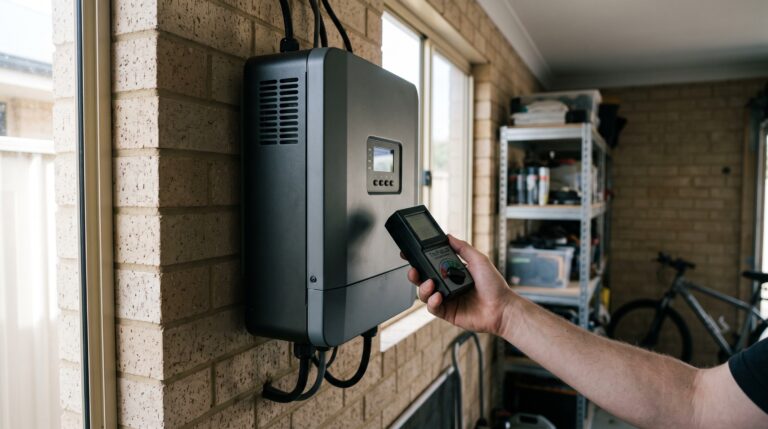
- If your home has old or faulty wiring, earthing via a power point earth pin may introduce stray current — test with a multimeter first or use an outdoor ground rod
| Approach | How it helps menopause symptoms | Verdict |
|---|---|---|
| Grounding half sheet (overnight) | Cortisol normalisation, HRV increase, 6-8 hours continuous contact during peak hot flush window | Recommended — best value |
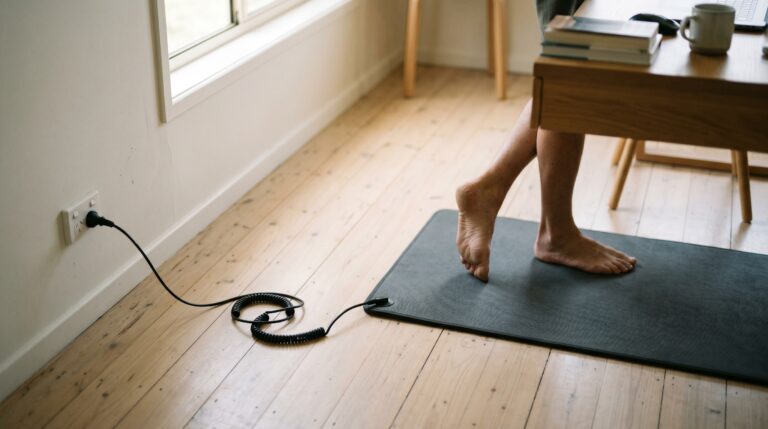
| Grounding desk mat (daytime) | Supplementary cortisol support during work hours, wrist/forearm contact | Good add-on, not primary |
| Barefoot outdoor grounding | Free, effective when possible — limited by weather, time, and consistency | Excellent but inconsistent |
Why Menopause Destroys Sleep and Triggers Hot Flushes
You already know something has changed. You wake at 2am soaked, heart racing, and cannot fall back asleep. The next day you are exhausted, irritable, and foggy. This is not weakness or stress — it is measurable physiology. Understanding the mechanism matters because it reveals exactly where grounding may intervene.
Oestrogen decline disrupts thermoregulation. The hypothalamus — your body’s thermostat — narrows its thermoneutral zone as oestrogen drops during perimenopause and post-menopause. According to research published in the Journal of Clinical Endocrinology & Metabolism, this narrowing means a smaller rise in core body temperature triggers a full vasomotor response: rapid vasodilation, sweating, and the subjective experience of a hot flush. In 75-80% of menopausal women, this happens multiple times per night.
Cortisol dysregulation compounds the damage. The hypothalamic-pituitary-adrenal (HPA) axis becomes less stable during menopause transition. According to data from the Study of Women’s Health Across the Nation (SWAN), perimenopausal women show flatter diurnal cortisol curves — meaning cortisol stays elevated at night when it should be at its lowest. Elevated night-time cortisol directly fragments sleep architecture, reducing deep slow-wave sleep by up to 30% compared to pre-menopausal patterns. Less deep sleep means less recovery, more inflammation, and more frequent hot flushes. It is a vicious cycle.
Systemic inflammation rises. The menopausal transition is associated with measurable increases in inflammatory markers including interleukin-6 (IL-6) and C-reactive protein (CRP), according to research published in Menopause: The Journal of The North American Menopause Society. This is not optional background biology — elevated CRP is independently associated with hot flush frequency and severity. Every night of broken sleep drives CRP higher, which drives more hot flushes, which fragments sleep further.
Autonomic nervous system shifts toward sympathetic dominance. Heart rate variability (HRV) — a reliable marker of parasympathetic (“rest and digest”) nervous system activity — decreases during menopause. Lower HRV is correlated with both sleep disruption severity and hot flush frequency. This is the battleground where earthing evidence becomes directly relevant.
What Earthing Actually Does: The Three Mechanisms Relevant to Menopause
Grounding (or earthing) means maintaining conductive contact with the Earth’s surface — barefoot on grass, or via a conductive sheet or mat connected to an earth ground. The proposed mechanism is electron transfer: the Earth’s surface carries a mild negative charge, and direct skin contact allows free electrons to flow into the body. The hypothesis is that these electrons act as antioxidants, neutralising reactive oxygen species (ROS) and reducing systemic inflammation.
Three specific findings from earthing research intersect with the menopausal symptom cascade outlined above. None of these studies were conducted on menopausal populations specifically — that caveat matters and should not be glossed over. But the physiological pathways are the same.
1. Cortisol normalisation (Chevalier et al., 2012)
This study, published in the Journal of Alternative and Complementary Medicine, measured salivary cortisol in 12 subjects who slept grounded for 8 weeks. The key finding: sleeping grounded resynchronised the diurnal cortisol rhythm, specifically reducing night-time cortisol levels. Subjects who had elevated midnight cortisol (the exact pattern seen in perimenopausal women according to SWAN data) showed the most significant normalisation.
Why this matters for menopause: if your cortisol stays elevated at 2am, you wake up. Your thermoneutral zone is already narrow from oestrogen decline. Elevated cortisol raises core temperature slightly. That tiny rise crosses the narrowed threshold. Hot flush. Waking. Broken sleep. Repeat. If grounding can pull night-time cortisol back toward baseline — even partially — it may reduce the trigger frequency.
2. Heart rate variability increase (Chevalier, 2019)
A study published in Integrative Medicine: A Clinician’s Journal demonstrated that grounding for as little as 40 minutes increased HRV in participants — a measurable shift toward parasympathetic activation. Higher HRV is associated with improved sleep quality, reduced anxiety, and in menopausal populations, lower hot flush intensity according to correlational data from the Melbourne Women’s Midlife Health Project.
The autonomic nervous system does not care whether you are menopausal or not. If grounding shifts the autonomic balance toward parasympathetic dominance, that shift applies equally to a perimenopausal woman whose sympathetic nervous system is already running hot. The question is not whether the mechanism is relevant — it is whether the effect size is clinically meaningful in menopausal women specifically. That study has not been done.
3. Anti-inflammatory electron transfer (proposed mechanism)
The proposed anti-inflammatory mechanism of grounding centres on free electron transfer neutralising ROS in tissue. According to a review by Oschman, Chevalier, and Brown (2015) published in the Journal of Inflammation Research, grounding may reduce chronic inflammation markers. Given that menopause transition elevates IL-6 and CRP — and that elevated CRP independently predicts hot flush frequency — this mechanism is directly relevant. However, the anti-inflammatory evidence in humans is primarily from thermal imaging studies showing reduced inflammation after injury, not from menopausal inflammation specifically.
For a deeper analysis of the full earthing evidence base, including study limitations and sample sizes, see our complete guide to earthing scientific evidence for Australia.
What the Evidence Actually Shows — Honest Framing
If you are reading this because you are desperate for better sleep and fewer hot flushes, you deserve honesty rather than marketing. Here is what the evidence supports, and what it does not.
What the evidence supports
Sleeping grounded may improve sleep quality. The Chevalier et al. (2012) cortisol study reported subjective sleep improvement alongside the cortisol data. A separate pilot study (Ghaly and Teplitz, 2004) reported that 100% of grounded subjects reported improved sleep quality versus controls. These are small studies — 12 and 60 subjects respectively — but the direction is consistent.
Grounding shifts autonomic function toward parasympathetic activation. This is measurable and replicated. Whether that shift is sustained over weeks and months during menopause has not been tested.
The intervention is actually low-risk. A conductive sheet connected to an earth ground introduces no chemicals, no hormones, no electromagnetic radiation. The only safety consideration is electrical: if your home has faulty wiring or stray current on the earth conductor, you could be exposed to current flow. Testing your power point earth with a basic multimeter or using an outdoor ground rod eliminates this risk.
What the evidence does not support
No one can claim earthing treats menopause. No RCT has tested earthing for hot flushes, night sweats, or menopausal sleep disruption. Grounding products are not TGA-listed medical devices in Australia and cannot legally claim to treat, cure, or prevent any medical condition. Anyone claiming earthing “cures” menopause symptoms is either uninformed or dishonest.
Earthing is not a substitute for hormone replacement therapy (HRT). If your symptoms are severe — multiple hot flushes per hour, complete sleep deprivation, significant quality of life impact — the evidence base for HRT is vastly stronger than for earthing. The Australian Government is expanding menopause care through 22+ dedicated clinics launching from July 2026 (health.gov.au). If you have not spoken with a GP or menopause specialist, do that first. Grounding sits alongside medical care, not instead of it.
The effect size is unknown. Even if grounding does reduce cortisol and increase HRV in menopausal women, the magnitude of symptom improvement cannot be predicted from existing data. You may experience significant sleep improvement. You may notice nothing. A 90-day trial period (offered by Earthing Oz) manages this uncertainty honestly.
How to Ground During Menopause: The Overnight Sheet Protocol
Sleep is where cortisol, thermoregulation, and autonomic function converge. If you are going to try grounding for menopause symptom support, the bedroom is the single highest-value environment. A grounding sheet provides 6-8 hours of continuous skin contact during the exact window when hot flushes peak and cortisol should be at its nadir.
Step 1: Choose the right sheet type
A half sheet (placed across the torso and hip area of the bed) is the most practical option for most women. It sits under your fitted sheet and makes contact with exposed skin — arms, torso, legs. A full sheet provides more coverage but costs more and is harder to launder. For menopause specifically, the half sheet targets the core body area where night sweats originate.
Step 2: Test your earth connection
Before connecting any grounding product to your power point earth pin, test the earth conductor with a multimeter or a dedicated grounding tester. In older Australian homes (pre-1980s wiring in suburbs across Sydney, Melbourne, Brisbane, and Adelaide), stray current on the earth conductor is not uncommon. If your reading shows voltage above 0.5V AC between earth and neutral, use an outdoor ground rod instead. This is a $30 solution that bypasses household wiring entirely.
Step 3: Reduce bedroom EMF sources first
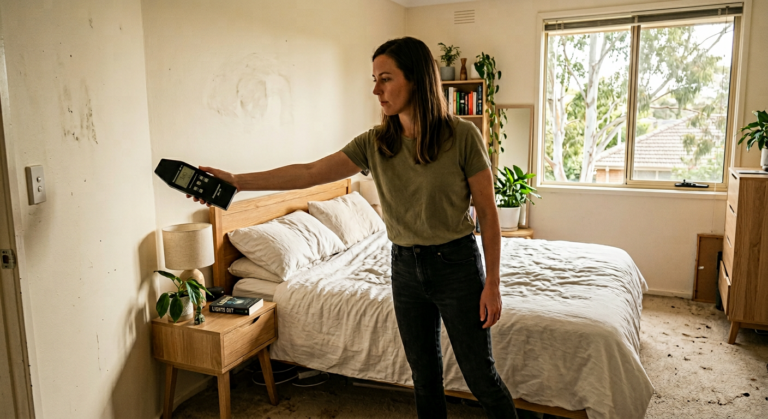
This is the step most grounding product sellers skip, and it matters. If you ground yourself while surrounded by active EMF sources, you may increase current flow through your body rather than reduce it. The correct EMF reduction sequence is: measure → remove internal sources → ground.
Practical bedroom actions that cost nothing or almost nothing:
- Phone on airplane mode — free. Eliminates the strongest RF source within 1 metre of your head.
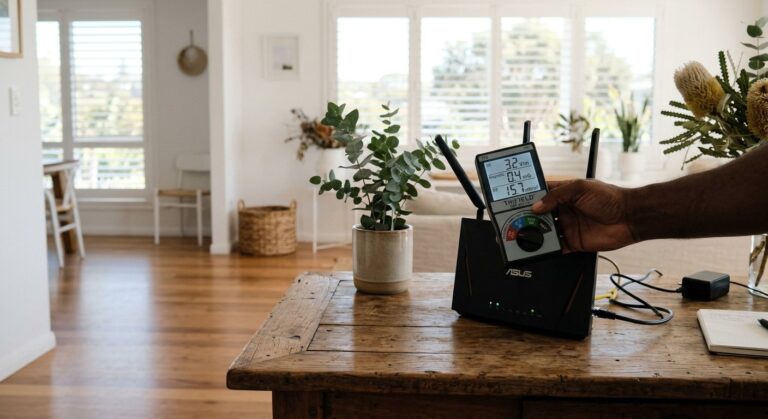
- Jackson 24hr mechanical timer (~$20) — cuts power to your Wi-Fi router during sleep hours. This eliminates the 2.4 GHz and 5 GHz RF that otherwise runs 24/7 through your bedroom walls.
- Move DECT cordless phone base stations out of the bedroom — these transmit at ~1.9 GHz continuously, even when not in use.
- Demand switch — a licensed electrician installs this on your bedroom circuit (~$100-150). It eliminates AC electric fields from wiring when no loads are drawing current.
Once internal EMF sources are addressed, a grounding sheet functions as intended: connecting you to the Earth’s potential without introducing competing current pathways.
Step 4: Give it time
The Chevalier et al. (2012) cortisol study ran for 8 weeks. Anecdotal reports from grounding sheet users typically describe initial sleep changes within the first 1-2 weeks, with more consistent effects after 4-6 weeks. This aligns with the timeframe for circadian rhythm and HPA axis recalibration. Do not expect results in two nights.
For the full grounding-for-sleep protocol including EMF measurement steps, see our dedicated guide to grounding for sleep in Australia.
Grounding Sheet vs Mat: Which Is Better for Menopause?
If you are choosing between a grounding sheet and a grounding mat, your primary symptom determines the answer.
If your main issue is sleep disruption, night sweats, or hot flushes at night: grounding sheet. The sheet provides 6-8 hours of continuous large-area skin contact during sleep — the window when cortisol should be lowest, when hot flushes peak, and when your autonomic nervous system should be in parasympathetic mode. No mat can replicate that duration or contact area.
If you also experience daytime hot flushes or work at a desk: add a grounding mat. A desk mat provides forearm or wrist contact for 4-8 hours during work. It supplements the overnight protocol but cannot replace it. The cortisol normalisation evidence from Chevalier et al. (2012) was specifically from overnight grounding.
| Feature | Grounding Sheet (Half) | Grounding Desk Mat |
|---|---|---|
| Primary use | Overnight sleep grounding | Daytime desk grounding |
| Duration of contact | 6-8 hours (full sleep cycle) | 4-8 hours (work hours) |
| Skin contact area | Large (torso, arms, legs) | Small (wrists, forearms) |
| Hot flush relevance | Night sweats — peak window | Daytime flushes only |
| Cortisol evidence | Directly tested (Chevalier 2012) | Not tested in published studies |
| Menopause priority | Primary — start here | Secondary add-on |
| Approximate cost | $100-180 AUD | $50-90 AUD |
For a full comparison of every grounding product type available in Australia — sheets, mats, pillowcases, and fitted options — see our best grounding sheets Australia 2026 guide.
Australian Grounding Products for Menopause: What to Buy
Two Australian-based grounding sheet brands stand out for menopause use. Both ship domestically, both use conductive silver-thread fabric, and both connect via the earth pin of a standard Australian power point. The key differentiator is the trial period — important when you are testing an intervention with uncertain individual results.
Premium Grounding Half Sheet — Best for overnight menopause grounding
Premium Grounding is an Australian company offering conductive silver-thread sheets designed for overnight use. The half sheet is the recommended starting point for menopausal women because it provides large-area skin contact across the torso and hip region — the epicentre of night sweats. It comes with a connection cord and Australian power point adapter for earth pin grounding. A full sheet is available for those who want whole-body coverage.
For daytime supplementation, Premium Grounding also offers a desk mat. If you experience daytime hot flushes during desk work, adding the mat to an overnight sheet protocol extends grounding contact to 12-16 hours per day. That said, start with the sheet. Night is the priority.
Earthing Oz Half Sheet — Best for sceptics (90-day trial)
Earthing Oz is an Australian-made grounding sheet brand offering a 90-day trial period — the longest trial window available from any Australian earthing supplier. For menopausal women who are understandably sceptical about an intervention with no menopause-specific RCT, the trial period eliminates financial risk. If you do not notice improved sleep or reduced hot flush frequency within 90 days, you return it.
Ninety days is also a meaningful testing window. It exceeds the 8-week protocol used in the Chevalier cortisol study and allows time for circadian and HPA axis adjustments to stabilise. This is not a 14-day trial where you barely have time to establish a baseline — it is a genuine assessment period.
Product Comparison: Australian Grounding Sheets for Menopause
| Feature | Premium Grounding Half Sheet | Earthing Oz Half Sheet |
|---|---|---|
| Country of origin | Australia | Australian-made |
| Conductive material | Silver thread woven through cotton | Silver thread woven through cotton |
| Connection method | Earth pin via AU power point | Earth pin via AU power point |
| Trial period | Standard returns policy | 90-day trial |
| Full sheet available | Yes | Yes |
| Desk mat available | Yes | Limited range |
| Best for menopause use | Women ready to commit to overnight grounding protocol | Women who want a risk-free trial before committing |
| Domestic shipping | Yes (Australia-wide) | Yes (Australia-wide) |
For a comprehensive ranking of all earthing products available in Australia — including pillowcases, fitted sheets, yoga mats, and grounding rods — see our best earthing products Australia 2026 hub.
Barefoot Grounding Outdoors: The Free Alternative
You do not need to buy anything to ground. Walking barefoot on grass, soil, sand, or concrete (not painted or sealed surfaces) achieves the same electron transfer as a conductive sheet. According to the published earthing research, 30-40 minutes of barefoot contact with the Earth’s surface is sufficient to produce measurable HRV changes (Chevalier, 2019).
For menopausal women in coastal areas of Queensland, NSW, and Western Australia, morning barefoot walks on sand or grass combine grounding with sunlight exposure — another circadian rhythm anchor that supports melatonin production and cortisol timing. Morning light through the eyes suppresses melatonin and primes the cortisol curve, while grounding addresses the HPA axis directly. It is a free, evidence-supported morning protocol.
The limitation is consistency. Australian winters (especially in Melbourne, Hobart, and Canberra) make daily barefoot outdoor grounding impractical. Rain, cold mornings, and daylight savings changes disrupt the routine. A grounding sheet maintains the overnight protocol regardless of weather or season — it is the consistency layer that barefoot grounding cannot provide.
The practical recommendation: do both. Barefoot outdoor grounding when weather and schedule allow. Grounding sheet every night, year-round. Consistency drives cortisol rhythm normalisation — not occasional bursts of contact.
EMF Reduction in the Bedroom: Why It Matters for Menopause Sleep
This is the angle most grounding product sellers ignore, and it is arguably more important than the grounding itself. Your bedroom’s electromagnetic environment directly affects sleep quality — and menopausal women with already-fragmented sleep are more vulnerable to that interference.
According to Building Biology SBM-2015 guidelines, a sleeping area should have RF exposure below 0.1 mW/m², AC magnetic fields below 0.2 µT, and AC electric fields below 5 V/m. Compare that to the ARPANSA general public limit of 10 W/m² (1,000 µW/cm²) at 2.4 GHz — a thermal-only safety limit that is 100,000 times higher than building biology sleeping area recommendations.
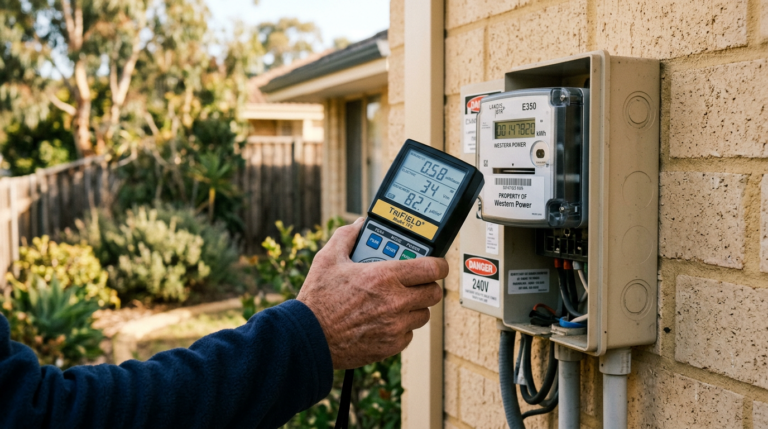
Smart meters (operating at 900 MHz on the Energex and Ausgrid networks in QLD and NSW respectively) transmit in bursts with peak readings 100-1,000 times higher than time-averaged readings. If your bedroom wall shares an exterior with your smart meter, that is measurable RF exposure during sleep. Wi-Fi routers run at 2.4 GHz and 5 GHz continuously unless disabled.
The complete EMF reduction protocol for Australian homes applies here, but the three highest-impact actions for menopausal sleep are:
- Phone on airplane mode during sleep — free, immediate
- Jackson mechanical timer on your Wi-Fi router — ~$20, eliminates overnight RF
- Demand switch on bedroom circuit — ~$100-150 installed by a licensed electrician, eliminates AC electric fields from wiring
These three actions combined cost under $200 and address the environmental factors that may be compounding menopausal sleep disruption. Do them before or alongside grounding sheet use — they are complementary, not competing interventions.
Final Verdict: Is Grounding Worth Trying for Menopause?
Yes — with clear expectations. Grounding is not a proven menopause treatment. No RCT has tested it for hot flushes or menopausal sleep disruption specifically. The cortisol and HRV evidence comes from small general-population studies.
But the physiological pathways are directly relevant. Cortisol normalisation, parasympathetic activation, and inflammation reduction are exactly the mechanisms that menopausal symptom management targets. The intervention is low-risk, low-cost (~$130 for a half sheet), requires no prescription, introduces no hormones or chemicals, and can be trialled for 90 days risk-free through Earthing Oz.
The worst outcome: you spend $130, do not notice improvement, and return it within the trial window. The more likely outcome: you start sleeping grounded alongside an EMF-reduced bedroom, and within 4-8 weeks you have measurably better sleep data — whether from a wearable tracker or simply from waking less. That data informs your next conversation with your GP or the expanding network of Australian menopause clinics.
Start with the sheet. Add the desk mat if daytime hot flushes persist. Walk barefoot when you can. And talk to a menopause specialist — grounding is a complement to care, not a substitute for it.
Last reviewed: July 2026 – Clean and Native
Start with overnight grounding. The half sheet is the foundation.
Targets cortisol, autonomic function, and thermoregulation during the 6-8 hour window when menopausal symptoms peak. If you are sceptical, the Earthing Oz 90-day trial eliminates purchase risk entirely.
Frequently Asked Questions
Can earthing stop hot flushes?
No study has tested earthing specifically for hot flushes. However, the Chevalier et al. (2012) study showed sleeping grounded normalised night-time cortisol — a hormone directly linked to hot flush triggering. Earthing may reduce the frequency or intensity of hot flushes by addressing cortisol dysregulation, but it cannot be claimed as a proven treatment.
Is grounding safe during menopause?
Grounding is considered low-risk. It introduces no chemicals, hormones, or electromagnetic radiation. The only safety consideration is electrical: test your power point earth with a multimeter before connecting a grounding sheet. If your home has faulty wiring or stray current above 0.5V AC on the earth conductor, use an outdoor ground rod instead.
Does earthing help with night sweats?
Night sweats are a vasomotor response triggered by the same cortisol-thermoregulation cascade as hot flushes. If grounding normalises night-time cortisol as the 2012 study suggests, it may reduce the frequency of the cortisol spike that triggers the thermoneutral threshold crossing. No study has measured night sweat frequency during grounding specifically.
How long before I notice sleep improvement from grounding?
Anecdotal reports describe initial changes within 1-2 weeks, with more consistent effects after 4-6 weeks. The Chevalier cortisol study ran for 8 weeks. Allow a minimum of 6-8 weeks of consistent overnight use before assessing results. Earthing Oz offers a 90-day trial, which exceeds this threshold.
Can I use a grounding sheet with an electric blanket?
Using both simultaneously is not recommended. An electric blanket generates AC electric and magnetic fields that may interfere with the grounding connection and increase current flow through the body. If you need warmth, pre-heat the bed with the electric blanket, switch it off before sleeping, and then rely on the grounding sheet for overnight use.
Is grounding a substitute for HRT?
No. Hormone replacement therapy has a substantial evidence base from large randomised controlled trials. Grounding has a small evidence base from pilot studies in general populations. If your menopausal symptoms are severe, speak with your GP or visit one of the 22+ Australian menopause clinics launching from July 2026. Grounding is a complement to medical care, not a replacement.
Which Australian earthing brand is best for menopause sleep?
Premium Grounding and Earthing Oz are the two leading Australian grounding sheet brands. Premium Grounding offers a half sheet and desk mat combination suitable for overnight and daytime grounding. Earthing Oz offers an Australian-made half sheet with a 90-day trial period — the best option for women who want to test grounding without financial risk.
Can I do earthing barefoot outside instead of buying a mat?
Yes. Walking barefoot on grass, soil, sand, or unsealed concrete provides the same electron transfer as a grounding product. Thirty to forty minutes is sufficient to produce measurable HRV changes according to published research. The limitation is consistency — weather and schedule make daily outdoor grounding impractical year-round, especially in Melbourne, Hobart, and Canberra winters. A grounding sheet provides the overnight consistency that cortisol normalisation requires.
Are grounding products TGA-approved in Australia?
No. Grounding sheets, mats, and related products are not listed on the Australian Register of Therapeutic Goods (ARTG) and are not TGA-approved medical devices. They cannot legally claim to treat, cure, or prevent any medical condition including menopause. Any product making such claims is in breach of Australian therapeutic goods advertising regulations.
Does reducing bedroom EMF help with menopause sleep?
Building Biology SBM-2015 guidelines recommend sleeping area RF exposure below 0.1 mW/m². Reducing Wi-Fi, phone, and smart meter RF during sleep may improve sleep quality by reducing electromagnetic interference with circadian and autonomic function. Three practical steps: phone on airplane mode (free), a mechanical timer on the router (~$20), and a demand switch on the bedroom circuit (~$100-150 installed). These complement grounding rather than replace it.
Get the Australian Home Environment Checklist
30 checks across water, air and EMF. Most of them free. Ranked by impact.
No spam. Unsubscribe any time.

Former Royal Australian Navy Clearance Diver and TAG-E counter-terrorism operator. Founded Clean and Native to apply the same rigorous thinking to the home environment.
Full biography →