Aussie Scientists Build Portable Water Filter
Australia’s portable water filtration market is growing fast, driven by bushfire emergencies, remote travel, and drought conditions that can strip safe drinking water access from hundreds of thousands of people in hours. Researchers at Queensland University of Technology have developed a membrane-based portable system capable of treating approximately 1,000 litres per day using solar or waste heat — a breakthrough with direct implications for emergency preparedness, rural communities, and every Australian who spends time off-grid.
The QUT Breakthrough: What It Actually Does and Why It Matters
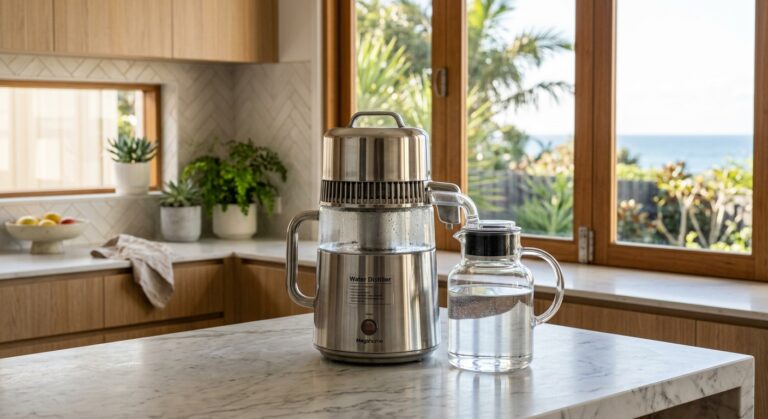
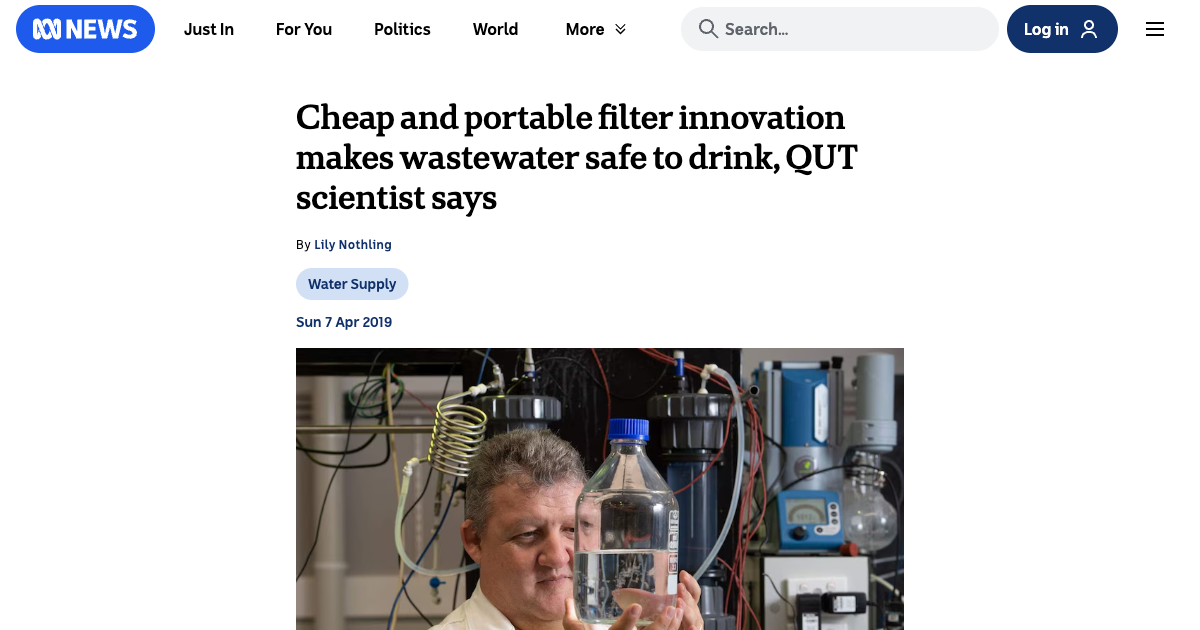
In 2019, researchers at Queensland University of Technology published details of a membrane-based water filtration system designed specifically for decentralised, off-grid treatment. The system uses a process called membrane distillation — where a hydrophobic membrane separates clean water vapour from a contaminated feed stream. The driving force is heat, not pressure, which means it can run on solar energy or industrial waste heat rather than mains electricity or diesel generators.
The published figures are significant. A single modular unit treats approximately 1,000 litres per day. Scale it to a shipping container configuration and you have a self-contained water treatment plant that can be air-dropped or trucked to a bushfire evacuation centre, a remote Indigenous community with compromised bore water, or a coastal town whose supply infrastructure has been damaged by flooding. That is not a marginal improvement. That is a category shift in emergency water response.
The technology addresses one of the persistent failures of conventional portable filtration: energy dependency. Most portable RO units require mains power or a generator. QUT’s membrane distillation approach uses low-grade heat — even the waste heat from a diesel generator running other equipment. In the context of the Black Summer bushfires (2019-2020), when power infrastructure across eastern Australia failed for weeks at a time, that distinction is critical.
As of 2026, the QUT system has not reached commercial retail. It remains a research and pilot-scale technology. That gap between “published innovation” and “available product” is where most Australians currently live — and where the practical purchasing decision has to be made with existing technology.
Australian Water Quality Standards and What Portable Filters Must Actually Meet
The Australian Drinking Water Guidelines (ADWG), published by the National Health and Medical Research Council (NHMRC), set the benchmark for safe drinking water in Australia. The 2022 update includes health-based guideline values for over 200 contaminants, including fluoride (1.5 mg/L maximum), PFAS compounds (0.00007 mg/L for PFOA), total dissolved solids (600 mg/L aesthetic guideline), and disinfection byproducts including chloramine.
Here is what most portable filter marketing never tells you: the disinfection method used by your city determines which portable filter technology actually works for you.
Chloramine vs Free Chlorine — the Most Important Fact in Australian Water Filtration
Brisbane and south-east Queensland (SEQ Water), Sydney (Sydney Water), Adelaide (SA Water), the Gold Coast, and Darwin use chloramine as their primary disinfection agent. Melbourne (Melbourne Water), Hobart, Canberra, Townsville, Cairns, and Toowoomba use free chlorine.
This distinction is not academic. Standard granular activated carbon (GAC) filtration — the technology inside most portable gravity filters, filter jugs (including Brita), and basic benchtop units — removes free chlorine effectively. It removes chloramine at approximately 1/40th the rate. That means a standard portable carbon filter used in Brisbane or Sydney is not providing meaningful protection against your city’s primary disinfection chemical.
Chloramine removal requires one of three approaches: catalytic carbon (a modified carbon with higher surface reactivity), compressed carbon block (much higher contact time than GAC), or reverse osmosis membrane filtration. In an emergency scenario — a bushfire that contaminates a water main, a flood event that introduces sediment and biological load into a supply network — the difference between these technologies determines whether you are drinking safe water or not.
Fluoride: What Portable Filters Can and Cannot Do
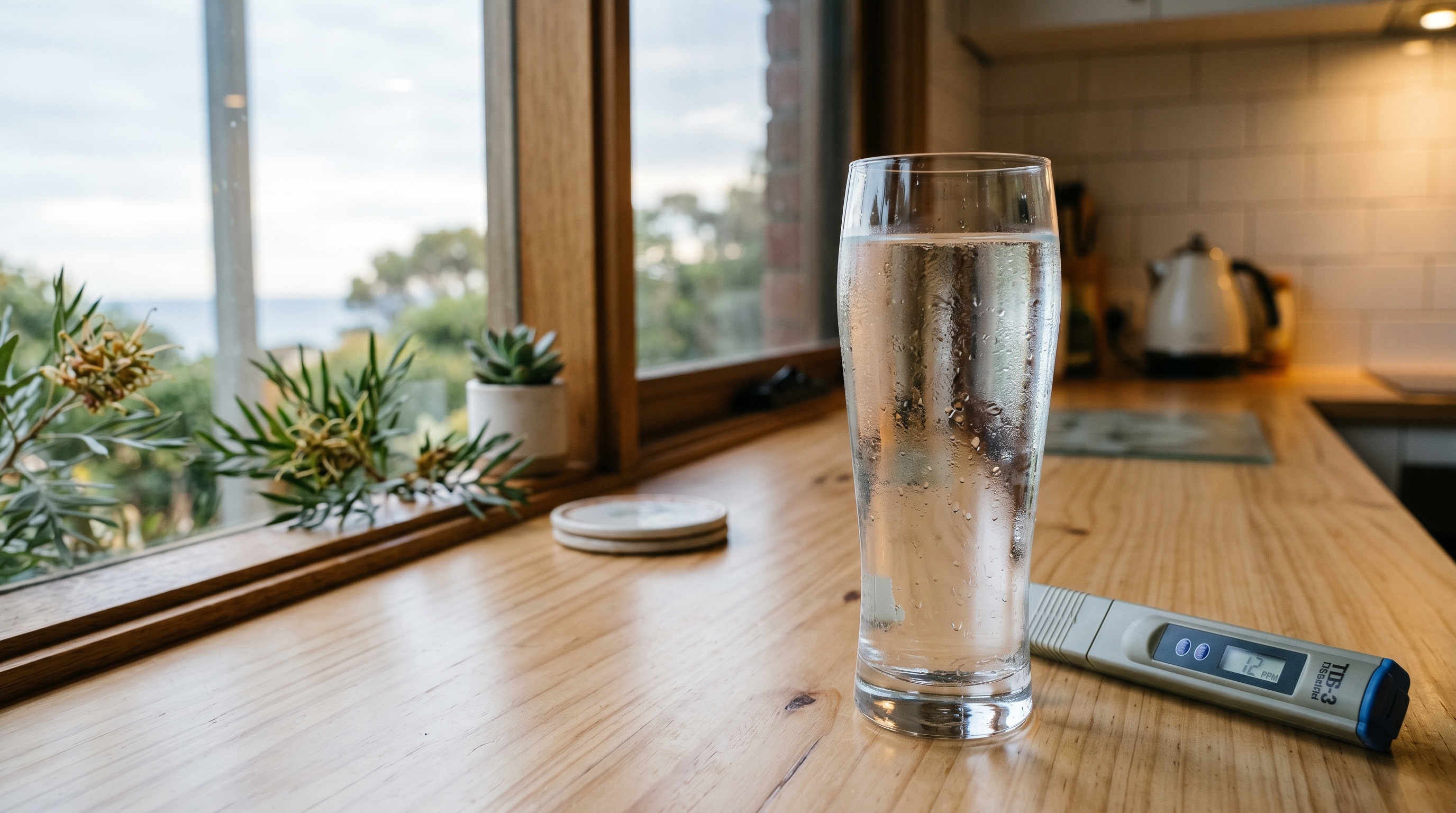
Australian capital cities fluoridate their water supplies at a target of approximately 0.6-1.0 mg/L, consistent with NHMRC recommendations for dental health. The ADWG sets a health-based maximum of 1.5 mg/L. If fluoride removal is your priority, there are only two technologies that achieve it: reverse osmosis (90-97% rejection) and activated alumina media (80-95% rejection at correct pH).
Carbon filters — including catalytic carbon, compressed carbon block, and ceramic filters — cannot remove fluoride. Gravity-fed systems using activated alumina as a separate stage can, but that specific media must be confirmed in the product specifications. Do not assume any portable filter removes fluoride without checking the NSF/ANSI 58 test data or the manufacturer’s independent laboratory report.
PFAS Contamination: The Hidden Emergency Driver
According to the DCCEEW national contamination register, PFAS contamination has been confirmed at more than 700 sites across Australia — predominantly around military bases, airports, and industrial corridors, but with groundwater plumes extending into residential bores and town supplies in some areas. Perth’s Kwinana industrial corridor and communities around RAAF Base Williamtown in NSW are among the highest-profile cases. Reverse osmosis removes PFAS at 90-97% rejection rates. No carbon-based portable filter achieves meaningful PFAS reduction.
Portable Water Filtration in Bushfire and Drought Emergencies: The Real Australian Scenario
The TechSci Research market analysis on Australia’s water purifier sector identifies three specific demand drivers: a strong outdoor culture, frequent bushfire events, and remote travel trends. All three converge in a single profile — the Australian who needs safe water when the infrastructure either doesn’t exist or has just been destroyed.
During the Black Summer bushfires of 2019-2020, the NSW Rural Fire Service and state emergency services issued water safety notices across multiple affected local government areas. The concern was not just loss of supply — it was contamination. Bushfire smoke and ash introduce hydrocarbons, heavy metals (including arsenic and lead from structural debris), and biological load into water systems. A filter rated for taste improvement is not a filter rated for post-disaster water safety.
What Contamination Actually Looks Like After a Bushfire
Research published in the journal Science of the Total Environment documented benzene contamination in plastic water supply pipes following the 2017 Tubbs and Nuns fires in California at levels exceeding 2,000 micrograms per litre — against a US EPA guideline of 5 micrograms per litre. Australian fire agencies have flagged the same risk profile for PVC supply infrastructure in areas like the Blue Mountains, Adelaide Hills (affected by the 2019-20 fires), and coastal NSW. Carbon filters can adsorb benzene. RO membranes provide a more complete barrier.
During drought conditions — as experienced across most of eastern Australia between 2017 and 2020 — reduced water flow in supply networks increases contact time between water and pipe materials, and can concentrate disinfection byproducts including trihalomethanes (THMs). The ADWG sets a guideline of 0.25 mg/L for total THMs. RO removes THMs at the membrane level.
The Cost Reality: Emergency Preparedness vs Ongoing Use
A countertop RO unit like the AquaTru Classic costs approximately $699 Australian. Run it at 4 litres per day for a family of four, replacing filters per manufacturer schedule, and your per-litre cost over five years is approximately $0.04 to $0.06/L. Bottled water at a supermarket runs $1.50-2.00/L for bulk 10L containers — and in an emergency, often more. During the 2019-20 bushfire season, bottled water sold out in multiple regional towns within 48 hours of water quality notices being issued.
The mental accounting is simple: a countertop RO unit is not just a convenience purchase. For households in bushfire-prone areas of NSW, Victoria, and QLD — or in communities adjacent to known PFAS contamination plumes — it is an infrastructure decision.
Best Portable Water Filters for Australian Conditions
Choosing a Portable Filter That Meets Australian Standards Right Now
As a former Royal Australian Navy Clearance Diver, I’ve operated in environments where water quality went from “this tastes bad” to “this will kill you” without warning. The discipline is the same whether you’re field-planning a dive operation or choosing a household filter: know your contaminant profile first, then select the technology that addresses it. Not the other way around.
The decision tree for portable water filtration in Australia comes down to three questions. First: can you connect to a power source or plumb under a bench? Second: which city, and therefore which disinfectant? Third: is your concern ongoing daily use, emergency preparedness, or travel?
Decision Framework: Portable Filtration for Australian Conditions
3-Question Decision Tree
Q1: Can you modify your kitchen bench or plumbing?
No plumbing access → Countertop RO (AquaTru Classic)
Plumbing available → Under-sink RO (PWS EcoHero 5-Stage)
Q2: Which city?
Brisbane / Sydney / Adelaide / Gold Coast / Darwin → Chloramine present. Requires RO or catalytic carbon block. Standard carbon filters fail.
Melbourne / Hobart / Canberra / Townsville / Cairns → Free chlorine. Catalytic carbon or standard carbon block works for taste/odour.
Q3: Primary concern?
PFAS / fluoride / chloramine → Reverse osmosis only
Bacteria + viruses (tank water, bore water) → UV + RO
Emergency preparedness → Countertop RO (no plumbing dependency) + stored filter media
The Countertop RO Case: No Plumbing, No Compromise
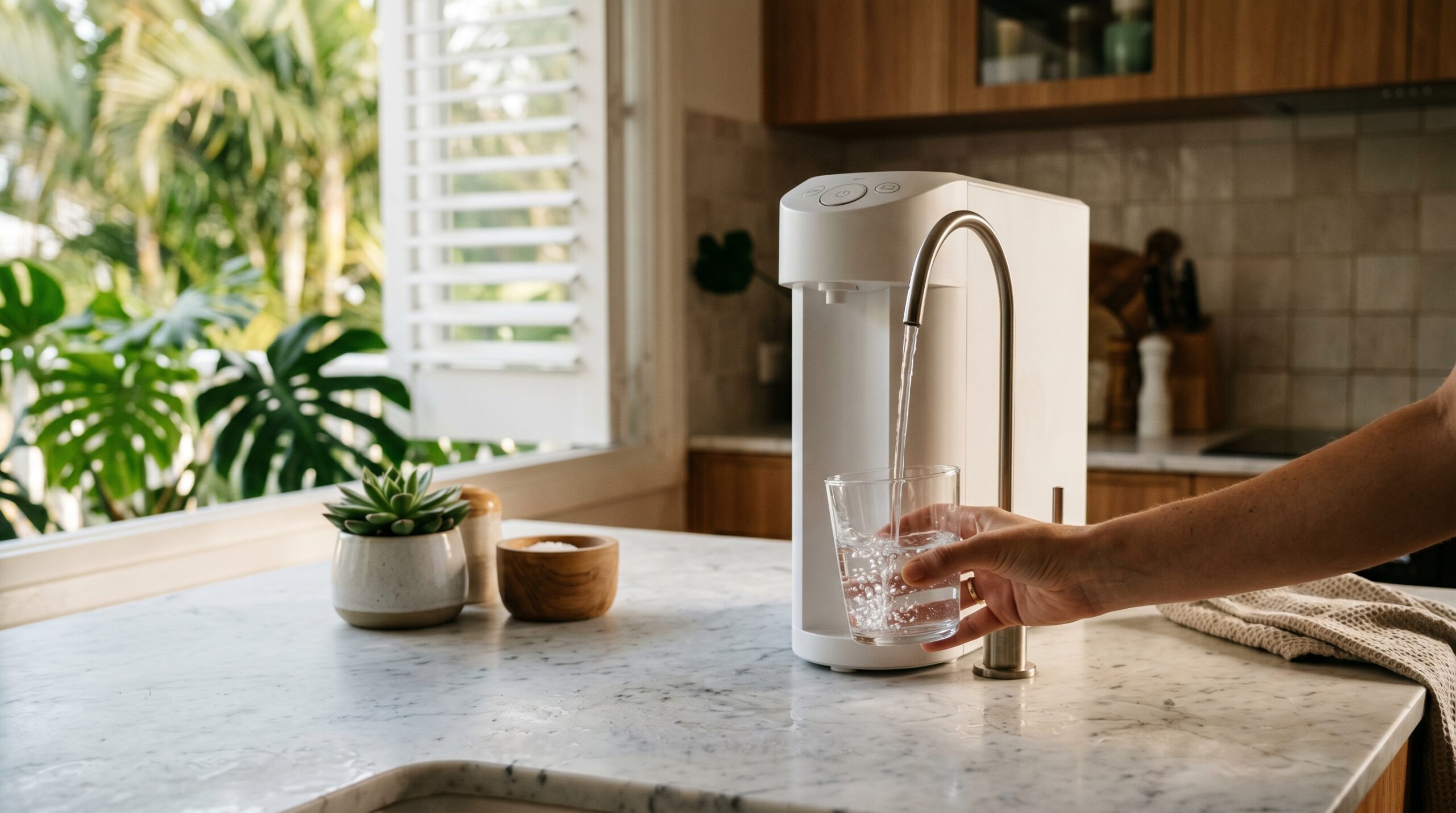
The AquaTru Classic is the strongest current answer for Australians who need genuine portable filtration without permanent installation. It sits on a bench, connects to no plumbing, and uses a four-stage process: pre-filter (sediment), activated carbon block (chloramine, VOCs, taste), RO membrane (fluoride, PFAS, heavy metals, nitrates), and a polishing carbon stage. Independently verified removal rates include 99.9% for lead, 97.7% for PFAS, and 93.5% for fluoride under NSF/ANSI P473 and NSF/ANSI 58 testing protocols.
It produces approximately 19 litres per day in a household setting. That is not 1,000 litres per day like the QUT system — but it is available today, independently certified, and operates on standard 240V power. For the Brisbane household that wants to stop buying bottled water, or the Penrith family preparing for the next fire season, it is the practical answer.
The Under-Sink RO Case: Permanent, Higher Throughput
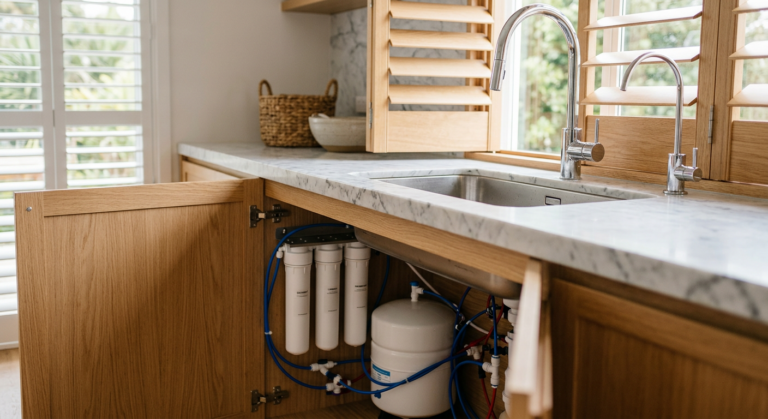
The PWS EcoHero 5-Stage RO is WaterMark certified to AS3497 — the Australian standard for water supply fittings — and NSF 58 certified for contaminant reduction. It handles the full contaminant profile: chloramine via the carbon block stage, fluoride and PFAS via the RO membrane, and biological risk via the post-filter stage. Throughput is higher than countertop units, and ongoing filter costs are lower per litre at scale. The trade-off is that it requires a licensed plumber for installation and is not portable in any meaningful sense — it is a fixed household infrastructure investment.
What the QUT Innovation Will Eventually Enable
When QUT’s membrane distillation technology reaches commercial scale, it fills a gap that current retail products cannot: high-volume, low-energy treatment in actually off-grid conditions. Think rural Queensland properties running off solar, remote Northern Territory communities with compromised bore infrastructure, and rapid-deployment emergency response at bushfire evacuation centres. The shipping container scalability noted in the ABC News coverage suggests the primary application is not consumer retail but emergency management and remote community infrastructure. That is exactly where it is needed most.
5-Year Cost Comparison: Portable and Semi-Portable Options for Australian Homes
5-Year Total Cost of Ownership — Portable/Semi-Portable Water Filtration, Australia
Assumes 4L/day household consumption; AUD pricing; filter replacement per manufacturer schedule.
Formula: Unit price + (annual filter cost x 5). Bottled water: $1.50/2L x 4L/day x 365 x 5 = $5,475. Berkey Royal: ~$600 unit + ~$178/yr filters. AquaTru: ~$699 unit + ~$134/yr filters. PWS EcoHero: ~$509 unit + ~$128/yr filters (excludes plumber install ~$150). Sources: Amazon AU, Pure Water Systems AU. Bar fill #3A8A5A = top pick (AquaTru); #1A3326 = peer products. Note: Berkey gravity filter uses carbon filtration only — does not remove chloramine in Brisbane/Sydney/Adelaide/Gold Coast/Darwin.
The numbers make the decision easier. Bottled water over five years at modest consumption costs nearly four times the total cost of ownership for a countertop RO unit. The AquaTru Classic produces water at approximately $0.04/L at that consumption rate. That is not a trivial saving — it is approximately $4,100 over five years compared to bottled water, and you get better contaminant removal in the process.
Note the Berkey gravity filter figure. At $1,490 over five years, it is cheaper than bottled water but more expensive than RO on a per-litre basis when you factor in the filter replacement schedule. More critically, the Berkey uses carbon block and ceramic filtration. In Brisbane, Sydney, Adelaide, Gold Coast, and Darwin — chloramine cities — it does not provide meaningful protection against your primary disinfectant. If you are in Melbourne, Hobart, or Canberra, the Berkey is a legitimate choice. If you are in Brisbane, it is not.
The Path From Lab to Litre: How QUT’s Innovation Reaches Australian Communities
The gap between a published university research outcome and a product in a hardware store is usually five to ten years in the water treatment sector. The QUT membrane distillation system was published in 2019. As of 2026, the commercialisation path appears to be directed at institutional and emergency management applications rather than consumer retail — and that makes strategic sense.
Australia’s emergency water response has historically relied on bottled water airlifts and tanker trucks. Both are logistically expensive and environmentally costly. A solar-powered, containerised system capable of treating 1,000 litres per day from contaminated surface water changes the calculus for State Emergency Service pre-positioning ahead of declared bushfire seasons. The Queensland Government has specific provisions under the Disaster Management Act 2003 for pre-deployed resources — QUT’s system fits that framework more naturally than a consumer filter unit.
The Remote Community Application
The Northern Territory has 72 communities that rely entirely on bore water or surface water catchments with no connection to a reticulated supply network. According to the NT Department of Housing, Urban Development and Land, water quality compliance in remote communities has been a persistent issue, with some communities receiving boil water advisories for months at a time. A system that runs on solar and processes 1,000 litres daily is precisely scaled for a community of 200-300 people at typical daily consumption rates of 3-4 litres per person for drinking and cooking.
The TechSci Research analysis of Australia’s portable water purification market identifies remote community infrastructure as a distinct demand segment alongside outdoor recreation and emergency preparedness. QUT’s technology addresses the infrastructure segment. Current retail products address the recreation and household segments. Neither fully addresses both — yet.
What Australian Consumers Should Do Now
The honest answer is that waiting for QUT’s technology to reach retail is not a preparedness strategy. Bushfire season in NSW, Victoria, and QLD runs October through March. Drought conditions across southern Queensland and inland NSW are a near-permanent feature of Australian climate. The 2021-22 La Niña flooding contaminated water supplies across Queensland and northern NSW. The 2019-20 fire season did the same in the south-east. These are not hypothetical scenarios.
If you are in a bushfire-prone area, or in a city on chloramine (Brisbane, Sydney, Adelaide, Gold Coast, Darwin), the practical step is a countertop or under-sink RO unit now. When QUT’s membrane system reaches institutional deployment, it will be relevant for emergency management agencies and remote communities. It will not replace the household decision you need to make today.
Last reviewed: June 2026 — Clean and Native
Final Verdict
QUT’s portable membrane distillation system is the most important Australian water filtration innovation published in the last decade — but it is not available to buy today. For Australian households in chloramine cities (Brisbane, Sydney, Adelaide, Gold Coast, Darwin), the AquaTru Classic countertop RO remains the only portable filtration option that independently removes chloramine, fluoride, PFAS, lead, and disinfection byproducts simultaneously without requiring plumbing. Households with plumbing access get better long-term value from the PWS EcoHero 5-Stage under-sink RO, WaterMark-certified and built for Australian supply chemistry.
Ready to filter your water?
The AquaTru Classic is the top-rated countertop RO for Australian homes — no plumbing required, NSF/ANSI 58 and P473 certified, removes fluoride, PFAS, lead, and chloramine. For under-sink installation, the PWS EcoHero 5-Stage is WaterMark AS3497 certified and built for Australian supply chemistry.
Frequently Asked Questions
Researchers at Queensland University of Technology developed a membrane distillation system that uses solar energy or industrial waste heat to drive water treatment. A single unit processes approximately 1,000 litres per day, and the system is designed to scale to shipping container size for deployment to remote communities or emergency scenarios. It has not yet reached commercial retail as of 2026.
Brisbane and all of south-east Queensland use chloramine as their primary disinfectant. SEQ Water adds chloramine rather than free chlorine to reduce trihalomethane formation in the distribution network. Standard activated carbon filters — including filter jugs and most portable gravity filters — remove chloramine at approximately 1/40th the rate they remove free chlorine, making them largely ineffective for this application. You need catalytic carbon, compressed carbon block, or reverse osmosis.
Only reverse osmosis (90-97% rejection) and activated alumina media (80-95%) remove fluoride. Activated carbon filters — including catalytic carbon, gravity ceramic filters, and filter jugs — cannot remove fluoride regardless of claims about “comprehensive filtration”. Always check for NSF/ANSI 58 certification, which specifically tests fluoride rejection at the membrane level.
A countertop reverse osmosis unit is the strongest choice because it requires no plumbing, runs on standard 240V power, and removes the full contaminant profile introduced by bushfire contamination events — including benzene, heavy metals, and biological load — not just taste compounds. The AquaTru Classic is NSF/ANSI P473 certified and does not require a plumber to install. Store a second set of replacement filter cartridges as part of your emergency kit.
The AquaTru Classic is compatible with 240V/50Hz power, which is the Australian standard. It requires a standard three-pin Australian power point. No transformer or converter is needed. Confirm with the seller that the unit shipped to Australia includes a compatible power adapter.
For plumbed systems installed under a sink, look for WaterMark certification to AS3497 (water supply fittings). For contaminant reduction performance, NSF/ANSI 58 certification is the applicable standard for reverse osmosis systems. NSF/ANSI P473 specifically covers PFAS (PFOA and PFOS) removal. The Australian Drinking Water Guidelines (ADWG) published by the NHMRC set the health-based targets these certifications test against.
Sydney Water treats to the Australian Drinking Water Guidelines and the water meets all regulatory requirements at the point of delivery. However, PFAS contamination has been detected in some Sydney basin catchment areas, and the supply uses chloramine as a disinfectant. If your concern is PFAS, fluoride, or chloramine byproducts, an RO filter is the appropriate additional measure. The water is not dangerous without a filter — but it is also not equivalent to RO-filtered water on those parameters.
Bottled water in Australia costs approximately $1.50-2.00 per litre at supermarket bulk pricing. The AquaTru Classic RO at $699 with annual filter costs of approximately $134/year produces water at around $0.04-0.06 per litre at 4 litres per day household consumption over five years. That is a saving of approximately $4,000 over five years compared to bottled water for a modest household — while providing better documented contaminant removal.
There is no confirmed retail release date for the QUT membrane distillation system as of June 2026. The technology appears to be targeting institutional applications — emergency management agencies and remote community infrastructure — rather than consumer retail. University technology commercialisation in the water treatment sector typically takes five to ten years from publication to scaled deployment. The 2019 ABC News publication date suggests a realistic commercial deployment window of 2025-2029 for institutional applications.
Get the Australian Home Environment Checklist
30 checks across water, air and EMF. Most of them free. Ranked by impact.
No spam. Unsubscribe any time.

Former Royal Australian Navy Clearance Diver and TAG-E counter-terrorism operator. Founded Clean and Native to apply the same rigorous thinking to the home environment.
Full biography →