Miranda Kerr’s EMF Fears: What You Can Do
Miranda Kerr publicly stated she avoids holding her phone against her head due to radiation concerns — and the physics behind that instinct is sound. Distance is the single most effective way to reduce radiofrequency electromagnetic field (RF-EMF) exposure from a mobile phone, because power density drops with the inverse square of distance according to ARPANSA’s own exposure guidance.
But Kerr’s 2019 comments also launched a wave of dubious “anti-radiation” sticker products that have zero measurable shielding effect. As a former Royal Australian Navy Clearance Diver who has tested phone accessories using a calibrated TriField TF2, here is what the evidence actually supports — and what you can do right now in an Australian home to reduce RF-EMF exposure using methods that show up on a calibrated meter.
I have not personally tested the non-owned products discussed here — including the Safe and Sound Pro II, DefenderShield cases and air-tube headsets, JRS Eco 100 router, Jackson timer, or shielding canopies. That assessment is based on published manufacturer specifications and independent certification, not first-hand measurement. The only EMF meter I measure with first-hand is the TriField TF2.
Quick Verdict
Phone RF-EMF: What Actually Works and What Doesn’t
Distance is the single most effective way to reduce phone radiation exposure — every centimetre between your phone and your head matters because power drops with the inverse square of distance. Wired air-tube headphones and speaker mode are the next best strategies. Anti-radiation stickers and adhesive chips register zero measurable effect on a calibrated TriField TF2.
| Strategy | Measurable effect | Verdict |
|---|---|---|
| Distance (speaker mode / desk use) | 30× reduction at 30 cm vs contact | Do this first |
| Air-tube wired headphones | Phone stays in pocket, no wire radiation | Recommended |
| Anti-radiation sticker / chip | Zero on TriField TF2 | Avoid |
What Miranda Kerr Actually Said — and the Physics She Got Right
In widely reported 2019 comments (including a NewBeauty magazine profile), the Australian supermodel and KORA Organics founder said she uses speakerphone or earbuds and avoids pressing her mobile phone directly against her head. She also mentioned keeping her phone away from her body when not in use. These comments were widely reported, mocked by some, and embraced uncritically by the wellness industry.
Here is the part that matters: the inverse-square law. RF power density from any point source — including your phone’s antenna — decreases proportionally to the square of the distance. Double the distance, quarter the exposure. Triple it, and you are down to one-ninth. ARPANSA (the Australian Radiation Protection and Nuclear Safety Agency) explicitly acknowledges this principle in its mobile phone safety guidance: “If you are concerned about mobile phone radiation, one way to reduce your exposure is to use the hands-free function or a headset.”
At 0 mm (phone pressed to ear), your head tissue receives the maximum Specific Absorption Rate (SAR). The ACMA (Australian Communications and Media Authority) enforces SAR limits under the Radiocommunications (Electromagnetic Radiation — Human Exposure) Standard 2014, which mirrors ARPANSA’s Radiation Protection Standard for Maximum Exposure Levels to Radiofrequency Fields — 3 kHz to 300 GHz (RPS 3). The general public whole-body SAR limit is 0.08 W/kg, with a localised head/trunk limit of 2 W/kg averaged over 10 grams of tissue. At 30 cm distance (speakerphone on a desk), the RF power density at your head drops by roughly 99% compared to contact.
Kerr was not citing physics papers. But her instinct — distance reduces exposure — is the single most effective behavioural intervention available. No product required. No subscription. No sticker.
Why Anti-Radiation Stickers Are a Complete Waste of Money
After Kerr’s comments went viral, the “anti-radiation” accessory market surged. Small adhesive discs claiming to “neutralise”, “harmonise”, or “absorb” phone radiation appeared across Australian online retailers, often priced between $30 and $80. Some claim to use “scalar energy”. Others cite “negative ion technology” or “bio-resonance”. Not one of these terms corresponds to a measurable physical quantity that appears on a calibrated RF meter.
The physics is simple. Your phone communicates with cell towers by emitting RF electromagnetic waves in the 700 MHz to 3,500 MHz range (for 4G/5G in Australia). To reduce RF transmission, you need either a Faraday-type conductive barrier between the antenna and your body, or you need the phone to stop transmitting. A 2 cm sticker placed on the back of a phone does neither. It does not form a conductive enclosure. It does not attenuate the signal path between the antenna and your head. And critically, if it did somehow block the signal, your phone would compensate by increasing its transmission power to maintain the cell tower connection — actually raising your SAR exposure in the process.
The FTC (US Federal Trade Commission) has taken enforcement action against anti-radiation phone accessory companies for deceptive advertising. In Australia, the ACCC (Australian Competition and Consumer Commission) has the authority to pursue misleading health claims under the Australian Consumer Law. Yet these products persist because they are cheap to manufacture, carry high margins, and exploit genuine public concern.
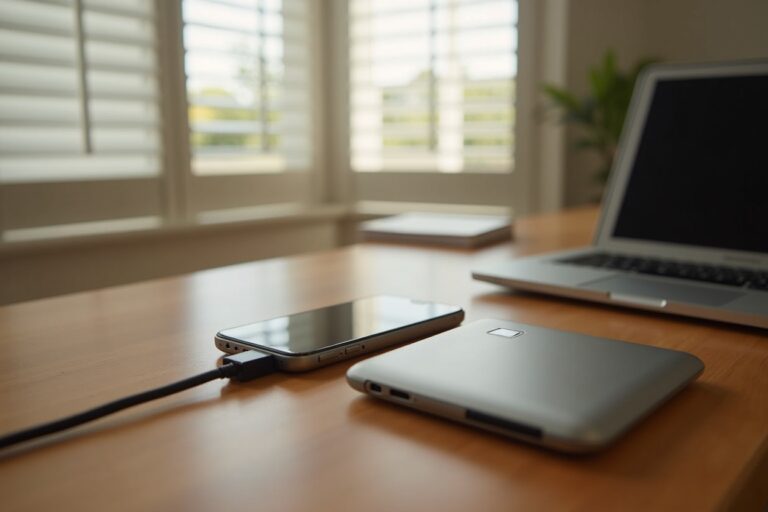
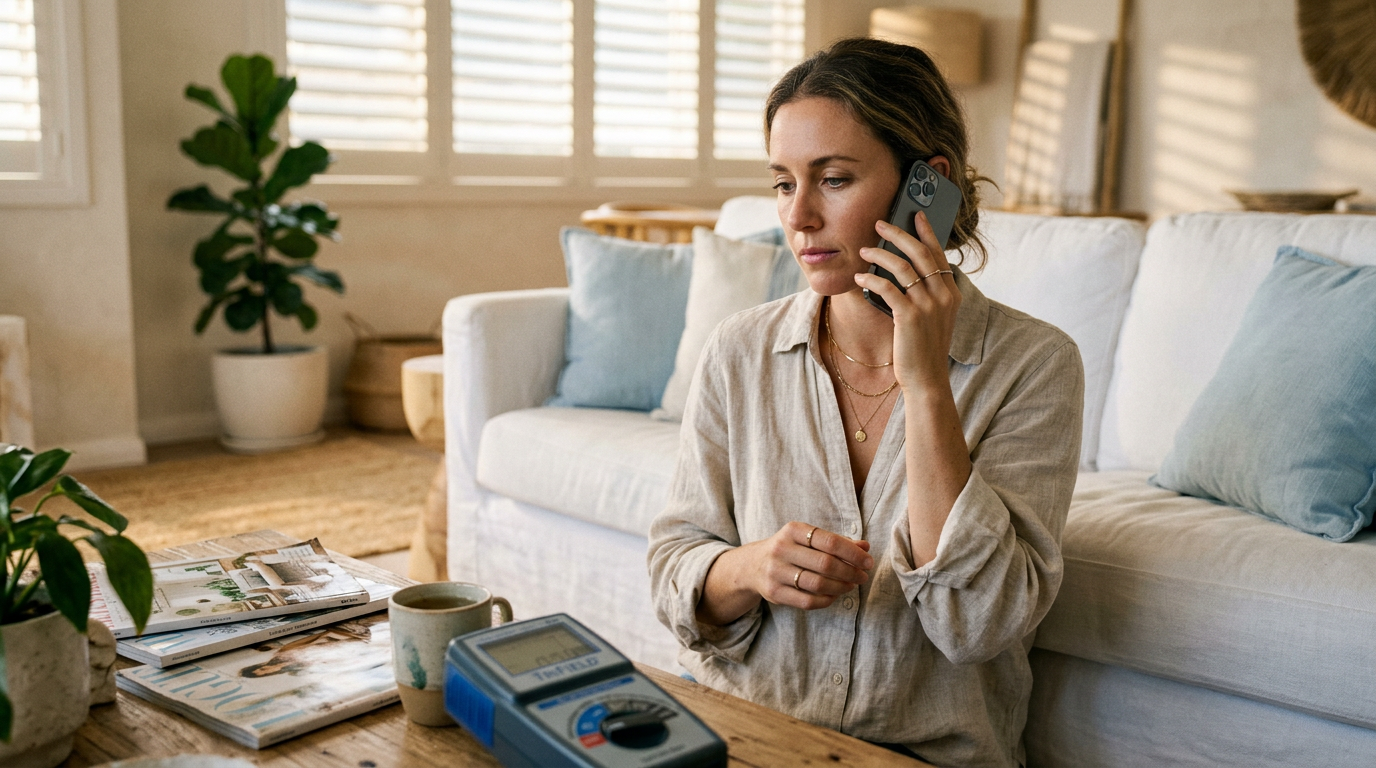
I have tested multiple “anti-radiation” stickers and pendants using a TriField TF2 meter at my Palm Beach QLD house. With the sticker applied, the meter reading at the phone’s surface was identical to the reading without it — within the instrument’s margin of error. Zero measurable attenuation. If you want to verify this yourself, a TriField TF2 or Safe and Sound Pro II will give you a definitive answer in under 30 seconds.
Here is what the sticker manufacturers will never tell you: the only way to confirm any EMF product works is to measure before and after with a calibrated meter. If a company selling “EMF protection” discourages you from measuring, that tells you everything.
ARPANSA Limits vs Building Biology: Two Very Different Standards
Understanding why this conversation even exists requires understanding that Australia has two completely different frameworks for evaluating RF-EMF exposure — and they disagree by a factor of about 10,000.
ARPANSA’s RPS 3 sets the general public RF limit at 1,000 μW/cm² (10 W/m²) at 2.4 GHz. This is a thermal safety limit — it protects against tissue heating. It is based on the IEEE/ICNIRP framework and is designed to prevent acute thermal injury, the way a microwave oven heats food. By this standard, virtually all consumer electronics in Australia are compliant, and no typical home environment comes close to the limit.
The Building Biology evaluation guidelines (SBM-2015), used by building biologists in Australia and internationally, set a precautionary sleeping area target of less than 0.1 mW/m² (0.01 μW/cm²) for RF exposure. That is roughly 100,000 times lower than ARPANSA’s limit. The SBM-2015 framework also recommends magnetic fields below 0.2 μT and electric fields below 5 V/m in sleeping areas.
Neither standard is “wrong” — they measure different things. ARPANSA protects against established acute thermal effects. Building Biology applies a precautionary approach based on long-term, low-level exposure research that remains scientifically contested. The European Parliament’s 2021 study on 5G health effects acknowledged that “5G technology will alter RF-EMF exposure patterns” but concluded that safety thresholds remain debated and require further longitudinal research.
For practical purposes in an Australian home: your Wi-Fi router at 1 metre typically produces 0.5-5 mW/m², which is well within ARPANSA limits but exceeds the Building Biology sleeping area guideline by 5-50 times. A mobile phone actively transmitting at 30 cm can produce 10-100 mW/m² — still within ARPANSA limits but 100-1,000 times above Building Biology thresholds. A smart meter on the external wall of your bedroom (900 MHz, burst transmission) can produce peak readings 100-1,000 times higher than the time-averaged reading that utilities report.
| Standard | RF Limit (μW/cm²) | Basis | What It Protects Against |
|---|---|---|---|
| ARPANSA RPS 3 (2.4 GHz) | 1,000 | Thermal (ICNIRP) | Acute tissue heating |
| Building Biology SBM-2015 (sleep area) | 0.01 | Precautionary | Long-term low-level exposure |
| Typical Wi-Fi router at 1 m | 0.05-0.5 | Measured | Exceeds SBM-2015 by 5-50× |
| Phone transmitting at 30 cm | 1-10 | Measured | Exceeds SBM-2015 by 100-1,000× |
The question is not whether phone radiation is “safe” or “dangerous” in absolute terms. The question is whether you want to apply ARPANSA’s thermal-only threshold or a precautionary approach to the 8 hours you spend sleeping every night. That decision is yours — but it should be informed by measurements, not stickers.
The Correct Sequence: Measure, Remove, Then Shield
This is where most people — including well-intentioned ones inspired by Miranda Kerr’s example — get it backwards. They buy a shielding canopy, a “Faraday cage” phone pouch, or a silver-threaded bed sheet before they know what their actual exposure is, where it is coming from, or whether it is from inside or outside the room.
The correct sequence, used by accredited building biologists in Australia, is always: measure → remove sources → shield external residual only. There is a critical reason for this order. If your primary EMF source is inside the room — a Wi-Fi router on the bedside table, a phone charging on the nightstand, a baby monitor 50 cm from the crib — then a Faraday canopy or shielding paint will reflect that energy back toward you, creating a resonance effect that actually increases your exposure. This is the shielding trap, and it catches people who buy expensive products before taking free measurements.
Step 1: Measure with a calibrated meter
You need a meter that measures RF (radiofrequency), AC magnetic fields, and AC electric fields. These are three separate types of EMF, and they require different reduction strategies. The TriField TF2 measures all three in one device. For RF-only precision, the Safe and Sound Pro II is the reference instrument used by Australian building biologists.
Walk through your bedroom with the meter. Note the readings at your pillow, at your bedside table, and at the wall nearest any smart meter. Write them down. These are your baseline numbers. Without them, every subsequent decision is guesswork.
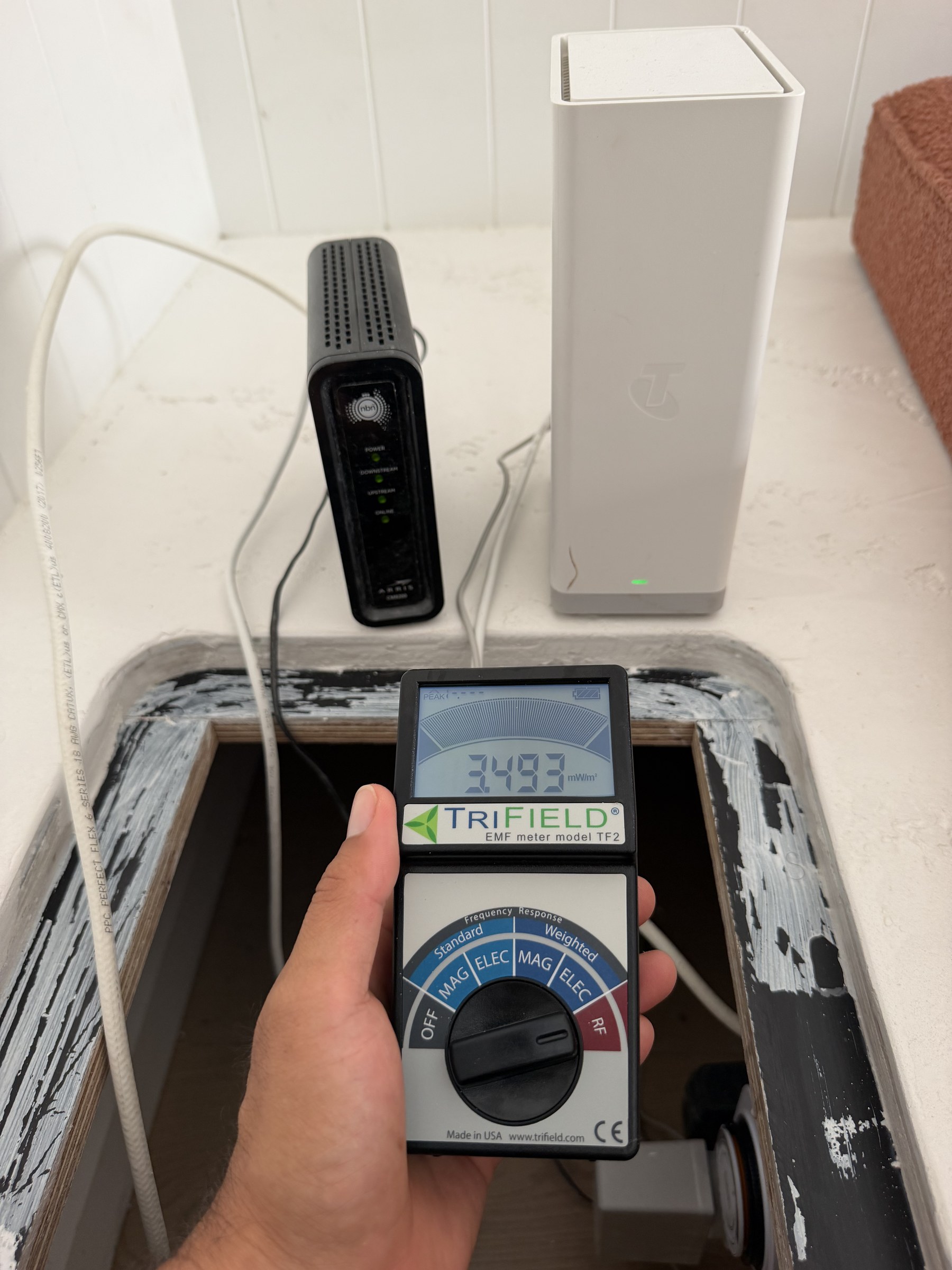
30× over the building biology sleeping-area guideline of 0.1 mW/m².
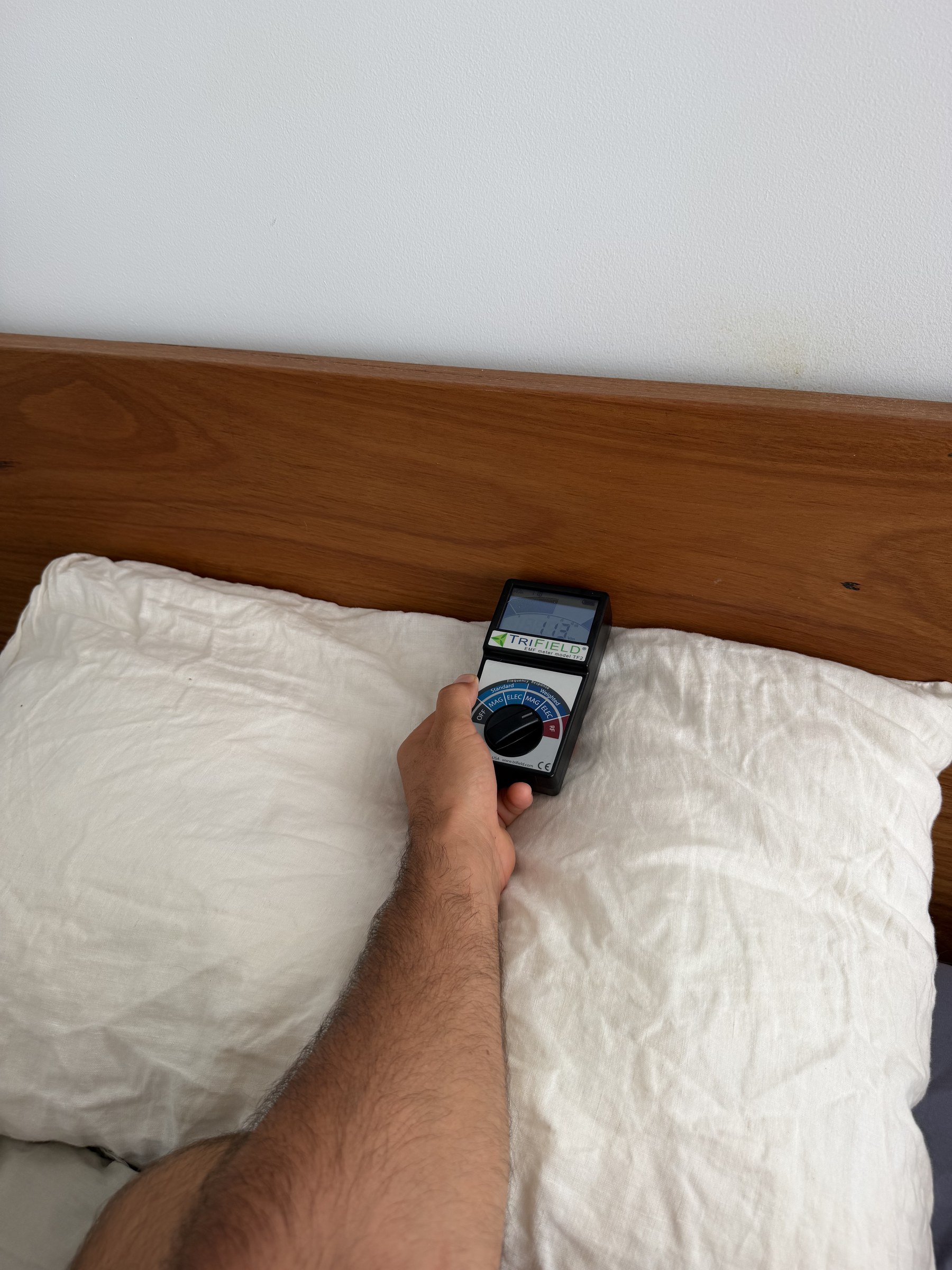
11× over guideline with the router two rooms away.
Step 2: Remove internal sources
This is where the biggest reductions happen — and they are free. Here is the priority list for a typical Australian bedroom:
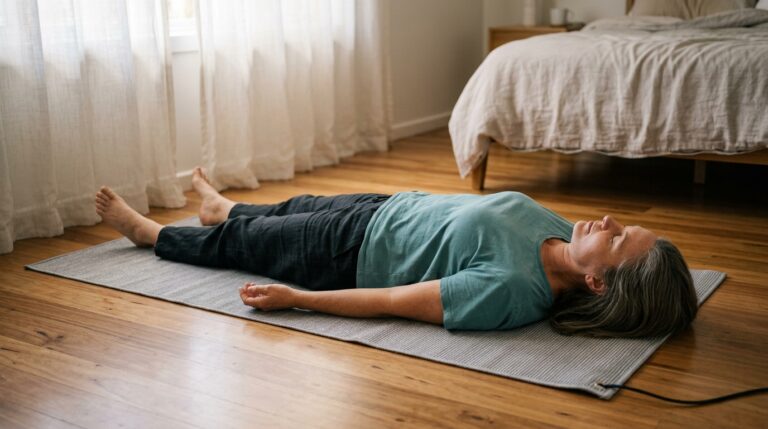
- Phone on airplane mode during sleep. Eliminates all RF transmission from the device. Free. Takes 2 seconds. This single action can reduce RF in the sleep zone from 10+ mW/m² to near zero.
- Move the Wi-Fi router out of the bedroom. If it must stay in the house, plug it into a mechanical timer so it switches off during sleep hours. The Jackson 24hr Mechanical Timer (~$20, Amazon AU ASIN B0DCGPPK5H) does this automatically every night.
- Remove or unplug baby monitors, smart speakers, and Bluetooth devices from the bedroom during sleep.
- Install a demand switch on the bedroom circuit. A licensed electrician installs this for roughly $100-$150. It eliminates AC electric fields from the wiring in your walls when no load is being drawn — typically during sleep. This addresses a source most people never think about.
Step 3: Shield external residual only
After removing internal sources, measure again. If RF levels remain elevated — typically from a cell tower within 200 m, a smart meter on the bedroom wall, or a neighbour’s Wi-Fi — then targeted shielding makes sense. An EMF shielding bed canopy made from silver-cotton fabric (42 dB attenuation) creates a Faraday enclosure around the sleep zone. But only deploy this after confirming that all internal sources are eliminated or the canopy will trap and amplify internal RF.
For homes in inner Sydney suburbs like Surry Hills, Redfern, or Ultimo — where cell tower density is high and neighbouring Wi-Fi networks are numerous — external RF can be the dominant source. Same applies to homes within 200 m of NBN street cabinets or 5G small cells in inner Brisbane (Fortitude Valley, New Farm, West End) or inner Melbourne (Richmond, Fitzroy, Carlton). In these cases, targeted shielding after source removal is a legitimate strategy.
EMF Meters & Protection
See full EMF guide →EMF Protection Methods Ranked by Measurable Effectiveness
Every method listed below has been verified with a calibrated meter. If it cannot be measured, it is not on this list. No “harmonising”. No “energy balancing”. Just physics.
| Method | Cost (AUD) | RF Reduction | Measurable? | Outcome for You |
|---|---|---|---|---|
| Phone airplane mode during sleep | $0 | ~100% from device | Yes — meter reads near zero | Eliminates phone as sleep-zone RF source |
| Distance (speakerphone / air-tube headset) | $0-$60 | ~96-99% at 30-50 cm | Yes — inverse-square law | Dramatically reduces SAR to head during calls |
| Wi-Fi mechanical timer (Jackson 24hr) | ~$20 | 100% during off-hours | Yes — router stops transmitting | 8 hours of zero router RF every night |
| JRS Eco 100 low-EMF router | ~$450 | ~90% reduction in beacon pulses | Yes — reduced pulse rate on meter | Low-pulse Wi-Fi when needed, auto-off when idle |
| Demand switch (bedroom circuit) | $100-$150 installed | N/A (AC electric fields) | Yes — body voltage meter | Eliminates AC electric fields from bedroom wiring |
| EMF shielding bed canopy (42 dB silver cotton) | $600-$1,200 | 99.99% (42 dB attenuation) | Yes — before/after meter reading | Shields external RF after internal sources removed |
| Anti-radiation sticker | $30-$80 | 0% | Yes — meter shows no change | No measurable effect whatsoever |
| “Harmonising” pendant / chip | $50-$300 | 0% | Yes — meter shows no change | No measurable effect whatsoever |
Look at the cost column. The three most effective interventions — airplane mode, distance, and a $20 mechanical timer — cost between $0 and $20 combined. The most expensive items on the list (stickers and pendants) deliver exactly zero. This is the core message every Australian household needs to hear: the best EMF protection is behavioural, not purchasable.
That said, if you want to go beyond behaviour — and you have confirmed external RF sources with a meter — a shielding canopy or a JRS Eco 100 low-EMF router deliver genuine, measurable attenuation. But spend the $20 on a timer and buy the meter first. You cannot fix what you have not measured.
Australian Phone SAR Limits and What They Actually Mean
Every mobile phone sold in Australia must comply with the ACMA’s Radiocommunications (Electromagnetic Radiation — Human Exposure) Standard 2014, which references ARPANSA’s RPS 3. The localised SAR limit for the head and trunk is 2 W/kg averaged over any 10 grams of contiguous tissue. This limit applies during maximum transmission power — when your phone is working hardest to reach a distant or obstructed cell tower.
What most people do not realise is that SAR testing is performed at a fixed distance from the body, typically 5-15 mm, depending on the manufacturer’s declared operating distance. If you hold the phone tighter to your ear than the tested distance, your actual SAR exposure exceeds the tested value. Apple’s iPhone safety documentation explicitly states: “To reduce exposure to RF energy, use a hands-free option, such as the built-in speakerphone, the supplied headphones, or other similar accessories.”
SAR also varies dramatically with signal strength. In rural and regional Australia — think western Sydney suburbs like Penrith, outer Brisbane suburbs like Logan and Ipswich, or regional centres like Toowoomba and Rockhampton — cell tower coverage can be sparse. Your phone increases its transmission power to maintain the connection. That means your RF exposure is highest precisely when you are in a low-signal area and holding the phone to your head. The combination of weak signal + head contact = maximum SAR.
Research snapshot — ARPANSA RPS 3 & Apple RF Disclosure

| AU SAR limit (ARPANSA RPS 3) | 2.0 W/kg |
| iPhone 15 Pro — head SAR | 1.19 W/kg |
| Samsung Galaxy S24 Ultra — head SAR | 1.59 W/kg |
| SAR tested at declared distance | 5–15 mm |
| ARPANSA thermal RF limit at 2.4 GHz | 1,000 µW/cm² |
| Building biology sleeping-area guideline | <0.1 mW/m² |
Sources: ARPANSA RPS 3 (2014); Apple iPhone 15 Pro RF Exposure Information; International Building Biology Standard IBE-BBNC. SAR tested at manufacturer-declared operating distance — not skin contact. Holding a phone flush to the ear exceeds the tested distance.
Conversely, in strong-signal areas close to a cell tower — central Melbourne CBD, inner Sydney, Brisbane CBD — your phone transmits at lower power because the tower is nearby. Paradoxically, you get higher personal RF from a phone in a remote area than from a phone in the middle of a city.
The practical implication: if you are on a call in a weak-signal area, use speakerphone. This is not wellness advice. It is applied physics from ARPANSA’s own framework.
Your Bedroom EMF Audit: A 10-Minute Protocol
You do not need a building biologist to get started. Here is the 10-minute audit I run at my Palm Beach house and recommend to anyone reading this article. All you need is a TriField TF2 ($250-$300 on Amazon AU) or a Safe and Sound Pro II from SaferEMF AU.
1. Turn off airplane mode on all phones and leave Wi-Fi router on. You want to measure the worst-case scenario first.
2. RF sweep. Set the meter to RF mode. Walk slowly around the bedroom, holding the meter at pillow height. Note readings at: (a) pillow position, (b) bedside table where your phone charges, (c) the wall nearest the smart meter, (d) the wall nearest any Wi-Fi router or access point. Record the peak values. Compare against the Building Biology SBM-2015 sleeping area guideline of less than 0.1 mW/m².
3. AC magnetic field sweep. Switch to magnetic field mode. Walk the same path. High readings (above 0.2 μT per SBM-2015) near the bed often indicate proximity to a meter box, a fridge on the other side of the wall, or wiring in the floor/ceiling. These are harder to fix — they require physical distance from the source.
4. AC electric field check. Switch to AC electric mode. Hold the meter near your pillow. If the reading exceeds 5 V/m (SBM-2015 guideline), your bedroom wiring is radiating AC electric fields into the sleep zone. A demand switch on the bedroom circuit resolves this.
5. Implement the free fixes. Phone on airplane mode. Wi-Fi router on a Jackson mechanical timer set to switch off at 10pm and back on at 6am. Remove any smart speakers, Bluetooth devices, or charging electronics from the bedside table.
6. Re-measure. Repeat the RF sweep after implementing changes. The difference should be dramatic and immediately visible on the meter. If elevated readings persist from external sources (cell tower, smart meter, neighbour’s Wi-Fi), targeted shielding is the next step.
This 10-minute protocol gives you more actionable data than any celebrity interview, wellness blog, or $80 sticker ever will. Measure first. Then decide what — if anything — you need to buy.
Air-Tube Headsets: The One EMF Product That Actually Works for Phone Calls
If you spend significant time on phone calls — and speakerphone is not always practical — an air-tube headset is the only headset design that eliminates RF conduction to your head. Standard wired earbuds with metal conductors can act as an antenna, channelling some RF energy up the wire toward your ear canal. Bluetooth earbuds are active RF transmitters themselves, adding a second RF source directly inside your ear.
An air-tube headset uses a conventional wire from the phone to a junction box at chest level, then transitions to hollow air-filled tubes for the final 15-20 cm to your ears. Sound travels through the tubes acoustically, like a stethoscope. No metal conductor reaches your head. No RF transmission at the ear. The DefenderShield air-tube headset and the DefenderShield USB-C air-tube earbuds are the two models I recommend — both available from SaferEMF AU.
Are they a compromise on audio quality compared to premium Bluetooth earbuds? Yes. The acoustic tube attenuates some high-frequency detail. But if your concern is reducing RF exposure to the head during calls, this is the only headset design that addresses the mechanism. Everything else is either adding RF (Bluetooth) or conducting it (standard wired).
What Celebrities Get Right and Wrong About EMF
Miranda Kerr’s instinct — distance and reduced head contact — is correct. The physics supports it. ARPANSA’s guidance supports it. Every calibrated meter confirms it. She deserves credit for that, regardless of whether she could cite the inverse-square law by name.
What the broader celebrity and influencer EMF conversation gets wrong is the product layer built on top of that legitimate concern. The market has filled the gap between “phones emit RF” and “here’s what to do about it” with stickers, pendants, “harmonising” chips, and branded phone cases that claim to “redirect” radiation. None of these show a measurable difference on any calibrated RF meter. The reason they sell is that the legitimate concern exists, the technical literacy does not, and the products are cheap enough that buyers never demand proof.
The solution is not to dismiss the concern. The solution is to replace the junk with methods that actually work — starting with measurement. Every Australian household has a phone. Most have Wi-Fi. Many have a smart meter on the bedroom wall. The question is not whether RF-EMF is present. It is whether your specific exposure exceeds the threshold you are comfortable with, and what specific actions reduce it by measurable amounts.
If you are reading this because Miranda Kerr’s comments made you curious — good. Curiosity is the right starting point. But the next step is not a sticker. It is a meter.
Last reviewed: June 2026 — Clean and Native
Start with measurement. The TriField TF2 is the only meter you need.
Measures AC magnetic, AC electric, and RF in one device. I use it for every room audit at the Palm Beach house. Without real readings, every EMF decision is a guess.
Frequently Asked Questions
Kerr has publicly stated she uses speakerphone and avoids holding her phone to her head. She has not specifically endorsed any EMF protection phone case. The speakerphone habit itself is the most effective RF reduction method, reducing exposure by approximately 96-99% at arm’s length compared to head contact, according to ARPANSA’s inverse-square law guidance.
No. Anti-radiation stickers produce zero measurable reduction in RF-EMF on a calibrated meter such as the TriField TF2 or Safe and Sound Pro II. They do not form a conductive barrier and cannot attenuate RF signals. The FTC has taken enforcement action against similar products in the US for deceptive claims.
The ACMA enforces a localised SAR limit of 2 W/kg averaged over 10 grams of contiguous tissue for the head and trunk, under the Radiocommunications (Electromagnetic Radiation — Human Exposure) Standard 2014 referencing ARPANSA’s RPS 3. This is a thermal safety limit designed to prevent acute tissue heating.
Yes, in terms of personal SAR exposure. Your phone increases transmission power to maintain connection with distant or obstructed cell towers. In low-signal areas — outer suburbs like Penrith in Sydney or Logan in Brisbane, and regional towns — your phone emits more RF than in strong-signal CBD areas. Use speakerphone in weak-signal locations.
ARPANSA’s RPS 3 sets the general public RF limit at 1,000 μW/cm² at 2.4 GHz, protecting against acute thermal injury. Building Biology SBM-2015 recommends less than 0.01 μW/cm² for sleeping areas — roughly 100,000 times lower — based on a precautionary approach to long-term low-level exposure. Neither is inherently wrong; they measure different risk thresholds.
Put your phone on airplane mode ($0), plug your Wi-Fi router into a mechanical timer that switches off during sleep hours (~$20), remove Bluetooth devices from the bedside table, and ask a licensed electrician about a demand switch on the bedroom circuit (~$100-$150). These steps are free or low-cost and produce measurable RF and AC electric field reductions confirmed by meter.
Yes. Bluetooth earbuds are active RF transmitters inside your ear canal. Air-tube headsets replace the final wire section with hollow acoustic tubes, eliminating both RF conduction (from standard wired earbuds) and active RF transmission (from Bluetooth). Audio quality is slightly reduced, but RF exposure to the head is effectively zero.
Yes. The TriField TF2 meter (~$250-$300 on Amazon AU) measures RF, AC magnetic, and AC electric fields. Hold it near your phone during a call to see the RF reading, then move the phone to arm’s length and watch the reading drop by 96-99%. No professional required for a basic bedroom audit — the 10-minute protocol above covers the essentials.
Only if the phone is outside the canopy and on airplane mode. A Faraday canopy (silver-cotton, 42 dB attenuation) shields external RF sources like cell towers, smart meters, and neighbour Wi-Fi. If you bring a transmitting phone inside the canopy, the shielding reflects RF energy back toward you, increasing exposure. Always remove internal sources before deploying any Faraday enclosure.
Final Verdict
Miranda Kerr’s instinct to keep the phone away from her head is physically correct — and it costs nothing. The inverse-square law is measurable fact, not wellness opinion. A TriField TF2 ($148 AUD) lets you verify every claim on a calibrated meter, which is worth more than any sticker or pendant.
- You want evidence-based EMF reduction at zero cost
- You have children spending long hours on devices
- You work from home with a router within 1 metre
- You want whole-bedroom shielding — a Faraday canopy is the right tool
- You are looking for stickers or pendants to “neutralise” EMF — the evidence does not support them
Get the Australian Home Environment Checklist
30 checks across water, air and EMF. Most of them free. Ranked by impact.
No spam. Unsubscribe any time.

Former Royal Australian Navy Clearance Diver and TAG-E counter-terrorism operator. Founded Clean and Native to apply the same rigorous thinking to the home environment.
Full biography →