Is Tap Water Safe to Drink in Australia? 2026 City-by-City Check
Drafted with AI assistance and checked against published specifications and certifications. First-hand measurements appear only where stated. How we make content
How this assessment was made. I own one product in this guide: the Pure Water Systems EcoHero 5-stage reverse osmosis system under my sink in Palm Beach, on the Gold Coast supply. Every city fact comes from the water utility’s own report or a state health department, listed in the sources with its date; where I could not read a primary source, the guide says so instead of guessing. The other filters are assessed from their certifications and the makers’ specifications. Prices checked 7 Nov 2026.
Yes. Tap water in every Australian capital city is treated and monitored against the NHMRC’s Australian Drinking Water Guidelines, and it is safe to drink. You do not need a filter for safety on a normal day. Where a filter earns its place is taste (especially chloramine in Brisbane and most of Sydney), fluoride if you have decided to reduce it, PFAS near a known contamination site, and lead from older taps and fittings inside the house. The times not to drink it are simple: when your utility issues a boil water or do not drink notice.
I spent years as a Royal Australian Navy Clearance Diver working in water you would never drink, and the habit that stuck is to check the data before trusting the water or the equipment. So this guide does not rank cities by reputation. It uses each utility’s own numbers, says which disinfectant your suburb actually gets, and tells you the cheapest filter that solves your specific problem, or that you need none.
Safe to drink everywhere on the mains. Filter only for a specific reason, and match the filter to that reason.
| Your situation | What to do | Cost (7 Nov 2026) |
|---|---|---|
| No concern, any city | Drink it as it comes | $0 |
| Chlorine taste (Melbourne, Perth, Canberra, Gold Coast and others) | Carbon jug or under-sink carbon (Waterdrop 10UA) | Up to about $100 |
| Chloramine taste (Brisbane, most of Sydney) | Reverse osmosis | $379 to $949 |
| Fluoride or PFAS | Reverse osmosis; cheapest certified option is the ZeroWater pitcher | $53 to $949 |
| Older house, lead worry | Flush the cold tap; RO or an NSF/ANSI 53 lead-certified filter | $0 to $53+ |
Choose where you live to see what is in your tap water and what, if anything, is worth filtering.
✓ This guide is for you if
- You want a straight answer on whether your tap water is safe
- You want to know if your suburb gets chlorine or chloramine
- You are deciding whether a filter is worth buying, and which type
- You live in an older house and wonder about lead
× It will not
- Tell you tap water is dangerous to sell you a filter
- Argue for or against fluoridation
- Guess at a city’s disinfectant without a source
- Replace your utility’s notices or your GP’s advice
Why Australian tap water is safe
Australia’s drinking water is managed against the Australian Drinking Water Guidelines (ADWG), published by the National Health and Medical Research Council. The current edition is version 4.0, updated in June 2025, which lowered the lead guideline to 0.005 mg/L and lowered its PFAS values, adding one for PFBS. Utilities sample from the catchment to the tap, publish annual and often monthly or quarterly water quality reports, and are regulated by their state health department. When something goes wrong, they issue a boil water or do not drink notice.
That system is why the answer to “is it safe” is yes. The better question for most households is whether it is the water they want: how it tastes, which disinfectant is in it, and whether they want less fluoride or extra protection from PFAS or old plumbing. Those are choices, not emergencies.
What is actually in it
Chlorine or chloramine: the disinfectant decides your filter
Every utility leaves a small disinfectant residual in the water so it stays safe through the pipes. Most Australian areas use free chlorine. Brisbane’s central grid and most of Sydney use chloramine, made by adding ammonia to chlorine, because it lasts longer in long pipe networks. The ADWG health guideline is 5 mg/L for chlorine and 3 mg/L for monochloramine (Seqwater gives the monochloramine limit as 5 mg/L when expressed as chlorine, which is how its reports show results); most people can smell chlorine from about 0.6 mg/L and monochloramine from about 0.5 mg/L.
This matters because the filter that fixes the taste differs. Carbon removes free chlorine well, so a jug or under-sink carbon filter is enough in Melbourne, Perth, Canberra, Darwin or on the Gold Coast. Carbon removes chloramine far more slowly than free chlorine, so in Brisbane and most of Sydney a jug barely touches the taste; you need catalytic carbon with enough contact time, or a reverse osmosis system, whose carbon stages do the chloramine work.
Fluoride
The ADWG health limit for fluoride is 1.5 mg/L. The NHMRC supports fluoridation between 0.6 and 1.1 mg/L, and utilities typically target 0.7 to 1.0 mg/L. All capital cities fluoridate. In Queensland each council decides: Queensland Health says about 72% of Queenslanders receive fluoridated water, and Cairns does not fluoridate. Whether to reduce it at home is your call; if you do, reverse osmosis is the dependable technology and standard carbon jugs do not do it.
PFAS
In June 2025 the NHMRC set guideline values of 8 ng/L for PFOS, 200 ng/L for PFOA, 30 ng/L for PFHxS and 1,000 ng/L for PFBS, and said most water supplies are already below them. The risk is local: firefighting foam used at some Defence bases, airports and industrial sites. Defence runs a PFAS investigation program around sites such as RAAF Base Williamtown and RAAF Base Tindal, and where PFAS has been found it has mostly been in groundwater and bores near contaminated sites, though a few town supplies, such as Katherine in the NT and the upper Blue Mountains, have needed extra treatment. If you live near one, read your utility’s PFAS results first; if you still want a filter, a 2020 Duke University study found reverse osmosis and two-stage under-sink filters removed nearly all the PFAS tested, while jugs were variable.
Lead
Lead in Australian tap water comes from inside the property: older brass taps and fittings, and solder. The ADWG lead guideline is 0.005 mg/L. From 1 May 2026 only lead-free plumbing products (no more than 0.25% weighted average lead) are authorised for drinking water, which helps new work but does not change the fittings already in your walls. enHealth’s advice is simple and free: use the cold tap for drinking and cooking, run it for at least 10 seconds first thing each morning, and for at least 2 minutes after you have been away for more than 48 hours.
Hardness and TDS
Hardness (calcium and magnesium) and total dissolved solids (TDS) are taste and scale issues, not health ones. The ADWG aesthetic values are 200 mg/L for hardness and 600 mg/L for TDS. Hard water leaves scale in the kettle; it is not a reason to worry about drinking it.
City by city: disinfectant and fluoride
Each row is from the utility’s own report or page, or a state health department. Where a city gets two disinfectants, the row says so, because buying an RO system for free chlorine wastes money and buying a jug for chloramine wastes it the other way. Use the checker above for the filter that fits.
| Area | Disinfectant | Fluoride | What the utility says |
|---|---|---|---|
| Brisbane (central SEQ grid) | Chloramine | Yes, 0.69 mg/L | Seqwater’s Brisbane zone report shows chloramine averaging about 3.1 mg/L, reported as chlorine, with every sample within the guideline (September 2026). |
| Gold Coast | Free chlorine | Yes, 0.73 mg/L | Seqwater’s Gold Coast zone averages about 1.5 mg/L free chlorine and reports no monochloramine (September 2026). |
| Logan | Chloramine or chlorine | Yes, 0.71 mg/L | Logan Water says its water contains either chloramine or chlorine depending on area, and publishes no suburb list. |
| Sunshine Coast | Free chlorine | Yes, 0.76 mg/L | Unitywater reports free chlorine for the Sunshine Coast and Noosa region (2017-18 report). Some parts of its network on the Moreton Bay side are chloraminated. |
| Sydney | Chloramine | Yes, 1.0 mg/L target | Sydney Water adds ammonia in its main Prospect and Potts Hill systems. The Illawarra and Nepean systems use free chlorine. |
| Wollongong (Illawarra) | Free chlorine | Yes | Sydney Water’s Illawarra report shows typical free chlorine of 0.69 mg/L at the tap. |
| Newcastle and Hunter | Free chlorine | Yes, about 1.0 mg/L | Hunter Water: chlorine ranges from 0 to about 1.5 mg/L. |
| Central Coast NSW | Free chlorine | Yes, 0.77 mg/L | Central Coast Council: 12-month mean free chlorine 1.19 mg/L. |
| Melbourne | Free chlorine | Yes, 0.9 mg/L optimum | Chlorine is the primary disinfectant. Yarra Valley Water says it no longer uses chloramination. |
| Geelong | Free chlorine (mainly) | Yes, 0.9 mg/L | Barwon Water disinfects with chlorine; several secondary sites (including Lovely Banks, Clifton Springs and Ocean Grove) use chloramination. |
| Canberra | Free chlorine | Yes, about 0.7 mg/L | Icon Water: chloramine is not used in Canberra’s drinking water system. |
| Adelaide | Chlorine (metro); chloramine in parts | Yes | SA Water’s Happy Valley plant, which serves much of the metro area and the CBD, uses chlorine. The southern Adelaide Hills and much of regional SA receive chloraminated water. |
| Perth | Free chlorine | Yes, 0.9 mg/L optimum | Water Corporation names only the Goldfields and Agricultural scheme as chloraminated. |
| Darwin | Free chlorine | Yes | Power and Water uses chlorine in all drinking water supply systems. |
| Hobart | Not verified | Yes, about 0.9 mg/L | I could not read TasWater’s disinfection page, so I am not stating it. Check TasWater before buying a filter for chloramine. |
| Townsville | Free chlorine | Yes (Douglas plant about 0.5 mg/L for now) | Townsville’s plants use chlorine disinfection; reticulation mean free chlorine 1.18 mg/L (2022-23). |
| Cairns | Free chlorine | Not fluoridated | Cairns Regional Council adds chlorine as sodium hypochlorite. |
| Toowoomba | Free chlorine | Yes, 0.8 mg/L target | Toowoomba Regional Council adds chlorine during treatment. |
City guides: Brisbane, Sydney, Melbourne, Adelaide, Perth, Hobart and Darwin. For every technology in one place, see the water filtration guide.
My own tap water
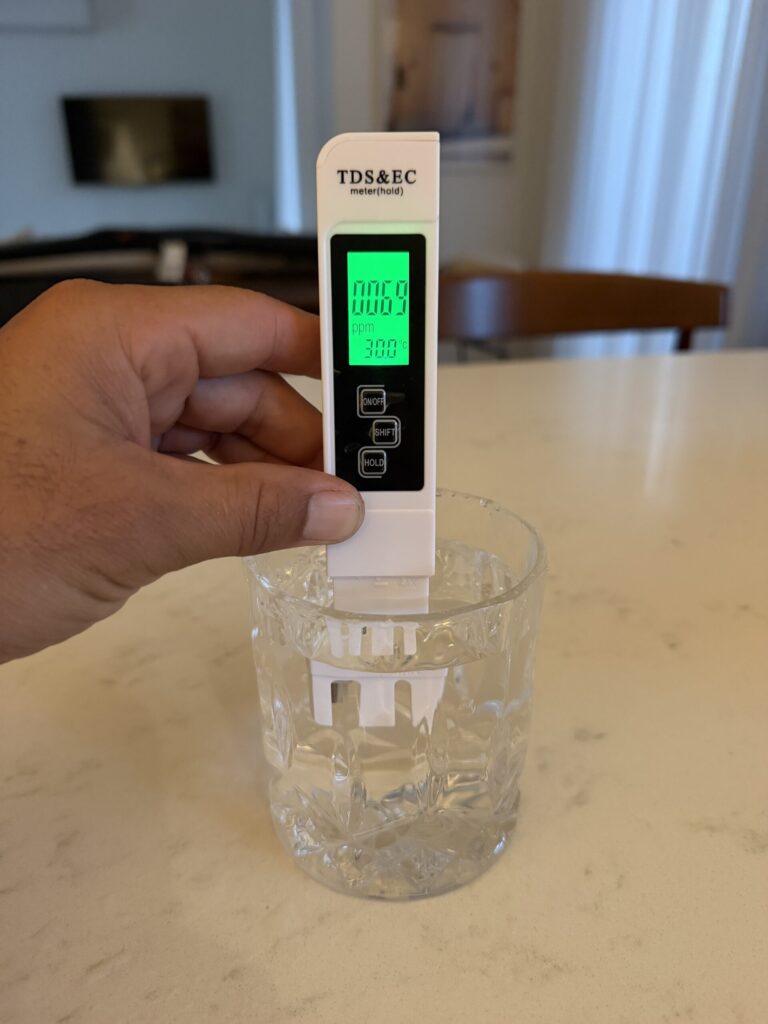
I live in Palm Beach on the Gold Coast, which is in Seqwater’s Gold Coast zone: free chlorine, no chloramine. My kitchen tap reads 69 ppm TDS on a handheld TDS meter. After the EcoHero 5-stage RO under my sink it reads 3 ppm, a 95.7% drop. That tells me the membrane is intact and rejecting dissolved ions. It does not identify chlorine, fluoride, lead or PFAS one by one; for that you need a lab test or your utility’s report.
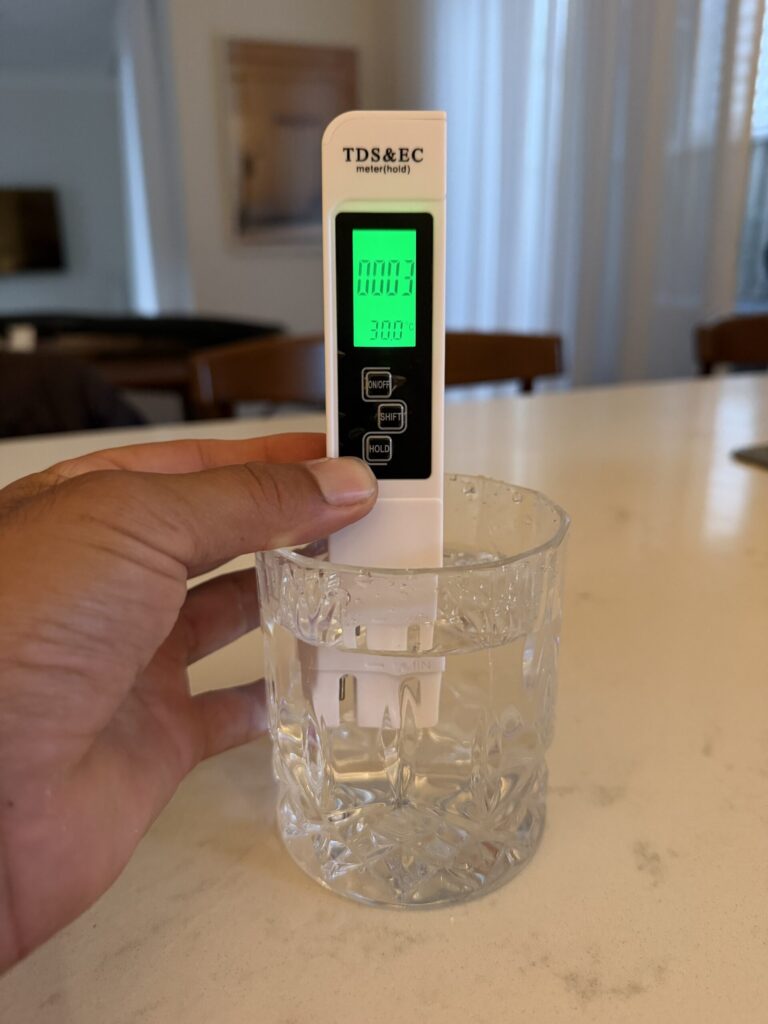
I run RO because I want lower fluoride and a margin on PFAS, and because I measured what it does. On the Gold Coast’s free chlorine, a carbon filter alone would have fixed the taste. That is the point of this guide: match the filter to the actual reason.
Check all seven rooms, not just this one
38 checks, 29 free, ranked by impact. Sent as a 32-page PDF.
We'll email you the audit and a short series of practical guides. Unsubscribe in one click, any time. Privacy.
Sent. Taking you to your download...
When not to drink it
Boil water or do not drink notices. Follow your utility’s notice exactly; they are issued after main breaks, treatment problems or flooding, and they are the main time Australian tap water is not safe to drink. A household filter is not a substitute unless the notice says so.
Your own tank or bore. If your water comes from your own rainwater tank or bore rather than the mains, no utility is testing it. That is a different job: sediment and carbon filtration plus UV, and regular testing. See drinking rainwater safely and tank and bore filters.
Near a PFAS investigation area. Check your utility’s PFAS monitoring and the Defence program page for your area. Most town supplies are below the 2025 guideline values. Where PFAS has been found it has mostly been in bores and groundwater near contaminated sites, and a few town supplies (Katherine, the upper Blue Mountains) have needed extra treatment.
Older plumbing. If the house has old brass taps or you are drinking the first water of the morning, flush the cold tap first. If you want certainty, a lab test of first-draw water is cheap compared to guessing.
Which filter removes what
| Technology | Free chlorine | Chloramine | Fluoride | PFAS | Lead |
|---|---|---|---|---|---|
| Carbon jug | Yes | Slow, partial | No | Variable | If certified |
| Under-sink carbon block | Yes | Slow, partial | No | Two-stage units: high | If certified (NSF/ANSI 53) |
| Catalytic carbon | Yes | Yes, with enough contact time | No | Variable | If certified |
| Reverse osmosis system | Yes | Yes, via its carbon stages | Removes most | Near complete in testing | Yes |
| Activated alumina / bone char | No | No | Can remove significant amounts | No | No |
Sources: the American Dental Association for fluoride, the 2020 Duke and NC State study for PFAS, and Water Conditioning and Purification for chloramine contact time. Look for the certification that names your contaminant (NSF/ANSI 42 for chlorine taste, 53 for lead, fluoride or total PFAS, 58 for RO), and note who issued it.
What I would buy for each problem
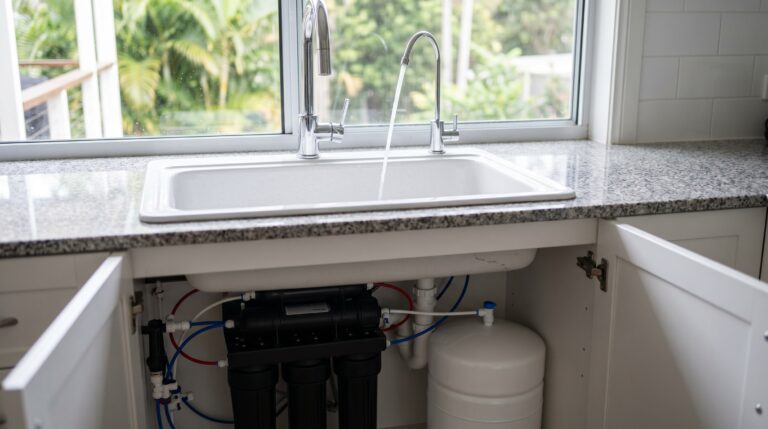
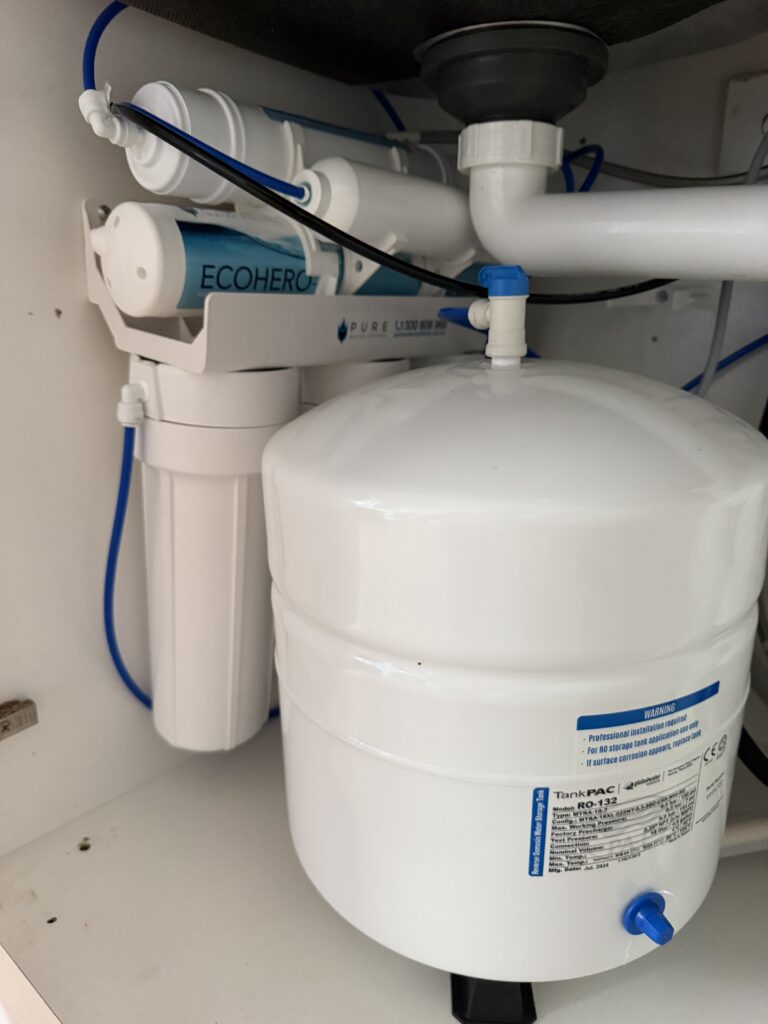
Fluoride, PFAS or chloramine, and you own: Pure Water Systems EcoHero 5-Stage RO
 Measured at home69 → 3ppm TDS, Palm Beach tap
5 stages incl. deioniser | AS/NZS 3497 (WaterMark standard) listed | Faucet sold separately | $949 system only (7 Nov 2026)
Black Friday alternative: Waterdrop X8 on Amazon AU →Amazon AU price: $611.29 · as of 22 Nov 2026, 2:43 am AEST DetailsThe system under my sink. RO plus a deionising stage; my tap went from 69 to 3 ppm TDS. It is on the national product register as AS/NZS 3497 compliant, which is what a licensed plumber needs to install it. Budget for a faucet and a plumber on top of $949, and about $490 a year in service from year two.
✓ Pros
- Measured result in my own kitchen
- AS/NZS 3497 listed
- Carbon stages for chloramine, RO for fluoride and PFAS
× Cons
- Most expensive option here
- Needs a plumber and cupboard space
- Fluoride figure is the maker’s, not certified
Buy this if…
you own your home, drink a lot of water, and want one system that covers every concern.
Same job, from Amazon: Waterdrop X8
 Under-sink RO2:1pure to drain (Waterdrop)
800 GPD tankless | 2:1 pure to drain | NSF/ANSI 42 and 58 certified (Waterdrop) | Needs a power point
Check the Waterdrop X8 Price on Amazon →Amazon AU price: $611.29 · as of 22 Nov 2026, 2:43 am AEST DetailsTankless under-sink RO sold by Waterdrop’s Australian store on Amazon. Waterdrop says it is certified to NSF/ANSI 42 and 58; its PFAS and fluoride figures are Waterdrop’s own tests. It needs power under the sink, and I could not find it on the WaterMark register, so confirm with your plumber.
✓ Pros
- Tankless, compact
- 2:1 waste ratio
- Certified to NSF/ANSI 58 (Waterdrop)
× Cons
- No WaterMark listing found
- Needs a power point
- PFAS and fluoride results not certified
Buy this if…
you want under-sink RO for less than the EcoHero and your plumber is happy with it.
Renters: Waterdrop C1S countertop RO
 Countertop RO3:1pure to drain (Waterdrop)
No plumbing | 6-stage incl. RO | Live TDS display | Room temperature only | NSF/ANSI 372
Check the Waterdrop C1S Price on Amazon →Amazon AU price: $379.22 · as of 22 Nov 2026, 2:43 am AEST DetailsRO without touching the plumbing: fill the tank from the tap, and it filters into a pitcher. Its RO membrane deals with fluoride and PFAS and its carbon stages with chlorine taste; Waterdrop’s figures come from SGS testing rather than a certification, and no product here is certified for chloramine.
✓ Pros
- Real RO with no install
- TDS display
- Moves with you
× Cons
- Refill by hand
- Takes bench space
- Results tested, not certified
Buy this if…
you rent in Brisbane or Sydney, or want fluoride reduced without a plumber.
Cheapest certified option: Culligan ZeroWater pitcher
 Certified jugFluorideIAPMO NSF/ANSI 53
IAPMO certified to NSF/ANSI 53: fluoride, lead, total PFAS and more | Filter rated about 76 L | TDS meter included
Check the ZeroWater Pitcher Price on Amazon →Amazon AU price: $55.19 · as of 22 Nov 2026, 8:29 am AEST DetailsThe one inexpensive product I found with an independent certification naming fluoride, lead and total PFAS (IAPMO certificate W-17155). The catch is the filter: about 76 litres, so it suits light use or a trial before committing to RO.
✓ Pros
- Certified for fluoride, lead and total PFAS
- $53
- Includes a TDS meter
× Cons
- Short filter life adds up
- Imported, stock varies
- Small pitcher
Buy this if…
you want a certified answer for the least money, or want to test whether filtered water changes anything for you.
Chlorine taste only: Waterdrop 10UA under-sink carbon
 Under-sink carbonfilter ~$50 a year
Connects to the cold line | NSF/ANSI 42 and 372 | Does not reduce TDS or fluoride | Filter about 12 months
Check the Waterdrop 10UA Price on Amazon →Amazon AU price: $79.99 · as of 22 Nov 2026, 6:29 am AEST DetailsThis article contains affiliate links. We may earn a commission at no extra cost to you.
If you are on free chlorine and only dislike the taste, this is all you need: certified to NSF/ANSI 42 for chlorine taste and odour, about $100, and roughly a filter a year. Renters can get the same result from a carbon jug such as the Brita Marella. Neither does anything for fluoride, and neither is the right tool for chloramine.
✓ Pros
- Fixes chlorine taste properly
- About $100
- Cheap yearly filter
× Cons
- Not for chloramine
- No fluoride or TDS reduction
- Needs simple plumbing
Buy this if…
you are in Melbourne, Perth, Canberra, Darwin, the Gold Coast or another free-chlorine area and want better-tasting water.
Verdict
Australian tap water is safe to drink, and the data from every utility I checked backs that up. Buy a filter for a reason, not out of fear: carbon for chlorine taste, reverse osmosis for chloramine, fluoride or PFAS, and a flushed cold tap plus a certified filter if you worry about old plumbing. If you are unsure which disinfectant you get, the checker above and your utility’s report will tell you in two minutes.
For the full range, see the best water filters in Australia, the best reverse osmosis systems, the best filters for PFAS and the best fluoride filters.
Prices change. Check Amazon AU before buying.
Frequently asked questions
Is tap water safe to drink in Australia?
Yes. Mains water in every Australian capital city is treated and monitored against the NHMRC’s Australian Drinking Water Guidelines and is safe to drink. The exceptions are when your utility issues a boil water or do not drink notice.
Do I need a water filter in Australia?
Not for safety. A filter is worth it for a specific reason: chlorine or chloramine taste, reducing fluoride, extra PFAS protection near a known site, or lead from older taps and fittings.
Which Australian cities use chloramine?
Brisbane’s central SEQ grid and most of Sydney (the Prospect and Potts Hill systems). Logan can receive either, and parts of Unitywater’s Moreton Bay network, the southern Adelaide Hills and regional SA are chloraminated. Melbourne, Perth metro, Canberra, Darwin, Newcastle, Wollongong, the Sunshine Coast and the Gold Coast use free chlorine.
Does a Brita jug remove chloramine?
Not well. Carbon removes chloramine far more slowly than free chlorine, so a jug makes little difference to chloramine taste. Reverse osmosis or catalytic carbon with enough contact time is needed.
Is fluoride in Australian tap water safe?
Australian health authorities support fluoridation for dental health. The ADWG limit is 1.5 mg/L and supplies typically sit around 0.7 to 1.0 mg/L. If you choose to reduce it, reverse osmosis is the dependable method.
Is there PFAS in Australian tap water?
Usually at very low levels. The NHMRC set new guideline values in June 2025 and said most supplies are already below them. Higher readings have mostly been in groundwater and bores near some Defence and industrial sites, and a few town supplies, such as Katherine and the upper Blue Mountains, have needed extra treatment.
Should I run the tap before drinking?
If you have older taps or fittings, yes. enHealth advises running the cold tap for at least 10 seconds each morning and at least 2 minutes after more than 48 hours away, and using cold water for drinking and cooking.
Which city has the best tap water in Australia?
There is no official ranking, and all capital cities meet the guidelines. In practice, free-chlorine cities such as Melbourne and Canberra are the easiest to make taste good with a simple carbon filter.
Is Gold Coast tap water chlorine or chloramine?
Free chlorine. Seqwater’s Gold Coast zone averaged about 1.5 mg/L free chlorine with no monochloramine reported in September 2026. It is fluoridated, at a 12-month average of 0.73 mg/L.
Can a TDS meter tell me if my water is safe?
No. A TDS meter measures total dissolved solids, mostly harmless minerals. It cannot identify bacteria, lead, PFAS or fluoride. It is useful for checking that an RO membrane is working.
- NHMRC: Australian Drinking Water Guidelines, version 4.0 (June 2025)
- NHMRC ADWG: Summary of guideline values (chlorine, monochloramine, hardness)
- NHMRC ADWG: Fluoride fact sheet
- NHMRC: Public statement on water fluoridation and human health (2017)
- NHMRC: PFAS guideline values (updated 25 June 2025)
- NHMRC ADWG: Lead fact sheet (0.005 mg/L, 2025)
- enHealth: Lead in drinking water from some plumbing products (October 2021)
- ABCB WaterMark: lead free plumbing products (mandatory from 1 May 2026)
- Department of Defence: PFAS Investigation and Management Program
- Department of Defence: RAAF Base Tindal and Katherine PFAS management
- WaterNSW: Blue Mountains PFAS investigations
- Seqwater: Brisbane zone water quality report, September 2026
- Seqwater: Gold Coast zone water quality report, September 2026
- Logan Water: chloramine or chlorine by area
- Unitywater: chloraminated and chlorinated areas
- Sydney Water: Potts Hill quarterly water quality report (monochloramine, fluoride)
- Sydney Water: Illawarra quarterly water quality report
- Hunter Water: what’s in your water (chlorine, fluoride)
- Central Coast Council: quarterly drinking water quality summary
- South East Water: Annual Drinking Water Quality Report 2024-25
- Yarra Valley Water: how Melbourne’s water is disinfected
- Yarra Valley Water: fluoridation
- Barwon Water: Annual Drinking Water Quality Report 2024-25
- Icon Water: Annual Drinking Water Quality Report 2018-19 (chloramine not used in Canberra)
- SA Water: Happy Valley water treatment plant fact sheet
- SA Water: disinfecting your drinking water (chloramine)
- SA Water: what’s in your water
- Water Corporation: Drinking Water Quality Annual Report 2023-24
- HealthyWA: fluoride facts for Western Australia
- Power and Water: drinking water quality (chlorine in all supplies)
- Tasmanian Department of Health: water fluoridation
- Townsville City Council: DWQMP annual report 2022-23 (chlorine)
- Townsville City Council: DWQMP annual report 2024-25 (fluoride)
- Cairns Regional Council: Drinking Water Report 2024-25
- Toowoomba Regional Council: water quality and fluoridation
- Queensland Health: water fluoridation
- American Dental Association: Fluoridation Facts (home treatment and fluoride)
- Herkert et al. 2020, Environ. Sci. Technol. Lett.: point-of-use filters and PFAS
- Potwora, Water Conditioning & Purification (2009): chlorine and chloramine removal with activated carbon
- Cooperative Extension: what a TDS test does and does not tell you
- ABCB product register: Pure Water Systems 5 Stage Undersink RO (AS/NZS 3497)
- Waterdrop: X8 reverse osmosis system specifications
- Waterdrop: C1S countertop RO specifications
- Waterdrop: 10UA under-sink filter certifications
- IAPMO R&T certificate W-17155 (Culligan ZeroWater pitcher filters)

Former Royal Australian Navy Clearance Diver and TAG-E counter-terrorism operator. Founded Clean and Native to apply the same rigorous thinking to the home environment.
Full biography →The 7-Room Home Audit
Your tap water is one room. The audit covers all seven: 38 checks across water, air and EMF, 29 of them free, ranked by impact against Australian guidelines.
- Morning tap flush: the free lead fix most homes skip
- How to read your utility's water quality report
- Renting or owning: the two reverse osmosis filters I use at home
We'll email you the audit and a short series of practical guides. Unsubscribe in one click, any time. Privacy.
Sent. Taking you to your download...