EMF Protection for Children’s Bedrooms Australia 2026
The most effective EMF protection for an Australian child’s bedroom costs nothing: remove devices, switch the router off at night, and move the bed away from the meter box. According to ARPANSA, Australia’s radiation safety authority, no definitive causal link has been established between low-level residential EMF exposure and health effects — but the WHO’s International EMF Project and the IARC Group 2B classification of radiofrequency fields as “possibly carcinogenic” both support a precautionary approach, especially for children whose bodies are still developing.
| Action | What It Does | Verdict |
|---|---|---|
| Remove devices + airplane mode | Eliminates internal RF sources at the child’s bed | Do this first — free |
| Router timer / off at night | Cuts whole-home RF for 8-10 hrs nightly | Recommended — ~$20 |
| Measure with TriField TF2 | Identifies RF, magnetic, and electric field sources you cannot see | Recommended — ~$260 |
| EMF shielding canopy | Blocks external RF only — reflects internal sources | Last resort — $400-$1,200+ |
Start with free actions, measure before you spend. Eighty percent of the EMF exposure in a typical Australian child’s bedroom comes from devices inside the room — a Wi-Fi-connected tablet on the bedside table, a DECT baby monitor, or the router in the next room. Removing those sources costs nothing and delivers a bigger reduction than any $1,000 shielding canopy. A canopy installed before internal sources are removed will actually increase exposure by reflecting those signals back toward the bed. The TriField TF2 meter is the tool that tells you exactly what you are dealing with before you spend a dollar on shielding.
Key catches
- ARPANSA’s thermal exposure limit (1,000 µW/cm² at 2.4 GHz) is not a precautionary guideline — it only protects against tissue heating, not long-term low-level exposure
- DECT cordless baby monitors transmit RF continuously at ~1.9 GHz, even when no sound is detected — they are one of the highest RF sources in a nursery
- Australian smart meters (900 MHz, Energex QLD / Ausgrid NSW) transmit in bursts — peak readings are 100-1,000x higher than time-averaged readings, so always use peak-hold mode when measuring
Why Children’s EMF Exposure Deserves a Precautionary Approach
You are not being paranoid. You are responding to a legitimate classification from one of the world’s most authoritative cancer research bodies. In 2011, the International Agency for Research on Cancer (IARC), an arm of the WHO, classified radiofrequency electromagnetic fields as Group 2B — “possibly carcinogenic to humans.” That classification sits alongside lead and DDT. It is not definitive proof of harm. It is a statement that the evidence is strong enough to warrant caution.
For children, caution carries more weight than for adults. According to the WHO’s International EMF Project, established in 1996 to assess health effects across the 0-300 GHz frequency range, children’s skulls are thinner, their neural tissue is still developing, and their cumulative lifetime exposure will be significantly longer than any adult alive today. A child born in 2024 will have had continuous ambient RF exposure from birth through their entire developmental window — something no previous generation experienced.
Here is what ARPANSA, Australia’s radiation protection authority, actually says: their public exposure limit for RF at 2.4 GHz is 1,000 µW/cm² (equivalent to 10 W/m²). That limit protects against acute thermal effects — tissue heating. It does not address chronic low-level exposure, and it was not designed with children’s developing biology as the primary consideration. ARPANSA acknowledges that ELF-EMF emissions from powerlines, substations, transformers, and household appliances exist in residential environments. They maintain that current evidence does not establish a causal link. But “not established” is not the same as “safe.”
The Building Biology SBM-2015 standard, used by environmental health practitioners internationally, recommends sleeping area RF exposure below 0.1 mW/m² (no anomaly), AC magnetic fields below 0.2 µT, and AC electric fields below 5 V/m. These thresholds are thousands of times stricter than ARPANSA’s limits. For a child’s bedroom — where they spend 10-12 hours daily — those are the numbers I work toward.
Further Reading
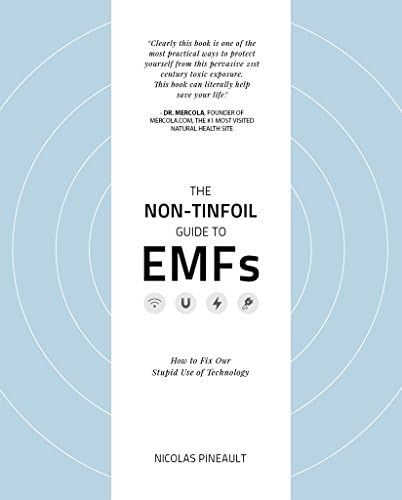
The Non-Tinfoil Guide to EMFs
A practical, non-alarmist breakdown of EMF sources and reduction strategies for the home — useful background reading if you want the fuller picture beyond this guide’s bedroom-specific protocol.
See on Amazon AU →The Six Biggest EMF Sources in an Australian Child’s Bedroom
Before you buy a single product, you need to understand what is actually generating the fields your child is sleeping in. Most parents fixate on the mobile tower visible from the window. In practice, the sources inside the home — and often inside the bedroom itself — account for the overwhelming majority of exposure at the bed. Here are the six sources I find most often when auditing children’s rooms on the Gold Coast and across south-east Queensland.
1. Wi-Fi Router in or Near the Bedroom
A standard dual-band Wi-Fi router (2.4 GHz and 5 GHz) transmits continuously, not just when devices are actively transferring data. At 1 metre distance, typical readings on a TriField TF2 sit between 1-10 mW/m². At 3 metres, that drops to 0.1-1 mW/m². If the router is in the child’s bedroom or on the other side of a plasterboard wall, readings at the pillow often exceed Building Biology thresholds by 10-100x. This is the single highest-impact source in most homes I measure.
2. DECT Cordless Baby Monitors
DECT (Digital Enhanced Cordless Telecommunications) baby monitors operate at approximately 1.9 GHz and transmit continuously — not just when the baby is crying. Unlike Wi-Fi, which has some idle-mode power reduction, DECT base stations maintain a constant RF beacon. According to measurements published in peer-reviewed EMF surveys, a DECT monitor at 0.5 metres produces RF power densities comparable to having a Wi-Fi router on the cot rail. If you are using a DECT monitor in a nursery, you are adding a significant RF source at point-blank range to a sleeping infant.
3. Smart Meters on Shared Walls
Australian smart meters — Energex in Queensland, Ausgrid in New South Wales, Jemena in Victoria — operate at 900 MHz in a mesh network configuration. They transmit in short bursts, not continuously. But here is the critical detail: peak readings during a burst are 100-1,000x higher than the time-averaged value the utilities report. If your child’s bedroom shares an exterior wall with the meter box, and the bed head is against that wall, those burst peaks hit the pillow repeatedly throughout the night. Always use peak-hold mode on your meter when assessing smart meter exposure.
4. Tablets, Phones, and Laptops Left on the Bedside Table
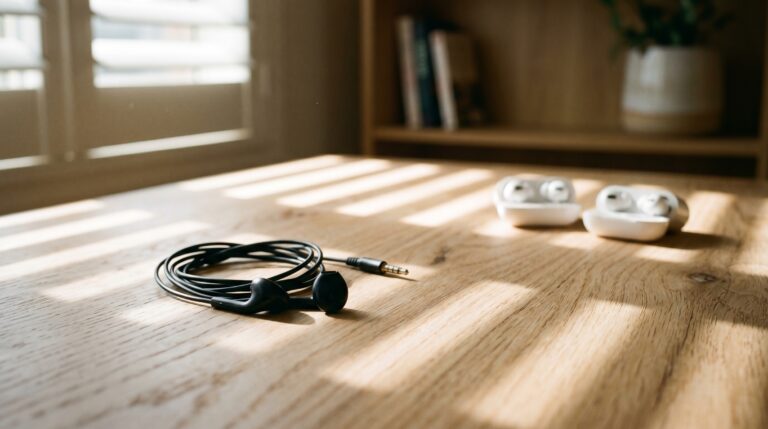
A tablet or phone with Wi-Fi enabled and connected to the network transmits regular beacon signals even when the screen is off. With Bluetooth enabled (for AirPods, smartwatches, or other peripherals), you add a second transmitter at 2.4 GHz. A child who falls asleep with an iPad under the pillow is experiencing RF exposure at the absolute closest possible range to their developing brain. This is not a difficult problem to solve. It costs nothing.
5. Wiring in Walls and Under-Floor
The 240V AC wiring inside walls and under floors generates two types of fields: AC electric fields (measured in V/m) and AC magnetic fields (measured in µT). Electric fields are present whenever a circuit is energised — even with nothing plugged in and switched on. Magnetic fields require current flow. In older Australian homes, wiring runs can pass directly behind the head of a child’s bed, creating electric field readings of 10-50 V/m at the pillow — well above the 5 V/m Building Biology threshold. A licensed electrician can install a demand switch on the bedroom circuit for approximately $100-$150, which cuts power to the circuit when no loads are present, eliminating both AC electric fields and the magnetic fields from wiring.
6. External Sources: Powerlines, Substations, 5G Small Cells
External sources matter, but they are usually lower-priority than internal sources. High-voltage powerlines (66kV+) can produce elevated magnetic fields at distances under 50 metres. Telstra, Optus, and TPG are deploying 5G small cells at 3.5 GHz and 28 GHz on street poles in Australian suburban areas. Standard brick veneer walls provide 10-30 dB of attenuation for RF. If your child’s bedroom window faces a small cell antenna at less than 20 metres, you need to measure at the window first. But in most homes, the router on the other side of the wall is producing more RF at the pillow than the tower 200 metres away.
Step-by-Step Children’s Bedroom EMF Audit
This is the exact sequence I use when I audit a child’s bedroom. The order matters. You measure first, reduce sources second, and only consider shielding third. If you skip straight to buying a canopy, you risk making the problem worse — not better.
Step 1: Measure with a TriField TF2 Meter
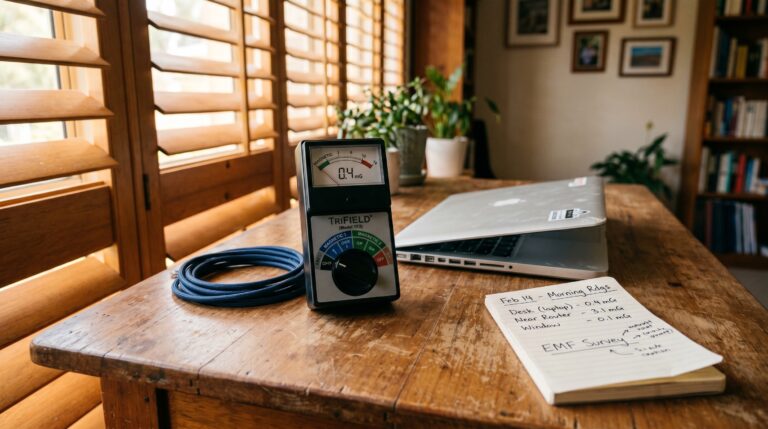
You cannot protect your child from what you cannot see or quantify. The TriField TF2 is the single most practical meter for Australian parents because it measures all three field types in one device: AC magnetic fields (in mT/µT), AC electric fields (in V/m), and radiofrequency (in mW/m²). It costs approximately $260 on Amazon AU — less than a single building biologist consultation.
How to measure a child’s bedroom:
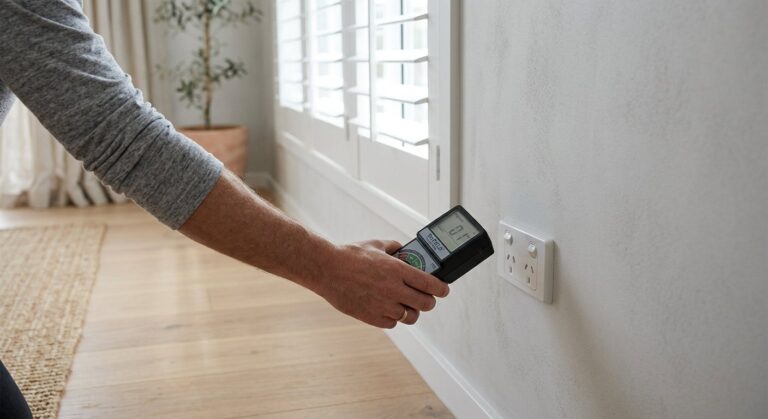
- Set the meter to RF mode (weighted). Walk the perimeter of the room slowly, noting readings at each wall. Pause at windows. Note the highest reading and its location.
- Switch to AC magnetic mode. Walk the same perimeter. Hold the meter at pillow height. Note any readings above 0.2 µT — these indicate current-carrying wiring or appliances behind the wall.
- Switch to AC electric mode. Hold at pillow height along the wall where the bed head sits. Readings above 5 V/m indicate energised wiring in the wall.
- Measure at the pillow position in all three modes. This is the number that matters most — it is where your child’s head spends 10-12 hours every night.
- Use peak-hold mode when measuring smart meter walls. A single sweep in standard mode will miss the burst transmissions.
Record your readings. Write down the date, meter mode, location in the room, and the reading. You will compare these to the Building Biology thresholds: RF below 0.1 mW/m², AC magnetic below 0.2 µT, AC electric below 5 V/m. Every reading above those thresholds is a specific problem with a specific solution.
Step 2: Remove Internal Sources (Cost: $0)
This is the highest-impact step and it is free. Based on your measurements, remove or relocate every transmitting device inside the bedroom:
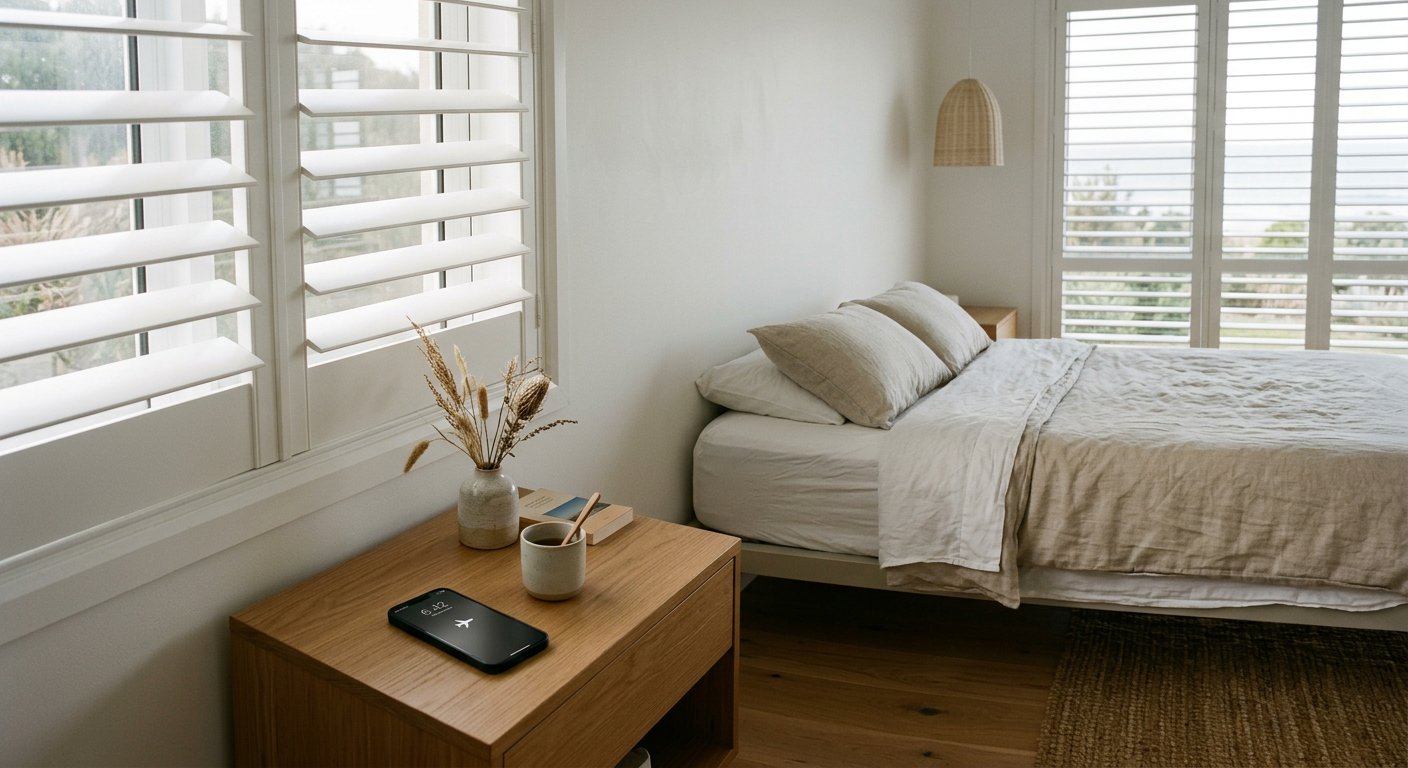
- Tablets and phones: charge them in another room overnight. If a child uses a tablet as a white noise machine, download the audio file and switch to a battery-powered speaker with no Bluetooth or Wi-Fi.
- DECT baby monitor: replace with a wired audio monitor or an analogue low-power monitor. If you must use a wireless monitor, place it at maximum distance from the cot — at least 1.5 metres — and choose a VOX-activated model that only transmits when sound is detected.
- Smart speakers (Alexa, Google Home): these are always-listening, always-connected RF sources. Remove them from the bedroom entirely.
- Bluetooth nightlights and smart plugs: replace with non-smart alternatives.
After removing devices, re-measure at the pillow. In most bedrooms I audit, this single step drops RF readings from 1-10 mW/m² to below 0.1 mW/m². That is a 90-99% reduction, and it costs zero dollars.
Step 3: Turn Off Wi-Fi at Night (~$20)
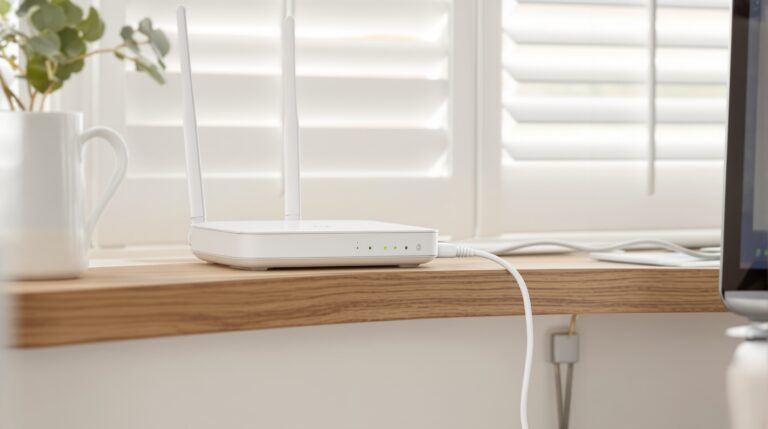
Your child does not need Wi-Fi between 9pm and 6am. Nobody in your house does. A Jackson 24hr Mechanical Timer plugged into the router’s power outlet cuts Wi-Fi automatically every night and restores it every morning. No apps, no configuration, no forgetting. It costs approximately $20 on Amazon AU. This is the single highest-impact-per-dollar action for whole-home overnight RF reduction.
For families in inner Sydney, Brisbane, or Melbourne where NBN NTD (Network Termination Device) is separate from the router — the NTD itself does not transmit RF. Only the router does. You can safely timer the router without affecting the NTD.
Step 4: Move the Bed Away from High-Field Walls (Cost: $0)
If your measurements identified elevated readings on a specific wall — smart meter on the exterior, wiring run behind the plasterboard, or the router on the other side — move the bed head to the opposite wall. Distance is the most effective EMF reduction tool in physics. RF power density drops with the inverse square of distance: doubling the distance quarters the exposure.
In homes across Palm Beach and the Gold Coast where I have taken readings, moving the bed 2 metres from a smart meter wall typically reduces peak RF at the pillow by 75-90%. Free. Takes 20 minutes.
Step 5: Install a Demand Switch on the Bedroom Circuit (~$100-$150)
If your AC electric field readings at the pillow exceed 5 V/m — common in older Queensland and NSW homes where wiring runs directly behind the bed head — a demand switch is the correct fix. A licensed electrician installs it on the bedroom circuit. When no loads are drawing current (everything switched off for the night), the demand switch cuts power to the circuit entirely, eliminating AC electric fields from the wiring. When a load is switched on (bedside lamp in the morning), the demand switch instantly restores power.
Cost: approximately $100-$150 installed. This eliminates AC electric fields and any magnetic fields generated by wiring in the bedroom walls and ceiling during sleep hours. It is a one-time investment that works every night automatically.
Step 6: Shield Only Confirmed External Sources (Last Resort)
If — and only if — you have completed steps 1 through 5 and your RF readings at the pillow still exceed 0.1 mW/m² from confirmed external sources (a cell tower, a neighbour’s router through a party wall, a smart meter you cannot relocate), then shielding is appropriate.
Critical warning: the shielding trap. If you install an EMF shielding canopy over a child’s bed while transmitting devices are still inside the room, the canopy acts as a Faraday reflector. It bounces the internal RF signals back toward the child, concentrating exposure instead of reducing it. This is not a theoretical concern — it is measurable. I have seen canopy installations increase RF at the pillow by 3-5x when a baby monitor was left inside the enclosure. The correct sequence is always: remove sources first, shield external residual only.
EMF bed canopies in Australia range from approximately $400 to $1,200+ depending on size and shielding fabric specification. A silver-cotton canopy rated at 42 dB attenuation is a strong performer for external RF. But at $400-$1,200, it should be the last thing you buy, not the first. The free actions in Steps 2-4 will deliver a larger total reduction in almost every home.
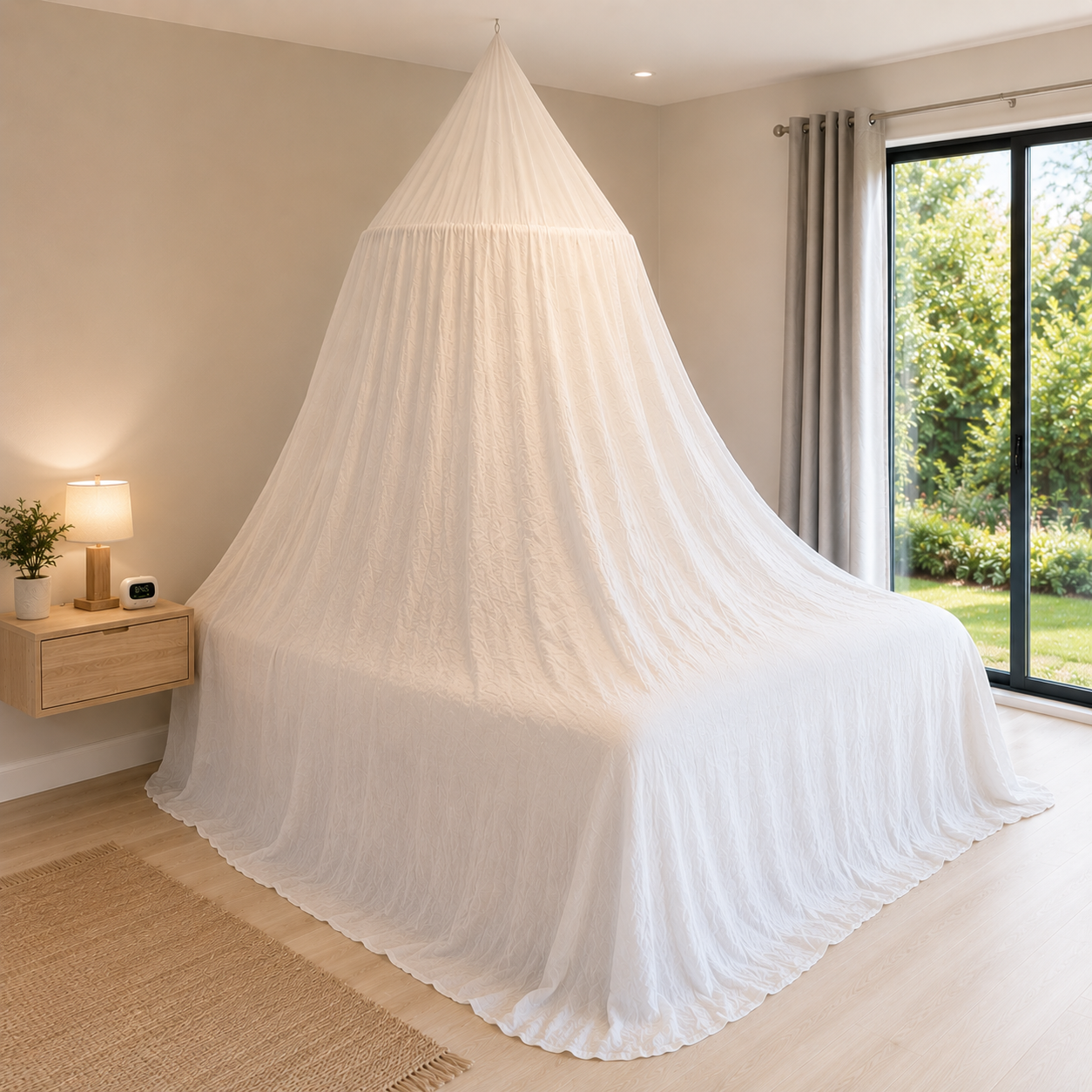
Swiss-made silver-copper cotton mesh rated 40 dB (99.99%) attenuation at 1 GHz, covering mobile tower, 5G, Wi-Fi and smart meter RF plus AC electric fields. Collapsible hoop packs into a standard suitcase. Only appropriate once internal sources (Steps 1-5 above) are already removed — shielding a room with transmitting devices still inside will reflect RF back at your child rather than reduce it.
View at SaferEMF →Australian-Specific EMF Considerations for Children’s Rooms
Australia has specific infrastructure and regulatory conditions that affect how you approach EMF protection. Generic international advice misses these details, and they matter for your decisions.
ARPANSA Standards: What They Cover and What They Do Not
ARPANSA’s Radiation Protection Standard for Maximum Exposure Levels to Radiofrequency Fields (RPS 3, updated 2021) sets public exposure limits based on ICNIRP guidelines. At 2.4 GHz (Wi-Fi frequency), the limit is 1,000 µW/cm². According to ARPANSA’s own documentation, this standard protects against established thermal effects — tissue heating from absorbed RF energy. It is not a precautionary guideline for chronic low-level exposure, and it does not specifically address children’s developing neurology.
For ELF-EMF (extremely low frequency, from powerlines and household wiring at 50 Hz), ARPANSA’s limit is 1,000 µT. The Building Biology sleeping area threshold is 0.2 µT — five thousand times stricter. ARPANSA’s standard is a thermal ceiling, not a health-optimised sleeping environment target. Use it as the “absolute maximum” reference. Use Building Biology thresholds as your practical target for your child’s bedroom.
Smart Meters by State
Smart meter deployments vary by state, and the specifics affect your measurement approach:
- Queensland (Energex, Ergon Energy): 900 MHz mesh network. Deployed across south-east Queensland including Brisbane, Gold Coast, Sunshine Coast, Ipswich, Logan, and Toowoomba. If your child’s bedroom shares an exterior wall with the meter box — common in single-storey Queensland homes — measure with peak-hold mode at the pillow.
- New South Wales (Ausgrid, Endeavour Energy, Essential Energy): Similar 900 MHz mesh deployment in Sydney metro and regional areas. Homes in Penrith, western Sydney, and suburban Newcastle should check meter box location relative to bedrooms.
- Victoria (Jemena, AusNet, CitiPower, Powercor, United Energy): Victoria had the earliest mandatory rollout. Virtually all Victorian homes have smart meters. Homes in inner Melbourne, the Dandenong corridor, and Geelong should verify bedroom wall proximity.
- South Australia (SA Power Networks): Rollout in progress across Adelaide metropolitan area. Check your specific property.
- Western Australia (Western Power): Advanced metering infrastructure rollout across Perth metro including Rockingham, Mandurah, and Kwinana corridor.
NBN and 5G: What You Can and Cannot Control
The NBN NTD (the box on the wall) does not transmit RF. It is an ethernet device. The router plugged into it does. You can run a Cat6 ethernet cable from the NTD to a router in another room — or directly to a computer — eliminating Wi-Fi from the child’s bedroom entirely for wired devices.
5G small cells on street poles (3.5 GHz and 28 GHz deployments by Telstra, Optus, and TPG) are appearing in Australian suburban streets. Standard brick veneer construction provides 10-30 dB of RF attenuation. If a 5G small cell is within 20 metres of your child’s bedroom window, measure RF at the window with the TriField TF2 in peak-hold mode. If readings exceed 0.1 mW/m² at the pillow with all internal sources removed, a shielding film on the window or relocating the bed to an interior wall is appropriate.
Cost Comparison: Free Actions vs Purchased Solutions
The EMF protection industry sells fear. I am going to give you the numbers so you can make a decision based on cost-effectiveness, not anxiety.
| Action | Cost (AUD) | Typical RF Reduction | Addresses | Priority |
|---|---|---|---|---|
| Remove devices from bedroom | $0 | 90-99% | RF (internal) | 1 — Do this tonight |
| Phone on airplane mode | $0 | 100% from that device | RF (device) | 1 — Do this tonight |
| Move bed from high-field wall | $0 | 75-90% (inverse square) | RF + magnetic (external) | 2 |
| Router timer (Jackson 24hr) | ~$20 | 100% (router off) | RF (whole home, overnight) | 2 |
| TriField TF2 meter | ~$260 | Identifies all sources | RF + magnetic + electric | 3 |
| Demand switch (electrician) | ~$100-$150 | Eliminates wiring fields | AC electric + magnetic (wiring) | 4 |
| EMF shielding bed canopy | $400-$1,200+ | 30-42 dB (external RF only) | RF (external residual) | 5 — Last resort only |
| Building biologist consultation | $300-$600 | Comprehensive assessment | All field types | Optional — DIY first |
The pattern is clear. The first four actions cost $20 or less and eliminate 90%+ of the EMF exposure in a typical child’s bedroom. The TriField TF2 at ~$260 gives you the data to know whether steps 5 and 6 are even necessary. In most homes, they are not. A $1,200 canopy without the free actions is like buying a $2,000 air purifier and leaving the windows open during a bushfire. Sequence matters more than budget.
The 3-Question Decision Tree for Parents
If you are reading this at 11pm with a sleeping child in the next room, here is the fastest path to a decision:
Question 1: Are there any transmitting devices inside your child’s bedroom right now?
Phone, tablet, smart speaker, DECT baby monitor, Bluetooth nightlight, laptop? If yes — remove them. Tonight. This is your single biggest win. If the child uses a device for white noise or an alarm, switch it to airplane mode or replace it with a non-wireless alternative.
Question 2: Is your Wi-Fi router in or adjacent to the child’s bedroom?
If yes — move the router to the opposite end of the house if possible, or put it on a mechanical timer that cuts power from 9pm to 6am. If you need internet overnight (shift worker, security cameras), consider running ethernet to the devices that need it and switching off Wi-Fi.
Question 3: Do you want to verify your readings with actual data?
If yes — the TriField TF2 measures all three field types. Take readings at the pillow position before and after your changes. The numbers will tell you whether a demand switch, bed relocation, or shielding is justified — or whether the free actions were enough.
Three questions. For most families, the answer to Question 3 is “yes, the free actions were enough.” The meter just gives you the confidence to stop spending.
What Not to Buy: EMF Products That Do Not Work
The EMF protection market is full of products that exploit parental anxiety with pseudoscientific claims. As a former Royal Australian Navy Clearance Diver, I have zero tolerance for unverifiable claims. Here is what to avoid:
- “EMF harmonising” stickers, pendants, and chips: Products that claim to “harmonise” or “neutralise” EMF fields without physically blocking, absorbing, or reflecting them have no plausible mechanism of action. No independent laboratory has demonstrated measurable RF or ELF field reduction from a sticker applied to a phone case. If a product claims to protect without measurably changing the field, it is not protection.
- Himalayan salt lamps for “EMF absorption”: Salt lamps do not absorb radiofrequency energy. They are a sodium chloride crystal with a light bulb inside. If you enjoy the ambience, keep it. But it is not EMF protection.
- Orgonite pyramids and “scalar energy” devices: No peer-reviewed study, no ARPANSA recognition, no measurable effect on any EMF meter. These are decorative objects marketed with pseudoscience.
- Phone cases that claim “99% EMF blocking”: Some phone cases contain metallic shielding on one side. If the shielding is between the phone’s antenna and your body, it may reduce SAR in that direction. But it also forces the phone to increase its transmission power to maintain the cell connection, potentially increasing exposure on the unshielded side. Without independent SAR testing specific to that case-phone combination, the claim is unverifiable.
The test is simple: if a product claims to reduce EMF, it must produce a measurable change on an EMF meter. Hold a TriField TF2 next to the device. If the reading does not change, the product does not work. Do not buy it for your child’s room.
Grounding: What the Evidence Supports
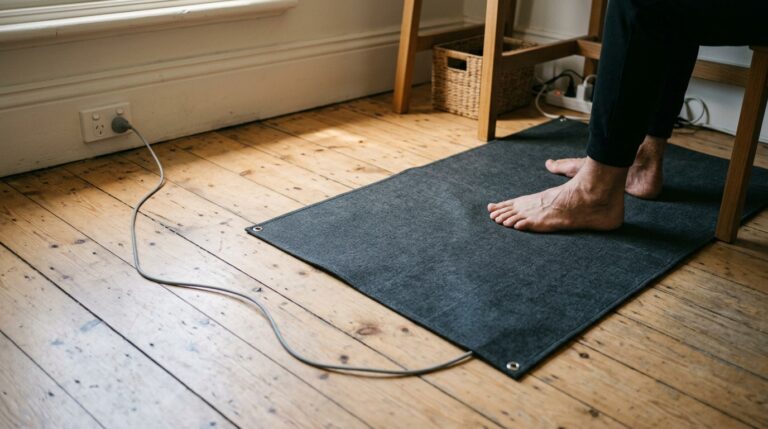
Grounding (also called earthing) involves direct physical contact between the body and the earth’s surface, or connection to the earth’s electrical potential via a grounded conductor. The theory is that this equalises the body’s electrical potential with the earth, potentially reducing AC electric field coupling through the body.
There is a limited body of peer-reviewed research. A 2004 study by Ghaly and Teplitz published in the Journal of Alternative and Complementary Medicine found that grounding during sleep reduced cortisol secretion and improved sleep quality in a small sample. A 2010 study by Chevalier and Sinatra found reduced blood viscosity after grounding. These studies are small and have methodological limitations, but they are published in indexed journals.
From an electrical perspective, a grounding mat connected to the earth pin of an Australian power outlet does establish a path to earth ground. If AC electric fields from bedroom wiring are coupling through your child’s body (measurable with a body voltage meter), a grounding mat or sheet can reduce body voltage. However, this only addresses AC electric fields — it has no effect on RF or AC magnetic fields.
A grounding mat is not a substitute for removing RF sources or installing a demand switch. It addresses one specific field type (AC electric). If your TF2 readings show elevated AC electric fields at the pillow and you cannot install a demand switch, a grounding mat is a reasonable supplementary step. It is not a primary intervention.
Final Verdict: Protect Your Child’s Bedroom Tonight for $0
Every minute you spend reading about EMF protection is a minute your child could be sleeping in a lower-exposure environment. The three most effective actions cost nothing: remove wireless devices from the bedroom, put any remaining phones on airplane mode, and move the bed away from the meter box wall. A $20 router timer adds whole-home overnight Wi-Fi elimination. A $260 TriField TF2 tells you whether you need to spend anything else.
Do not start with a $1,200 canopy. Do not start with a $600 building biologist. Start with the free actions, measure the result, and let the data guide your next step. That is the ARPANSA-aligned, measurement-first approach that actually protects your child — not marketing that exploits your concern.
Your child sleeps 10-12 hours a night. That is 10-12 hours of cumulative exposure, every night, for years. The free actions take 15 minutes. The router timer takes 2 minutes to plug in. Tonight is the right time to start.
Last reviewed: August 2026 – Clean and Native
Start with measurement. The TriField TF2 is the only meter you need.
Measures AC magnetic, AC electric, and RF in one device. Without real readings, every EMF decision is a guess — and every product purchase is a gamble with your child’s sleep environment.
Frequently Asked Questions
Does Wi-Fi harm children’s health?
The IARC classified radiofrequency fields (including Wi-Fi) as Group 2B — “possibly carcinogenic to humans” — in 2011. According to the WHO International EMF Project, no definitive causal link has been established for low-level residential exposure. The precautionary approach is to reduce unnecessary exposure during sleep, when the child gains no benefit from active Wi-Fi.
What is a safe EMF level for a child’s bedroom in Australia?
ARPANSA’s public limit at 2.4 GHz is 1,000 µW/cm², which only addresses thermal effects. The Building Biology SBM-2015 sleeping area standard recommends RF below 0.1 mW/m², AC magnetic below 0.2 µT, and AC electric below 5 V/m. These precautionary thresholds are used by environmental health practitioners internationally.
Are baby monitors safe to use in a nursery?
DECT digital baby monitors transmit RF continuously at approximately 1.9 GHz, even when no sound is detected. At 0.5 metres from the cot, RF exposure is comparable to having a Wi-Fi router at the same distance. Safer alternatives include wired audio monitors, analogue low-power models, or VOX-activated monitors placed at least 1.5 metres from the cot.
How do I measure EMF in my child’s bedroom?
Use a TriField TF2 meter (~$260 on Amazon AU). It measures RF, AC magnetic, and AC electric fields in one device. Take readings at the pillow position in all three modes, and use peak-hold mode when measuring near smart meter walls.
Does turning off Wi-Fi at night reduce EMF exposure?
Yes. Turning off the Wi-Fi router eliminates 100% of router-generated RF in the home. A Jackson 24hr Mechanical Timer (~$20) automates this nightly without any effort. The NBN NTD is unaffected — only the router needs to be timed.
Do EMF shielding canopies work for children’s beds?
Shielding canopies can block external RF when rated at 30-42 dB attenuation. However, if transmitting devices remain inside the canopy, the shielding reflects internal RF back toward the child, increasing exposure. Always remove all internal RF sources before installing any shielding. A canopy should be the last step, not the first.
What is a demand switch and does my child’s bedroom need one?
A demand switch is a device installed by a licensed electrician on the bedroom circuit (~$100-$150). It cuts power to the circuit when no loads are drawing current, eliminating AC electric fields from wiring in walls and ceiling during sleep. Your child’s room needs one if TriField TF2 readings show AC electric fields above 5 V/m at the pillow position.
Do EMF protection stickers and harmonisers actually work?
No. Products claiming to “harmonise” or “neutralise” EMF without physically blocking, absorbing, or reflecting the fields have no plausible mechanism of action and produce no measurable change on a calibrated EMF meter. No independent laboratory has demonstrated RF or ELF reduction from stickers, pendants, or orgonite devices. Only physical shielding, source removal, and distance produce verifiable reductions.
Can I use my phone to measure EMF instead of buying a meter?
Phone-based EMF apps use the phone’s internal magnetometer, which can detect AC magnetic fields with limited accuracy. They cannot measure RF power density or AC electric fields. For a child’s bedroom audit, a dedicated tri-mode meter like the TriField TF2 is necessary to assess all three field types accurately. Phone apps are not a substitute.
Is the smart meter on my house wall dangerous for my child’s bedroom?
Australian smart meters (900 MHz) transmit in bursts. Time-averaged exposure is low, but peak readings during bursts can be 100-1,000x higher. If your child’s bedroom shares a wall with the meter box, measure at the pillow using peak-hold mode on your meter. If readings exceed Building Biology thresholds (0.1 mW/m²), move the bed to the opposite wall — this alone typically reduces exposure by 75-90%.
Get the Australian Home Environment Checklist
30 checks across water, air and EMF. Most of them free. Ranked by impact.
No spam. Unsubscribe any time.

Former Royal Australian Navy Clearance Diver and TAG-E counter-terrorism operator. Founded Clean and Native to apply the same rigorous thinking to the home environment.
Full biography →