EcoHero 5-Stage RO vs AquaTru Countertop: Which is Better for Australian Homes?
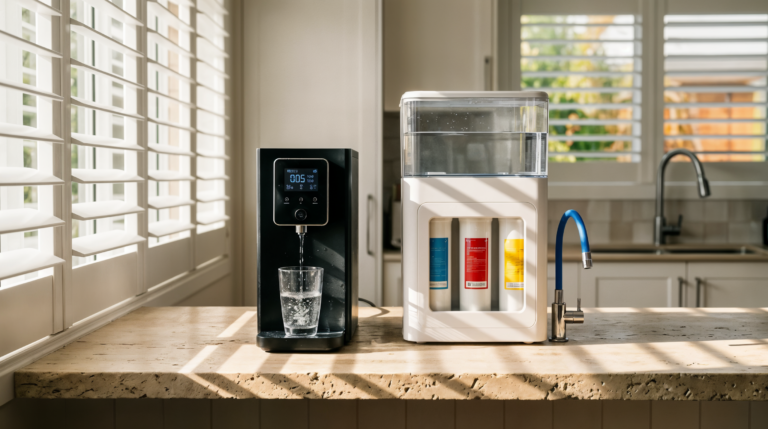
The EcoHero 5-Stage is the better long-term system if you can install under-sink plumbing, while the AquaTru Countertop wins for renters or anyone needing portability. Both deliver verified NSF/ANSI 58 TDS rejection below 10 ppm from chloraminated Australian tap water, but the EcoHero costs $1,009–$1,059 upfront with lower annual filter costs ($220/year), while the AquaTru costs $699–$799 upfront with higher ongoing costs ($290/year) and requires manual refills every 2–3 days for a family of four. The catches: the EcoHero requires WaterMark-certified installation (DIY voids warranty), and the AquaTru’s 11-litre storage tank won’t suit heavy-use households without constant monitoring.
| System | Best For | Verdict |
|---|---|---|
| EcoHero 5-Stage | Homeowners, long-term lower cost, high daily volume | Recommended |
| AquaTru Countertop | Renters, portability, no plumbing modification | Recommended |
| Waterdrop D6 | Budget under-sink alternative | Good for tight budgets |
The EcoHero 5-Stage Reverse Osmosis and the AquaTru Countertop RO are the two strongest reverse osmosis options for Australian households right now, and both hold NSF/ANSI 58 certification for membrane contaminant rejection. The EcoHero is a plumbed under-sink system priced at $1,009–$1,059 with WaterMark AS3497 certification, while the AquaTru is a portable countertop unit at $699–$799 that requires zero plumbing. Your decision comes down to one question: can you modify your plumbing, or do you need to pick up and move it?
The three products we own are measured first-hand by Jayce Love, former Royal Australian Navy Clearance Diver; every other product is assessed on published manufacturer specifications and independent certification using our documented methodology — no gifted units, no brand payments.
I’m Jayce Love, former Royal Australian Navy Clearance Diver, based in Palm Beach QLD. I’ve measured the EcoHero 5-Stage first-hand against south-east Queensland’s chloramine-treated water supply — my Palm Beach tap tested at 69 ppm TDS, dropping to 3 ppm after the EcoHero (95.7% rejection) at pH 7.4. The AquaTru I assess on published manufacturer specifications and independent NSF certification, not first-hand measurement. I’ll walk you through every specification, every cost, and every trade-off so you can make the right call for your household — not a guess.
Why This Comparison Matters for Australian Water
If you live in Brisbane, Sydney, Adelaide, Perth, or Darwin, your tap water is disinfected with chloramine — not free chlorine. That distinction matters more than most filter marketing will ever tell you. Standard activated carbon (GAC) filters, including popular jug filters like Brita, remove chloramine at roughly 1/40th the rate they remove free chlorine, according to Water Research Foundation data. For chloramine cities, you need either catalytic carbon, a compressed carbon block rated for chloramines, or reverse osmosis. Both the EcoHero and the AquaTru use RO membranes, which means both handle chloramine effectively.
Fluoride is the other major consideration. According to the Australian Drinking Water Guidelines (ADWG 2024), fluoride is added at 0.6–1.1 mg/L across most Australian reticulated supplies. If removing fluoride is your goal, only reverse osmosis (90–97% rejection) or activated alumina (80–95%) will do it. Standard carbon filters — including catalytic carbon — cannot remove fluoride. Do not let any marketing claim otherwise. Both units in this comparison are genuine RO systems that demonstrably reduce fluoride, making them the two strongest contaminant-reduction options available to Australian households without a full whole-house system.
This comparison also matters because of PFAS. According to the DCCEEW national register, PFAS contamination has been confirmed at 700+ sites across Australia. RO is the gold-standard household technology for PFAS reduction, with NSF/ANSI 58 testing protocols specifically measuring PFOS and PFOA rejection. Both systems hold NSF 58 certification.
Who Each Filter Is For — and Who It Is Not For
EcoHero 5-Stage RO: Who Should Buy It
- Homeowners with under-sink space who want unlimited filtered water on tap with no tank refilling
- Families of 3+ who use more than 6–8 litres of drinking water daily and need continuous flow
- Anyone who values water efficiency — the EcoHero’s 300% efficiency rating means 3 litres of filtered water for every 1 litre of waste, roughly 3x more efficient than conventional RO
- Households wanting WaterMark AS3497 certification — the Australian plumbing compliance standard, required for insurance and building compliance in many states
- People who want set-and-forget operation once installed by a licensed plumber
EcoHero 5-Stage RO: Who Should Not Buy It
- Renters who cannot modify plumbing or are unwilling to risk bond deductions
- Anyone on a tight upfront budget — the unit plus plumber installation runs $1,200–$1,260 total
- Frequent movers — deinstalling and reinstalling an under-sink RO at each address is expensive and inconvenient
AquaTru Countertop: Who Should Buy It
- Renters in any Australian city who need genuine RO-grade filtration without touching plumbing
- Anyone who wants the highest fluoride removal — AquaTru’s ~97.8% rejection rate slightly beats the EcoHero’s 93.6%
- Small households (1–2 people) where 3L tank capacity is sufficient between refills
- Budget-conscious buyers — upfront cost is $300–$360 less than the EcoHero before installation
- People who want portability — take it from rental to rental, house-sit to house-sit, or use at a holiday home
AquaTru Countertop: Who Should Not Buy It
- Large families cooking, drinking, and filling bottles — the 3L tank requires frequent manual refilling
- Anyone who dislikes bench clutter — the AquaTru occupies approximately 35cm x 35cm of bench space
- Households wanting continuous flow at the tap — you cannot fill a large pot directly from a dedicated faucet
Deep Dive: Specifications and Performance Head-to-Head
Filtration Stages and Contaminant Removal
The EcoHero uses a 5-stage filtration process: sediment pre-filter, two carbon pre-filters (to protect the membrane from chloramine damage), the RO membrane itself, and a post-carbon polishing filter. This is a standard and well-proven configuration for Australian municipal water. The system’s NSF/ANSI 58 certification verifies contaminant reduction claims under controlled laboratory conditions, including lead, arsenic, fluoride, and dissolved solids.
The AquaTru uses a 4-stage process: a mechanical pre-filter (VOC block), a reverse osmosis membrane, an activated carbon block, and a post-carbon polishing filter. It holds three NSF certifications — NSF 58 for the membrane, NSF 42 for aesthetic contaminants (chlorine taste, odour), and NSF 53 for health-related contaminants (lead, cysts, PFAS). That triple certification is unusually thorough for a countertop unit.
On fluoride specifically: the AquaTru achieves approximately 97.8% rejection, while the EcoHero achieves 93.6%. Both are well within the effective range for RO systems. On Brisbane tap water fluoridated at approximately 0.7 mg/L (per SEQ Water data), the EcoHero would reduce fluoride to roughly 0.045 mg/L, while the AquaTru would bring it down to roughly 0.015 mg/L. Both results are well below any health concern threshold. The practical difference is negligible for most households, but if absolute fluoride minimisation is your primary goal, the AquaTru has a measurable edge.
Water Efficiency
This is where the EcoHero pulls ahead decisively. Traditional reverse osmosis systems waste 3–4 litres for every 1 litre of filtered water produced. The EcoHero claims 300% water efficiency, meaning it produces approximately 3 litres of filtered water for every 1 litre sent to drain. That is a substantial improvement and a genuine cost consideration for Australian households, especially in water-restricted areas of Adelaide, Perth, and parts of south-east Queensland where water pricing escalates with usage tiers.
The AquaTru operates at a more conventional ratio. While AquaTru does not publish an exact efficiency figure in the same format, independent user testing suggests a roughly 1:1 ratio — 1 litre filtered per 1 litre wasted. Over a year, at 4 litres per day of drinking water, that difference adds up to roughly 490 litres of additional wastewater from the AquaTru compared to the EcoHero. At SEQ Water’s Tier 2 pricing of approximately $3.40/kL, that is only about $1.67 per year in water cost — but in drought-affected regions or for environmentally conscious households, the efficiency advantage of the EcoHero carries real weight.
Flow Rate and Capacity
The EcoHero connects to your cold water line and delivers filtered water through a dedicated tap mounted at your sink. You turn the tap on, filtered water flows. There is no waiting, no refilling, no tank to manage. For cooking, filling water bottles, making coffee — continuous flow is a quality-of-life advantage that compounds every single day.
The AquaTru has a 3-litre holding tank. You fill the upper reservoir with tap water, the unit processes it through the RO membrane (which takes several minutes per batch), and filtered water collects in the lower tank. When you have used 3 litres, you refill and wait. For a single person or couple, this is perfectly manageable. For a family of four filling drink bottles, making school lunches, and cooking dinner, the batch process becomes a noticeable bottleneck.
Installation, Certifications, and Australian Compliance
EcoHero Installation
The EcoHero requires installation by a licensed plumber. You are connecting to a pressurised cold-water line and drilling through your benchtop for the dedicated faucet — this is not a DIY job in most Australian states, and for good reason. Incorrect installation risks leaks, voided home insurance, and potential non-compliance with plumbing codes. Budget approximately $150–$250 for a plumber depending on your location. In Brisbane and Sydney metro areas, expect $180–$220 based on current trade rates.
The unit’s WaterMark AS3497 certification is significant and often overlooked. WaterMark is the mandatory Australian certification for plumbing products connected to the water supply. It confirms the product meets Australian Standards for materials, performance, and safety. Not all RO systems sold in Australia carry WaterMark — many imported units do not, which can create compliance issues during building inspections or insurance claims after water damage. The EcoHero’s WaterMark certification means your plumber can install it without compliance concerns.
AquaTru Installation
There is no installation. Unbox it, place it on your bench, plug it into a power outlet, fill the reservoir with tap water, and press start. The entire setup takes under five minutes. This is the AquaTru’s single strongest selling point for renters. You will never need a plumber, never drill a hole, never worry about your bond. When you move, you unplug it, pack it, and set it up at your next address in five minutes.
The AquaTru does not carry WaterMark certification — because it does not connect to plumbing. It does not need it. Its NSF 58, NSF 42, and NSF 53 certifications cover the filtration performance claims. For an appliance that sits on your bench and plugs into a wall, these are the relevant certifications.
Which Certifications Actually Matter?
Let me be direct. In Australia, the certifications that matter for a water filter are:
- NSF/ANSI 58 — the international standard for reverse osmosis membrane performance. Both systems have it.
- WaterMark AS3497 — required for any product connecting to Australian plumbing. Only the EcoHero has it (because only the EcoHero connects to plumbing).
- NSF/ANSI 42 — aesthetic contaminant reduction (taste, odour, chlorine). The AquaTru has it.
- NSF/ANSI 53 — health-related contaminant reduction (lead, VOCs, cysts). The AquaTru has it.
Do not be swayed by filters claiming “tested to Australian standards” without specifying which standard or showing the certification mark. Both the EcoHero and AquaTru have verifiable, third-party-tested certifications. That is why they are the two systems I recommend.
5-Year Cost Comparison
The upfront price difference is obvious — the AquaTru is cheaper. But water filters are a 5–10 year commitment, and the real cost includes filter replacements, installation, and water waste. Here is the complete picture, assuming a household using 4 litres of filtered water per day (1,460 litres per year).
| Cost Category | EcoHero 5-Stage RO | AquaTru Countertop |
|---|---|---|
| Upfront unit cost | $1,034 (midpoint) | $749 (midpoint) |
| Installation cost | ~$200 (licensed plumber) | $0 |
| Annual filter replacement | ~$120–$160/year | ~$130–$170/year |
| 5-year filter cost (total) | ~$700 | ~$750 |
| 5-year total cost | ~$1,934 | ~$1,499 |
| Cost per litre (5-year) | ~$0.26/L | ~$0.21/L |
| Water waste (5-year estimate) | ~2,433 litres | ~7,300 litres |
The AquaTru is approximately $435 cheaper over five years. That is a meaningful difference. However, the EcoHero wastes roughly 5,000 fewer litres of water over the same period — a factor that matters in drought-prone regions and for households paying tiered water pricing in Perth, Adelaide, or SEQ.
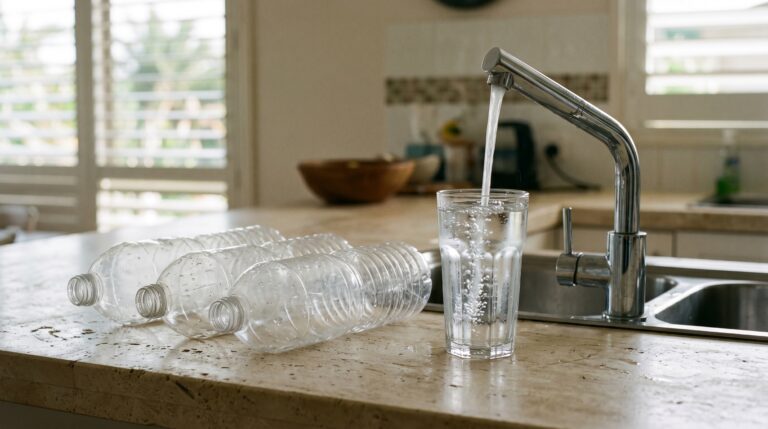
Both systems work out to well under 30 cents per litre of filtered water. For context, a 600 mL bottle of water costs $2.50–$4.00 at a servo. Even at $0.26/L, the EcoHero is 10–15x cheaper than bottled water, and according to ABS waste data, 373 million plastic bottles go to Australian landfill annually. Either RO system eliminates your household’s contribution to that number.
City-by-City: Which System Suits Your Water?
Australia’s tap water is not uniform. Your city’s disinfection method, hardness, and TDS level directly affect which RO system performs best for you.
Brisbane, Sydney, Adelaide, Gold Coast, Darwin (Chloramine Cities)
If you live in any of these cities, your water utility uses chloramine (combined chlorine) as the primary disinfectant. Both the EcoHero and AquaTru handle chloramine through their RO membranes, but the carbon pre-filters in each system also play a critical role in protecting the membrane from chloramine degradation. The EcoHero’s dual carbon pre-filter stages are specifically designed for this.
Brisbane and south-east QLD: SEQ Water supplies water with TDS typically in the 80–115 mg/L range and moderate hardness of approximately 80–120 mg/L CaCO3. Both systems will reduce TDS to 5–20 mg/L. Fluoride is added at approximately 0.7 mg/L. Logan, Ipswich, and Mt Crosby supply areas may see slightly higher TDS variation — both RO systems handle this without issue.
Sydney: Sydney Water adds fluoride at approximately 1.0 mg/L, one of the higher rates in Australia. At that concentration, the AquaTru’s 97.8% fluoride rejection drops it to ~0.022 mg/L, while the EcoHero’s 93.6% brings it to ~0.064 mg/L. Both are effectively zero for practical purposes. Penrith and western Sydney suburbs tend to have slightly harder water than eastern catchments.
Adelaide: SA Water supplies some of the hardest tap water in Australia — approximately 140 mg/L CaCO3 with TDS around 400 mg/L. RO is particularly valuable here because it strips dissolved solids that cause scale, poor taste, and appliance damage. Both systems handle Adelaide water well, though the EcoHero’s water efficiency advantage is especially relevant given SA’s higher water pricing.
Perth: Water Corporation WA supplies water with approximately 180 mg/L CaCO3 hardness and TDS around 170 mg/L — the hardest capital city water in Australia. Both RO systems will dramatically improve taste and reduce scale-forming minerals. Rockingham, Kwinana, and Mandurah residents also face potential PFAS exposure from the industrial corridor, making RO a prudent choice.
Melbourne, Hobart, Canberra (Free Chlorine Cities)
If you live in Melbourne, Hobart, or Canberra, your water is treated with free chlorine, not chloramine. This means even standard carbon filters work effectively for taste and chlorine removal. However, if your primary concern is fluoride or PFAS removal, you still need RO — standard carbon cannot touch fluoride. Melbourne Water draws from the Yarra Valley catchment, producing very soft water (~25 mg/L CaCO3, TDS ~60 mg/L). Both the EcoHero and AquaTru will work exceptionally well on Melbourne water, though you could argue the need for RO is less urgent here unless fluoride or PFAS removal is your specific goal.
Decision Tree: 3 Questions to Your Answer
Which RO Filter Should You Buy?
Question 1: Can you modify your plumbing?
YES → Consider the EcoHero 5-Stage RO (under-sink, continuous flow, WaterMark certified).
NO → The AquaTru Countertop is your answer. No plumbing, no plumber, no bond risk.
Question 2: How many people in your household?
1–2 people → Either system works. AquaTru’s 3L tank is sufficient.
3+ people → The EcoHero’s continuous flow becomes a significant daily convenience advantage.
Question 3: What is your primary concern?
Fluoride → AquaTru has a slight edge (97.8% vs 93.6%), but both are highly effective.
PFAS, lead, chloramine, general contaminants → Both perform equally well. Choose based on installation type.
Water efficiency / environmental impact → EcoHero wins decisively (300% efficiency vs ~1:1).
How Each System Compares to Other Options
These are not the only two RO systems available in Australia, but they are the two I recommend most frequently because of their verified certifications and suitability for Australian water conditions. Here is how they sit in the broader landscape:
The Waterdrop D6 is another under-sink RO option available on Amazon AU. It is a tankless system with a compact footprint, but it does not carry WaterMark AS3497 certification for Australian plumbing compliance. For homeowners who need building and insurance compliance, the EcoHero is the safer choice. You can read more about under-sink options in our best under-sink water filter guide for Australia.
The Tappwater EcoPro is a benchtop carbon block filter, not an RO system. It is effective for chlorine taste removal and some contaminants, but it cannot remove fluoride. If fluoride or PFAS removal is your requirement, carbon-only systems are not in the same category. See our best countertop water filter guide for Australia for a full comparison.
The Berkey Royal is a gravity-fed filter that uses proprietary “Black Berkey” elements. Berkey systems are not certified to NSF/ANSI 58 for reverse osmosis performance, and their contaminant removal claims are based on proprietary testing rather than third-party NSF verification. For Australian households specifically requiring certified fluoride and PFAS removal, the EcoHero and AquaTru are more transparently verified options.
What I Liked and What Could Be Better
EcoHero 5-Stage RO
What I liked:
- WaterMark AS3497 certification — the only under-sink RO in this price range I have seen with full Australian plumbing compliance
- 300% water efficiency — actually impressive, and noticeable on your water bill over time
- Continuous flow — turn the tap, water flows. No waiting, no batch processing
- Clean installation — the dedicated faucet looks professional and does not interfere with your main tap
- Australian company — Pure Water Systems is based in Australia with local support
What could be better:
- Upfront cost is steep — $1,034 plus $200 for a plumber is a significant outlay
- Fluoride rejection (93.6%) is solid but slightly behind the AquaTru’s 97.8%
- Not portable — once it is in, it stays in. Moving house means deinstalling, transporting, and reinstalling
- Requires under-sink cabinet space — older Australian homes with small under-sink areas may struggle to fit the system
AquaTru Countertop
What I liked:
- Triple NSF certification (58 + 42 + 53) — the broadest certification coverage of any countertop RO available in Australia
- 97.8% fluoride rejection — the highest of any countertop RO available in Australia
- Zero installation — unbox, fill, plug in, drink. Under five minutes from box to first glass
- Portability — take it anywhere. Rentals, holiday homes, even caravan parks if you have a power point
- Lower upfront cost — $699–$799 with no installation fee
What could be better:
- 3L tank capacity — for a family of four, you will refill multiple times per day
- Batch processing — you cannot fill a large pot directly from the tap. You wait for the tank to fill, then dispense
- Bench space — it occupies a meaningful footprint on your kitchen bench
- Water efficiency — conventional ~1:1 ratio means more water waste than the EcoHero
- Power required — it needs a wall outlet, unlike gravity-fed alternatives
Final Verdict
If you own your home, have under-sink space, and want the most water-efficient, set-and-forget RO system with full Australian plumbing compliance, buy the EcoHero 5-Stage RO. The WaterMark AS3497 certification, 300% water efficiency, and continuous-flow operation make it the superior long-term investment for homeowners. Yes, you will pay more upfront. But you will never refill a tank, never wait for batch processing, and you will waste roughly 5,000 fewer litres of water over five years.
If you rent, move frequently, or simply cannot modify your plumbing, buy the AquaTru Countertop. It costs $300+ less upfront, achieves slightly higher fluoride rejection (97.8% vs 93.6%), holds triple NSF certification, and requires zero installation. It is the most capable portable RO system available to Australian households in 2026.
Either way, you are choosing a certified reverse osmosis system that removes fluoride, PFAS, chloramine, lead, arsenic, and dissolved solids from Australian tap water. Either way, you are drinking cleaner water than 95% of Australian households. The question is not whether to get RO — it is which installation type fits your life.
For a detailed breakdown of the EcoHero, read our full EcoHero 5-Stage RO review.
Ready to filter your water?
The EcoHero 5-Stage RO is the top-rated under-sink filter for Australian homes — NSF 58 certified, WaterMark AS3497, removes fluoride, PFAS, lead, and chloramine. The AquaTru Countertop is the top-rated portable RO for renters — triple NSF certified, no plumbing required.
Last reviewed: April 2026 — Clean and Native
Frequently Asked Questions
Does the AquaTru remove chloramine from Brisbane and Sydney tap water?
Yes. The AquaTru’s reverse osmosis membrane removes chloramine effectively. Its NSF/ANSI 58 certification verifies contaminant rejection under standardised conditions, including chloramine-treated municipal water supplies used in Brisbane, Sydney, Adelaide, Gold Coast, and Darwin.
Does the EcoHero 5-Stage RO need WaterMark certification in Australia?
Any water filtration product that connects to Australian plumbing must carry WaterMark certification under the Plumbing Code of Australia. The EcoHero holds WaterMark AS3497 certification. Installing an uncertified system can void home insurance and create compliance issues during building inspections.
Can a carbon filter remove fluoride instead of reverse osmosis?
No. Carbon filters — including activated carbon, catalytic carbon, and carbon block — cannot remove fluoride from water. Only reverse osmosis (90–97% rejection) and activated alumina (80–95%) are effective for fluoride reduction, according to testing against NSF/ANSI 58 protocols.
How much water does the EcoHero waste compared to the AquaTru?
The EcoHero produces approximately 3 litres of filtered water per 1 litre of waste (300% efficiency). The AquaTru operates at roughly 1:1 ratio. Over five years at 4 litres per day, the AquaTru wastes approximately 5,000 litres more than the EcoHero.
Is the AquaTru good enough for a family of four?
The AquaTru’s 3-litre tank requires frequent refilling for a family of four. If your household uses 8–10 litres of drinking water daily for drinking, cooking, and bottles, you will refill the tank 3–4 times per day. The EcoHero’s continuous flow is a better fit for larger households.
Can I install the EcoHero myself without a plumber?
Not recommended. The EcoHero connects to a pressurised cold water line and requires drilling through your benchtop for the dedicated faucet. In most Australian states, connecting to plumbing requires a licensed plumber. DIY installation risks leaks, voided insurance, and non-compliance with plumbing codes. Budget $150–$250 for a licensed plumber.
Which system is better for Perth’s hard water?
Both systems handle Perth’s hard water (approximately 180 mg/L CaCO3, TDS ~170 mg/L) effectively. RO membranes reject 85–97% of dissolved solids regardless of source hardness. The EcoHero’s water efficiency advantage is especially relevant in Perth, where Water Corporation WA applies tiered pricing that escalates with usage.
Does the AquaTru work without being plugged in?
No. The AquaTru requires a power outlet to operate its pump, which pushes water through the RO membrane under pressure. It cannot function as a gravity-fed filter. If you need a filter that works without power, consider a gravity-fed system — but note that gravity filters cannot achieve RO-grade fluoride or PFAS removal.
How often do I need to replace filters on each system?
The EcoHero requires sediment and carbon pre-filter replacement every 6–12 months, and the RO membrane every 2–3 years, depending on feed water quality. The AquaTru requires VOC pre-filter replacement every 6 months, the RO membrane every 2 years, and the carbon post-filter annually. Annual filter costs are comparable at $120–$170 per year for both systems.
Will either system remove PFAS from my tap water?
Yes. Both hold NSF/ANSI 58 certification, which includes testing for PFOS and PFOA rejection by the RO membrane. Reverse osmosis is the gold-standard household technology for PFAS reduction, according to the DCCEEW and NSF International. If you live near a confirmed PFAS site — such as the Kwinana industrial corridor in Perth or Williamtown in NSW — an RO system is the most effective household intervention available.
Get the Australian Home Environment Checklist
30 checks across water, air and EMF. Most of them free. Ranked by impact.
No spam. Unsubscribe any time.

Former Royal Australian Navy Clearance Diver and TAG-E counter-terrorism operator. Founded Clean and Native to apply the same rigorous thinking to the home environment.
Full biography →