
Dirty Electricity Meter Australia 2026
A dirty electricity meter measures high-frequency voltage transients (2-150 kHz) riding on your 50 Hz mains wiring — the electrical noise your standard power meter ignores completely. With Australia‘s mandatory smart meter rollout accelerating toward 100% coverage by November 2030, and 33% of Australian homes now running solar inverters that generate significant transient noise, measuring your home’s dirty electricity levels before buying any filter is the only way to know whether you have a problem, where it originates, and whether a filter actually fixes it.
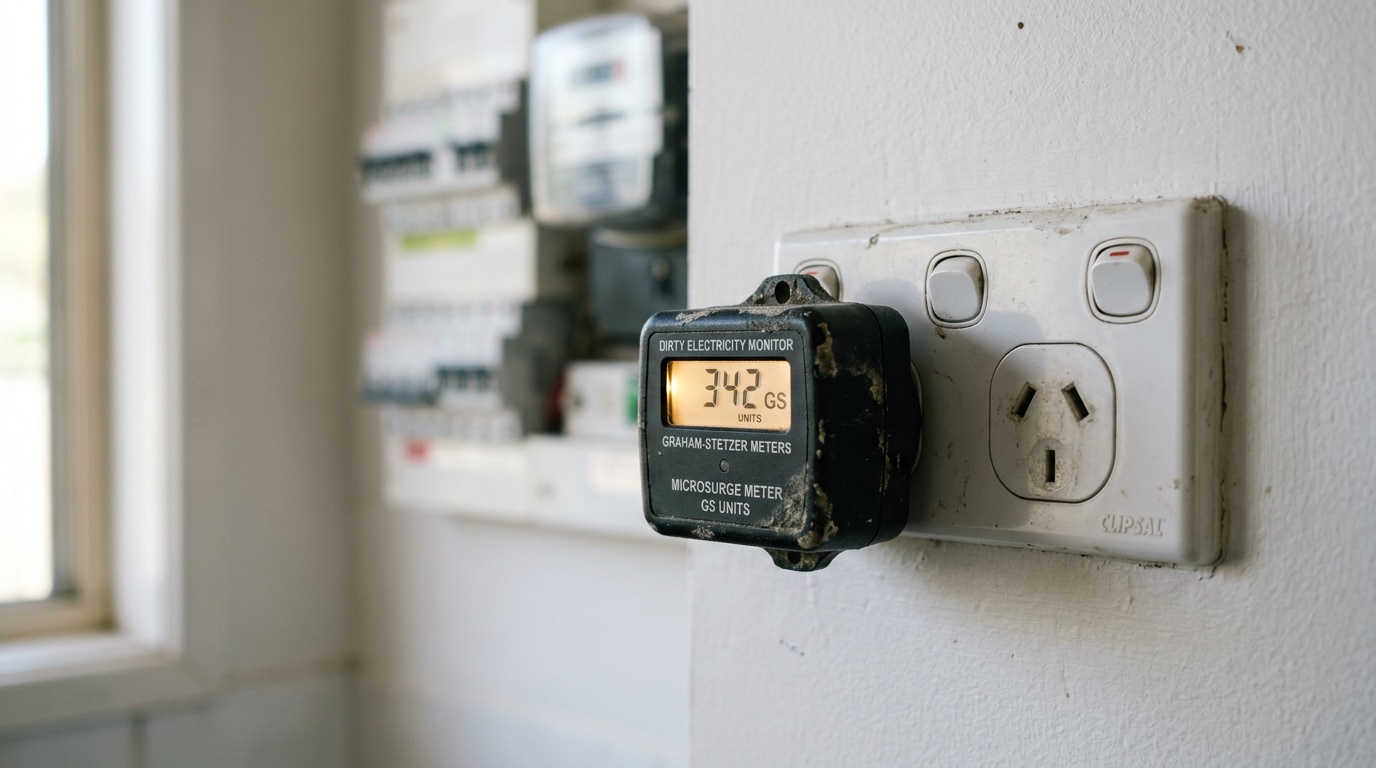
The Stetzerizer Microsurge Meter is the standard tool for measuring dirty electricity in Australian homes — plug it into any GPO, read GS units instantly, and map every circuit before spending a dollar on filters. It measures high-frequency transients in the 4-150 kHz range and gives you a numerical reading in Graham-Stetzer (GS) units that directly tells you whether action is needed. The Line EMI Meter is the professional-grade alternative with a wider frequency range and oscilloscope output. However, neither meter measures RF radiation from smart meters or Wi-Fi — for that, you need a separate RF meter like the Safe and Sound Pro II or TriField TF2.
Key catches
- Dirty electricity meters measure conducted EMI on wiring only — not radiated RF from smart meters, Wi-Fi, or 5G
- Solar inverter homes typically show 2-5x higher GS readings during daylight hours — always measure at midday AND after sunset to isolate solar contribution
- Stetzerizer meters are not available on Amazon AU — purchase through SaferEMF AU or direct from Stetzer Electric
| Meter | What It Measures | Verdict |
|---|---|---|
| Stetzerizer Microsurge | HF transients 4–150 kHz (GS units) | Recommended for most homes |
| Line EMI Meter | Wider frequency range, mV readout | Professional / detailed diagnostics |
| TriField TF2 (RF mode) | Radiated RF, AC magnetic, AC electric | Complementary — measures RF, not conducted |
Jayce Love here — former Navy Clearance Diver, now based in Palm Beach QLD. In the military, we never deployed countermeasures without intelligence first. You do not throw smoke grenades before knowing the wind direction. Dirty electricity filters work the same way: without a meter reading telling you exactly which circuits carry high-frequency noise and at what levels, you are spending money blind. This guide covers everything you need to measure dirty electricity in an Australian home in 2026, with specific attention to the solar inverter and smart meter issues that make Australian homes distinct from anywhere else in the world.
What Dirty Electricity Actually Is and Why Australians Should Care
Your mains wiring carries 50 Hz alternating current. That is the fundamental frequency. Dirty electricity — technically called conducted electromagnetic interference (EMI) or high-frequency voltage transients — refers to bursts of higher-frequency electrical noise (typically 2 kHz to 150 kHz) that ride on top of that 50 Hz sine wave. These transients are generated by any device that chops, switches, or converts electrical current: switch-mode power supplies in phone chargers, dimmer switches, variable-speed motors in modern appliances, compact fluorescent lamps, and critically for Australian homes, solar inverters.
The concern is simple. Your home’s wiring was designed to carry 50 Hz power. It was not designed as an antenna. When high-frequency transients ride on that wiring, the wiring itself radiates those frequencies into the living space as electric and magnetic fields. According to Building Biology guidelines (SBM-2015), the precautionary limit for AC electric fields in sleeping areas is below 5 V/m. High-frequency transients on bedroom circuit wiring can push radiated fields well above that threshold — but you will never know without measuring.
Here is the Australian-specific problem: according to the Clean Energy Regulator, approximately 33% of Australian homes now have rooftop solar photovoltaic systems. Solar inverters — the device that converts DC panel output to AC mains — are one of the most prolific generators of dirty electricity. During daylight hours, a typical string inverter can push GS readings from under 50 (excellent) to over 500 (severe) on circuits near the inverter. After sunset, readings drop back. If you live in Brisbane, Perth, or any high-solar-uptake suburb and you have not measured your daytime vs nighttime GS readings, you are operating without critical information.
Compounding this, the Australian Energy Market Commission’s accelerated smart meter deployment — targeting 100% coverage by 30 November 2030 according to AEMC rule changes finalised in 2025 — means every Australian home will soon have a smart meter. Smart meters use switched-mode power supplies internally and communicate via 900 MHz RF in bursts (Ausgrid in NSW, Energex in QLD). The meter itself can contribute conducted EMI to your wiring at the point of entry. Households receiving smart meter installation notices between now and 2030 have a narrow window to take baseline dirty electricity readings before installation, providing a genuine before-and-after comparison.
Two Meter Types: Stetzerizer Microsurge vs Line EMI Meter
You have two practical options for measuring dirty electricity in an Australian home. Both plug into a standard AU GPO (general purpose outlet). Both give you a numerical reading that tells you whether action is needed. The difference is resolution, frequency range, and price.
Stetzerizer Microsurge Meter
The Stetzerizer Microsurge Meter, designed by Dr Dave Stetzer and Professor Martin Graham (UC Berkeley), is the most widely used dirty electricity meter globally. It measures high-frequency voltage transients in the 4-150 kHz range and displays the result in Graham-Stetzer (GS) units — a proprietary but well-documented scale that quantifies the rate of change of voltage (dV/dt) on the circuit.
The threshold framework published by Stetzer Electric is simple:
| GS Reading | Classification | What It Means for You |
|---|---|---|
| Under 50 GS | Excellent | Clean power. No filtering needed on this circuit. |
| 50–200 GS | Moderate | Some transient noise present. Prioritise bedroom circuits. |
| 200–1,000 GS | Elevated | Filtering recommended. Identify the source device. |
| Over 1,000 GS | Severe | Major noise source nearby. Investigate immediately. |
The Stetzerizer meter is available in Australia through SaferEMF AU. It is not sold on Amazon AU. Operation is dead simple: plug it into any GPO, read the number on the LCD screen. No calibration, no setup, no software. The limitation is that it gives you a single number per outlet — useful for screening, but it does not show you the frequency spectrum of the noise or differentiate between multiple noise sources on the same circuit.
Line EMI Meter
The Line EMI Meter (also known as the Alpha Lab Line EMI meter or similar branded versions) provides a millivolt (mV) reading of high-frequency noise on the line. It typically covers a wider frequency range than the Stetzerizer and some models include an audio output that lets you hear the noise character — useful for identifying specific source types (solar inverter noise has a distinctive signature different from dimmer switch noise).
Professional building biologists and EMF consultants typically use the Line EMI Meter for detailed diagnostic work. For most Australian homeowners, the Stetzerizer Microsurge Meter is the correct starting point — simpler to use, easier to interpret, and directly compatible with the GS threshold framework that Stetzerizer filters are designed around.
How to Measure Dirty Electricity: Step by Step
Measuring dirty electricity is not complicated, but the sequence matters. Skip steps and you will draw wrong conclusions — particularly in a solar home where readings change dramatically between day and night.
Step 1: Establish a Baseline (Night Reading)
Wait until after sunset when solar panels have stopped generating. Turn off all unnecessary appliances and devices in the home. Walk to your main bedroom and plug the Stetzerizer meter into the GPO closest to your bed. Record the reading. This is your baseline — the background dirty electricity level on your bedroom circuit with minimal internal sources active.
In a typical Australian home without solar, baseline bedroom readings generally fall between 30-80 GS according to published case studies from building biology practitioners. If your baseline is already over 200 GS with everything off, you likely have an external noise source entering via the mains — potentially from a neighbour’s solar inverter or the distribution transformer on your street.
Step 2: Daytime Solar Comparison
If you have rooftop solar, repeat the exact same measurement at midday on a sunny day with the inverter running at full capacity. Record the reading at the same GPO. The difference between your nighttime baseline and your midday reading isolates the solar inverter’s contribution to dirty electricity on that circuit.
According to manufacturer documentation from major inverter brands (Fronius, SMA, Enphase), modern inverters include EMC filtering to meet Australian Standard AS/NZS CISPR 11 (industrial emissions limits). However, these emissions limits are designed to prevent interference with communications equipment — not to achieve Building Biology SBM-2015 precautionary thresholds for sleeping areas. The gap between the two standards is significant. An inverter can be fully AS/NZS CISPR 11 compliant and still push bedroom circuit readings above 200 GS.
Step 3: Map Every Room
Now systematically measure every accessible GPO in your home. Use a simple table:
| Room | GPO Location | Night (GS) | Day (GS) | Priority |
|---|---|---|---|---|
| Master bedroom | Bedside left | 45 | 310 | High — filter |
| Kitchen | Bench GPO | 180 | 520 | High — identify source |
| Home office | Desk GPO | 120 | 290 | Moderate — monitor |
| Living room | TV wall | 65 | 150 | Low — acceptable |
The pattern shown here is typical of a QLD or WA solar home: bedroom reads clean at night but spikes during the day due to inverter noise propagating through the wiring. Kitchen reads high at night too — likely from a microwave, induction cooktop, or fridge with a variable-speed compressor. Office has moderate noise from computer switch-mode power supplies.
Step 4: Isolate Sources
For any GPO reading over 200 GS, isolate the source. Turn off devices on that circuit one at a time at the switchboard. After each change, re-read the GPO. When the reading drops sharply, you have found your primary source. Common culprits in Australian homes: LED dimmer switches (especially cheap trailing-edge dimmers), induction cooktops, variable-speed pool pumps, solar inverters, and cheap phone chargers plugged in continuously.
Step 5: Verify Filter Effectiveness
Only after you have mapped your home and identified high-GS circuits should you install dirty electricity filters. The verification process is simple: read the GPO, install the filter, read the GPO again immediately. A properly functioning Stetzerizer filter on a circuit with 350 GS should drop that reading to under 50 GS. If it does not, either the noise source is too powerful for a single filter (add a second) or the noise is entering the circuit from a different point.
Australia-Specific Sources: Solar Inverters, Smart Meters, and the 2030 Rollout
Australian homes face a unique combination of dirty electricity sources that homes in Europe, the UK, and North America typically do not. Understanding these sources is essential before you start measuring — because they determine when, where, and how aggressively you need to measure.
Solar Inverters: The Biggest Source in One-Third of Australian Homes
According to the Clean Energy Regulator’s quarterly reports, over 3.7 million Australian homes have rooftop solar PV systems as of early 2026. That is roughly one in three houses. Every one of those systems includes an inverter that converts variable DC from the panels to 50 Hz AC for the grid. This conversion process uses high-frequency switching (typically 10-50 kHz depending on the inverter topology) and those switching frequencies appear as conducted EMI on the house wiring.
String inverters (Fronius, SMA, Goodwe) are typically mounted on the garage wall near the switchboard. Microinverters (Enphase) sit under each panel on the roof. Both generate dirty electricity, but the propagation pattern differs. String inverter noise enters the wiring at a single point near the switchboard and propagates to all circuits. Microinverter noise enters at the roof and travels down to the switchboard, then propagates. In both cases, the circuits closest to the inverter or its wiring run show the highest GS readings.
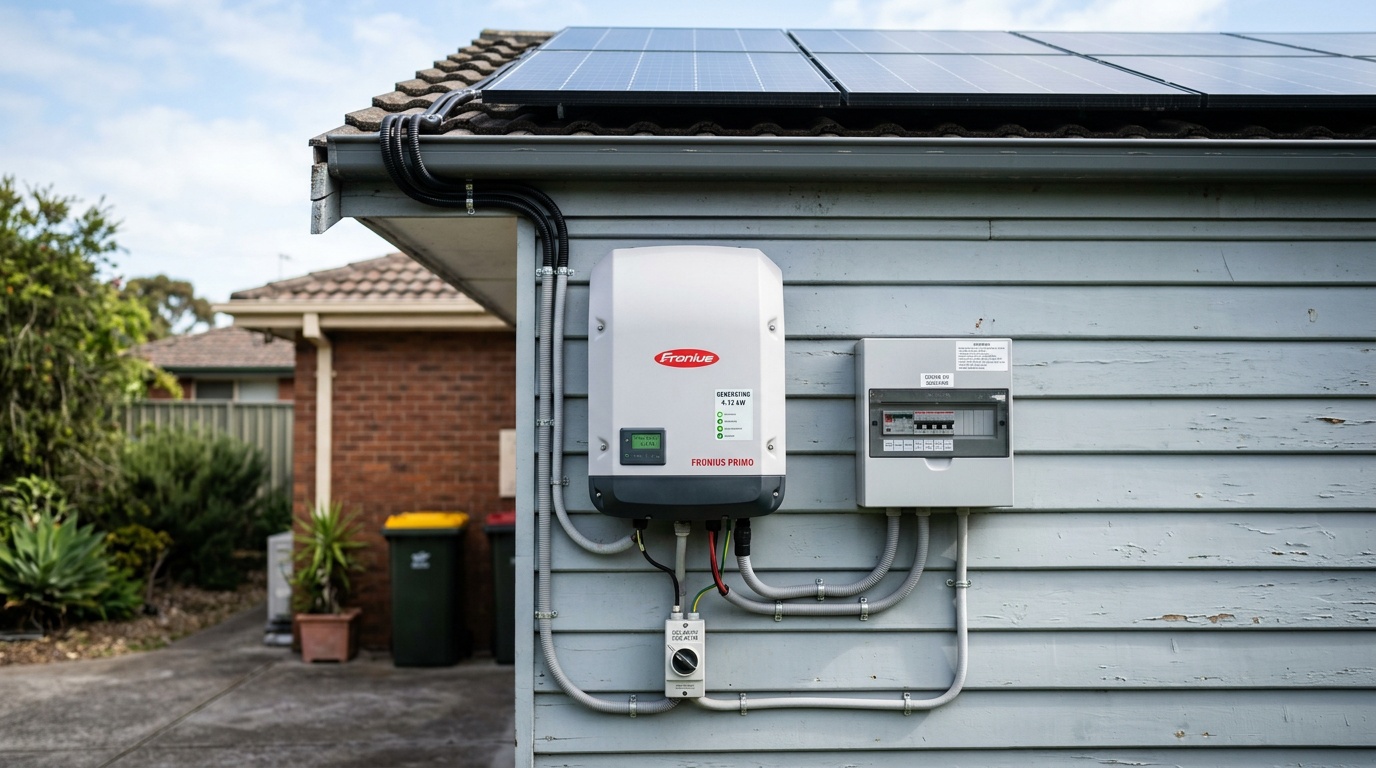
The practical implication: if your bedroom shares a wall with the garage where the inverter is mounted, or if the inverter’s DC isolator wiring runs through the ceiling above your bedroom, you are likely sleeping in the highest-dirty-electricity zone in your house during daylight hours. Measure there first.
Smart Meters and the AEMC 2030 Mandate
The Australian Energy Market Commission finalised rules in 2025 to accelerate smart meter deployment, targeting 100% penetration by 30 November 2030. Distribution networks — Ausgrid and Endeavour Energy in NSW, Energex in QLD, AusNet and CitiPower/Powercor in Victoria, SA Power Networks in SA — are currently rolling out installations suburb by suburb.
Smart meters contribute to dirty electricity in two ways. First, their internal switch-mode power supply generates conducted EMI at the point of connection to your mains. Second, they communicate via 900 MHz RF in short bursts to mesh network repeaters. The RF component is a radiated emission — your dirty electricity meter will not detect it. For that, you need an RF meter like the TriField TF2 or Safe and Sound Pro II.
If you are in a suburb currently receiving smart meter installation notices, take a full house dirty electricity reading before the installer arrives. Then re-measure after installation. This gives you an objective before-and-after comparison that no amount of speculation can replace.
The Solar Sharer Offer Complication
From 1 July 2026, the Solar Sharer Offer (SSO) launched in NSW, SA, and south-east QLD, with Victoria following from 1 October 2026 according to ABC News reporting. This scheme provides free or discounted electricity from neighbour solar exports, routed through smart meters. The practical effect: more smart meter installations, more solar export activity on local distribution transformers, and potentially more high-frequency noise entering homes from the grid side — even in homes without their own solar panels. If your neighbour has solar and you do not, your dirty electricity levels can still be elevated by noise coupling through the shared distribution transformer.
Bedroom vs Kitchen vs Office: Where Readings Matter Most
Not all rooms carry equal weight when it comes to dirty electricity exposure. Your bedroom is the priority, followed by your home office, then your kitchen. The logic is exposure duration and vulnerability.
Bedroom (highest priority): You spend 7-9 hours in your bedroom every night, typically within 1-2 metres of wiring in the walls, floor, and ceiling. Building Biology SBM-2015 sets the strictest thresholds for sleeping areas precisely because exposure is long-duration and the body is in a recovery state. A circuit running 300 GS at the bedside GPO means your body is exposed to elevated high-frequency electric fields for the entire sleep period. This is where you focus filtering first. A Jackson 24hr Mechanical Timer on your router ($20) combined with phone airplane mode eliminates two major sources of both RF and dirty electricity in the bedroom for zero ongoing cost.
Home office (second priority): If you work from home — and ABS data shows 37% of employed Australians regularly work from home as of 2024 — your office is your second-highest-exposure room by duration. Computers, monitors, multi-plug powerboards with switch-mode adaptors, and printers all generate dirty electricity. Typical home office GS readings range from 80-300 GS depending on equipment. A Stetzerizer filter at the desk GPO combined with removing unnecessary chargers from the circuit addresses most office noise.
Kitchen (monitor but do not over-prioritise): Kitchens often show the highest absolute GS readings in the house — 400-800+ GS is common due to induction cooktops, microwaves, fridges with inverter compressors, and multiple switch-mode appliances. However, you typically spend 1-2 hours per day in the kitchen. The exposure duration is short. Address kitchen circuits after bedroom and office are clean. If you have an induction cooktop generating 600+ GS, a filter alone may not bring readings below 50 GS — you may need to consider whether the induction hob is the right choice for your household. That is a decision the meter forces you to confront with data rather than speculation.
Recommended Meters and Where to Buy in Australia
Dirty electricity meters are niche products. You will not find them at Bunnings, Jaycar, or Officeworks. The two reliable Australian sources are SaferEMF AU (specialist EMF retailer based in Australia) and direct import from Stetzer Electric in the US. SaferEMF handles shipping, GST, and AU warranty — it is the simpler path.
For a comprehensive EMF assessment, pair a dirty electricity meter with an RF and low-frequency EMF meter. The TriField TF2 measures AC magnetic fields, AC electric fields, and RF in one device — covering everything the dirty electricity meter does not. The Safe and Sound Pro II is the specialist RF meter with higher sensitivity and an audio output that lets you hear smart meter burst transmissions in real time.
The dirty electricity meter handles conducted EMI on wiring. The TriField or Safe and Sound handles radiated EMI from smart meters, Wi-Fi routers, DECT phones, and 5G small cells. Together, they cover every EMF exposure pathway in your home. Separately, each one leaves gaps. Read the full breakdown in our complete EMF guide for Australian homes.
Common Mistakes That Waste Your Time and Money
After reviewing hundreds of forum posts, building biology case studies, and manufacturer documentation on dirty electricity measurement in Australian homes, the same errors appear repeatedly. Avoid these and you will get accurate readings on your first attempt.
Mistake 1: Measuring Only at Night (Solar Homes)
If you have solar panels and only measure after dark, you are measuring your home at its cleanest. You will conclude everything is fine, buy no filters, and spend every daylight hour in elevated dirty electricity without knowing it. Always measure at solar peak (midday, clear sky) and after sunset. The delta between the two readings is your solar inverter contribution.
Mistake 2: Confusing Dirty Electricity with RF Radiation
A Stetzerizer meter measures conducted noise on wiring. It does not measure the 900 MHz RF bursts from your smart meter, your 2.4 GHz Wi-Fi router, or the 3.5 GHz 5G small cell on the power pole outside. These are different exposure pathways that require different meters. Buying a dirty electricity filter will not reduce your smart meter’s RF emissions. For that, you need to address the RF source directly — move the router, use a mechanical timer to shut it off at night, or shield the wall (only after confirming the source is external — see our EMF protection guide for the correct shielding sequence).
Mistake 3: Buying Filters Before Measuring
This is the most expensive mistake. A pack of Stetzerizer filters costs significantly more than a single meter. If your home’s GS readings are already below 50 on bedroom circuits, you need zero filters. If your kitchen reads 500 GS but your bedroom reads 40 GS, you need filters for the kitchen only — not every room. The meter pays for itself by preventing unnecessary filter purchases. Without measurement data, the most common outcome is buying too many filters for rooms that do not need them and too few for circuits that do.
Mistake 4: Not Re-Measuring After Changes
You install a filter, assume it is working, and move on. Three months later, you add a new appliance to the circuit or your solar inverter firmware updates. GS readings change. The filter that brought your bedroom from 280 GS to 45 GS may now only bring it to 120 GS because a new noise source has been added to the circuit. Re-measure quarterly, or any time you add significant electrical equipment.
Mistake 5: Measuring with the Meter Extension Cord
If you use an extension cord to position the meter, the extension cord itself adds impedance and can alter the reading. Always plug the Stetzerizer meter directly into the wall GPO. No powerboards, no extension leads, no adaptors. Direct insertion gives you the true reading at that outlet.
Mistake 6: Ignoring the Switchboard
Your switchboard is the distribution point for all circuits. Measuring at the switchboard (if there is an accessible GPO nearby) gives you a sense of the total incoming noise from the grid plus solar inverter. If switchboard readings are high but individual room readings are low, your wiring may be attenuating the noise naturally. If switchboard readings are low but a specific room reads high, the noise source is local to that room’s circuit.
The Complete Measurement Protocol: Decision Tree
Condense everything above into a three-question decision framework you can follow in under 90 minutes:
1. Do you have rooftop solar?
Yes → Measure every GPO at midday (sunny) AND after dark. Calculate the delta. If daytime readings exceed 200 GS on bedroom or office circuits, dirty electricity filters are warranted on those circuits.
No → Measure at any consistent time. Focus on identifying internal sources (dimmers, appliances, chargers).
2. Are any circuits above 200 GS?
Yes → Isolate the source (turn off devices one by one at the switchboard). If the source is removable (dimmer, cheap charger), remove it. If not (solar inverter, fridge), filter the circuit.
No → Your home is already below action thresholds. Re-measure after smart meter installation or when adding new equipment.
3. Have you addressed RF sources separately?
No → A dirty electricity meter does not measure RF. Use a TriField TF2 or Safe and Sound Pro II to measure smart meter RF, Wi-Fi, and DECT phone radiation separately. These are different exposure pathways requiring different solutions.
Yes → You have a complete EMF picture. Prioritise by exposure duration: bedroom first, office second, kitchen third.
Last reviewed: July 2026 – Clean and Native
Start with measurement. Every EMF decision without data is a guess.
The Stetzerizer Microsurge Meter measures conducted dirty electricity on your wiring. The TriField TF2 measures radiated RF, AC magnetic, and AC electric fields. Together, they cover every exposure pathway in your home.
Frequently Asked Questions
What is dirty electricity in simple terms?
Dirty electricity is high-frequency electrical noise (2-150 kHz) that rides on your standard 50 Hz mains wiring. It is generated by devices that switch or convert power — solar inverters, dimmer switches, LED drivers, and switch-mode power supplies. Your home wiring radiates this noise into the living space as electric and magnetic fields.
Does a Stetzerizer meter detect smart meter radiation?
No. The Stetzerizer Microsurge Meter measures conducted noise on wiring only. Smart meters transmit via 900 MHz RF bursts — a radiated emission. You need an RF meter such as the TriField TF2 or Safe and Sound Pro II to detect smart meter RF radiation.
What GS reading is considered safe for a bedroom?
Below 50 GS is classified as excellent by Stetzer Electric’s published threshold framework. Between 50 and 200 GS is moderate. Above 200 GS, filtering is recommended, particularly for sleeping areas where exposure duration is 7-9 hours nightly.
Do solar panels cause dirty electricity?
The panels themselves do not. The solar inverter does. Inverters use high-frequency switching (typically 10-50 kHz) to convert DC from panels to AC mains. This generates conducted electromagnetic interference that propagates through house wiring. Readings can be 2-5 times higher during daylight hours compared to after sunset.
Can I buy a Stetzerizer meter on Amazon Australia?
No. The Stetzerizer Microsurge Meter is not listed on Amazon AU. The most reliable Australian source is SaferEMF AU, which handles shipping, GST, and local warranty. Alternatively, you can order directly from Stetzer Electric in the US, though shipping and import fees apply.
How many dirty electricity filters do I need per room?
That depends entirely on your meter readings. One filter per GPO typically drops readings by 50-80%. High-noise circuits (over 500 GS) may need two filters on the same circuit to reach below 50 GS. Never buy filters without measuring first — many rooms may already be below 50 GS and need zero filters.
Will a demand switch reduce dirty electricity in my bedroom?
A demand switch cuts power to the bedroom circuit when no loads are drawing current, eliminating AC electric fields from the wiring. This also eliminates any dirty electricity on that circuit, because no current flows. A licensed electrician installs it on the bedroom circuit breaker for approximately $100-150. It is the most effective single intervention for sleeping area EMF reduction.
Does my neighbour’s solar affect my dirty electricity levels?
Yes, it can. High-frequency noise from a neighbour’s solar inverter can couple through the shared distribution transformer and enter your home wiring via the mains. This is measurable with a Stetzerizer meter at your switchboard GPO. If readings are elevated at the switchboard but low at internal GPOs, grid-side noise from neighbours’ solar is a likely contributor.
When should I take baseline readings before smart meter installation?
As soon as you receive your smart meter installation notice from your distribution network (Ausgrid, Energex, AusNet, etc.). Map every room with the Stetzerizer meter at both daytime and nighttime. Record and photograph readings. After the smart meter is installed, repeat the exact same measurements at the same GPOs. The delta isolates the smart meter’s contribution to your home’s dirty electricity levels.
Can I use the TriField TF2 to measure dirty electricity?
The TriField TF2 measures radiated AC magnetic fields, AC electric fields, and RF radiation. It does not directly measure conducted high-frequency transients on wiring in GS units. However, its AC electric field mode can detect elevated radiated fields from wiring carrying dirty electricity. For direct dirty electricity measurement with GS thresholds, use a dedicated Stetzerizer Microsurge Meter. The two meters are complementary, not interchangeable.