Why Shower Water Makes Eczema Worse in Australia
Drafted with AI assistance and checked against published specifications and certifications. First-hand measurements appear only where stated. How we make content
Australian shower water can worsen eczema through three distinct mechanisms: chloramine disinfectant (used in Brisbane, Sydney, and Adelaide; Darwin: verify with Power and Water Corp), hard water minerals that raise skin pH and damage the lipid barrier, and hot water temperature that strips natural sebum. Not every trigger applies in every city — Adelaide faces all three, Perth faces hard water and temperature (free chlorine: standard filters work), while Melbourne and Hobart face only the temperature problem — so the fix depends entirely on where you live.
| Trigger | Mechanism | Worst-affected cities |
|---|---|---|
| Chloramine | Penetrates lipid bilayer, disrupts skin barrier | Brisbane, Sydney, Adelaide, Darwin (Perth: free chlorine — Water Corporation WA) |
| Hard water | Ca² raises skin pH, activates proteases | Perth (226 mg/L), Adelaide (148 mg/L) |
| Hot water (>37°C) | Strips sebum, increases TEWL | All cities — behavioural, not chemical |
Shower water worsens eczema through chloramine, hard water minerals, and heat — but which triggers apply to you depends on your city’s water supply. Adelaide residents face the hardest combination: chloramine disinfection, hard water (134–148 mg/L CaCO₃, SA Water), and the universal temperature factor. Perth faces hard water (up to 226 mg/L CaCO₃, Water Corporation WA) and temperature — free chlorine means standard shower filters work for the disinfectant. Melbourne and Hobart residents face only the heat problem — their water is soft (~25 mg/L) and uses free chlorine that dissipates quickly. The fix is city-specific: chloramine cities need a vitamin C or catalytic carbon shower filter, hard water cities benefit from shower softening, and everyone benefits from dropping water temperature below 37°C.
Key catches
- KDF-55 shower filters do NOT remove chloramine — only vitamin C (ascorbic acid) or catalytic carbon works in Brisbane, Sydney, Adelaide, and Darwin. Perth uses free chlorine (Water Corporation WA) — standard carbon or KDF works
- Hard water clinical trials on water softeners show mixed results for established eczema — prevention is better supported than treatment (Jabbar-Lopez et al. 2020, PubMed 33259122)
- Temperature control is free and applies in every Australian city — it is the most universally effective action
Reason 1: Chloramine Disinfectant Damages Your Skin Barrier
If you live in Brisbane, Sydney, Adelaide, or Darwin, the disinfectant in your shower water is not free chlorine. Perth uses free chlorine (confirmed by Water Corporation WA) — standard carbon shower filters work effectively for Perth’s disinfectant. It is chloramine — a combination of chlorine and ammonia that water utilities use because it persists longer in the pipe network. According to SEQ Water’s 2023-24 Annual Report, south-east Queensland uses chloramine as its primary residual disinfectant across the entire distribution network. Sydney Water confirms the same for greater Sydney.
This matters for your skin because chloramine is chemically more stable than free chlorine. That stability — the very reason utilities prefer it — means it does not off-gas at the showerhead the way free chlorine does. It stays in the water that contacts your skin. Chloramine penetrates the stratum corneum (the outermost skin layer) more readily than free chlorine, disrupting the lipid bilayer that keeps moisture in and irritants out.
For someone with eczema, that lipid barrier is already compromised. Every shower in a chloramine city delivers a chemical that attacks the weakest point of an already-weakened defence. The result is increased transepidermal water loss (TEWL), dryness, redness, and the itch-scratch cycle that drives eczema flares.
Why your current shower filter probably is not helping
Here is the problem most Australians do not know about: the vast majority of shower filters sold in Australia use KDF-55 (copper-zinc alloy) as their primary filtration media. KDF-55 removes free chlorine through a redox reaction effectively — it works well in Melbourne, Hobart, Canberra, Cairns, and Townsville, where utilities use free chlorine.
KDF-55 does not effectively remove chloramine. Standard GAC (granular activated carbon) is even worse — it removes chloramine at approximately 1/40th the rate it removes free chlorine, according to published carbon adsorption kinetics data. If you live in Brisbane, Sydney, Adelaide, or Darwin and you bought a shower filter with KDF-55 media, you are getting minimal chloramine reduction. Perth uses free chlorine — KDF-55 works fine there. The filter may improve the smell and feel of your water slightly, but the chloramine reaching your skin is largely unaffected.
The only shower filter media proven effective against chloramine are vitamin C (ascorbic acid), which neutralises chloramine through a direct chemical reaction, and catalytic carbon, which has a modified surface structure that accelerates chloramine breakdown. A standard carbon filter is not the same as catalytic carbon — the distinction is critical. For a detailed breakdown of shower filter technologies for chloramine cities, that guide covers the specific products that actually work.
Reason 2: Hard Water Minerals Raise Skin pH and Trigger Inflammation
Water hardness is the concentration of dissolved calcium and magnesium, measured in mg/L of calcium carbonate (CaCO₃). According to Water Corporation WA, Perth tap water reaches up to 226 mg/L CaCO₃ — classified as “hard” to “very hard” on the ADWG aesthetic guideline scale. SA Water reports Adelaide hardness at 134-148 mg/L CaCO₃, also firmly in the hard category. Compare that with Melbourne Water’s supply at approximately 25 mg/L CaCO₃ (very soft) and the difference is stark.
The mechanism by which hard water damages eczema-prone skin is well documented. A 2018 King’s College London study led by Danby SG demonstrated that washing with hard water at 180 mg/L CaCO₃ — comparable to Perth’s supply — caused measurable skin barrier damage compared with softened water. The calcium ions (Ca²⁺) interact with surfactants in soap and shampoo, particularly sodium lauryl sulphate (SLS), to form insoluble calcium stearate deposits on the stratum corneum.
Those deposits do two things. First, they physically clog pores and remain on the skin surface even after rinsing, creating a film that traps irritants against the skin. Second — and this is the more damaging mechanism — they raise local skin pH from its natural acidic range of 4.5-5.5 to an alkaline range of 7.5-8.5. That pH shift activates serine proteases, enzymes that break down the proteins holding skin cells together. In eczema-prone skin, this enzymatic degradation accelerates barrier breakdown and drives the itch-scratch cycle.
The epidemiological evidence: what the numbers say
Jabbar-Lopez ZK et al. published a systematic review and meta-analysis in Clinical & Experimental Allergy in 2020 (PubMed 33259122) examining the association between hard water and eczema prevalence. The pooled odds ratio was 1.28 — meaning people in hard water areas had 28% higher odds of developing eczema compared with soft water areas.
A 2022 UK Biobank analysis (PMC 9804584) extended this finding to adults, demonstrating that the biological mechanism — calcium and magnesium disrupting skin barrier function — applies across age groups, not only in infants as earlier research had suggested.
However, honesty demands this caveat: clinical trials on whole-house water softeners for treating established eczema have produced mixed results. The largest, the Softened Water Eczema Trial (SWET), found no significant improvement in eczema severity scores after 12 weeks of softened water use in children with existing eczema. The association between hard water and eczema development (prevention) is stronger than the evidence for softening water as a treatment for existing eczema.
What this means practically: if you live in Perth or Adelaide and your child develops eczema, hard water is a plausible contributing factor. But installing a water softener alone is unlikely to resolve established eczema — it is one piece of a multi-factor management approach that includes emollients, temperature control, and addressing other triggers.
| City | Hardness (mg/L CaCO₃) | Disinfectant | Eczema risk level |
|---|---|---|---|
| Perth | ~180–226 | Free chlorine (Water Corp WA) | High — hard water + temperature |
| Adelaide | ~134-148 | Chloramine | High — all 3 triggers |
| Darwin | ~150 | Chloramine | High — chloramine + hard water |
| Brisbane / SEQ | ~80-120 | Chloramine | Moderate — chloramine present, moderate hardness |
| Sydney | ~50 | Chloramine | Moderate — chloramine present, soft water |
| Melbourne | ~25 | Free chlorine | Low — soft water, free chlorine dissipates |
| Hobart | ~15 | Free chlorine | Lowest — very soft, free chlorine |
| Canberra | ~40 | Free chlorine | Low — soft water, free chlorine |
Reason 3: Hot Water Strips Sebum and Damages Filaggrin
This trigger applies in every Australian city regardless of water chemistry. Water temperature above 37°C — and most Australians shower well above that — strips the natural sebum layer from the skin surface. Sebum is the oily secretion that locks moisture in and keeps the stratum corneum flexible. Remove it, and TEWL (transepidermal water loss) spikes within minutes.
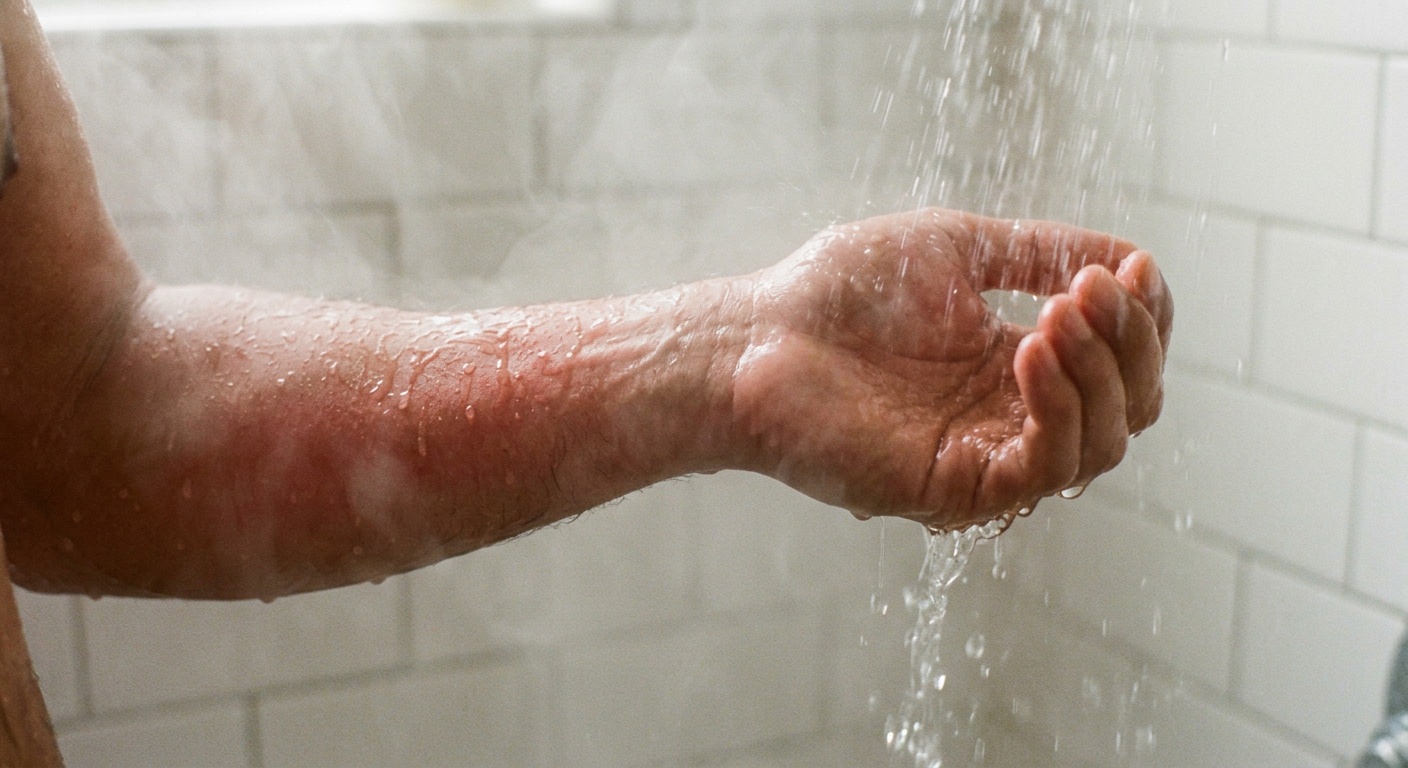
The mechanism goes deeper than sebum stripping. Heat above 37°C denatures filaggrin, the structural protein that holds skin cells together in the outermost layer. Filaggrin breakdown products (natural moisturising factor, or NMF) are critical for maintaining the acidic skin pH that protects against microbial colonisation and protease activation. When hot water damages filaggrin, NMF production drops, skin pH rises, and the same inflammatory cascade triggered by hard water minerals begins — through a completely independent pathway.
This is why some eczema sufferers in Melbourne — where water is very soft (25 mg/L CaCO₃ per Melbourne Water) and disinfected with free chlorine that dissipates quickly — still experience post-shower flares. The water chemistry is not the problem. The temperature is.
The fix is free and immediate: reduce your shower temperature to 32-35°C. It will feel cool for the first few days. After a week, your skin adjusts and the thermal comfort threshold drops. This single change eliminates the temperature trigger entirely — no product required, no cost, works in every city.
The Compounding Triple Threat: Why Perth and Adelaide Are the Worst Cities for Shower Eczema
Each of the three triggers above can worsen eczema independently. But they are not additive — they are compounding. Chloramine disrupts the lipid bilayer. Hard water minerals raise pH and activate proteases in the already-disrupted barrier. Hot water strips the sebum that might have partially compensated for the chemical damage. The three mechanisms attack different layers and pathways of the skin barrier simultaneously.
Perth faces two of the three. Water Corporation WA confirms hardness reaching 226 mg/L CaCO₃ in some supply zones and free chlorine disinfection (not chloramine) across the metro network, plus the universal temperature factor. Adelaide faces the same triple combination with SA Water reporting 134-148 mg/L CaCO₃ hardness and chloramine disinfection.
Brisbane and Sydney get two of three — chloramine plus moderate hardness (80-120 mg/L for Brisbane per SEQ Water, ~50 mg/L for Sydney). The hard water contribution is lower, but the chloramine exposure is identical.
Melbourne, Hobart, and Canberra get only one: the temperature trigger. Their water is soft, and free chlorine dissipates readily at the showerhead and during skin contact. If you live in these cities and your eczema worsens after showering, temperature is the primary suspect — not water chemistry. A shower filter is unlikely to make a meaningful difference in Melbourne unless you are specifically sensitive to low-level free chlorine residual.
Who Is Most at Risk: Filaggrin Mutations, Infants, and the Atopic March
Not everyone’s skin responds to these triggers equally. Three populations are disproportionately affected.
Filaggrin gene (FLG) mutation carriers. Approximately 10% of European-descent populations carry loss-of-function FLG mutations. Filaggrin is the protein that hot water damages — carriers start with lower baseline filaggrin production, so any additional assault on that protein has a proportionally larger effect. If you have a family history of eczema, asthma, or hay fever, FLG mutations are more likely. You cannot fix your genetics, but you can minimise the environmental triggers that exploit the vulnerability.
Infants under two. The stratum corneum in infants is approximately 30% thinner than in adults. Chloramine and hard water minerals penetrate more readily and cause more damage per unit of exposure. This is particularly relevant in Perth and Adelaide, where hard water hardness (Perth up to 226 mg/L, Adelaide 134–148 mg/L) and the Jabbar-Lopez 2020 meta-analysis (PubMed 33259122) association are most pronounced. If you are bathing an infant in a hard water city, lukewarm water (32-34°C) and a brief bathing time (5-7 minutes) are the minimum standard dermatological recommendations.
Those on the atopic march. The atopic march is the progression from eczema in infancy to allergic rhinitis and then asthma in childhood. Early skin barrier damage — from any cause, including shower water triggers — allows allergen sensitisation through the skin. Addressing shower water triggers early is not just about eczema management. It is about reducing the risk of the entire atopic cascade. For a deeper analysis of how hard water drives eczema in Australian cities, that guide covers the regional data in detail.
The Fix: City-Specific Interventions That Actually Work
Generic advice like “get a shower filter” is worse than useless if you buy the wrong type for your city’s water chemistry. Here is what works, organised by the triggers present in your water supply.
Perth and Adelaide: all three triggers present
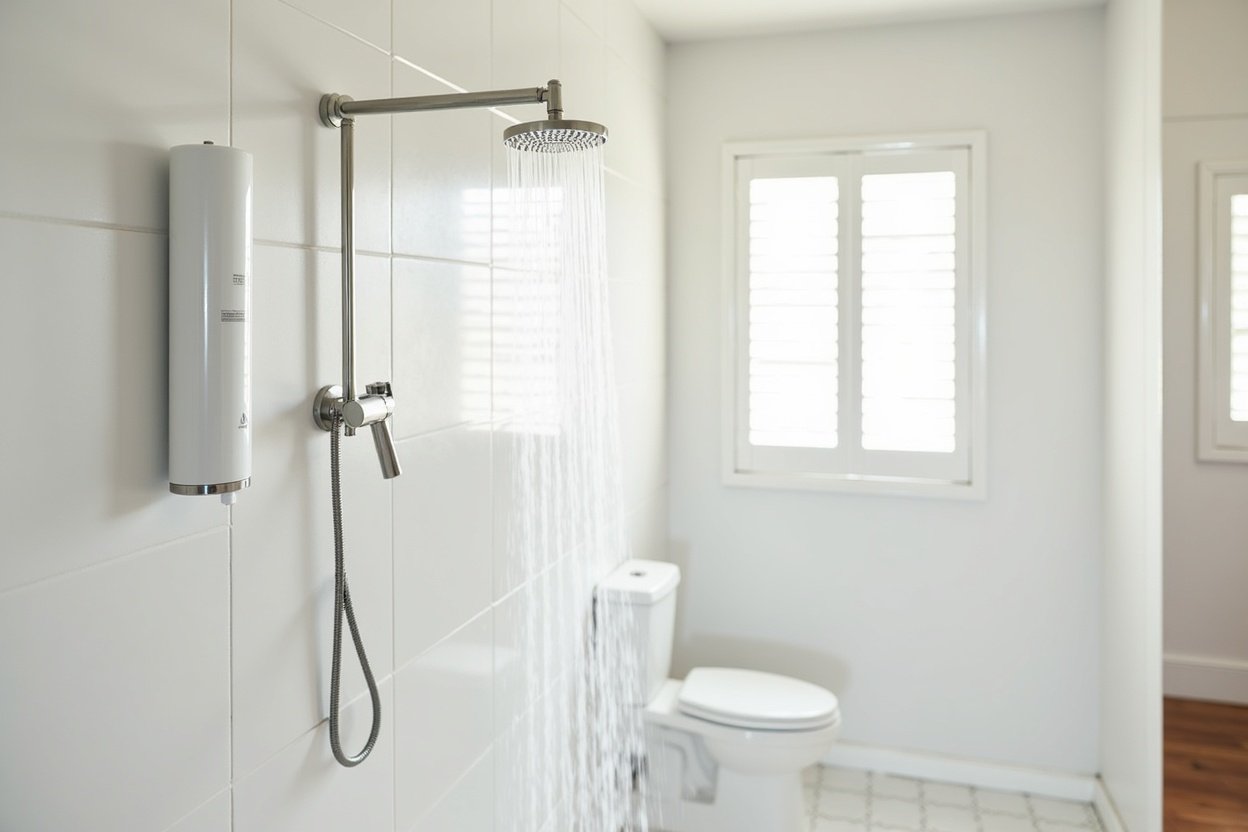
You need the full intervention stack. Step 1: Install a shower filter that uses vitamin C (ascorbic acid) or catalytic carbon media. Not KDF-55. Not standard GAC. Those will not touch the chloramine in your water. The Philips Premium Shower Filter uses a multi-stage system with vitamin C and catalytic carbon media designed for Australian chloramine conditions. Step 2: Drop your shower temperature to 32-35°C. Step 3: Apply emollient within 3 minutes of towelling off, while the stratum corneum is still partially hydrated. This “soak and seal” approach is the standard dermatological recommendation for eczema management.
For the hard water component specifically, a shower-head softening cartridge provides some mineral reduction but does not achieve the same level as a whole-house water softener. Given the mixed clinical trial evidence for water softening in established eczema, the chloramine removal and temperature control are likely to deliver more noticeable results than focusing on hardness alone.
Brisbane, Sydney, Darwin: chloramine + moderate hardness
Chloramine is your primary chemical trigger. A vitamin C or catalytic carbon shower filter rated for chloramine is the main intervention. Hard water hardness in Brisbane (80-120 mg/L per SEQ Water) and Sydney (~50 mg/L per Sydney Water) falls in the moderate-to-soft range — below the 180 mg/L threshold used in the Danby SG 2018 King’s College London study that demonstrated measurable skin damage. Temperature control remains important as the universal trigger.
Melbourne, Hobart, Canberra: temperature is the main factor
Your water is soft (Melbourne ~25 mg/L, Hobart ~15 mg/L, Canberra ~40 mg/L) and uses free chlorine, which dissipates readily during showering. A shower filter is probably not necessary for eczema management in these cities unless you have documented sensitivity to free chlorine residual. Your primary interventions are temperature control (32-35°C), brief shower duration (5-7 minutes), and emollient application within 3 minutes. These are free, evidence-based, and address the trigger that actually applies to your water.
How to Test Whether Your Water Is the Problem
Before spending money on products, confirm which triggers are actually present in your water. This takes 10 minutes and under $20.
Step 1: Identify your disinfectant type. Search your water utility’s website or annual report for “chloramine” or “monochloramine”. Brisbane (SEQ Water), Sydney (Sydney Water), and Adelaide (SA Water) confirm chloramine use in their annual water quality reports. Perth uses free chlorine, confirmed by Water Corporation WA. Melbourne Water, TasWater (Hobart), and Icon Water (Canberra) also use free chlorine. (Darwin: verify current method with Power and Water Corporation.) This is not a guess — it is published data.
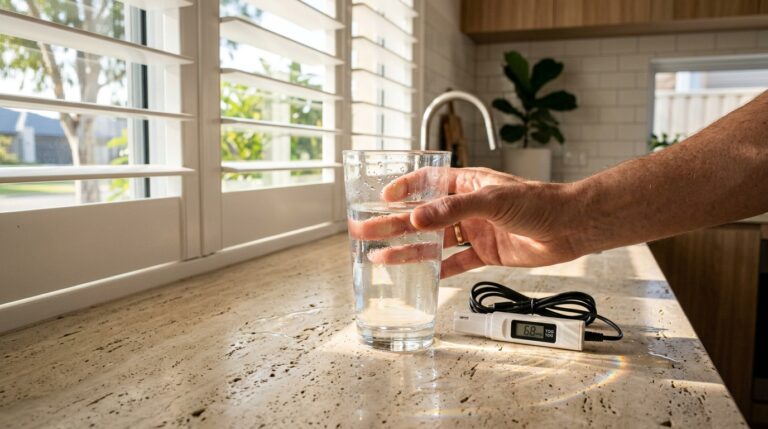
Step 2: Test your hardness. Buy a water hardness test strip kit from Amazon AU ($8-15). Run your shower for 30 seconds, then dip the strip in a glass of collected water. Compare the colour change to the chart. If hardness reads above 120 mg/L CaCO₃, hard water is a plausible contributing trigger. Below 60 mg/L, it is unlikely to be a significant factor.
Step 3: Temperature audit. Hold a digital thermometer under your shower stream at normal settings. If it reads above 37°C, you have identified the universal trigger. Most people find their “comfortable” shower temperature is 40-42°C — well into the sebum-stripping and filaggrin-damaging range.
Step 4: Elimination test. For two weeks, reduce shower temperature to 33°C and limit duration to 5 minutes. Apply emollient within 3 minutes of every shower. If eczema improves, temperature was a primary contributor. If symptoms persist and you are in a chloramine city, add a vitamin C or catalytic carbon shower filter for the next 2-4 weeks. Systematic elimination identifies your specific triggers rather than throwing money at all of them simultaneously.
What About Whole-House Water Softeners and Under-Sink RO?
If shower water triggers eczema, why not soften all the water in the house? Two reasons: cost and evidence.
A whole-house water softener in Australia runs $2,000-5,000 installed, requires salt replenishment, and adds sodium to the water (which is then not recommended for drinking or watering gardens without a bypass). For the broader water filtration picture, a whole-house softener is a significant investment.
More importantly, the SWET clinical trial — the largest randomised controlled trial of water softening for eczema — found no statistically significant improvement in eczema severity (SASSAD score) after 12 weeks. The association between hard water and eczema incidence is epidemiologically supported (Jabbar-Lopez 2020, OR 1.28). But the evidence for softening water as a treatment for existing eczema is weaker than the evidence for prevention.
Under-sink reverse osmosis systems remove both chloramine and hardness minerals with greater than 95% efficiency — but they filter drinking water, not shower water. Plumbing an RO system to supply a shower is technically possible but impractical and expensive. For drinking water in chloramine cities, an RO system addresses the fluoride that carbon filters miss; the certified Waterdrop X8 under-sink RO lists fluoride among the contaminants it reduces. But for shower exposure, a point-of-use shower filter matched to your city’s disinfectant type is the practical and evidence-supported approach.
Address the triggers your city’s water actually has
If you are in Brisbane, Sydney, or Adelaide, chloramine is reaching your skin every shower. Perth uses free chlorine — a standard shower filter works for the disinfectant.
Final Verdict
Shower water worsens eczema through three independent mechanisms — and which ones apply depends entirely on your postcode. Chloramine exposure affects Brisbane, Sydney, and Adelaide (and Darwin — verify with Power and Water Corp); hard water compounds the problem in Perth and Adelaide specifically (Perth uses free chlorine for disinfection — Water Corporation WA); temperature above 37°C applies everywhere. The fix for each is different: chloramine requires vitamin C or catalytic carbon, hard water requires whole-house softening or RO (not a shower filter), temperature requires a thermometer. Addressing the wrong trigger first wastes money and months of recovery time.
Start with the free diagnosis: confirm your city’s disinfectant type from your utility’s annual report and audit your shower temperature before buying anything. In a chloramine city, a vitamin C or catalytic carbon shower filter is the most targeted intervention. If hard water is your compounding factor, see the full guide to water filters for eczema in Australia.
Last reviewed: July 2026 – Clean and Native
Frequently Asked Questions
Why does my shower make my eczema worse?
Three factors can worsen eczema during showering: chloramine disinfectant (present in Brisbane, Sydney, Adelaide tap water; Perth uses free chlorine per Water Corporation WA), hard water minerals that raise skin pH and activate inflammatory enzymes, and water temperature above 37°C that strips protective sebum. Which triggers apply depends on your cityâs water supply.
Does Melbourne tap water cause eczema?
Melbourne tap water is very soft (~25 mg/L CaCO₃ per Melbourne Water) and uses free chlorine, which dissipates readily. The chloramine and hard water triggers are absent. If eczema worsens after showering in Melbourne, water temperature is the most likely cause. A shower filter is unlikely to help — reducing temperature to 32-35°C and applying emollient within 3 minutes is the recommended approach.
How long before a shower filter helps eczema?
Community reports and dermatological guidance suggest most people notice improvement within 1-4 weeks of installing a chloramine-removing shower filter, provided they also address water temperature. This is not a clinical guarantee — individual response depends on the severity of eczema, the specific triggers involved, and whether other irritants (laundry detergent, soap type) are contributing.
Do KDF-55 shower filters remove chloramine?
No. KDF-55 (copper-zinc alloy) removes free chlorine through a redox reaction but is ineffective against chloramine. If you live in a chloramine city (Brisbane, Sydney, Adelaide, Gold Coast, Darwin), you need a shower filter that uses vitamin C (ascorbic acid) or catalytic carbon media. Standard GAC removes chloramine at approximately 1/40th the rate of free chlorine — it is equally inadequate.
Does hard water cause eczema in Perth?
Perth has some of the hardest mains water in Australia, reaching 226 mg/L CaCO₃ according to Water Corporation WA. Jabbar-Lopez et al. 2020 (PubMed 33259122) found a pooled odds ratio of 1.28 for eczema in hard water areas. The Danby SG 2018 King’s College London study demonstrated measurable skin barrier damage at 180 mg/L. Perth’s water exceeds that threshold. Hard water is a plausible contributing factor to eczema in Perth, though not the sole cause.
Can a water softener cure eczema?
Unlikely as a standalone treatment. The SWET trial — the largest randomised controlled trial of water softening for eczema — found no statistically significant improvement in eczema severity scores after 12 weeks. The evidence is stronger for hard water as a risk factor for developing eczema than for softening as a treatment for existing eczema. A water softener may help as part of a multi-factor approach but should not be expected to resolve eczema on its own.
What temperature should I shower at for eczema?
Dermatological guidelines recommend 32-35°C for eczema-prone skin. Water above 37°C strips sebum, denatures filaggrin protein, and increases transepidermal water loss. Most people shower at 40-42°C without realising it. Use a digital thermometer to check. Reducing temperature is the single most effective free intervention for post-shower eczema flares in any city.
Does Brisbane tap water have chloramine?
Yes. According to SEQ Water’s 2023-24 Annual Report, south-east Queensland uses chloramine (monochloramine) as its primary residual disinfectant across the entire distribution network serving Brisbane, Logan, Ipswich, Gold Coast, and surrounding areas. Standard carbon and KDF-55 shower filters are ineffective against chloramine — only vitamin C or catalytic carbon media provide adequate removal.
Should I apply moisturiser before or after a shower for eczema?
After. The standard dermatological recommendation is to apply emollient within 3 minutes of towelling off, while the stratum corneum retains residual hydration. This “soak and seal” technique locks moisture in before transepidermal water loss peaks. Pat skin dry gently — do not rub — and apply a thick emollient (ointment or cream, not lotion) to all affected areas immediately.
Is Adelaide tap water bad for eczema?
Adelaide faces two of the three shower eczema triggers: chloramine disinfection and hard water at 134-148 mg/L CaCO₃ (SA Water data). Combined with hot shower temperatures, Adelaide residents face the same triple-threat as Perth. A vitamin C or catalytic carbon shower filter addresses the chloramine, while temperature control and emollient application manage the other triggers.
Get the Australian Home Environment Checklist
30 checks across water, air and EMF. Most of them free. Ranked by impact.
No spam. Unsubscribe any time.

Former Royal Australian Navy Clearance Diver and TAG-E counter-terrorism operator. Founded Clean and Native to apply the same rigorous thinking to the home environment.
Full biography →