Best EMF Meter Australia 2026: 4 Meters Compared, With Real Home Readings
Drafted with AI assistance and checked against published specifications and certifications. First-hand measurements appear only where stated. How we make content
How this assessment was made. I own one meter in this guide, a TriField TF2, and every reading on this page comes from it, photographed in my home in Palm Beach, QLD. I have not used the Safe and Sound Pro II, GQ EMF-390 or TM192; they are assessed from their manuals, the retailers’ published specifications and their Australian listings. Prices were checked on 30 Oct 2026. Clean and Native may earn a commission on some links.
The best EMF meter for most Australian homes is the TriField TF2 ($299.00at Amazon AU · as of 19 Nov 2026, 11:43 pm AEST Details). It reads all three field types (AC magnetic, AC electric and RF up to 6 GHz) in one meter, it is the meter I use at home, and its manual publishes accuracy figures, which most cheaper meters do not. The TF2 can show whether a bedroom sits in the building biology “severe” or “extreme” bands, but it cannot read low enough to confirm the “no concern” band (under 0.1 µW/m²). For that, the Safe and Sound Pro II ($499 from SaferEMF on the Gold Coast, or $99 to hire for three days) is the meter to use. On a budget, the GQ EMF-390 ($183) logs all three fields every second. For power-line and wiring fields only, the TM192 gauss meter ($186 on sale) is a low-cost way to measure magnetic fields on their own.
Diving taught me to know what an instrument can and cannot read before trusting its numbers. That is the whole game with EMF meters. Every meter below has real limits, and most of the bad advice online comes from reading a number outside them.
Choose the meter by the question you are asking, not by the number of fields on the box. Prices checked 30 Oct 2026.
| Meter | Best for | Price |
|---|---|---|
| TriField TF2 | Best overall: one meter for all three fields; the one I use | $299.00at Amazon AU · as of 19 Nov 2026, 11:43 pm AEST Details |
| Safe and Sound Pro II | Best for bedroom RF: reads far lower than the TF2 | $499, or $99 hire |
| GQ EMF-390 | Best budget: all three fields plus a 1-second data log | $139.00at Amazon AU · as of 19 Nov 2026, 4:29 pm AEST Details |
| TM192 gauss meter | Best for wiring and power lines: magnetic only | $186 (sale) |
✓ An EMF meter is worth buying if
- You want to know what your router, smart meter or wiring actually puts out where you sleep or work
- You are deciding where to put a bed, cot or desk
- You want to check whether a change (a router timer, moving a device) made a difference
- Someone is selling you a shielding product and you want to test the claim
× Skip it, or hire one, if
- You only need one bedroom checked once: hiring is cheaper
- You will not move or change anything whatever it reads
- You need a reading for a dispute or a property sale: use a professional with a laboratory-calibrated instrument
- You hoped a phone app would do the job (it cannot; see below)
What my TF2 read at home
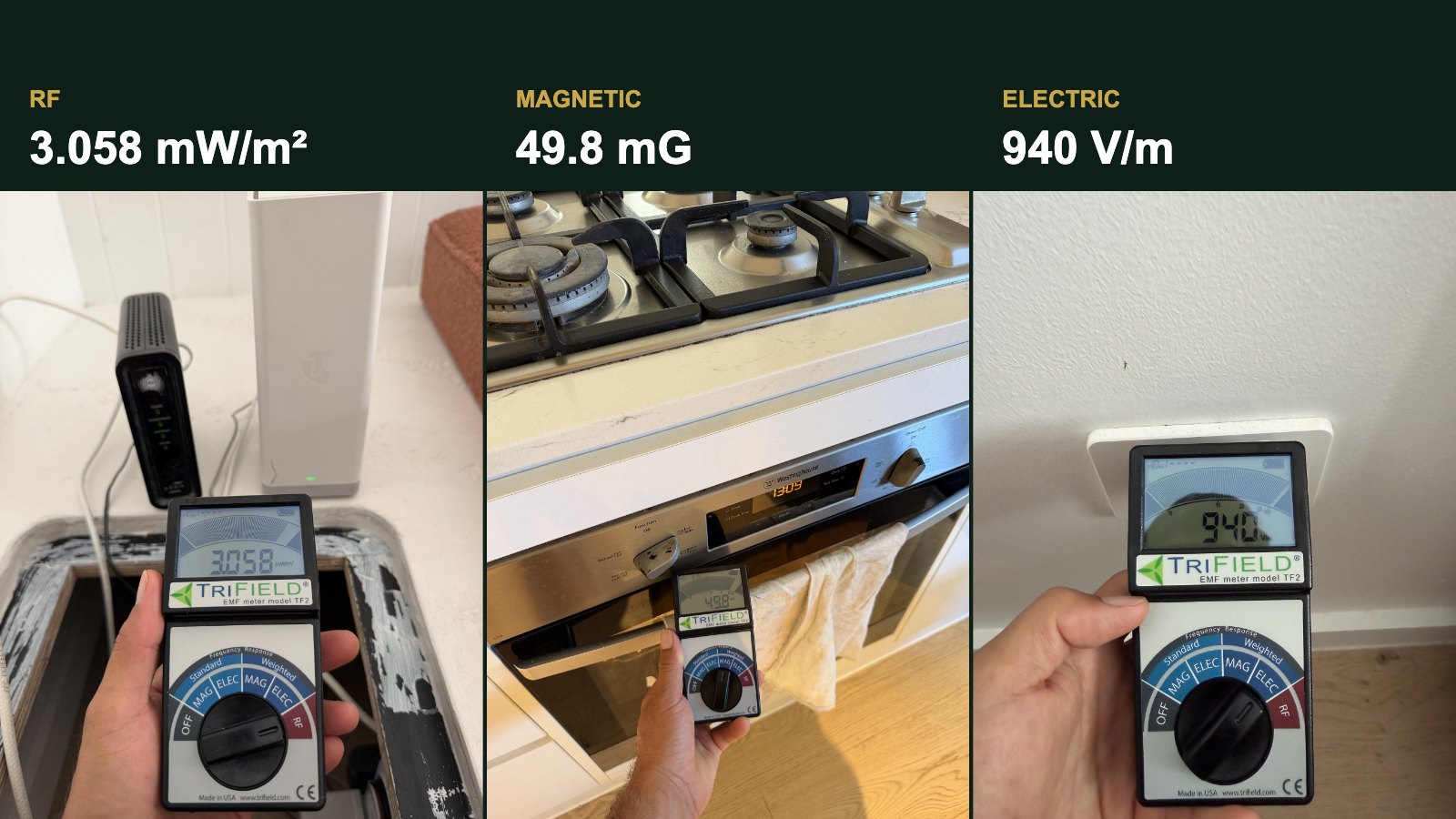
These are readings from my own TriField TF2 in my house in Palm Beach, on the Gold Coast, taken between March and June 2026. Each number below was read off the meter’s display in a photo, not from memory. The house has an NBN connection box and a Telstra modem-router, and the router runs on a timer, off from 9 pm to 6 am. The readings come from different visits, so treat them as a picture of one house, not a controlled experiment.
| Where | Field | TF2 reading |
|---|---|---|
| Close range to the modem and NBN box (highest seen) | RF | 4.380 mW/m² |
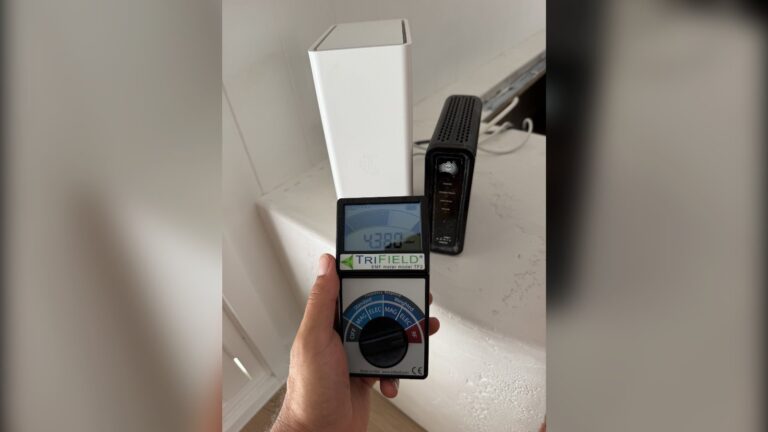
| Close range to the router (photo below) | RF | 3.058 to 3.878 mW/m² |
| Same room, about 2 to 3 m from the router | RF | 0.521 mW/m² |
| Same room, further back | RF | 0.257 mW/m² |
| Hallway, router several metres away | RF | 0.124 mW/m² |
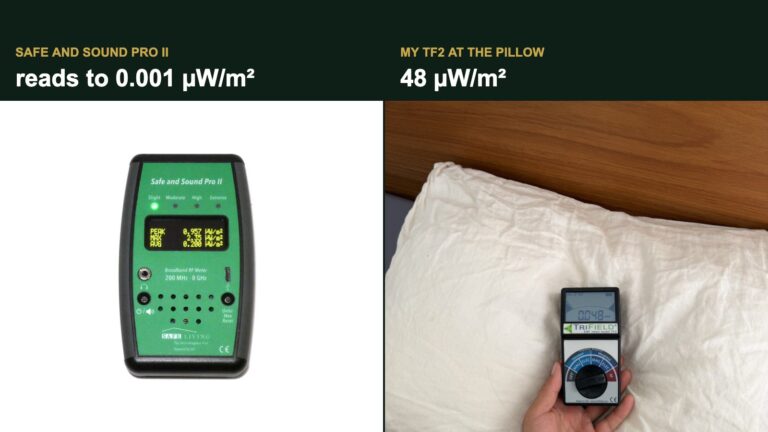
| Bed, at the pillow | RF | 0.048 mW/m² (peak 0.150) |
| Living room couch | RF | 0.032 mW/m² |
| Gas oven door, cooking position | Magnetic | 49.8 mG (peak about 51.5) |
| Internal walls (two spots) | Magnetic | 8.2 and 11.7 mG |
| Meter against a wall power outlet | Electric | 940 to 997 V/m |
| Timber bedhead (three spots) | Electric | 50 to 105 V/m |
| Pillow surface | Electric | 2 V/m |
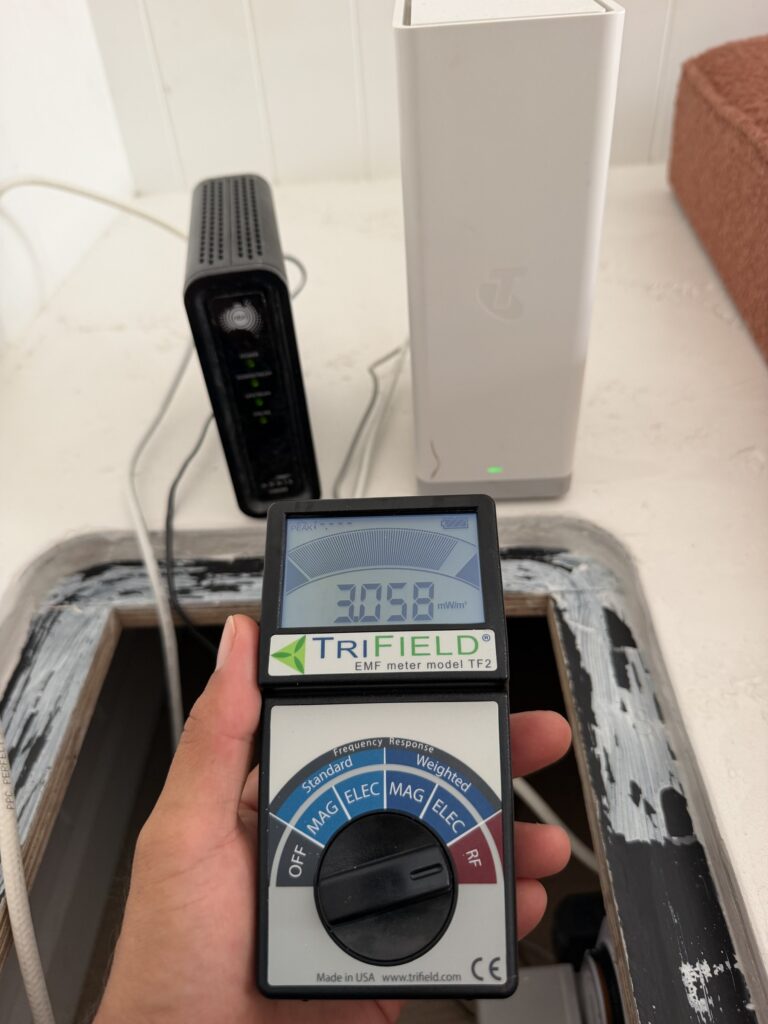
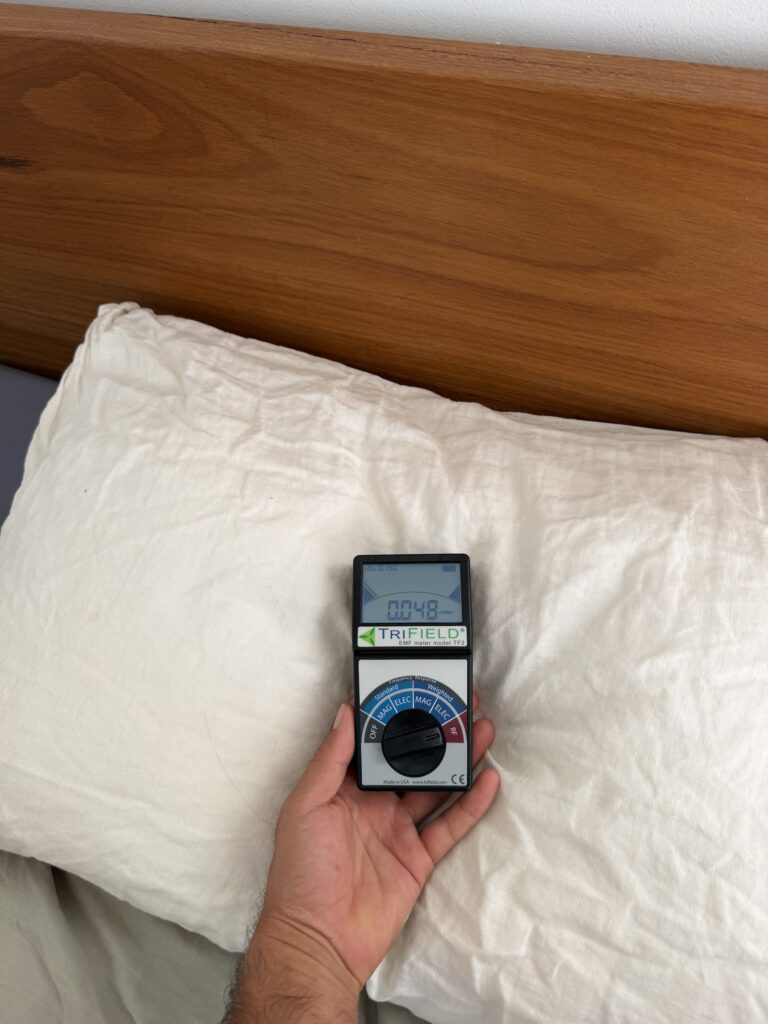
Three things stand out. Distance does most of the work. RF fell from about 3 to 4 mW/m² right beside the router to about 0.5 mW/m² two or three metres away, and to under 0.05 mW/m² at the pillow. The biggest magnetic field I measured was the oven, not the wiring. 49.8 mG at the oven door is where you stand to cook, and magnetic fields from appliances fall off quickly with distance. Electric field readings depend on what you hold the meter against. 940 V/m with the meter touching an outlet plate is not what your body sits in; the 2 V/m on the pillow is closer to the number that matters at night.
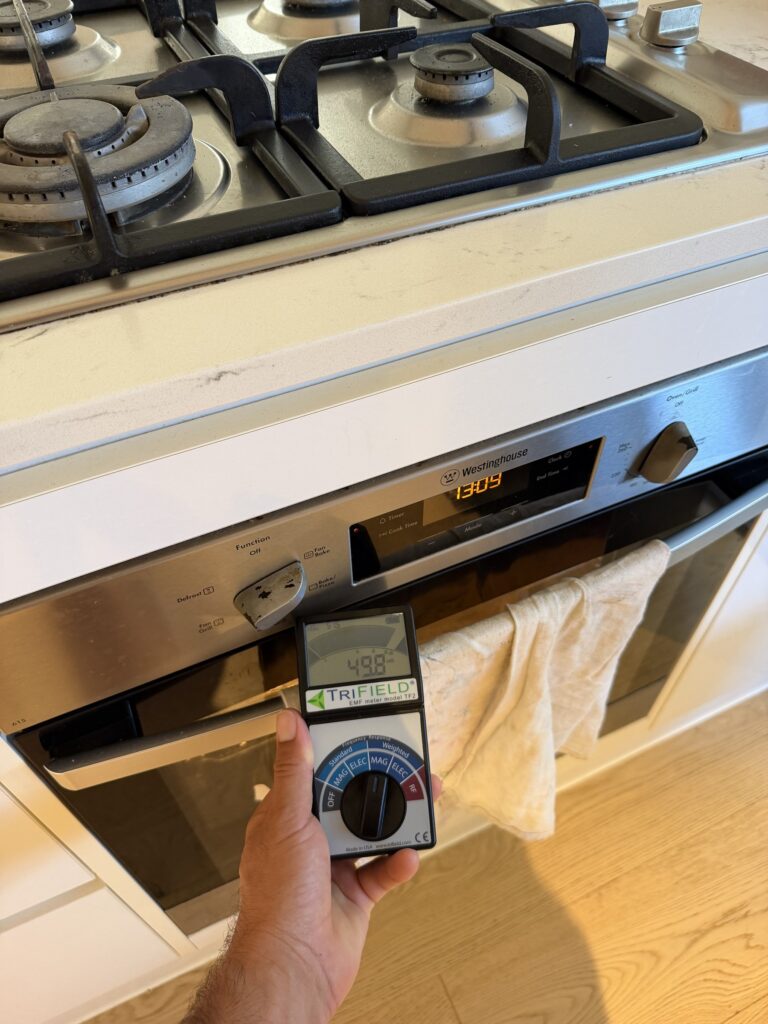
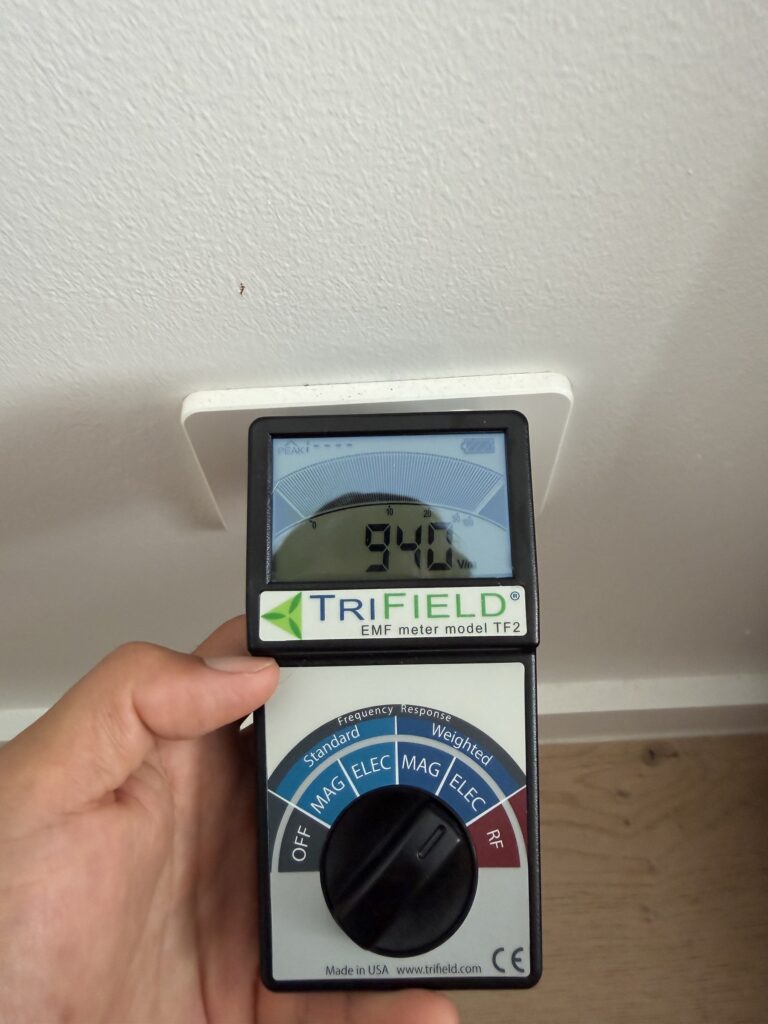
The full set of photos, and how I use the meter room by room, is in my TriField TF2 review. The bedroom method is in the EMF bedroom audit guide, and the router timer is covered in the router timer guide.
What the numbers mean: three yardsticks
A reading on its own means nothing. There are three yardsticks people use in Australia, and for RF they disagree by a factor of up to 100 million, so it is worth knowing which one you are using.
1. The legal and regulatory limits. ARPANSA’s RF standard (RPS S-1) follows the international ICNIRP limits; for the general public from 2 to 300 GHz, which covers Wi-Fi and Australia’s 3.5 GHz 5G, the whole-body reference level is 10 W/m², which is 10,000 mW/m² (lower limits apply below 2 GHz). For 50 Hz mains fields, ARPANSA points to the international guideline of 200 µT (2,000 mG) for magnetic fields, and ICNIRP’s 2010 guidelines give 5,000 V/m for electric fields. These limits are set to prevent known effects such as heating and nerve stimulation, with a safety margin.
2. The meter maker’s “typical” levels. The TF2 manual says that in most homes the magnetic field is usually under 5 mG, the electric field under 20 V/m and RF under 5 mW/m². It also says plainly that there is no consensus on safe levels for long-term exposure.
3. Building biology guidelines. The German building biology standard (SBM-2008) gives precautionary bands for sleeping areas only. They are not health limits, and they are far lower than the regulatory limits. The SBM has since been revised in 2015 and 2024, and the authors say most sleeping-area entries changed only slightly in 2024. The figures below are from the 2008 table.
| Field | ARPANSA / ICNIRP limit (public) | SBM-2008 “no concern” (sleeping) | SBM-2008 “extreme” (sleeping) |
|---|---|---|---|
| RF, 2 to 300 GHz (Wi-Fi, 3.5 GHz 5G) | 10,000 mW/m² | under 0.0001 mW/m² (0.1 µW/m²) | over 1 mW/m² (1,000 µW/m²) |
| AC magnetic, 50 Hz | 2,000 mG (200 µT) | under 0.2 mG (20 nT) | over 5 mG (500 nT) |
| AC electric, 50 Hz | 5,000 V/m | under 0.3 V/m (potential-free meter) | over 10 V/m (potential-free meter) |
Now put my readings against them. The 0.048 mW/m² at my pillow is about 0.0005% of the ARPANSA limit. On the building biology bands it is 48 µW/m², which sits in the “severe” band (10 to 1,000 µW/m²), and the SBM says its RF values refer to peak readings; the 0.150 peak is 150 µW/m², also in the severe band. The 49.8 mG at the oven door is about 2.5% of the 2,000 mG guideline. Both ways of reading those numbers are true. Which one you act on is your call, and a meter is how you get the facts to make it. One caution on electric fields: the potential-free values in that table need a potential-free meter, and a handheld TF2 is not one, so my electric readings cannot be placed in that table directly.
The spec that decides which meter you need
Most buying guides compare frequency ranges. The spec that matters more is the lowest reading a meter can show, because that decides which questions it can answer. The TF2’s RF display steps in 0.001 mW/m², which is 1 µW/m². That is plenty to find a router, compare rooms and see a timer working. It is not enough to tell whether a bedroom is in the building biology “no concern” band (under 0.1 µW/m²) or the lower part of the “slight” band (0.1 to 10 µW/m²): the TF2 cannot display anything below 1 µW/m², so a bedroom that shows 0.000 could be in either.
| Meter | Lowest RF reading | Lowest electric reading | Lowest magnetic step |
|---|---|---|---|
| TriField TF2 | 1 µW/m² (0.001 mW/m²) | 1 V/m | 0.1 mG |
| Safe and Sound Pro II | 0.005 µW/m² (range start) | Not measured | Not measured |
| GQ EMF-390 | 0.02 µW/m² (range start, no accuracy figure) | 1 V/m | 0.1 mG |
| TM192 gauss meter | Not measured | Not measured | 0.01 mG |
| TM-190T (left out) | 0.2 µW/m² | 50 V/m | 0.02 mG |
A low range start is not the same as accuracy. The Pro II is specified at ±6 dB, which for power density means a reading could be up to four times high or low; the TF2 is specified at ±20% at 1 GHz; GQ publishes no accuracy figure at all. For comparing rooms, and before and after a change, consistency from the same meter matters more than absolute accuracy, so whichever meter you buy, use it the same way every time.
The best EMF meters in Australia
1. TriField TF2: best overall (the one I use)
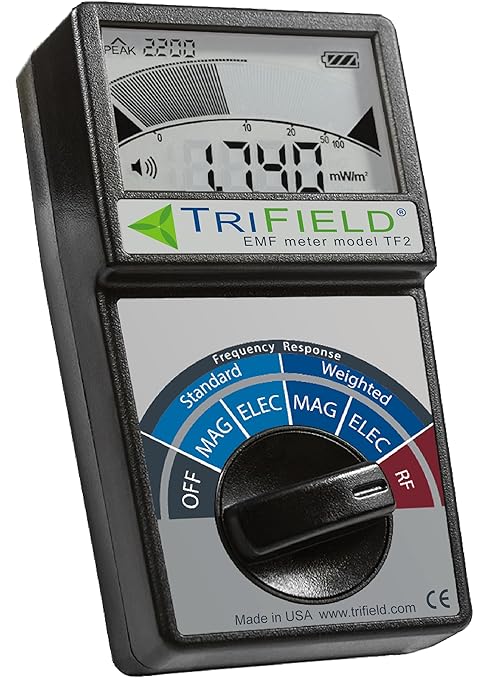 My meter3 fieldsmagnetic, electric and RF
Magnetic 0.1 to 100 mG, 3-axis, 40 Hz to 100 kHz | Electric 1 to 1000 V/m | RF 20 MHz to 6 GHz, 0.001 to 19.999 mW/m² | 9 V battery, 20+ hours
Check the TriField TF2 Price on Amazon →Amazon AU price: $299.00 · as of 19 Nov 2026, 11:43 pm AEST DetailsThe TF2 is made by AlphaLab and is one of the most widely used consumer EMF meters. One knob selects magnetic, electric or RF, and the screen shows the reading, the peak and a circular bar graph. The magnetic sensor is three-axis, so you do not have to rotate the meter to catch the field; the electric and RF sensors are single-axis, so for those you turn it to find the peak. The manual specifies ±4% for magnetic and ±5% for electric at 50 and 60 Hz, which matters in Australia, and ±20% for RF at 1 GHz. In RF mode it samples for peaks every 12 ms and holds the highest for 3 seconds, which is how you see a smart meter or a phone check in.
Standard or Weighted? The magnetic and electric settings each have a Standard mode, which reads all frequencies from 40 Hz to 100 kHz equally, and a Weighted mode that counts frequencies from 60 Hz to about 500 Hz more heavily and becomes less sensitive above 1,000 Hz, which TriField recommends for body effects. For comparing against the limits and the building biology table above, use Standard. RF has one mode.
Its limits are the RF floor covered above, a 100 mG magnetic ceiling (fine for homes, but it maxes out right against some appliances), and a 6 GHz RF ceiling, which covers 2.4 and 5 GHz Wi-Fi, 4G and Australia’s sub-6 GHz 5G, but not mmWave 5G or most of the 6 GHz Wi-Fi band.
✓ Pros
- All three fields in one meter, with published accuracy
- Three-axis magnetic sensor; accuracy specified at 50 Hz
- Fast RF peak capture for bursty sources like smart meters
- Real readings from my house throughout this page
× Cons
- Cannot display RF below 1 µW/m², so it cannot confirm a “no concern” bedroom
- Electric and RF sensors are single-axis
- Runs on a 9 V battery, no logging
Buy this if…
you want one meter to find the strongest sources in your home, compare rooms and check that a change worked.
2. Safe and Sound Pro II: best for bedroom RF
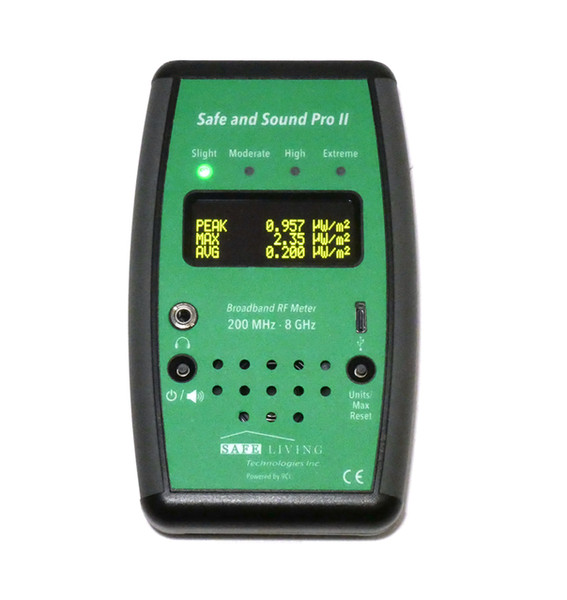 Lowest RF floor0.005µW/m², bottom of range
RF only, 200 MHz to 8 GHz | 0.005 to 3,180,000 µW/m² | ±6 dB | Peak, max and average on an OLED screen, audio | 12 to 15 h battery (SaferEMF) | 2-year warranty | $499 at SaferEMF, Gold Coast; hire $99 for 3 days (30 Oct 2026)
See the Pro II at SaferEMF →The Pro II measures RF only, from 200 MHz to 8 GHz, but it reads far lower than the TF2: its range starts at 0.005 µW/m², about 200 times below the TF2’s lowest step. It has colour-coded LEDs based on building biology guidance, shows peak, maximum and average readings, and its audio mode lets you identify sources by the sound of their signal. That makes it the right instrument for the question “is my bed actually low?”, which the TF2 cannot answer below 1 µW/m².
The trade-offs: no magnetic or electric fields, ±6 dB accuracy, and the price. SaferEMF, which is based on the Gold Coast, sells it for $499 with a two-year warranty; the same meter is about $570 online. SaferEMF also hires it out for $99 for three days plus a $400 refundable deposit, which is the sensible route if you want one bedroom checked once. I have not used it. The full assessment is in the Safe and Sound Pro II review; for the head-to-head, see TF2 vs Safe and Sound Pro II.
✓ Pros
- Reads RF far below the TF2’s floor
- Peak, max and average readings, plus audio
- Australian stockist with hire option
- Two-year warranty at SaferEMF
× Cons
- RF only: no magnetic or electric fields
- ±6 dB accuracy
- $499 to buy
Buy this if…
your main concern is RF where you or your children sleep, and you want to measure against building biology guidance.
3. GQ EMF-390: best budget meter, with a data logger
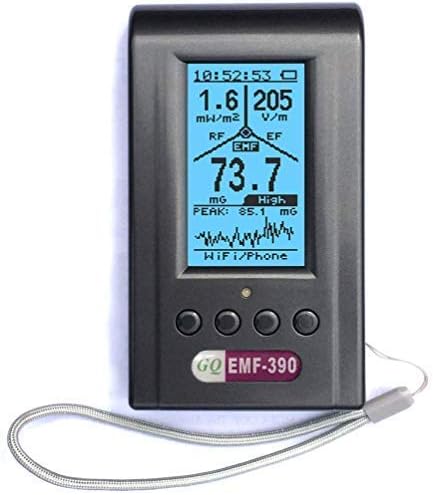 Budget loggerlogs every second
Magnetic 0 to 500 mG, 3-axis | Electric 0 to 1000 V/m | RF up to 10 GHz | Logs EMF, EF and RF every second to 1 MB memory, exports .csv | Li-ion, ~24 h | No published accuracy figure
Check the GQ EMF-390 Price on Amazon →Amazon AU price: $139.00 · as of 19 Nov 2026, 4:29 pm AEST DetailsThe EMF-390 reads all three fields at once on one screen: a three-axis magnetic sensor to 500 mG, electric field to 1,000 V/m and RF up to 10 GHz. Its standout feature is logging: it saves magnetic, electric and RF readings every second to internal memory, which you download as a spreadsheet. Leave it by the bed overnight and you see when RF rises and falls through the night, which a spot reading can miss. It runs on a rechargeable Li-ion cell for about 24 hours.
The catch is accuracy. GQ’s user guide gives ranges and resolution but no accuracy figure, and its RF screen offers a standard mode and a more aggressive “sensitivity” mode that can read higher. GQ’s guide also gives no frequency range for the magnetic sensor, so its response at Australia’s 50 Hz is not confirmed. Use it for patterns and comparisons, not for numbers you will quote against a limit. It ships from GQ in the USA. I have not used it; see our GQ EMF-390 review for more.
✓ Pros
- All three fields on one screen
- 1-second logging with .csv export
- RF range to 10 GHz
- About $183
× Cons
- No published accuracy figure
- Magnetic frequency range not stated, so 50 Hz response unconfirmed
- Two RF modes that read differently
- Ships from the USA
Buy this if…
you want all three fields for under $200, or you want to log a room overnight.
4. TM192 triaxial gauss meter: best for wiring and power lines
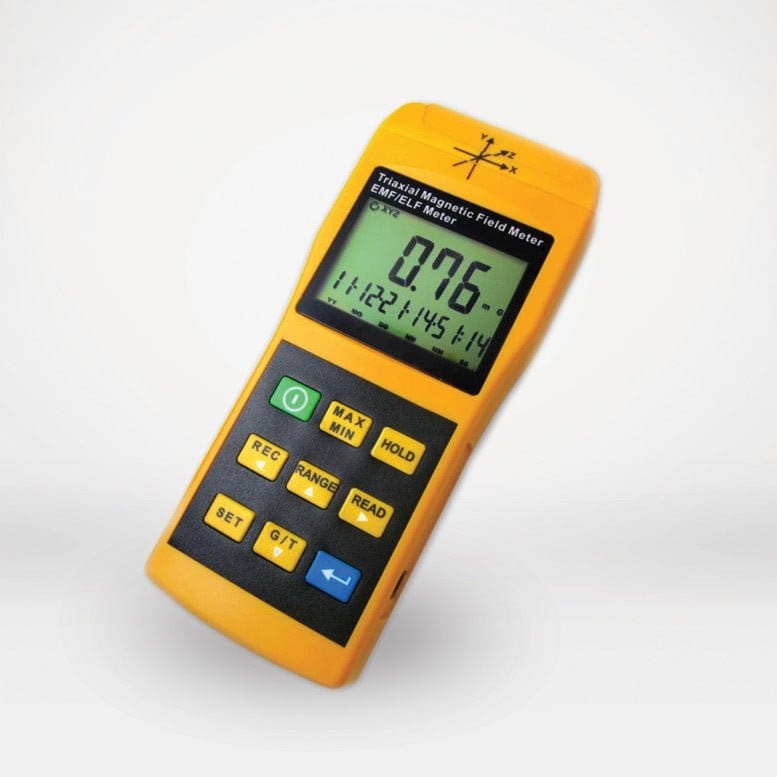 Magnetic only0.01 mGfinest resolution
AC magnetic only, 30 Hz to 2000 Hz | 20 / 200 / 2000 mG ranges, 3-axis | Max/min and data hold | 9 V battery, 15 to 20 h | 1-year warranty | $186 on sale at Earthing Oz, $310 regular (30 Oct 2026)
See the TM192 at Earthing Oz →If your concern is a power line, a switchboard behind the bedroom wall or a substation down the street, you only need to measure AC magnetic fields, and a dedicated gauss meter covers a wider range for less. The Tenmars TM192 reads 30 Hz to 2,000 Hz on three axes at once, in ranges of 20, 200 and 2,000 mG with resolution down to 0.01 mG, so it covers everything from bedroom levels to the strong fields right beside an appliance, where the TF2 tops out at 100 mG. It does not read RF or electric fields.
Earthing Oz lists it at $186 on sale (regular $310) with a one-year warranty. Its listed accuracy is ±(15% + 100 digits); on the 20 mG range the digit allowance alone is about ±1 mG, so it is better for finding and comparing sources than for proving a bed is under 0.2 mG. The TF2 is specified at ±4%. I have not used it.
✓ Pros
- Resolution 0.01 mG, range to 2,000 mG
- Three-axis: hold it still and read
- Covers 50 Hz and its harmonics
× Cons
- Magnetic only
- Looser accuracy than the TF2
- Sale price may not last
Buy this if…
your question is wiring, a power line or a switchboard, and you do not need RF.
Comparison table
| Meter | Fields | RF range | Accuracy (maker) | Logging | Price |
|---|---|---|---|---|---|
| TriField TF2 | Magnetic, electric, RF | 20 MHz to 6 GHz | Mag ±4%, elec ±5%, RF ±20% at 1 GHz | No | $299.00at Amazon AU · as of 19 Nov 2026, 11:43 pm AEST Details |
| Safe and Sound Pro II | RF only | 200 MHz to 8 GHz | ±6 dB | No | $499 SaferEMF, $99 hire (30 Oct 2026) |
| GQ EMF-390 | Magnetic, electric, RF | Up to 10 GHz | Not published | Yes, every second | $139.00at Amazon AU · as of 19 Nov 2026, 4:29 pm AEST Details |
| TM192 | Magnetic only | None | ±(15% + 100 digits) | No | $186 sale, Earthing Oz (30 Oct 2026) |
Check all seven rooms, not just this one
38 checks, 29 free, ranked by impact. Sent as a 32-page PDF.
We'll email you the audit and a short series of practical guides. Unsubscribe in one click, any time. Privacy.
Sent. Taking you to your download...
Meters we left out, and why
TM-190T multi-field meter ($269 on sale at Earthing Oz). On paper it beats the TF2 in places: RF to 10 GHz and down to 0.2 µW/m², magnetic fields to 2,000 mG, a colour screen with traffic-light warnings, and published accuracy (±2 dB at 2.45 GHz for RF). We left it out for two reasons. Its electric field range starts at 50 V/m, so it cannot read the low electric fields that matter at a bed (my pillow read 2 V/m), and it takes a new reading only every 6 seconds, which makes sweeping a room slow. If RF is your only concern, the Pro II reads lower; if you want all three fields, the TF2 covers bedroom electric fields.
Cornet ED88TPlus2. A capable tri-mode meter (RF 100 MHz to 8 GHz, plus magnetic and electric fields, with logging), and an earlier version of this guide wrongly said it had no electric field mode. It is not listed on Amazon AU and we could not confirm a current Australian stockist, so it is not ranked; see TF2 vs Cornet.
Acoustimeter AM-10. A respected RF meter from EMFields in the UK, in the same class as the Pro II. See TF2 vs Acoustimeter. Dirty electricity meters measure something different again (high-frequency noise on wiring); see dirty electricity meters.
Phone apps and cheap meters
Phone apps cannot measure the 50 Hz and RF fields this guide is about. A phone’s magnetometer is a compass sensor built to detect the Earth’s static magnetic field (around 50 µT, or 500 mG); it is not designed to measure 50 Hz fields from wiring, and it cannot read RF at all. Apps that show “Wi-Fi radiation” are showing signal strength at the phone’s antenna, not power density at your body.
Cheap “3-in-1” meters ($54 to $80 online when checked) are worth a look only if the listing or manual gives an accuracy figure and a magnetic frequency range that includes 50 Hz. If it does not, you cannot assume it reads Australian mains fields correctly, so treat its numbers as rough indications. If you want to test a shielding sticker or harmoniser, use a meter with published specs; my TF2 harmoniser test shows how.
How to measure your home in 30 minutes
1. Start where you sleep. You spend a third of your life there, and it is the one place you can change cheaply. Measure at the pillow, then at the bedhead, then at the wall behind it. 2. Use Standard mode on the TF2 for magnetic and electric, keep your hand off the sensors at the top and hold the meter the same way every time; the TF2 manual notes that your hand and body change electric field readings. 3. Wait for the peak. Smart meters, phones and Wi-Fi transmit in bursts; give each RF spot at least a minute and note the peak as well as the average. 4. Find the source, then step back. Walk towards the highest reading until you find what is causing it, then measure at 1, 2 and 3 metres. 5. Change one thing and re-measure. Move the bed, put the router on a timer or switch off a device, then measure the same spot the same way.
For the step-by-step method, see how to measure EMF in your home. If a smart meter is on the other side of your bedroom wall, see smart meter options by state. For the router, see router safe distance.
Which meter should you buy?
You want one meter for the whole house: the TriField TF2. Your concern is RF in the bedroom, measured against building biology guidance: the Safe and Sound Pro II, and hire it if you only need it once. You want all three fields for under $200, or an overnight log: the GQ EMF-390. Your concern is a power line, switchboard or substation: the TM192. You are serious about both: a TF2 for magnetic and electric fields plus a hired Pro II for one weekend of bedroom RF covers almost every question for about $390.
Prices change. Check the retailer before buying.
Frequently asked questions
What is the best EMF meter in Australia?
For most homes, the TriField TF2 ($299.00at Amazon AU · as of 19 Nov 2026, 11:43 pm AEST Details). It measures AC magnetic, AC electric and RF fields up to 6 GHz, and its manual publishes accuracy figures at 50 Hz. For bedroom RF measured against building biology guidance, the Safe and Sound Pro II reads much lower.
Can I hire an EMF meter in Australia?
Yes. SaferEMF on the Gold Coast hires the Safe and Sound Pro II RF meter for $99 for three days, plus a $400 refundable deposit (checked 30 Oct 2026). That is the cheapest way to check one bedroom once.
Does the TriField TF2 measure 5G?
It measures RF from 20 MHz to 6 GHz, which covers 4G, Wi-Fi and Australia’s sub-6 GHz 5G. It does not measure mmWave 5G at 26 GHz and above.
What EMF reading is safe?
ARPANSA’s public limits are 10,000 mW/m² for RF at Wi-Fi and 3.5 GHz 5G frequencies and 2,000 mG for 50 Hz magnetic fields, and normal homes read tiny fractions of those. Building biology guidelines for sleeping areas are far lower: under 0.1 µW/m² RF and under 0.2 mG magnetic is “no concern”. They are precautionary guidelines, not health limits.
Do EMF apps on my phone work?
No. A phone’s magnetometer is a compass sensor for static magnetic fields, and phones have no sensor that measures RF power density. Wi-Fi apps show signal strength, not exposure.
Should I use Standard or Weighted mode on the TF2?
Standard, when you want to compare a reading with a limit or a guideline. Weighted counts frequencies from 60 Hz to about 500 Hz more heavily, which TriField recommends for body effects; it is useful for spotting harmonics but is not what published limits are based on.
Will a US EMF meter work on Australia’s 50 Hz power?
Only if its magnetic and electric ranges include 50 Hz. The TF2 is specified from 40 Hz with accuracy stated at 50 and 60 Hz, and the TM192 from 30 Hz; GQ does not state one for the EMF-390’s magnetic sensor. Check the frequency range in the manual, not the product title.
TriField TF2 or GQ EMF-390?
The TF2 if you want readings you can trust against published accuracy figures. The GQ EMF-390 if you want all three fields for less and an overnight data log, accepting that GQ publishes no accuracy figure.
- AlphaLab: TriField TF2 owner’s manual (ranges, accuracy, Standard and Weighted modes, peak capture)
- Amazon AU: TriField TF2 listing (price and ratings, 30 Oct 2026)
- SaferEMF: Safe and Sound Pro II product page (price, hire, specifications)
- GQ Electronics: EMF-360V2/380V2/390 user guide (ranges, logging, battery)
- Earthing Oz: Digital Triaxial Gauss Meter TM192 (specifications, price)
- Earthing Oz: TM-190T Multi-Field EMF Meter (specifications, price)
- Cornet: ED88TPlus2 user manual (RF, LF magnetic and electric ranges)
- ARPANSA: Standard for Limiting Exposure to Radiofrequency Fields, 100 kHz to 300 GHz (RPS S-1)
- ARPANSA: mobile phone base stations (no evidence of adverse health effects below the RF standard limits)
- ARPANSA: electricity and health (200 µT international guideline, IARC classification)
- ICNIRP 2010: guidelines for limiting exposure to time-varying electric and magnetic fields (1 Hz to 100 kHz)
- Baubiologie Maes / IBN: Building Biology Evaluation Guidelines for Sleeping Areas, SBM-2008
- Baubiologie Maes: the new Standard of Building Biology Testing Methods 2024
- IARC Monograph 80: static and extremely low-frequency electric and magnetic fields
- IARC Monograph 102: radiofrequency electromagnetic fields

Former Royal Australian Navy Clearance Diver and TAG-E counter-terrorism operator. Founded Clean and Native to apply the same rigorous thinking to the home environment.
Full biography →The 7-Room Home Audit
Distance and off-time do most of the work, and they are free. The audit maps every room: 38 checks across EMF, air and water, ranked by impact.
- Our own TF2 readings from router to pillow
- What to check behind the bedhead wall
- ARPANSA limits and precautionary bands, side by side
We'll email you the audit and a short series of practical guides. Unsubscribe in one click, any time. Privacy.
Sent. Taking you to your download...